

CHEMISTRY
INVESTIGATORY
PROJECT
ON
DETERMINATION OF CAFFEINE
IN TEA SAMPLES
NAME: ASHNA
CLASS:
XII
SECTION: ‘C’
ROLL NO.: 1
Lovely Public Sr. Sec. School
Chemistry Department
CERTIFICATE
This is to certify that Ashna, a student of class
XII-C has successfully completed the research
on the below mentioned project under the
guidance of Mrs. Rampal Mam ( Subject Teacher
) during the year 2016-17 in partial fulfillment of
chemistry practical examination conducted by
AISSCE, New Delhi.
Signature of external examiner Signature of chemistry teacher
ACKNOWLEDGEMENT
I am extremely grateful to Mrs.
Rampal Mam, Teacher of
Department of Chemistry for her
able guidance and useful
suggestions, which helped me in
completing the project work, in
time.
I would also like to thank all the
teaching and non-teaching staff
of Chemistry Department who
helped me directly or indirectly in
the completion of this project.
Finally, yet importantly, I would
like to express my heartfelt thanks
to my beloved parents for their
blessings.
INDEX
 Certificate
 Acknowledgement
 Aim
 Introduction
 Theory
 Apparatus and Chemical
required
 Procedure followed
 Observations
 Conclusion
 Uses of Caffeine
 Effects of Caffeine
 Precaution
AIM OF THE PROJECT
To determination of Caffeine in
different Tea Samples –
 Lipton Tea Leaves
 Stevia Tea Leaves
 Tetley Tea Leaves
INTRODUCTION
Tea is the most commonly and widely used soft beverage
in the household. It acts as a stimulant for central
nervous system and skeletal muscles. That is why tea
removes fatigue, tiredness and headache. It also
increases the capacity of thinking. It is also used for
lowering body temperature. The principal constituent of
tea, which is responsible for all these properties, is the
alkaloid-caffeine. The amount of caffeine in tea leaves
varies from sample to sample.
Originally it was thought that caffeine is responsible for
the taste and flavor of tea. But pure caffeine has been
found to be a tasteless while substance. Therefore, the
taste and flavor of tea is due to some other substance
present in it. There is a little doubt that the popularity of
the xanthene beverages depends on their stimulant
action, although most people are unaware of any
stimulation. The degree to which an individual is
stimulated by given amount of caffeine varies from
individual to individual.
For example, some people boast their ability to drink
several cups of coffee in evening and yet sleep like a
long, on the other hand there are people who are so
sensitive to caffeine that even a single cup of coffee will
cause a response boarding on the toxic.
The xanthene beverages also create a medical problem.
They are dietary of a stimulant of the CNS. Often the
physicians face the question whether to deny caffeine-
containing beverages to patients or not. In fact children
are more susceptible than adults to excitation by
xanthene.
For this reason, tea and coffee should be excluded from
their diet. Even cocoa is of doubtful value. It has a high
tannin content may be as high as 50 mg per cup.
After all our main stress is on the presence of caffeine in
xanthene beverages and so in this project we will study
and observe the quantity of caffeine varying in different
samples of tea leaves.
Theory
The most important methylated alkaloid that occurs naturally
is caffeine. Its molecular formula is C8H10N4O2. Its IUPAC name
is 1, 3, 7-trimethylxanthene and common name is 1-
methylated thiobromine.
Purely it is white, crystalline solid in the form of needles. Its
melting point is 1230 C°. It is the main active principle
component of tea leaves.
It is present in tea leaves up to 3% and can be extracted by first
boiling the tea leaves with water which dissolves many
glycoside compounds in addition to caffeine.
The clear solution is then treated with lead acetate to
precipitate the glycoside compounds in the form of lead
complex. The clear filtrate is then extracted with extracts
caffeine because it is more soluble in it then water.
APPARATUS AND CHEMICAL REQUIRED
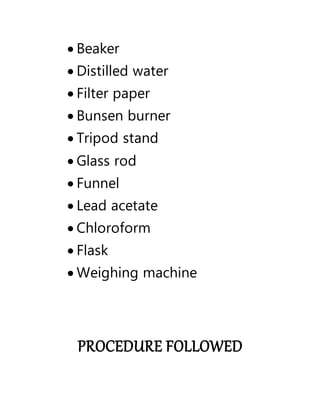
 Tea Samples (50 grams each)
 Beaker
 Distilled water
 Filter paper
 Bunsen burner
 Tripod stand
 Glass rod
 Funnel
 Lead acetate
 Chloroform
 Flask
 Weighing machine
PROCEDURE FOLLOWED
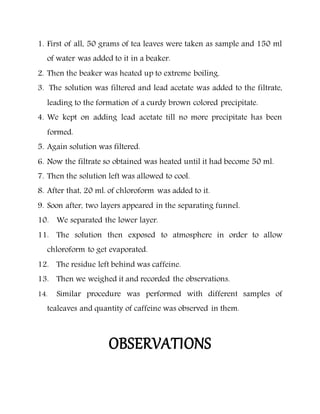
1. First of all, 50 grams of tea leaves were taken as sample and 150 ml
of water was added to it in a beaker.
2. Then the beaker was heated up to extreme boiling.
3. The solution was filtered and lead acetate was added to the filtrate,
leading to the formation of a curdy brown colored precipitate.
4. We kept on adding lead acetate till no more precipitate has been
formed.
5. Again solution was filtered.
6. Now the filtrate so obtained was heated until it had become 50 ml.
7. Then the solution left was allowed to cool.
8. After that, 20 ml. of chloroform was added to it.
9. Soon after, two layers appeared in the separating funnel.
10. We separated the lower layer.
11. The solution then exposed to atmosphere in order to allow
chloroform to get evaporated.
12. The residue left behind was caffeine.
13. Then we weighed it and recorded the observations.
14. Similar procedure was performed with different samples of
tealeaves and quantity of caffeine was observed in them.
OBSERVATIONS
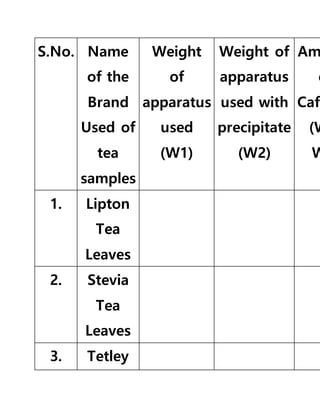
S.No. Name
of the
Brand
Used of
tea
samples
Weight
of
apparatus
used
(W1)
Weight of
apparatus
used with
precipitate
(W2)
Am
o
Caff
(W
W
1. Lipton
Tea
Leaves
2. Stevia
Tea
Leaves
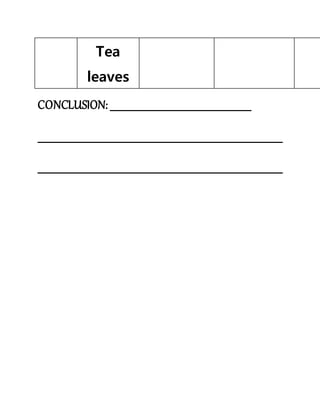
3. Tetley
Tea
leaves
CONCLUSION: _______________
__________________________
__________________________
USES OF CAFFEINE
 In medicine, it is used to stimulate, central nervous system and
to increase flow of urine.
 Because of its stimulating effects, caffeine has been used to
relieve fatigue. But it is dangerous and one may collapse if not
consumes it under certain limit.
 Caffeine is also used in analgesic tablets, as it is believed to be
a pain reliever. It is also beneficial in migraines
EFFECTS OF CAFFEINE
1. It is psycho – stimulant.
2. It improves physical and mental ability.
3. Its effect in learning is doubtful but intellectual performance
may improve where it has been used to reduce fatigue or
boredom.
4. When administered internally, it stimulates heart and
nervous system and also acts as diuretic. On the contrary
their excessive use is harmful to digestion and their long use
leads to mental retardation.
PRECAUTIONS
1. Chloroform should not be smelt directly for a long time
as it itself is toxic.
2. The measurement of weight of tea leaves and all
extract should be precise.
3. The measurement of weight of tea sample and all
extract should be precise.
4. The water used should be distilled.
5. Apparatus should be clean and dry.
6. No water should be added to any extract in between
the experiment as it may get errors in calculation.
7. No prolonged heating should be done as water may
evaporate in large quantity along with same volatile
solutes.
Chemistry Project

Chemistry Project

  • 2.
  • 3.
    CLASS: XII SECTION: ‘C’ ROLL NO.:1 Lovely Public Sr. Sec. School Chemistry Department CERTIFICATE This is to certify that Ashna, a student of class XII-C has successfully completed the research on the below mentioned project under the guidance of Mrs. Rampal Mam ( Subject Teacher
  • 4.
    ) during theyear 2016-17 in partial fulfillment of chemistry practical examination conducted by AISSCE, New Delhi. Signature of external examiner Signature of chemistry teacher ACKNOWLEDGEMENT I am extremely grateful to Mrs. Rampal Mam, Teacher of Department of Chemistry for her able guidance and useful
  • 5.
    suggestions, which helpedme in completing the project work, in time. I would also like to thank all the teaching and non-teaching staff of Chemistry Department who helped me directly or indirectly in the completion of this project. Finally, yet importantly, I would like to express my heartfelt thanks
  • 6.
    to my belovedparents for their blessings. INDEX  Certificate  Acknowledgement  Aim  Introduction  Theory  Apparatus and Chemical required  Procedure followed
  • 7.
     Observations  Conclusion Uses of Caffeine  Effects of Caffeine  Precaution AIM OF THE PROJECT To determination of Caffeine in different Tea Samples –  Lipton Tea Leaves  Stevia Tea Leaves
  • 8.
     Tetley TeaLeaves INTRODUCTION Tea is the most commonly and widely used soft beverage in the household. It acts as a stimulant for central nervous system and skeletal muscles. That is why tea removes fatigue, tiredness and headache. It also increases the capacity of thinking. It is also used for lowering body temperature. The principal constituent of tea, which is responsible for all these properties, is the alkaloid-caffeine. The amount of caffeine in tea leaves varies from sample to sample.
  • 9.
    Originally it wasthought that caffeine is responsible for the taste and flavor of tea. But pure caffeine has been found to be a tasteless while substance. Therefore, the taste and flavor of tea is due to some other substance present in it. There is a little doubt that the popularity of the xanthene beverages depends on their stimulant action, although most people are unaware of any stimulation. The degree to which an individual is stimulated by given amount of caffeine varies from individual to individual. For example, some people boast their ability to drink several cups of coffee in evening and yet sleep like a long, on the other hand there are people who are so sensitive to caffeine that even a single cup of coffee will cause a response boarding on the toxic. The xanthene beverages also create a medical problem. They are dietary of a stimulant of the CNS. Often the physicians face the question whether to deny caffeine- containing beverages to patients or not. In fact children are more susceptible than adults to excitation by xanthene.
  • 10.
    For this reason,tea and coffee should be excluded from their diet. Even cocoa is of doubtful value. It has a high tannin content may be as high as 50 mg per cup. After all our main stress is on the presence of caffeine in xanthene beverages and so in this project we will study and observe the quantity of caffeine varying in different samples of tea leaves. Theory The most important methylated alkaloid that occurs naturally is caffeine. Its molecular formula is C8H10N4O2. Its IUPAC name is 1, 3, 7-trimethylxanthene and common name is 1- methylated thiobromine. Purely it is white, crystalline solid in the form of needles. Its melting point is 1230 C°. It is the main active principle component of tea leaves.
  • 11.
    It is presentin tea leaves up to 3% and can be extracted by first boiling the tea leaves with water which dissolves many glycoside compounds in addition to caffeine. The clear solution is then treated with lead acetate to precipitate the glycoside compounds in the form of lead complex. The clear filtrate is then extracted with extracts caffeine because it is more soluble in it then water. APPARATUS AND CHEMICAL REQUIRED  Tea Samples (50 grams each)
  • 12.
     Beaker  Distilledwater  Filter paper  Bunsen burner  Tripod stand  Glass rod  Funnel  Lead acetate  Chloroform  Flask  Weighing machine PROCEDURE FOLLOWED
  • 13.
    1. First ofall, 50 grams of tea leaves were taken as sample and 150 ml of water was added to it in a beaker. 2. Then the beaker was heated up to extreme boiling. 3. The solution was filtered and lead acetate was added to the filtrate, leading to the formation of a curdy brown colored precipitate. 4. We kept on adding lead acetate till no more precipitate has been formed. 5. Again solution was filtered. 6. Now the filtrate so obtained was heated until it had become 50 ml. 7. Then the solution left was allowed to cool. 8. After that, 20 ml. of chloroform was added to it. 9. Soon after, two layers appeared in the separating funnel. 10. We separated the lower layer. 11. The solution then exposed to atmosphere in order to allow chloroform to get evaporated. 12. The residue left behind was caffeine. 13. Then we weighed it and recorded the observations. 14. Similar procedure was performed with different samples of tealeaves and quantity of caffeine was observed in them. OBSERVATIONS
  • 14.
    S.No. Name of the Brand Usedof tea samples Weight of apparatus used (W1) Weight of apparatus used with precipitate (W2) Am o Caff (W W 1. Lipton Tea Leaves 2. Stevia Tea Leaves 3. Tetley
  • 15.
  • 16.
    USES OF CAFFEINE In medicine, it is used to stimulate, central nervous system and to increase flow of urine.  Because of its stimulating effects, caffeine has been used to relieve fatigue. But it is dangerous and one may collapse if not consumes it under certain limit.  Caffeine is also used in analgesic tablets, as it is believed to be a pain reliever. It is also beneficial in migraines EFFECTS OF CAFFEINE 1. It is psycho – stimulant. 2. It improves physical and mental ability. 3. Its effect in learning is doubtful but intellectual performance may improve where it has been used to reduce fatigue or boredom. 4. When administered internally, it stimulates heart and nervous system and also acts as diuretic. On the contrary
  • 17.
    their excessive useis harmful to digestion and their long use leads to mental retardation. PRECAUTIONS 1. Chloroform should not be smelt directly for a long time as it itself is toxic. 2. The measurement of weight of tea leaves and all extract should be precise. 3. The measurement of weight of tea sample and all extract should be precise. 4. The water used should be distilled. 5. Apparatus should be clean and dry. 6. No water should be added to any extract in between the experiment as it may get errors in calculation. 7. No prolonged heating should be done as water may evaporate in large quantity along with same volatile solutes.