•Adolescence Education
In-House Teachers’ training By:
VIDYA BHUSHAN PANDEY
Resource Person CBSE
Adolescence
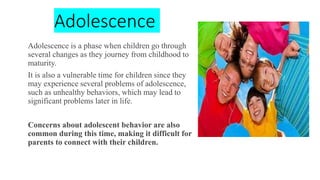
Adolescence is a phase when children go through
several changes as they journey from childhood to
maturity.
It is also a vulnerable time for children since they
may experience several problems of adolescence,
such as unhealthy behaviors, which may lead to
significant problems later in life.
Concerns about adolescent behavior are also
common during this time, making it difficult for
parents to connect with their children.
WHO’s Concept
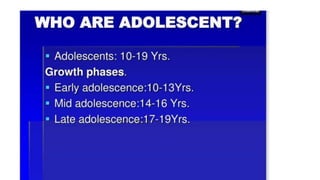
The World Health Organization (WHO) considers “adolescence” as the period
between 10-19 years of age, which generally encompasses the time from the
onset of puberty to legal age of majority.
Adolescence in the sociological sense refers to the experience of passing
through a phase that lies between childhood and adulthood. The contributions
of great anthropologist Margaret Mead, gave us much insight into perspectives
on adolescent development in a cultural context.
The sociological and psychological definitions complement each other insofar
as they call attention to the principle that an undefined social situation will have
a corresponding repercussion in the personality of the individual who goes
through it.
Erik H. Erikson’s concept of identity crisis has been considered to be of as
much relevance to our epoch as the problems of sex seemed to be to Freud’s.
• Aims of Adolescent Education:
• 1. To enable and to develop one’s fullest capacity of live.
• 2. To make one fit to lead a life which is free from guit-feeling and unnecessary complex
associated with sex.
• 3. To enable one to be physically and mentally fit to enjoy one’s partner’s company in the married
life.
• The family life is full of pleasure, pain, happiness, sadness etc. These facts of life, make the child
conversant with the realities of life. Experiencing of pain is necessary to understand life. So proper training
of the child’s innate urges and desires is of great importance.
• The doubts of children should be carefully removed. The curiosity should be satisfied through proper
explanation or activities. We should not try to hide the answer of a question from a child . Boys and girls
are to be treated alike in the matter of gaining information on sex. The girls have the same right to
knowledge as boys. The girls should acquire some rudiments of the knowledge regarding menstruation and
the hygiene of sex.
Importance of Adolescence Education (AE)
Adolescence education needed for smooth and successful transition as adults. The adolescence
education is for imparting information, providing encouragement and support, clarification of
doubts and myths so that adolescents can make sense of their world and grow as productive
members of the society.
Good mental and physical health, including reproductive health, and the
knowledge and means to sustain health during adulthood;
An appropriate stock of human and social capital to enable an individual to be
a productive adult member of society;
 The acquisition of pro-social values and the ability to contribute to the
collective well-being as citizen and community participant;
 Adequate preparation for the assumption of adult social roles and
obligations, including the roles of spouse or partner, parent, and household
and family manager; The capability to make choices
Social Taboo
• Adolescent Education Sex-Education for better family life
is the need of the hour. But the concept of sex is surrounded
by superstitions and taboos.
• Due to this fact, Indian society is still steeped in traditional
belief.
• From the history of Indian culture, it is evident that in Vedic
period, the attitudes towards sex of the individual, were
fairly liberal.
• With the beginning of the Buddhistic period and then with
the coming of Muslims in this country, people started
becoming more conservative and rigid in this matter.
• So we should relax on the matter of sex education or
adolescent education.
1. The teacher should establish a warm, friendly, open-minded class-room climate free of
embarrassment and self-consciousness in which students feel free to ask questions and expect to
get sensible answers.
2. discuss matters relating to sex in a direct, unemotional and unembarrassed manner.
3. talk in an objective, matter-of-fact way as in dealing with the normal aspects of sex.
4. Seek to build up healthy attitudes which will enable a student to make wise choices.
5. discuss problems with students and let them draw their own conclusions.
6. give appropriate facts to the students to participate in planning the lesson.
7. use a question box in which students may put questions anonymously, if they do not feel free
enough to ask questions in class.
8. use films and other visual aids to help clarify.
9. see that adequate and selected books are in the school library
10. start doing something concrete to make out future citizens fuller and happier.
Puberty in Girls
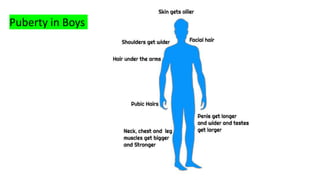
Puberty in Boys
Challenges Faced By Adolescents
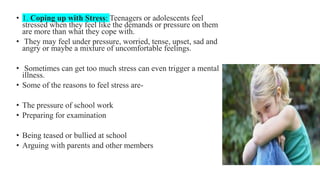
• 1. Coping up with Stress: Teenagers or adolescents feel
stressed when they feel like the demands or pressure on them
are more than what they cope with.
• They may feel under pressure, worried, tense, upset, sad and
angry or maybe a mixture of uncomfortable feelings.
• Sometimes can get too much stress can even trigger a mental
illness.
• Some of the reasons to feel stress are-
• The pressure of school work
• Preparing for examination
• Being teased or bullied at school
• Arguing with parents and other members
2. Teenage social Problems: Teenagers or Adolescence is a
period of “Stress and Storm”
Act and live according to social values: home , society, school
Not willing to obey –out dated
Fear of being judge
Refusing to take part in social activities
Cyberbullying including cruel text, posting image or text on social media
Peer Pressure
Drug Abuse
3. School or Study Problems: School constitutes a large part of an
adolescent’s existence. Difficulties in almost any area of life often manifest as a
school problem.
Fear of going to School
Absenteeism without permission
Dropping out
Academic poor performance
4. Body Image problem faced by teenagers: Body image is how you view your physical
self-including whether you feel you are attractive and whether others like your looks.
Body changes during puberty
Compare with others peers
Compare themselves with celebrities
Negative comments and teasing about the way they look from classmate and peers
5. Teenage problems with parents: There is a family conflict between teenagers and
parents.
Generation gap between the parents and children cause serious problems of
adjustment
Adolescence seeks greater independence( Social and Economic)
Social Taboos and moral code
Pressurised on study for better grade
Separation-cause disagreement over time with peers versus time with family
Living on parental Terms and Condition
6. Teenage Pregnancy: They develop secondary sexual organs that give rise to new feelings in teenagers
and push them to experiment with their body.
Without proper knowledge of appropriate use of contraceptive pills or guidance, teenagers may become
sexually active this could result in unwanted pregnancy. Unwanted pregnancy is the biggest risk that
teenagers or adolescence girls face
seek information from inexperienced friends
Unprotected sex can also lead to sexually transmitted disease
7. Adolescent Behaviour Problem:
The raging hormones in teenage boys give more strength inside the body to do new things this can even
push to get into physical confrontations. At this age they wanted to listen loud music
Children wanted to be independence. Stand up for what they believe is right
Significant developmental changes in the brain makes teen moody, tired and difficult to deal with.
The most troubling behaviour is perhaps teens hanging out with problem children and adopting to
dangerous lifestyle
Peer pressure make certain bad habits that’s are hard to break
8. Teenage Health issue: Teenagers are very vulnerable emotionally and physically. Without
proper healthcare and nutrition lead to falling ill.
Teenagers have very hectic schedule in school from one activity to another, they have
very little time to rest or eat. Un-healthy eating habits resist them from getting proper
nutrition.
In this period they are conscious about their body can lead to eating disorder, obesity
especially in girls sudden increase of weight during adolescence they start dieting to maintain
their appearance this lead to serious health problem .
Stress can also lead to loss appetite
9. Teenage Emotional Problems: Hormones changes inside the body during adolescence
affects physically as well as emotionally.
Mood swings are common among teenage boys and girls
Gender roles in some family may affects emotionally
Teenage girls are more vulnerable to cry
Feelings of inferiority or superiority
Teenagers is the age when sexual feelings arise .Feelings and thoughts about sex can trigger a
sense of guilt
10. Teenage Anger Issue: Teenagers is a challenging time for both them and their
parents.
At this stage, they are moody, reckless and unpredictable.
Teenagers with a serious anger issue is consumed with anger they have very little
control over their anger.
Low self-esteem
Negative peer pressure
Conflicts with family
Breakup with love one
Bullying
11. Gender-related problems in adolescence:
Gender-related issues are more commonly seen in rural areas.
Many health behaviours acquired during adolescence are influenced by
gender norms and beliefs these impact both boys and girls.
12. Physical Changes: Physical changes happen during adolescence due to changes
in hormone levels.
Development of full breasts in girls can be awkward in the beginning, girls may start
feel conscious about their figure.
Acne / Pimples is one of the major problems
Changes of voice and appearance of facial hairs in boys is perhaps the most
prominent change takes place during adolescence
The growth of pubic hairs in girls and boys
Girls start their periods
13. Peer Pressure:
During adolescence, peer pressure is common both positive and
negative peer pressure.
Negative peer pressure can lead to serious problems.
Pressure to use alcohol, cigarette, drugs etc.
Pressure to engage in risk taking behaviour
Distraction from school work
Drastic changes in behaviour and attitudes.
Teacher’s Role
• The teachers have to take up seriously Sex Education in
order to develop healthy attitude towards sex. The more
informal the sex education, the better it is.
• Children are likely to be stimulated, if formal
instruction is given in a formal period. The whole thing
must be ordinary and every day.
• We should impart knowledge about sex to our children
in the most spontaneous and natural way.
Role of School
• Schools take greatest responsibility to impart Sex Education. The children
can be given knowledge of male and female animals from elementary school
age. The nature study lessons offer a valuable medium for the study of sex
and reproduction. The study of plants can gives idea of sexual cells, of
fertilization, of embryological development.
• Formal instruction of sex at the secondary stage is highly essential. Children
pick up so much sex knowledge at so early age from films, newspapers,
magazines, and conversation of elders. So it is necessary for the education to
estimate the degree of their instruction in this regard.
• Schools should explore the possibility of Sex Education through hygiene
lessons. Reference can be made to dangerous diseases such as HIV/STD/
AIDS. In this regard, the teacher must be very thorough of the facts.
• Educate Adolescence for a healthy future
Thank You

Adolescence Education.pptx

  • 1.
    •Adolescence Education In-House Teachers’training By: VIDYA BHUSHAN PANDEY Resource Person CBSE
  • 2.
    Adolescence Adolescence is aphase when children go through several changes as they journey from childhood to maturity. It is also a vulnerable time for children since they may experience several problems of adolescence, such as unhealthy behaviors, which may lead to significant problems later in life. Concerns about adolescent behavior are also common during this time, making it difficult for parents to connect with their children.
  • 4.
    WHO’s Concept The WorldHealth Organization (WHO) considers “adolescence” as the period between 10-19 years of age, which generally encompasses the time from the onset of puberty to legal age of majority. Adolescence in the sociological sense refers to the experience of passing through a phase that lies between childhood and adulthood. The contributions of great anthropologist Margaret Mead, gave us much insight into perspectives on adolescent development in a cultural context. The sociological and psychological definitions complement each other insofar as they call attention to the principle that an undefined social situation will have a corresponding repercussion in the personality of the individual who goes through it. Erik H. Erikson’s concept of identity crisis has been considered to be of as much relevance to our epoch as the problems of sex seemed to be to Freud’s.
  • 6.
    • Aims ofAdolescent Education: • 1. To enable and to develop one’s fullest capacity of live. • 2. To make one fit to lead a life which is free from guit-feeling and unnecessary complex associated with sex. • 3. To enable one to be physically and mentally fit to enjoy one’s partner’s company in the married life. • The family life is full of pleasure, pain, happiness, sadness etc. These facts of life, make the child conversant with the realities of life. Experiencing of pain is necessary to understand life. So proper training of the child’s innate urges and desires is of great importance. • The doubts of children should be carefully removed. The curiosity should be satisfied through proper explanation or activities. We should not try to hide the answer of a question from a child . Boys and girls are to be treated alike in the matter of gaining information on sex. The girls have the same right to knowledge as boys. The girls should acquire some rudiments of the knowledge regarding menstruation and the hygiene of sex.
  • 7.
    Importance of AdolescenceEducation (AE) Adolescence education needed for smooth and successful transition as adults. The adolescence education is for imparting information, providing encouragement and support, clarification of doubts and myths so that adolescents can make sense of their world and grow as productive members of the society. Good mental and physical health, including reproductive health, and the knowledge and means to sustain health during adulthood; An appropriate stock of human and social capital to enable an individual to be a productive adult member of society;  The acquisition of pro-social values and the ability to contribute to the collective well-being as citizen and community participant;  Adequate preparation for the assumption of adult social roles and obligations, including the roles of spouse or partner, parent, and household and family manager; The capability to make choices
  • 8.
    Social Taboo • AdolescentEducation Sex-Education for better family life is the need of the hour. But the concept of sex is surrounded by superstitions and taboos. • Due to this fact, Indian society is still steeped in traditional belief. • From the history of Indian culture, it is evident that in Vedic period, the attitudes towards sex of the individual, were fairly liberal. • With the beginning of the Buddhistic period and then with the coming of Muslims in this country, people started becoming more conservative and rigid in this matter. • So we should relax on the matter of sex education or adolescent education.
  • 9.
    1. The teachershould establish a warm, friendly, open-minded class-room climate free of embarrassment and self-consciousness in which students feel free to ask questions and expect to get sensible answers. 2. discuss matters relating to sex in a direct, unemotional and unembarrassed manner. 3. talk in an objective, matter-of-fact way as in dealing with the normal aspects of sex. 4. Seek to build up healthy attitudes which will enable a student to make wise choices. 5. discuss problems with students and let them draw their own conclusions. 6. give appropriate facts to the students to participate in planning the lesson. 7. use a question box in which students may put questions anonymously, if they do not feel free enough to ask questions in class. 8. use films and other visual aids to help clarify. 9. see that adequate and selected books are in the school library 10. start doing something concrete to make out future citizens fuller and happier.
  • 10.
  • 11.
  • 12.
  • 13.
    • 1. Copingup with Stress: Teenagers or adolescents feel stressed when they feel like the demands or pressure on them are more than what they cope with. • They may feel under pressure, worried, tense, upset, sad and angry or maybe a mixture of uncomfortable feelings. • Sometimes can get too much stress can even trigger a mental illness. • Some of the reasons to feel stress are- • The pressure of school work • Preparing for examination • Being teased or bullied at school • Arguing with parents and other members
  • 14.
    2. Teenage socialProblems: Teenagers or Adolescence is a period of “Stress and Storm” Act and live according to social values: home , society, school Not willing to obey –out dated Fear of being judge Refusing to take part in social activities Cyberbullying including cruel text, posting image or text on social media Peer Pressure Drug Abuse 3. School or Study Problems: School constitutes a large part of an adolescent’s existence. Difficulties in almost any area of life often manifest as a school problem. Fear of going to School Absenteeism without permission Dropping out Academic poor performance
  • 15.
    4. Body Imageproblem faced by teenagers: Body image is how you view your physical self-including whether you feel you are attractive and whether others like your looks. Body changes during puberty Compare with others peers Compare themselves with celebrities Negative comments and teasing about the way they look from classmate and peers 5. Teenage problems with parents: There is a family conflict between teenagers and parents. Generation gap between the parents and children cause serious problems of adjustment Adolescence seeks greater independence( Social and Economic) Social Taboos and moral code Pressurised on study for better grade Separation-cause disagreement over time with peers versus time with family Living on parental Terms and Condition
  • 16.
    6. Teenage Pregnancy:They develop secondary sexual organs that give rise to new feelings in teenagers and push them to experiment with their body. Without proper knowledge of appropriate use of contraceptive pills or guidance, teenagers may become sexually active this could result in unwanted pregnancy. Unwanted pregnancy is the biggest risk that teenagers or adolescence girls face seek information from inexperienced friends Unprotected sex can also lead to sexually transmitted disease 7. Adolescent Behaviour Problem: The raging hormones in teenage boys give more strength inside the body to do new things this can even push to get into physical confrontations. At this age they wanted to listen loud music Children wanted to be independence. Stand up for what they believe is right Significant developmental changes in the brain makes teen moody, tired and difficult to deal with. The most troubling behaviour is perhaps teens hanging out with problem children and adopting to dangerous lifestyle Peer pressure make certain bad habits that’s are hard to break
  • 17.
    8. Teenage Healthissue: Teenagers are very vulnerable emotionally and physically. Without proper healthcare and nutrition lead to falling ill. Teenagers have very hectic schedule in school from one activity to another, they have very little time to rest or eat. Un-healthy eating habits resist them from getting proper nutrition. In this period they are conscious about their body can lead to eating disorder, obesity especially in girls sudden increase of weight during adolescence they start dieting to maintain their appearance this lead to serious health problem . Stress can also lead to loss appetite 9. Teenage Emotional Problems: Hormones changes inside the body during adolescence affects physically as well as emotionally. Mood swings are common among teenage boys and girls Gender roles in some family may affects emotionally Teenage girls are more vulnerable to cry Feelings of inferiority or superiority Teenagers is the age when sexual feelings arise .Feelings and thoughts about sex can trigger a sense of guilt
  • 18.
    10. Teenage AngerIssue: Teenagers is a challenging time for both them and their parents. At this stage, they are moody, reckless and unpredictable. Teenagers with a serious anger issue is consumed with anger they have very little control over their anger. Low self-esteem Negative peer pressure Conflicts with family Breakup with love one Bullying 11. Gender-related problems in adolescence: Gender-related issues are more commonly seen in rural areas. Many health behaviours acquired during adolescence are influenced by gender norms and beliefs these impact both boys and girls.
  • 19.
    12. Physical Changes:Physical changes happen during adolescence due to changes in hormone levels. Development of full breasts in girls can be awkward in the beginning, girls may start feel conscious about their figure. Acne / Pimples is one of the major problems Changes of voice and appearance of facial hairs in boys is perhaps the most prominent change takes place during adolescence The growth of pubic hairs in girls and boys Girls start their periods 13. Peer Pressure: During adolescence, peer pressure is common both positive and negative peer pressure. Negative peer pressure can lead to serious problems. Pressure to use alcohol, cigarette, drugs etc. Pressure to engage in risk taking behaviour Distraction from school work Drastic changes in behaviour and attitudes.
  • 21.
    Teacher’s Role • Theteachers have to take up seriously Sex Education in order to develop healthy attitude towards sex. The more informal the sex education, the better it is. • Children are likely to be stimulated, if formal instruction is given in a formal period. The whole thing must be ordinary and every day. • We should impart knowledge about sex to our children in the most spontaneous and natural way.
  • 22.
    Role of School •Schools take greatest responsibility to impart Sex Education. The children can be given knowledge of male and female animals from elementary school age. The nature study lessons offer a valuable medium for the study of sex and reproduction. The study of plants can gives idea of sexual cells, of fertilization, of embryological development. • Formal instruction of sex at the secondary stage is highly essential. Children pick up so much sex knowledge at so early age from films, newspapers, magazines, and conversation of elders. So it is necessary for the education to estimate the degree of their instruction in this regard. • Schools should explore the possibility of Sex Education through hygiene lessons. Reference can be made to dangerous diseases such as HIV/STD/ AIDS. In this regard, the teacher must be very thorough of the facts.
  • 23.
    • Educate Adolescencefor a healthy future Thank You