English
Project
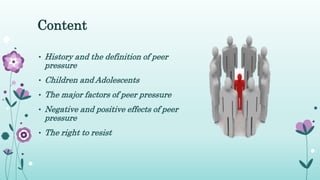
Content
• History and the definition of peer
pressure
• Children and Adolescents
• The major factors of peer pressure
• Negative and positive effects of peer
pressure
• The right to resist
History and the definition of peer pressure
• Definitioninfluence from members of one's peer group.
• Peers influence your life, even if you don't realize it, just by spending time
with you. You learn from them, and they learn from you. It's only human
nature to listen to and learn from other people in your age group.
• The Holocaust is probably the most well-known of genocides.
• The Rwandan genocide occurred in 1994, with ethnic violence between
the Hutu and Tutsi ethnicities.
• The ethnic tensions among the groups were the main factors that affected
peer pressure throughout the history.
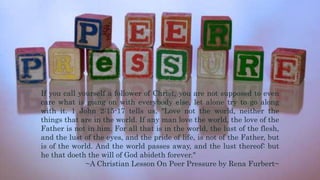
If you call yourself a follower of Christ, you are not supposed to even
care what is going on with everybody else, let alone try to go along
with it. 1 John 2:15-17 tells us, "Love not the world, neither the
things that are in the world. If any man love the world, the love of the
Father is not in him. For all that is in the world, the lust of the flesh,
and the lust of the eyes, and the pride of life, is not of the Father, but
is of the world. And the world passes away, and the lust thereof: but
he that doeth the will of God abideth forever."
~A Christian Lesson On Peer Pressure by Rena Furbert~
Children and Adolescents
• Imitation plays a large role in children’s' lives; in order to pick up skills
and techniques that they use in their own life, children are always
searching for behaviors and attitudes around them that they can co-opt.
• An interesting insight is that children can monitor and intervene in their
peers' behavior through pressure.
• Adolescence is the time when a person is most susceptible to peer
pressure because peers become an important influence on behavior
during adolescence, and peer pressure has been called a hallmark of
adolescent experience.
• Peer conformity in young people is most pronounced with respect to style,
taste, appearance, ideology, and values.
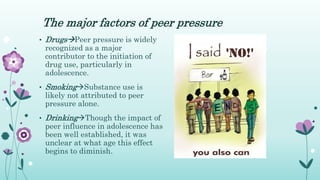
The major factors of peer pressure
• DrugsPeer pressure is widely
recognized as a major
contributor to the initiation of
drug use, particularly in
adolescence.
• SmokingSubstance use is
likely not attributed to peer
pressure alone.
• DrinkingThough the impact of
peer influence in adolescence has
been well established, it was
unclear at what age this effect
begins to diminish.
Negative and positive effects of peer pressure
Negative effects
• Artificial lifestyle
• Loss of rational thinking
• Selfishness
• Don’t respect others
• Being materialistic
• Academics are affected
• Makes them feel ashamed or bad
about themselves and their family
• Distances them from family and
friends
Positive effects
• Self introspection
• Exposure
Here are some good things friends can
pressure each other to do:
 Be honest
 Avoid Alcohol
 Avoid drugs
 Not smoke
 Be nice
 Respect others
 Work hard
 Exercise (together!)
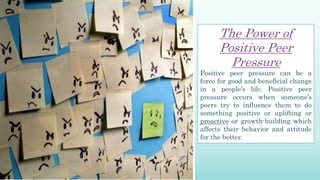
The Power of
Positive Peer
Pressure
Positive peer pressure can be a
force for good and beneficial change
in a people’s life. Positive peer
pressure occurs when someone’s
peers try to influence them to do
something positive or uplifting or
proactive or growth-building which
affects their behavior and attitude
for the better.
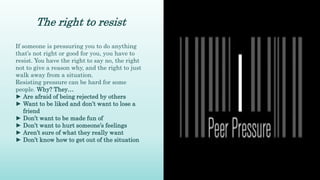
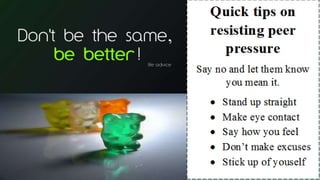
The right to resist
If someone is pressuring you to do anything
that’s not right or good for you, you have to
resist. You have the right to say no, the right
not to give a reason why, and the right to just
walk away from a situation.
Resisting pressure can be hard for some
people. Why? They…
► Are afraid of being rejected by others
► Want to be liked and don’t want to lose a
friend
► Don’t want to be made fun of
► Don’t want to hurt someone’s feelings
► Aren’t sure of what they really want
► Don’t know how to get out of the situation
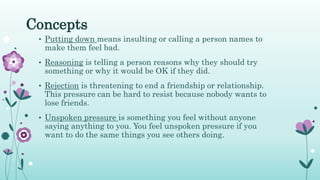
Concepts
• Putting down means insulting or calling a person names to
make them feel bad.
• Reasoning is telling a person reasons why they should try
something or why it would be OK if they did.
• Rejection is threatening to end a friendship or relationship.
This pressure can be hard to resist because nobody wants to
lose friends.
• Unspoken pressure is something you feel without anyone
saying anything to you. You feel unspoken pressure if you
want to do the same things you see others doing.
Now you try:
• https://www.thecoolspot.gov/bagOfTricks.aspx
• https://www.thecoolspot.gov/spokenVsUnspoken.aspx
• https://www.thecoolspot.gov/knowYourNos.aspx
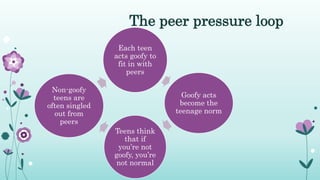
The peer pressure loop
Each teen
acts goofy to
fit in with
peers
Goofy acts
become the
teenage norm
Teens think
that if
you’re not
goofy, you’re
not normal
Non-goofy
teens are
often singled
out from
peers
Peer pressure

Peer pressure

  • 1.
  • 2.
    Content • History andthe definition of peer pressure • Children and Adolescents • The major factors of peer pressure • Negative and positive effects of peer pressure • The right to resist
  • 3.
    History and thedefinition of peer pressure • Definitioninfluence from members of one's peer group. • Peers influence your life, even if you don't realize it, just by spending time with you. You learn from them, and they learn from you. It's only human nature to listen to and learn from other people in your age group. • The Holocaust is probably the most well-known of genocides. • The Rwandan genocide occurred in 1994, with ethnic violence between the Hutu and Tutsi ethnicities. • The ethnic tensions among the groups were the main factors that affected peer pressure throughout the history.
  • 4.
    If you callyourself a follower of Christ, you are not supposed to even care what is going on with everybody else, let alone try to go along with it. 1 John 2:15-17 tells us, "Love not the world, neither the things that are in the world. If any man love the world, the love of the Father is not in him. For all that is in the world, the lust of the flesh, and the lust of the eyes, and the pride of life, is not of the Father, but is of the world. And the world passes away, and the lust thereof: but he that doeth the will of God abideth forever." ~A Christian Lesson On Peer Pressure by Rena Furbert~
  • 5.
    Children and Adolescents •Imitation plays a large role in children’s' lives; in order to pick up skills and techniques that they use in their own life, children are always searching for behaviors and attitudes around them that they can co-opt. • An interesting insight is that children can monitor and intervene in their peers' behavior through pressure. • Adolescence is the time when a person is most susceptible to peer pressure because peers become an important influence on behavior during adolescence, and peer pressure has been called a hallmark of adolescent experience. • Peer conformity in young people is most pronounced with respect to style, taste, appearance, ideology, and values.
  • 6.
    The major factorsof peer pressure • DrugsPeer pressure is widely recognized as a major contributor to the initiation of drug use, particularly in adolescence. • SmokingSubstance use is likely not attributed to peer pressure alone. • DrinkingThough the impact of peer influence in adolescence has been well established, it was unclear at what age this effect begins to diminish.
  • 7.
    Negative and positiveeffects of peer pressure Negative effects • Artificial lifestyle • Loss of rational thinking • Selfishness • Don’t respect others • Being materialistic • Academics are affected • Makes them feel ashamed or bad about themselves and their family • Distances them from family and friends Positive effects • Self introspection • Exposure Here are some good things friends can pressure each other to do:  Be honest  Avoid Alcohol  Avoid drugs  Not smoke  Be nice  Respect others  Work hard  Exercise (together!)
  • 8.
    The Power of PositivePeer Pressure Positive peer pressure can be a force for good and beneficial change in a people’s life. Positive peer pressure occurs when someone’s peers try to influence them to do something positive or uplifting or proactive or growth-building which affects their behavior and attitude for the better.
  • 9.
    The right toresist If someone is pressuring you to do anything that’s not right or good for you, you have to resist. You have the right to say no, the right not to give a reason why, and the right to just walk away from a situation. Resisting pressure can be hard for some people. Why? They… ► Are afraid of being rejected by others ► Want to be liked and don’t want to lose a friend ► Don’t want to be made fun of ► Don’t want to hurt someone’s feelings ► Aren’t sure of what they really want ► Don’t know how to get out of the situation
  • 11.
    Concepts • Putting downmeans insulting or calling a person names to make them feel bad. • Reasoning is telling a person reasons why they should try something or why it would be OK if they did. • Rejection is threatening to end a friendship or relationship. This pressure can be hard to resist because nobody wants to lose friends. • Unspoken pressure is something you feel without anyone saying anything to you. You feel unspoken pressure if you want to do the same things you see others doing.
  • 12.
    Now you try: •https://www.thecoolspot.gov/bagOfTricks.aspx • https://www.thecoolspot.gov/spokenVsUnspoken.aspx • https://www.thecoolspot.gov/knowYourNos.aspx
  • 13.
    The peer pressureloop Each teen acts goofy to fit in with peers Goofy acts become the teenage norm Teens think that if you’re not goofy, you’re not normal Non-goofy teens are often singled out from peers