PRESENTED BY:-
DEEPIKA KAITHAL
LUCKNOW
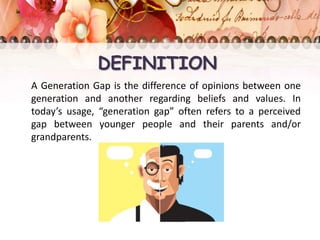
DEFINITION
A Generation Gap is the difference of opinions between one
generation and another regarding beliefs and values. In
today’s usage, “generation gap” often refers to a perceived
gap between younger people and their parents and/or
grandparents.
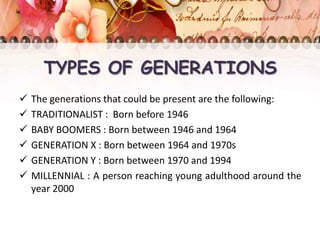
TYPES OF GENERATIONS
 The generations that could be present are the following:
 TRADITIONALIST : Born before 1946
 BABY BOOMERS : Born between 1946 and 1964
 GENERATION X : Born between 1964 and 1970s
 GENERATION Y : Born between 1970 and 1994
 MILLENNIAL : A person reaching young adulthood around the
year 2000
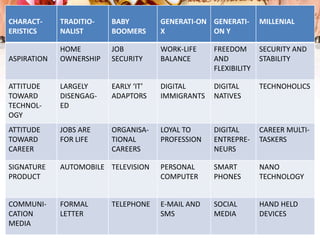
CHARACT-
ERISTICS
TRADITIO-
NALIST
BABY
BOOMERS
GENERATI-ON
X
GENERATI-
ON Y
MILLENIAL
ASPIRATION
HOME
OWNERSHIP
JOB
SECURITY
WORK-LIFE
BALANCE
FREEDOM
AND
FLEXIBILITY
SECURITY AND
STABILITY
ATTITUDE
TOWARD
TECHNOL-
OGY
LARGELY
DISENGAG-
ED
EARLY ‘IT’
ADAPTORS
DIGITAL
IMMIGRANTS
DIGITAL
NATIVES
TECHNOHOLICS
ATTITUDE
TOWARD
CAREER
JOBS ARE
FOR LIFE
ORGANISA-
TIONAL
CAREERS
LOYAL TO
PROFESSION
DIGITAL
ENTREPRE-
NEURS
CAREER MULTI-
TASKERS
SIGNATURE
PRODUCT
AUTOMOBILE TELEVISION PERSONAL
COMPUTER
SMART
PHONES
NANO
TECHNOLOGY
COMMUNI-
CATION
MEDIA
FORMAL
LETTER
TELEPHONE E-MAIL AND
SMS
SOCIAL
MEDIA
HAND HELD
DEVICES
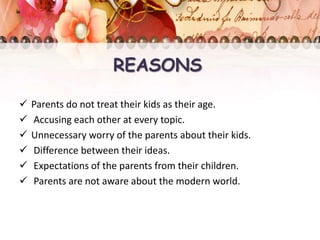
REASONS
 Parents do not treat their kids as their age.
 Accusing each other at every topic.
 Unnecessary worry of the parents about their kids.
 Difference between their ideas.
 Expectations of the parents from their children.
 Parents are not aware about the modern world.
CAUSES
 Lack of time spent together
 Lack of good communication
 Excessive control over the children
 Difference in lifestyles
 Difference in personalities
PEOPLE’S POINT OF VIEW
 It's natural that we often feel closer to distant generations
than to the generation immediately preceding us.
 It is due to the western culture.
 It is due to the busy parents.
 It is due to the lack of education.
EFFECTS
 As teens grow up they experience conflict and adopt values
different from those held by their parents and develops
unfavorable attitude toward the adults.
 The teenage is closely connected to making important life
decision, like career path.
 Difficulties in relationship with parents may lead to such
serious problems as drinking alcohol or drug addiction.
 Decrease in social values overtime.
 Youth is the constructor of the future. Generation Gap
causes psychological distress and differences among them.
HOW TO PREVENT IT
 Parents should develop ethical value system.
 Parents should become ideal.
 Parents should give them time.
 Don’t make extra expectations.
 Watch them about their society.
 Don’t criticize at their failure.
 Parents should try to mix with contemporary culture.
CONCLUSION
 Neither parents or children are alone responsible.
 Spend time with each other as more as possible.
 This happens due to change of generation.
 Parents should be aware about their children.
 This can be decreased by little compromise of both.
THE GENERATION GAP
THE GENERATION GAP

THE GENERATION GAP

  • 1.
  • 2.
    DEFINITION A Generation Gapis the difference of opinions between one generation and another regarding beliefs and values. In today’s usage, “generation gap” often refers to a perceived gap between younger people and their parents and/or grandparents.
  • 3.
    TYPES OF GENERATIONS The generations that could be present are the following:  TRADITIONALIST : Born before 1946  BABY BOOMERS : Born between 1946 and 1964  GENERATION X : Born between 1964 and 1970s  GENERATION Y : Born between 1970 and 1994  MILLENNIAL : A person reaching young adulthood around the year 2000
  • 4.
    CHARACT- ERISTICS TRADITIO- NALIST BABY BOOMERS GENERATI-ON X GENERATI- ON Y MILLENIAL ASPIRATION HOME OWNERSHIP JOB SECURITY WORK-LIFE BALANCE FREEDOM AND FLEXIBILITY SECURITY AND STABILITY ATTITUDE TOWARD TECHNOL- OGY LARGELY DISENGAG- ED EARLY‘IT’ ADAPTORS DIGITAL IMMIGRANTS DIGITAL NATIVES TECHNOHOLICS ATTITUDE TOWARD CAREER JOBS ARE FOR LIFE ORGANISA- TIONAL CAREERS LOYAL TO PROFESSION DIGITAL ENTREPRE- NEURS CAREER MULTI- TASKERS SIGNATURE PRODUCT AUTOMOBILE TELEVISION PERSONAL COMPUTER SMART PHONES NANO TECHNOLOGY COMMUNI- CATION MEDIA FORMAL LETTER TELEPHONE E-MAIL AND SMS SOCIAL MEDIA HAND HELD DEVICES
  • 5.
    REASONS  Parents donot treat their kids as their age.  Accusing each other at every topic.  Unnecessary worry of the parents about their kids.  Difference between their ideas.  Expectations of the parents from their children.  Parents are not aware about the modern world.
  • 6.
    CAUSES  Lack oftime spent together  Lack of good communication  Excessive control over the children  Difference in lifestyles  Difference in personalities
  • 7.
    PEOPLE’S POINT OFVIEW  It's natural that we often feel closer to distant generations than to the generation immediately preceding us.  It is due to the western culture.  It is due to the busy parents.  It is due to the lack of education.
  • 8.
    EFFECTS  As teensgrow up they experience conflict and adopt values different from those held by their parents and develops unfavorable attitude toward the adults.  The teenage is closely connected to making important life decision, like career path.  Difficulties in relationship with parents may lead to such serious problems as drinking alcohol or drug addiction.  Decrease in social values overtime.  Youth is the constructor of the future. Generation Gap causes psychological distress and differences among them.
  • 9.
    HOW TO PREVENTIT  Parents should develop ethical value system.  Parents should become ideal.  Parents should give them time.  Don’t make extra expectations.  Watch them about their society.  Don’t criticize at their failure.  Parents should try to mix with contemporary culture.
  • 10.
    CONCLUSION  Neither parentsor children are alone responsible.  Spend time with each other as more as possible.  This happens due to change of generation.  Parents should be aware about their children.  This can be decreased by little compromise of both.