1
Lecture No. 4
BEE
BEE 2
Contents
Kirchhoff’s Current Law (KCL)
Numerical Examples on KCL
Kirchhoff’s Voltage Law (KVL)
Numerical Examples on KVL
BEE 3
Node, loop, mesh and branch
Node: A node is simply a point of
connection of two or more circuit
elements. You are cautioned to note that,
although one node can be spread out with perfect
conductors, it is still only one node. This is illustrated
in Fig. b, where the circuit has been redrawn. Node 5
consists of the entire bottom connector of the
circuit. Nodes are mentioned by numbers 1, 2, 3, 4
and 5.
Loop: A loop is simply any closed path through
the circuit in which no node is encountered
more than once. For example, starting from node
1, one loop would contain the elements R1, v2, R4
and i1; another loop would contain R2, v1, v2, R4
and i1; and so on. However, the path R1, v1, R5, v2,
R3 and i1 is not a loop because we have encountered
node 3 twice.
Mesh: A mesh is a loop that has no other
loops inside of it. In figure b, starting from node
2, one mesh is R3, v2 and R4 and starting from node
1, the other mesh is R1, v1 and R2 and so on.
Branch: Finally, a branch is a portion of a
circuit containing only a single element and
the nodes at each end of the element. The
circuit in the figure contains eight branches.
BEE 4
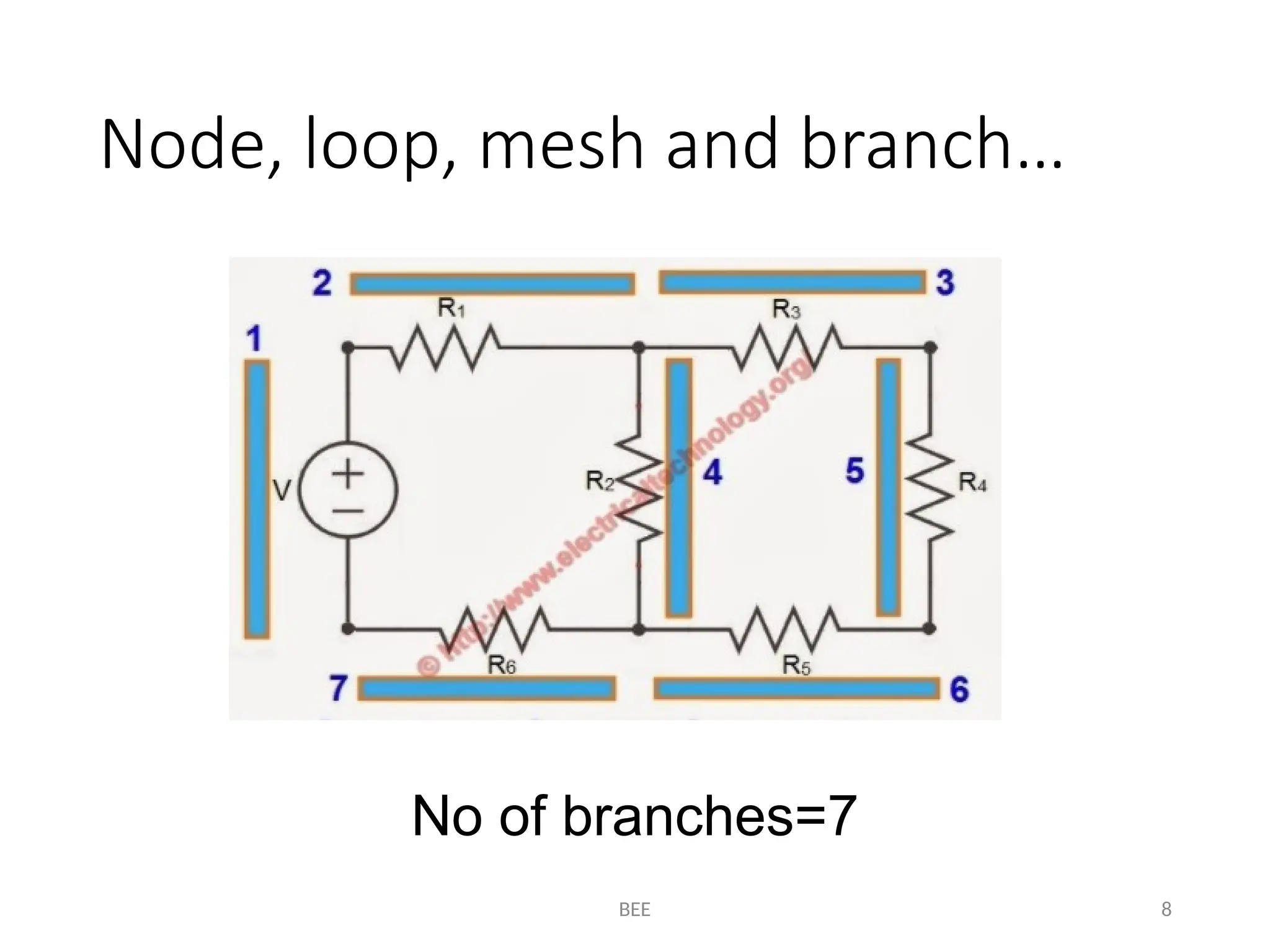
Node, loop, mesh and branch…
Question: Count the number of nodes, loops, meshes
and branches in the circuit given below.
BEE 5
Node, loop, mesh and branch…
No. of nodes=6
BEE 6
Node, loop, mesh and branch…
No of loops=3
BEE 7
Node, loop, mesh and branch…
No of meshes=2
BEE 8
Node, loop, mesh and branch…
No of branches=7
BEE 9
Kirchhoff’s Current Law (KCL)
Before discussing the first law
known as KCL, it is assumed that
current entering a node will be
taken as positive while current
leaving a node will be taken as
negative
Considering node 2, i1 and i6 are
leaving the node so are negative
while i4 is entering a node so it is
positive
Considering node 1, i1 is entering
the node so it is positive while i2
and i3 are leaving the node so
they are negative
BEE 10
Kirchhoff’s Current Law (KCL)
 Statement: The algebraic
sum of all the currents
entering any node is zero
Mathematically
Currents entering a node
are I1 and I2 and therefore
are positive
Currents leaving a node
are I3, I4 and I5 and
therefore are negative
BEE 11
Kirchhoff’s Current Law (KCL)
According to KCL, the algebraic sum
of all currents entering a node is
equal to zero, mathematically
Multiplying the above equation by “-1”
Which simply states the algebraic sum of all
the currents leaving a node is zero. This is
alternative form of KCL.
BEE 12
Kirchhoff’s Current Law
Taking all the negative terms of eq. (i) to the right side fo the equation
From the above equation we can state KCL as follows:
“The sum of all the currents (magnitude) entering a node is equal to the sum of all the
currents (magnitude) leaving a node”
The above statement is another alternative form of KCL
BEE 13
Numerical Example on KCL
Question: Write KCL
equation for every
node of the circuit
shown below
Solution:
According to KCL,
For node 1, KCL eq. is
For node 2, KCL eq. is
For node 3, KCL eq. is
For node 4, KCL eq. is
For node 5, KCL eq. is
BEE 14
Numerical Example on KCL…
Solution:
Labelling the currents
and nodes and then
applying KCL at each
node
Question: Find the
currents I1 and I2 in the
circuit shown below:
BEE
Numerical Example on KCL…
For node 3, KCL eq. is
For node 1, KCL eq. is
BEE
Kirchhoff’s Voltage Law (KVL)
 Before discussing the second law known as KVL, it is
assumed that an increase in the charge’s energy will
be considered as negative as the current first
encounter negative sign and is known as the
potential rise while a decrease in the charge’s energy
will be considered as positive as the current first
encounter a positive sign and this decrease of
charge’s energy is termed as potential drop
 Finally, we employ the convention to indicate the
voltage of point “a” with respect to point “b”: that is,
the variable for the voltage between point “a” and
point “b”, with point “a” considered positive relative
to point “b”.
 Before applying KVL, we assume either clockwise
current or anticlockwise current in a loop according
to our wish
 If we consider clockwise current I as shown in Figure
B on right hand side, then the polarities will be
 At V1=potential rise=considered negative
 At V2=potential drop=considered positive
 At V3=potential rise=considered negative
16
Figure A
Figure B
BEE
Kirchhoff’s Voltage Law (KVL)
 Statement: The algebraic sum of
all the voltages around any closed
loop is zero
 Mathematically
 Assuming clockwise current in figure A and
then applying KVL as shown in figure B
 Taking all the negative terms of eq. 1 on right
hand side
 The sum of all the voltage (magnitude)
drops is equal to the sum of all the voltage
(magnitude) rises in a closed loop. This is
alternative form of KVL.
17
Figure A
Figure B
BEE
Kirchhoff’s Voltage Law (KVL)
Question: Find V3
in the circuit given
below:
18
Solution:
First we assume a
clockwise direction of the
current in the loop and
label all the voltages and
then indicate all the
voltage drops and voltage
rises as shown in the
circuit given in the next
slide
BEE
Kirchhoff’s Voltage Law (KVL)
Applying KVL,
30 + 5 + 15 = V1 + V3 + V2
50 = 20 + V3 + 50
19
50 = 20 + V3 +
50
50 = V3 + 70
50 – 70 = V3
V3 = -20 v
BEE
Kirchhoff’s Voltage Law (KVL)
Question: Find Vae and Vec in the circuit
given below:
Solution: Vae means that “point a” is
positive with respect to “point e” while Vec
means that “point e” is positive with respect
to “point c”. Assuming anticlockwise
direction of currents in both hypothetical
loops “aef” and “ecd” respectively
20
Applying KVL to the loop “aef”
Applying KVL to loop “ecd”
Dffsdfsdfsfsfddsfsdf
sfdfsfsdfsf
BEE 21
Homework
Question: Write KCL
equation for every
node of the circuit
shown below. Also
find the unknown
currents if
Question: Find in the circuit
shown below:
BEE 22
Thank you for your attention

Introduction to Node, Loops, Mesh and branch.

  • 1.
  • 2.
    BEE 2 Contents Kirchhoff’s CurrentLaw (KCL) Numerical Examples on KCL Kirchhoff’s Voltage Law (KVL) Numerical Examples on KVL
  • 3.
    BEE 3 Node, loop,mesh and branch Node: A node is simply a point of connection of two or more circuit elements. You are cautioned to note that, although one node can be spread out with perfect conductors, it is still only one node. This is illustrated in Fig. b, where the circuit has been redrawn. Node 5 consists of the entire bottom connector of the circuit. Nodes are mentioned by numbers 1, 2, 3, 4 and 5. Loop: A loop is simply any closed path through the circuit in which no node is encountered more than once. For example, starting from node 1, one loop would contain the elements R1, v2, R4 and i1; another loop would contain R2, v1, v2, R4 and i1; and so on. However, the path R1, v1, R5, v2, R3 and i1 is not a loop because we have encountered node 3 twice. Mesh: A mesh is a loop that has no other loops inside of it. In figure b, starting from node 2, one mesh is R3, v2 and R4 and starting from node 1, the other mesh is R1, v1 and R2 and so on. Branch: Finally, a branch is a portion of a circuit containing only a single element and the nodes at each end of the element. The circuit in the figure contains eight branches.
  • 4.
    BEE 4 Node, loop,mesh and branch… Question: Count the number of nodes, loops, meshes and branches in the circuit given below.
  • 5.
    BEE 5 Node, loop,mesh and branch… No. of nodes=6
  • 6.
    BEE 6 Node, loop,mesh and branch… No of loops=3
  • 7.
    BEE 7 Node, loop,mesh and branch… No of meshes=2
  • 8.
    BEE 8 Node, loop,mesh and branch… No of branches=7
  • 9.
    BEE 9 Kirchhoff’s CurrentLaw (KCL) Before discussing the first law known as KCL, it is assumed that current entering a node will be taken as positive while current leaving a node will be taken as negative Considering node 2, i1 and i6 are leaving the node so are negative while i4 is entering a node so it is positive Considering node 1, i1 is entering the node so it is positive while i2 and i3 are leaving the node so they are negative
  • 10.
    BEE 10 Kirchhoff’s CurrentLaw (KCL)  Statement: The algebraic sum of all the currents entering any node is zero Mathematically Currents entering a node are I1 and I2 and therefore are positive Currents leaving a node are I3, I4 and I5 and therefore are negative
  • 11.
    BEE 11 Kirchhoff’s CurrentLaw (KCL) According to KCL, the algebraic sum of all currents entering a node is equal to zero, mathematically Multiplying the above equation by “-1” Which simply states the algebraic sum of all the currents leaving a node is zero. This is alternative form of KCL.
  • 12.
    BEE 12 Kirchhoff’s CurrentLaw Taking all the negative terms of eq. (i) to the right side fo the equation From the above equation we can state KCL as follows: “The sum of all the currents (magnitude) entering a node is equal to the sum of all the currents (magnitude) leaving a node” The above statement is another alternative form of KCL
  • 13.
    BEE 13 Numerical Exampleon KCL Question: Write KCL equation for every node of the circuit shown below Solution: According to KCL, For node 1, KCL eq. is For node 2, KCL eq. is For node 3, KCL eq. is For node 4, KCL eq. is For node 5, KCL eq. is
  • 14.
    BEE 14 Numerical Exampleon KCL… Solution: Labelling the currents and nodes and then applying KCL at each node Question: Find the currents I1 and I2 in the circuit shown below:
  • 15.
    BEE Numerical Example onKCL… For node 3, KCL eq. is For node 1, KCL eq. is
  • 16.
    BEE Kirchhoff’s Voltage Law(KVL)  Before discussing the second law known as KVL, it is assumed that an increase in the charge’s energy will be considered as negative as the current first encounter negative sign and is known as the potential rise while a decrease in the charge’s energy will be considered as positive as the current first encounter a positive sign and this decrease of charge’s energy is termed as potential drop  Finally, we employ the convention to indicate the voltage of point “a” with respect to point “b”: that is, the variable for the voltage between point “a” and point “b”, with point “a” considered positive relative to point “b”.  Before applying KVL, we assume either clockwise current or anticlockwise current in a loop according to our wish  If we consider clockwise current I as shown in Figure B on right hand side, then the polarities will be  At V1=potential rise=considered negative  At V2=potential drop=considered positive  At V3=potential rise=considered negative 16 Figure A Figure B
  • 17.
    BEE Kirchhoff’s Voltage Law(KVL)  Statement: The algebraic sum of all the voltages around any closed loop is zero  Mathematically  Assuming clockwise current in figure A and then applying KVL as shown in figure B  Taking all the negative terms of eq. 1 on right hand side  The sum of all the voltage (magnitude) drops is equal to the sum of all the voltage (magnitude) rises in a closed loop. This is alternative form of KVL. 17 Figure A Figure B
  • 18.
    BEE Kirchhoff’s Voltage Law(KVL) Question: Find V3 in the circuit given below: 18 Solution: First we assume a clockwise direction of the current in the loop and label all the voltages and then indicate all the voltage drops and voltage rises as shown in the circuit given in the next slide
  • 19.
    BEE Kirchhoff’s Voltage Law(KVL) Applying KVL, 30 + 5 + 15 = V1 + V3 + V2 50 = 20 + V3 + 50 19 50 = 20 + V3 + 50 50 = V3 + 70 50 – 70 = V3 V3 = -20 v
  • 20.
    BEE Kirchhoff’s Voltage Law(KVL) Question: Find Vae and Vec in the circuit given below: Solution: Vae means that “point a” is positive with respect to “point e” while Vec means that “point e” is positive with respect to “point c”. Assuming anticlockwise direction of currents in both hypothetical loops “aef” and “ecd” respectively 20 Applying KVL to the loop “aef” Applying KVL to loop “ecd” Dffsdfsdfsfsfddsfsdf sfdfsfsdfsf
  • 21.
    BEE 21 Homework Question: WriteKCL equation for every node of the circuit shown below. Also find the unknown currents if Question: Find in the circuit shown below:
  • 22.
    BEE 22 Thank youfor your attention