

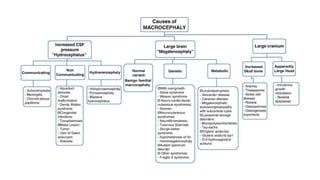
APPROACH
TO A CHILD
WITH
LARGE
HEAD
1. Introduction and proper exposure of
patient
Interact with child, gain impression of development
2. General observations(for 30 sec at least)
Alertness
Respiratory pattern (raised ICP)
Dysmorphic features (e.g. Sotos, mucopolysaccharidoses)
Skeletal anomalies (e.g. achondroplasia, Osteogenesis
imperfecta)
Growth Parameters
• Height: tall (e.g. Sotos); short (e.g. achondroplasia)
• Weight: failing to thrive (e.g. Tay–Sachs, subdural from non-
accidental injury, congenital toxoplasmosis)
Movement
• Quality (e.g. hypotonia, poor head control in Tay–Sachs)
• Symmetry (e.g. hemiplegia from subdural haematoma)
• Upper limb versus lower limb movements (e.g. spina bifida)
Skin
• Neurocutaneous stigmata (e.g. Tuberous sclerosis, NF1,
Sturge-Weber syndrome; Klippel-Trénauney-Weber syndrome)
• Bruising (Non-accidental injury)
3. HEAD
Initial inspection
• Size, shape
• Signs of hydrocephalus (scalp vein prominence, shiny skin,
sun-setting eyes)
• Eye signs, e.g. squint
• V-tap bandage/scars
ASK THE CHILD TO SIT if possible
Now touch the child
Size
• Measure head circumference: patient; parents
• Request progressive percentiles
• The head circumference is measured by placing the tape over
the occipital protuberance at the back and just over the
supraorbital ridge and the glabella in front.
• HC should be taken 3 times at least.
Shape (Describe with infant supine initially; then sit child up)
• Frontal prominence (obstructive hydrocephalus)
• Parietal prominence (subdural fluid, porencephalic cyst)
• Occipital prominence (Dandy walker syndrome)
• Small posterior fossa (aqueduct stenosis)
• Flat occiput (Arnold-chiari malformation)
Check back.(Look at the back at this point, for spina
bifida/scars)
Palpate
(With child sitting up; interact with child and observe
responsiveness, eye movements)
• Craniotabes (rickets)
• Split sutures (hydrocephalus)
• Bulging fontanelle (hydrocephalus)
• Absent fontanelle pulsation (hydrocephalus)
• Shunts—trace shunt tubing, look for chest (VA) and
abdomen (VP) scars
Auscultate(temporal ,mastoid and Frontal areas, over eyes)
Bruit (AV malformation of great vein of Galen, causing
increased CSF)
Transillumination test
when using a standard 2-cell flashlight held tight to the
anterior fontanelle, transillumination of more than 2 cm
around the edge of the beam or asymmetry of the
transillumination suggests underlying pathology.
4.EYES
• Ptosis (third nerve palsy)
• Nystagmus (brainstem tumour)
• Squint (sixth, third nerve palsies)
Proptosis (NF1 with orbital wall defect or optic nerve tumour)
Corneal clouding (MPS)
Visual acuity (impaired)
• Retinal causes (e.g. optic atrophy, retinal haemorrhage)
• Optic pathway causes (e.g. intracerebral glioma, optic nerve
glioma; both can occur in NF1)
Visual fields: field defect (e.g. porencephalic cyst, intracerebral
tumour)
External ocular movements
• Third nerve palsy (e.g. raised ICP)
• Sixth nerve palsy (e.g. raised ICP)
• Upward gaze palsy (e.g. pinealoma)
Pupils
• Enlarged (third nerve palsy)
• Unreactive to light (Parinaud’s syndrome from dilated third
ventricle)
Lens: cataracts (congenital toxoplasmosis)
Fundi
• Papilloedema (raised ICP with closed fontanelle)
• Optic atrophy (long-standing raised ICP)
• Retinal haemorrhage (Non-accidental injury)
• Astrocytic hamartoma (Tuberous Sclerosis)
• Chorioretinitis (congenital toxoplasmosis)
• Macular degeneration (lipidoses)
If possible, perform ask child to stand up
• Weight
• Height
• Plot on centile charts
• Check gait
• Look for scoliosis
ASK child to move back to couch
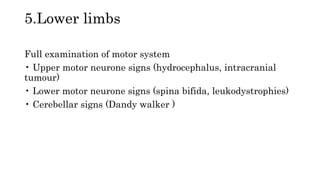
5.Lower limbs
Full examination of motor system
• Upper motor neurone signs (hydrocephalus, intracranial
tumour)
• Lower motor neurone signs (spina bifida, leukodystrophies)
• Cerebellar signs (Dandy walker )
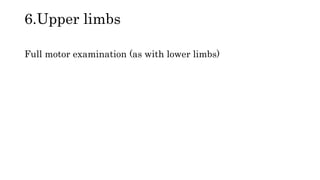
6.Upper limbs
Full motor examination (as with lower limbs)
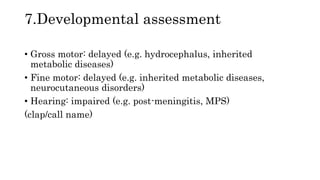
7.Developmental assessment
• Gross motor: delayed (e.g. hydrocephalus, inherited
metabolic diseases)
• Fine motor: delayed (e.g. inherited metabolic diseases,
neurocutaneous disorders)
• Hearing: impaired (e.g. post-meningitis, MPS)
(clap/call name)
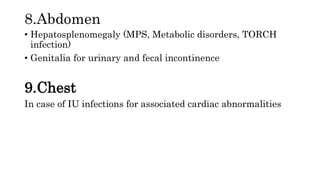
8.Abdomen
• Hepatosplenomegaly (MPS, Metabolic disorders, TORCH
infection)
• Genitalia for urinary and fecal incontinence
9.Chest
In case of IU infections for associated cardiac abnormalities
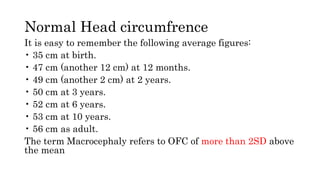
Normal Head circumfrence
It is easy to remember the following average figures:
• 35 cm at birth.
• 47 cm (another 12 cm) at 12 months.
• 49 cm (another 2 cm) at 2 years.
• 50 cm at 3 years.
• 52 cm at 6 years.
• 53 cm at 10 years.
• 56 cm as adult.
The term Macrocephaly refers to OFC of more than 2SD above
the mean
The most important things to remember in
this case:
1. Always measure the head yourself, until a constant result around the largest
diameter
is obtained (usually three times is enough).
2. Always measure the parents’ heads (in a similar fashion).
3. Always request the progressive percentiles of the child (parents’ charts unavailable).
4. Always examine the back, to avoid missing spinal dysraphism.
5. Always examine the lower limbs before the upper limbs, as the lower limbs are
first affected in hydrocephalus, because the tracts supplying them run closer to the
ventricles.
6. Always examine the eye movements, in particular the upward gaze (for Parinaud
syndrome, from raised intracranial pressure [ICP] compressing the mesencephalic
tectum/superior colliculus) and lateral rectus function (for raised ICP compressing
the sixth nerve).
Approach to a child with large head

Approach to a child with large head

  • 1.
  • 2.
    1. Introduction andproper exposure of patient Interact with child, gain impression of development
  • 3.
    2. General observations(for30 sec at least) Alertness Respiratory pattern (raised ICP) Dysmorphic features (e.g. Sotos, mucopolysaccharidoses) Skeletal anomalies (e.g. achondroplasia, Osteogenesis imperfecta) Growth Parameters • Height: tall (e.g. Sotos); short (e.g. achondroplasia) • Weight: failing to thrive (e.g. Tay–Sachs, subdural from non- accidental injury, congenital toxoplasmosis)
  • 4.
    Movement • Quality (e.g.hypotonia, poor head control in Tay–Sachs) • Symmetry (e.g. hemiplegia from subdural haematoma) • Upper limb versus lower limb movements (e.g. spina bifida) Skin • Neurocutaneous stigmata (e.g. Tuberous sclerosis, NF1, Sturge-Weber syndrome; Klippel-Trénauney-Weber syndrome) • Bruising (Non-accidental injury)
  • 5.
    3. HEAD Initial inspection •Size, shape • Signs of hydrocephalus (scalp vein prominence, shiny skin, sun-setting eyes) • Eye signs, e.g. squint • V-tap bandage/scars ASK THE CHILD TO SIT if possible
  • 6.
    Now touch thechild Size • Measure head circumference: patient; parents • Request progressive percentiles • The head circumference is measured by placing the tape over the occipital protuberance at the back and just over the supraorbital ridge and the glabella in front. • HC should be taken 3 times at least.
  • 7.
    Shape (Describe withinfant supine initially; then sit child up) • Frontal prominence (obstructive hydrocephalus) • Parietal prominence (subdural fluid, porencephalic cyst) • Occipital prominence (Dandy walker syndrome) • Small posterior fossa (aqueduct stenosis) • Flat occiput (Arnold-chiari malformation) Check back.(Look at the back at this point, for spina bifida/scars)
  • 8.
    Palpate (With child sittingup; interact with child and observe responsiveness, eye movements) • Craniotabes (rickets) • Split sutures (hydrocephalus) • Bulging fontanelle (hydrocephalus) • Absent fontanelle pulsation (hydrocephalus) • Shunts—trace shunt tubing, look for chest (VA) and abdomen (VP) scars Auscultate(temporal ,mastoid and Frontal areas, over eyes) Bruit (AV malformation of great vein of Galen, causing increased CSF)
  • 9.
    Transillumination test when usinga standard 2-cell flashlight held tight to the anterior fontanelle, transillumination of more than 2 cm around the edge of the beam or asymmetry of the transillumination suggests underlying pathology.
  • 10.
    4.EYES • Ptosis (thirdnerve palsy) • Nystagmus (brainstem tumour) • Squint (sixth, third nerve palsies)
  • 11.
    Proptosis (NF1 withorbital wall defect or optic nerve tumour) Corneal clouding (MPS) Visual acuity (impaired) • Retinal causes (e.g. optic atrophy, retinal haemorrhage) • Optic pathway causes (e.g. intracerebral glioma, optic nerve glioma; both can occur in NF1) Visual fields: field defect (e.g. porencephalic cyst, intracerebral tumour) External ocular movements • Third nerve palsy (e.g. raised ICP) • Sixth nerve palsy (e.g. raised ICP) • Upward gaze palsy (e.g. pinealoma)
  • 12.
    Pupils • Enlarged (thirdnerve palsy) • Unreactive to light (Parinaud’s syndrome from dilated third ventricle) Lens: cataracts (congenital toxoplasmosis) Fundi • Papilloedema (raised ICP with closed fontanelle) • Optic atrophy (long-standing raised ICP) • Retinal haemorrhage (Non-accidental injury) • Astrocytic hamartoma (Tuberous Sclerosis) • Chorioretinitis (congenital toxoplasmosis) • Macular degeneration (lipidoses)
  • 13.
    If possible, performask child to stand up • Weight • Height • Plot on centile charts • Check gait • Look for scoliosis ASK child to move back to couch
  • 14.
    5.Lower limbs Full examinationof motor system • Upper motor neurone signs (hydrocephalus, intracranial tumour) • Lower motor neurone signs (spina bifida, leukodystrophies) • Cerebellar signs (Dandy walker )
  • 15.
    6.Upper limbs Full motorexamination (as with lower limbs)
  • 16.
    7.Developmental assessment • Grossmotor: delayed (e.g. hydrocephalus, inherited metabolic diseases) • Fine motor: delayed (e.g. inherited metabolic diseases, neurocutaneous disorders) • Hearing: impaired (e.g. post-meningitis, MPS) (clap/call name)
  • 17.
    8.Abdomen • Hepatosplenomegaly (MPS,Metabolic disorders, TORCH infection) • Genitalia for urinary and fecal incontinence 9.Chest In case of IU infections for associated cardiac abnormalities
  • 19.
    Normal Head circumfrence Itis easy to remember the following average figures: • 35 cm at birth. • 47 cm (another 12 cm) at 12 months. • 49 cm (another 2 cm) at 2 years. • 50 cm at 3 years. • 52 cm at 6 years. • 53 cm at 10 years. • 56 cm as adult. The term Macrocephaly refers to OFC of more than 2SD above the mean
  • 20.
    The most importantthings to remember in this case: 1. Always measure the head yourself, until a constant result around the largest diameter is obtained (usually three times is enough). 2. Always measure the parents’ heads (in a similar fashion). 3. Always request the progressive percentiles of the child (parents’ charts unavailable). 4. Always examine the back, to avoid missing spinal dysraphism. 5. Always examine the lower limbs before the upper limbs, as the lower limbs are first affected in hydrocephalus, because the tracts supplying them run closer to the ventricles. 6. Always examine the eye movements, in particular the upward gaze (for Parinaud syndrome, from raised intracranial pressure [ICP] compressing the mesencephalic tectum/superior colliculus) and lateral rectus function (for raised ICP compressing the sixth nerve).