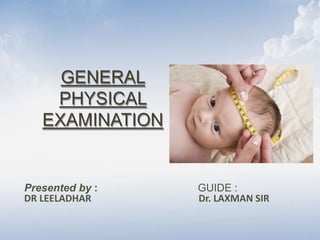
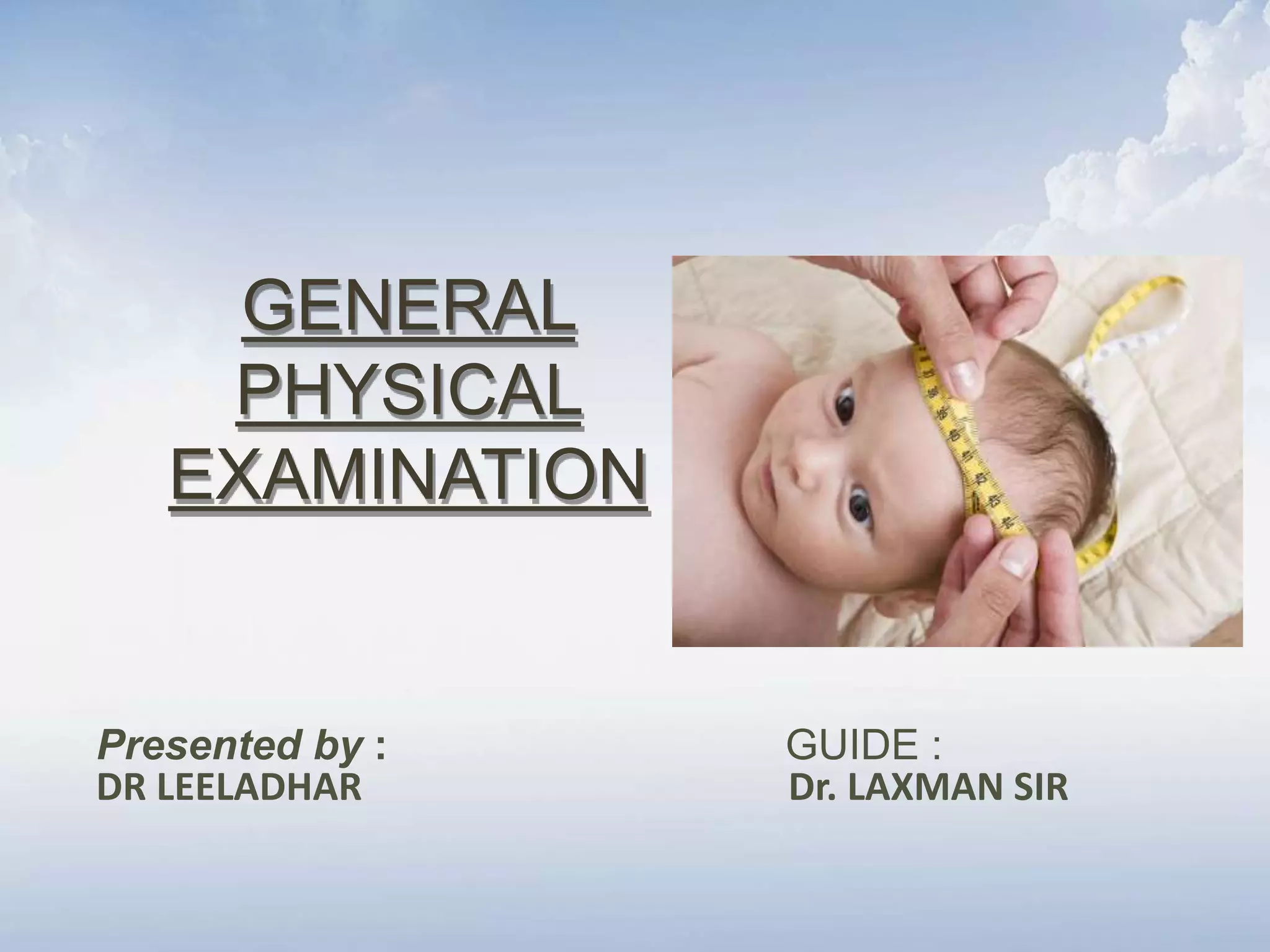
Presented by : GUIDE :
DR LEELADHAR Dr. LAXMAN SIR
GENERAL
PHYSICAL
EXAMINATION
General Physical Examination
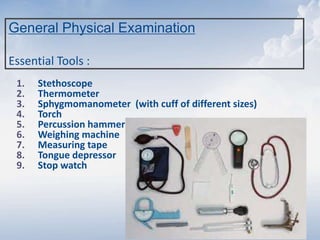
Essential Tools :
1. Stethoscope
2. Thermometer
3. Sphygmomanometer (with cuff of different sizes)
4. Torch
5. Percussion hammer
6. Weighing machine
7. Measuring tape
8. Tongue depressor
9. Stop watch
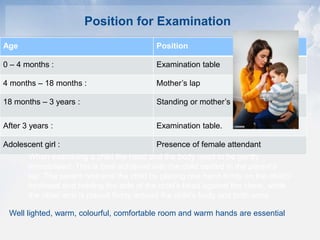
Position for Examination
Age Position
0 – 4 months : Examination table
4 months – 18 months : Mother’s lap
18 months – 3 years : Standing or mother’s lap
After 3 years : Examination table.
Adolescent girl : Presence of female attendant
Well lighted, warm, colourful, comfortable room and warm hands are essential
When examining a child the head and the body need to be gently
immobilised .This is best achieved with the child seated in the parent’s
lap. The parent restrains the child by placing one hand firmly on the child’s
forehead and holding the side of the child’s head against the chest, while
the other arm is placed firmly around the child’s body and both arms.
Sequence of examination
1.General appearance
2.Vital signs
3.General features & Head to toe
examination
4.Evidence of Deficiency states
5.Skin and its appendages
6.Anthropometry
7.Developmental assessment
General appearance
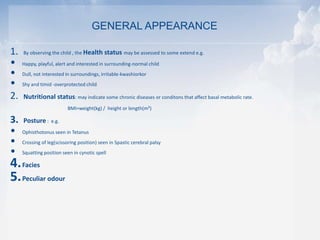
1. By observing the child , the Health status may be assessed to some extend e.g.
• Happy, playful, alert and interested in surrounding-normal child
• Dull, not interested in surroundings, irritable-kwashiorkor
• Shy and timid -overprotected child
2. Nutritional status: may indicate some chronic diseases or conditons that affect basal metabolic rate.
BMI=weight(kg) / height or length(m²)
3. Posture : e.g.
• Ophisthotonus seen in Tetanus
• Crossing of leg(scissoring position) seen in Spastic cerebral palsy
• Squatting position seen in cynotic spell
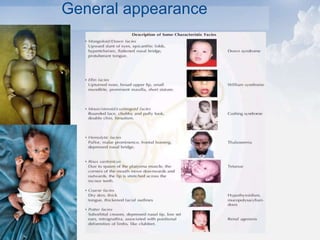
4.Facies
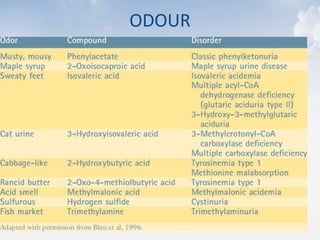
5.Peculiar odour
GENERAL APPEARANCE
ODOUR
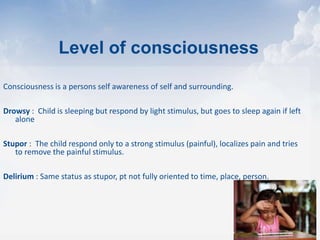
Consciousness is a persons self awareness of self and surrounding.
Drowsy : Child is sleeping but respond by light stimulus, but goes to sleep again if left
alone
Stupor : The child respond only to a strong stimulus (painful), localizes pain and tries
to remove the painful stimulus.
Delirium : Same status as stupor, pt not fully oriented to time, place, person.
Level of consciousness
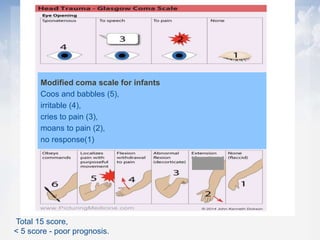
Glasgow coma scale : EVM scale
Total 15 score,
< 5 score - poor prognosis.
Modified coma scale for infants
Coos and babbles (5),
irritable (4),
cries to pain (3),
moans to pain (2),
no response(1)
Vital Signs : signs of life
1. Temperature – clinician can make a rough estimate of
body temperature by placing dorsum of his or her hand
over the neck of the child.
SITES:
• Axillary – Infants and small children
• Oral – Older children
• Rectal – only in malnourished or very ill child
• Rectal Temp > Oral Temp. >Axillary Temp. approximately by 0.7 0 F
• Normal diurnal variation is 10 F
• Other sites: Groin, ear canal
• Clinically significant fever is defined as
RECTAL temp. >= 100.4 0 F (38 0 C ) or
ORAL temp. >= 99.5 0 F (37.5 0 C ) or
AXILLARY temp. >= 99 0 F (37.2 0 C )
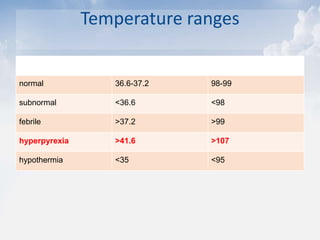
Temperature ranges
temperature Degree centigrade Degree fahrenheit
normal 36.6-37.2 98-99
subnormal <36.6 <98
febrile >37.2 >99
hyperpyrexia >41.6 >107
hypothermia <35 <95
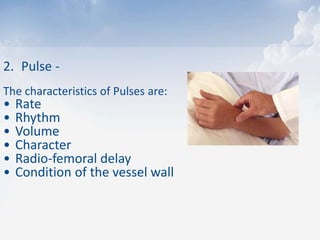
2. Pulse -
The characteristics of Pulses are:
• Rate
• Rhythm
• Volume
• Character
• Radio-femoral delay
• Condition of the vessel wall
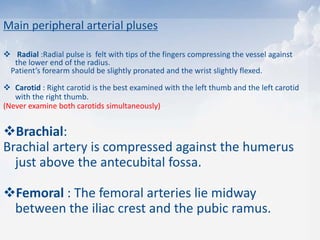
Main peripheral arterial pluses
 Radial :Radial pulse is felt with tips of the fingers compressing the vessel against
the lower end of the radius.
Patient’s forearm should be slightly pronated and the wrist slightly flexed.
 Carotid : Right carotid is the best examined with the left thumb and the left carotid
with the right thumb.
(Never examine both carotids simultaneously)
Brachial:
Brachial artery is compressed against the humerus
just above the antecubital fossa.
Femoral : The femoral arteries lie midway
between the iliac crest and the pubic ramus.
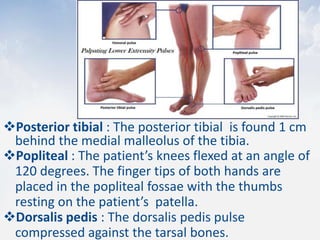
Posterior tibial : The posterior tibial is found 1 cm
behind the medial malleolus of the tibia.
Popliteal : The patient’s knees flexed at an angle of
120 degrees. The finger tips of both hands are
placed in the popliteal fossae with the thumbs
resting on the patient’s patella.
Dorsalis pedis : The dorsalis pedis pulse
compressed against the tarsal bones.
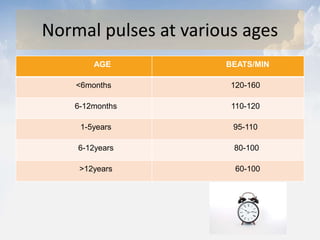
Normal pulses at various ages
AGE BEATS/MIN
<6months 120-160
6-12months 110-120
1-5years 95-110
6-12years 80-100
>12years 60-100
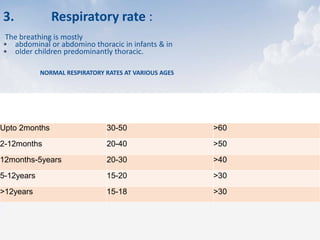
3. Respiratory rate :
The breathing is mostly
• abdominal or abdomino thoracic in infants & in
• older children predominantly thoracic.
NORMAL RESPIRATORY RATES AT VARIOUS AGES
Age Normal Respiratory Rate
(breaths / min)
Tachypnea (breaths / min)
Upto 2months 30-50 >60
2-12months 20-40 >50
12months-5years 20-30 >40
5-12years 15-20 >30
>12years 15-18 >30
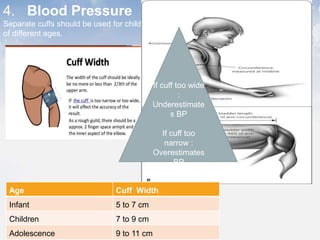
4. Blood Pressure
Separate cuffs should be used for children
of different ages.
Age Cuff Width
Infant 5 to 7 cm
Children 7 to 9 cm
Adolescence 9 to 11 cm
If cuff too wide
:
Underestimate
s BP
If cuff too
narrow :
Overestimates
BP
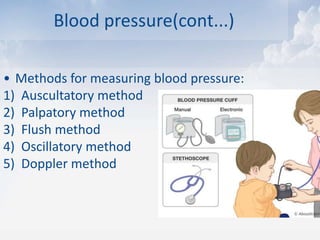
Blood pressure(cont...)
• Methods for measuring blood pressure:
1) Auscultatory method
2) Palpatory method
3) Flush method
4) Oscillatory method
5) Doppler method
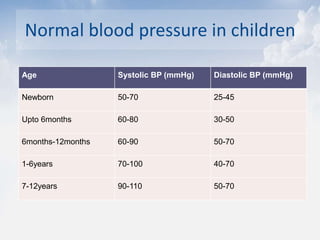
Normal blood pressure in children
Age Systolic BP (mmHg) Diastolic BP (mmHg)
Newborn 50-70 25-45
Upto 6months 60-80 30-50
6months-12months 60-90 50-70
1-6years 70-100 40-70
7-12years 90-110 50-70
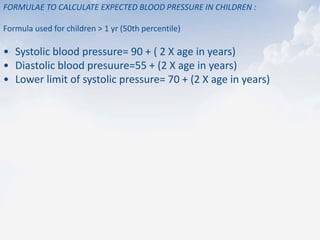
FORMULAE TO CALCULATE EXPECTED BLOOD PRESSURE IN CHILDREN :
Formula used for children > 1 yr (50th percentile)
• Systolic blood pressure= 90 + ( 2 X age in years)
• Diastolic blood presuure=55 + (2 X age in years)
• Lower limit of systolic pressure= 70 + (2 X age in years)
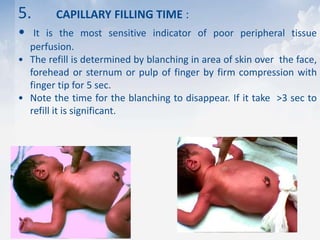
5. CAPILLARY FILLING TIME :
• It is the most sensitive indicator of poor peripheral tissue
perfusion.
• The refill is determined by blanching in area of skin over the face,
forehead or sternum or pulp of finger by firm compression with
finger tip for 5 sec.
• Note the time for the blanching to disappear. If it take >3 sec to
refill it is significant.
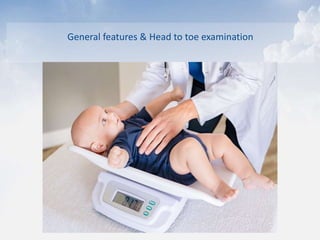
General features & Head to toe examination
General features
In GENERAL FEATURES look for
• Anaemia
• Cyanosis
• Jaundice
• Edema
• Lymphadenopathy
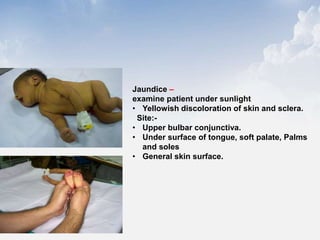
Jaundice –
examine patient under sunlight
• Yellowish discoloration of skin and sclera.
Site:-
• Upper bulbar conjunctiva.
• Under surface of tongue, soft palate, Palms
and soles
• General skin surface.
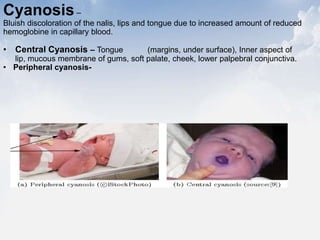
Cyanosis–
Bluish discoloration of the nalis, lips and tongue due to increased amount of reduced
hemoglobine in capillary blood.
• Central Cyanosis – Tongue (margins, under surface), Inner aspect of
lip, mucous membrane of gums, soft palate, cheek, lower palpebral conjunctiva.
• Peripheral cyanosis-
Pallorness
SITE-
Palm,
conjunctiva,
tongue,
nail bed,
lips,
oral cavity muacos
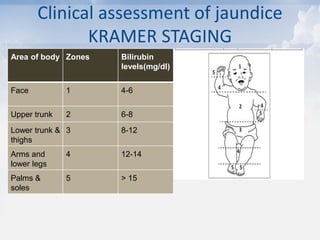
Clinical assessment of jaundice
KRAMER STAGING
Area of body Zones Bilirubin
levels(mg/dl)
Face 1 4-6
Upper trunk 2 6-8
Lower trunk &
thighs
3 8-12
Arms and
lower legs
4 12-14
Palms &
soles
5 > 15
Oedema
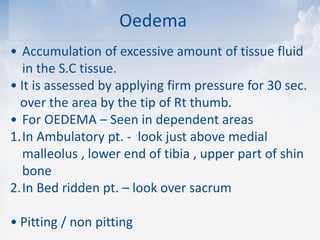
• Accumulation of excessive amount of tissue fluid
in the S.C tissue.
• It is assessed by applying firm pressure for 30 sec.
over the area by the tip of Rt thumb.
• For OEDEMA – Seen in dependent areas
1.In Ambulatory pt. - look just above medial
malleolus , lower end of tibia , upper part of shin
bone
2.In Bed ridden pt. – look over sacrum
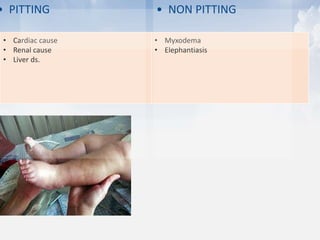
• Pitting / non pitting
• Cardiac cause
• Renal cause
• Liver ds.
• Myxodema
• Elephantiasis
• PITTING • NON PITTING
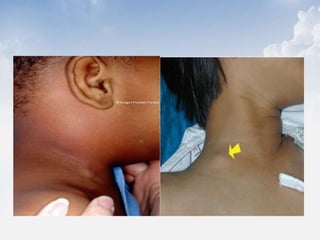
Lymphadenopathy
• Lymph nodes are palpated by the pads of index and
middle fingers with gentle but firm pressure and
moving the overlying skin in circular motion.
• Peripheral LN are looked in the neck, axillae,
Epitrochlear , groins and popliteal fossa.
• LN should be examined for -
Site, size, number, consistency, tenderness, mobility,
matting, overlying skin
• If LN -
1.Warm, tender gland-infection
2.Soft fluctuant gland- suppuration.
3.Matted gland- chronic inflammation ( T.B.)
4.Firm LN- Malignancy
Head to toe examination
1. Examination of Head & Face
In Head LOOK for
• Size
• Shape
• Symmetery
• Bossing or prominencies
• Ant. Fontanel
• Sutures
• Macewen’s sign
• Auscultation
• Transillumination of Skull
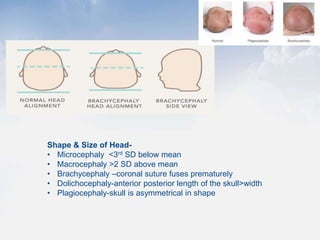
Shape & Size of Head-
• Microcephaly <3rd SD below mean
• Macrocephaly >2 SD above mean
• Brachycephaly –coronal suture fuses prematurely
• Dolichocephaly-anterior posterior length of the skull>width
• Plagiocephaly-skull is asymmetrical in shape
FONTANELLE
There are 6 fontanels at birth.
 Ant. Fontanels: 2.5 X 2.5 cm. It closes by 9-18 month of age.
 Post. Fontanels: < 1 cm. It closes by about 2 month of age.
ANTERIOR FONTANELS :
normal / bulging / sunken
open/ close
o Buldging fontanels –
Crying / Coughing / vomiting
Increased I.C.T  meningitis, intra cranial bleed, subdural hematoma, ICSOL , hydrocephalus, pseodotumor cerebri
o Sunken fontanels – Dehydration
o Early closure in craniosynostosis, primary microcephaly
o Disorders Associated with a Large Anterior
Fontanel -
• Hypothyroidism
• Achondroplasia
• Congenital rubella syndrome
• Hypophosphatasia
• Intrauterine growth restriction
• Osteogenesis imperfecta
• Prematurity
• Trisomies 13, 18, and 21
• Vitamin D deficiency rickets
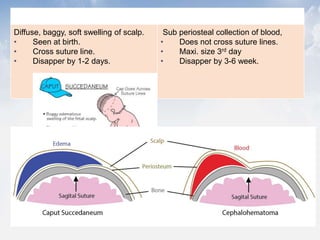
Caput succedaneum Cephalohematoma
Diffuse, baggy, soft swelling of scalp.
• Seen at birth.
• Cross suture line.
• Disapper by 1-2 days.
Sub periosteal collection of blood,
• Does not cross suture lines.
• Maxi. size 3rd day
• Disapper by 3-6 week.
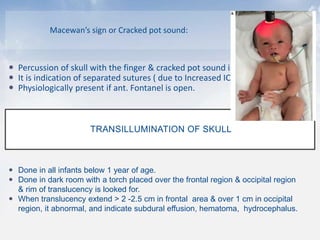
Macewan’s sign or Cracked pot sound:
 Percussion of skull with the finger & cracked pot sound is heard.
 It is indication of separated sutures ( due to Increased ICP)
 Physiologically present if ant. Fontanel is open.
TRANSILLUMINATION OF SKULL
 Done in all infants below 1 year of age.
 Done in dark room with a torch placed over the frontal region & occipital region
& rim of translucency is looked for.
 When translucency extend > 2 -2.5 cm in frontal area & over 1 cm in occipital
region, it abnormal, and indicate subdural effusion, hematoma, hydrocephalus.
2. Examination of Nose
Look for-
• Discharge ( watery / purulent / yellow ),
• congestion or blockage,
• bleeding ,
• polyps,
• DNS ,
• foreign body
Depressed nasal bridge-
• Down syndrome
• cong. Syphilis( saddle nose),
• late stages of leprosy,
3. Ear
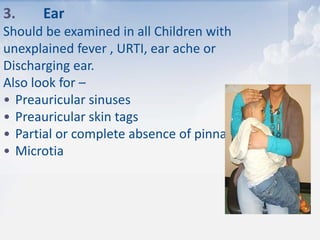
Should be examined in all Children with
unexplained fever , URTI, ear ache or
Discharging ear.
Also look for –
• Preauricular sinuses
• Preauricular skin tags
• Partial or complete absence of pinna
• Microtia
4. Eyes
Do not open eyes forcibly.
Look for
• Anameia
• Xerosis
• Bitot spot (Vit. A deficiency )
• Any developmental defect –cataract, corneal opacity
• Any bulging / proptosis of one or both eyes
• Puffiness and infection of eyelids
• Ptosis
• Size of pupils & pupillary reflexes
• Fundus examination
Ptosis
U/L in
• occulomotor nerve paralysis,
• Horner’s symdrome,
• tumors of eyelid and
B/L in
• myasthenia gravis,
• myotonic dystrophy
5. Mouth & Throat
• LIPS : Angular Stomatitis & Cheilosis (Nutritional deficiency)
• Dry mouth / Dry mucosa :
Dehydration,
Mouth breathing,
Antihistamine
• Trismus (Lock jaw)- Tetanus, part of dystonia
• Gums-Bleeding gums- Scurvy, gum hyperplasia
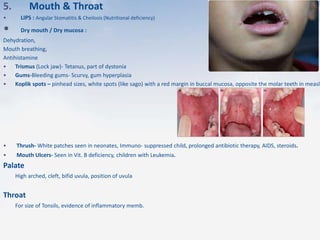
• Koplik spots – pinhead sizes, white spots (like sago) with a red margin in buccal mucosa, opposite the molar teeth in measle
• Thrush- White patches seen in neonates, Immuno- suppressed child, prolonged antibiotic therapy, AIDS, steroids.
• Mouth Ulcers- Seen in Vit. B deficiency, children with Leukemia.
Palate
High arched, cleft, bifid uvula, position of uvula
Throat
For size of Tonsils, evidence of inflammatory memb.
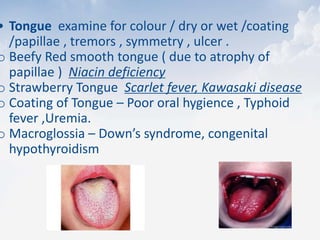
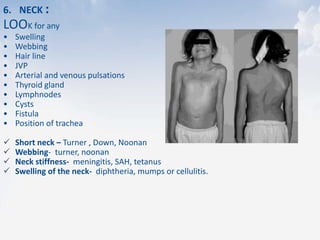
• Tongue examine for colour / dry or wet /coating
/papillae , tremors , symmetry , ulcer .
o Beefy Red smooth tongue ( due to atrophy of
papillae ) Niacin deficiency
o Strawberry Tongue Scarlet fever, Kawasaki disease
o Coating of Tongue – Poor oral hygience , Typhoid
fever ,Uremia.
o Macroglossia – Down’s syndrome, congenital
hypothyroidism
6. NECK :
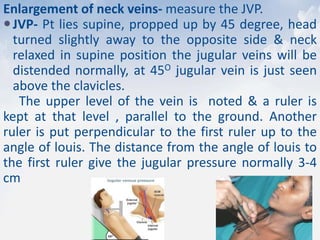
LOOK for any
• Swelling
• Webbing
• Hair line
• JVP
• Arterial and venous pulsations
• Thyroid gland
• Lymphnodes
• Cysts
• Fistula
• Position of trachea
 Short neck – Turner , Down, Noonan
 Webbing- turner, noonan
 Neck stiffness- meningitis, SAH, tetanus
 Swelling of the neck- diphtheria, mumps or cellulitis.
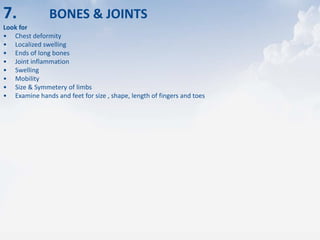
Enlargement of neck veins- measure the JVP.
JVP- Pt lies supine, propped up by 45 degree, head
turned slightly away to the opposite side & neck
relaxed in supine position the jugular veins will be
distended normally, at 45O jugular vein is just seen
above the clavicles.
The upper level of the vein is noted & a ruler is
kept at that level , parallel to the ground. Another
ruler is put perpendicular to the first ruler up to the
angle of louis. The distance from the angle of louis to
the first ruler give the jugular pressure normally 3-4
cm
7. BONES & JOINTS
Look for
• Chest deformity
• Localized swelling
• Ends of long bones
• Joint inflammation
• Swelling
• Mobility
• Size & Symmetery of limbs
• Examine hands and feet for size , shape, length of fingers and toes
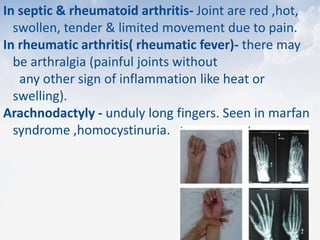
In septic & rheumatoid arthritis- Joint are red ,hot,
swollen, tender & limited movement due to pain.
In rheumatic arthritis( rheumatic fever)- there may
be arthralgia (painful joints without
any other sign of inflammation like heat or
swelling).
Arachnodactyly - unduly long fingers. Seen in marfan
syndrome ,homocystinuria.
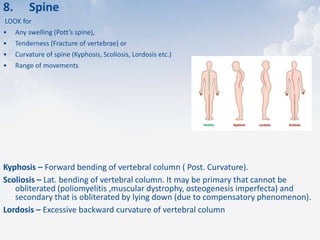
8. Spine
LOOK for
• Any swelling (Pott’s spine),
• Tenderness (Fracture of vertebrae) or
• Curvature of spine (Kyphosis, Scoliosis, Lordosis etc.)
• Range of movements
Kyphosis – Forward bending of vertebral column ( Post. Curvature).
Scoliosis – Lat. bending of vertebral column. It may be primary that cannot be
obliterated (poliomyelitis ,muscular dystrophy, osteogenesis imperfecta) and
secondary that is obliterated by lying down (due to compensatory phenomenon).
Lordosis – Excessive backward curvature of vertebral column
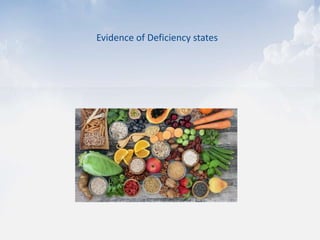
Evidence of Deficiency states
Vitamin Deficiency
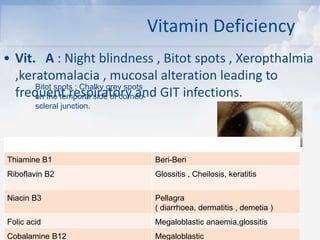
• Vit. A : Night blindness , Bitot spots , Xeropthalmia
,keratomalacia , mucosal alteration leading to
frequent respiratory and GIT infections.
• Vit. B :
Bitot spots : Chalky grey spots
on the temporal side of corneo-
scleral junction.
Thiamine B1 Beri-Beri
Riboflavin B2 Glossitis , Cheilosis, keratitis
Niacin B3 Pellagra
( diarrhoea, dermatitis , demetia )
Folic acid Megaloblastic anaemia,glossitis
Cobalamine B12 Megaloblastic
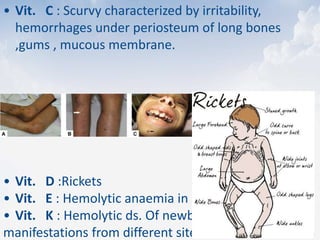
• Vit. C : Scurvy characterized by irritability,
hemorrhages under periosteum of long bones
,gums , mucous membrane.
• Vit. D :Rickets
• Vit. E : Hemolytic anaemia in preterm babies
• Vit. K : Hemolytic ds. Of newborn with bleeding
manifestations from different sites
Skin and its appendages
Skin examination should be done in well lighted room.
In SKIN following abnormalities should be looked for;
I. Colour changes- pallor, cynosis, jaundice
II. Scratch marks –seen in cholestasis
III. Rashes- measles , chickenpox
IV. Skin turgor- (by pinching the skin of abdomen or chest)
increased in marasmus,hypernatraemic dehydration.
V. Bed sore- over the sacrum, lateral malleolus, shoulder girdles, back
of heel of foot ( due to loss of muscular action )
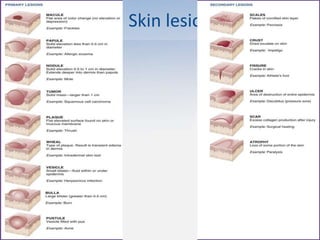
Skin lesions
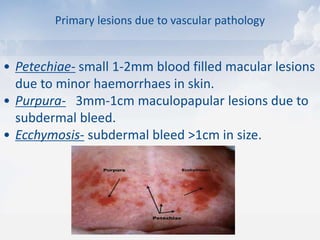
Primary lesions due to vascular pathology
• Petechiae- small 1-2mm blood filled macular lesions
due to minor haemorrhaes in skin.
• Purpura- 3mm-1cm maculopapular lesions due to
subdermal bleed.
• Ecchymosis- subdermal bleed >1cm in size.
Shape of Skin lesion
• Linear Lesion - contact dermatitis , incontinentia pigmenti
• Annular lesion – Ring worm
Distribution of Rashes
• If symmetrical lesions – endogenous cause
• If asymmetrical lesions – exogenous cause
Skin pigmentation
• Brown or blue-black pigmentation of buccal mucosa and
exposed parts of skin-in Addison’s disease
• Greyish bronze coloured skin- haemochromatosis
• Generalised hypopigmentation due to congenital absence of
melanin-albinism
• Depigmented patches in skin without any known cause-vitiligo
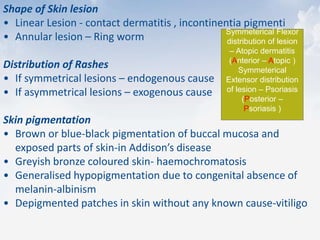
Symmeterical Flexor
distribution of lesion
– Atopic dermatitis
(Anterior – Atopic )
Symmeterical
Extensor distribution
of lesion – Psoriasis
(Posterior –
Psoriasis )
HAIR AND NAIL
Examine Scalp for–
• Seborrhea
• Alopecia (zinc deficincy, candidiasis, tinea capitis,
polyendocrine deficiency syndrome)
• Pediculosis
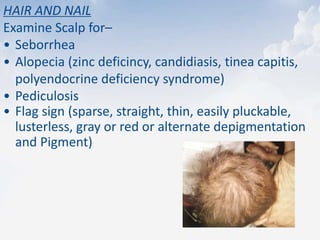
• Flag sign (sparse, straight, thin, easily pluckable,
lusterless, gray or red or alternate depigmentation
and Pigment)
NAILS
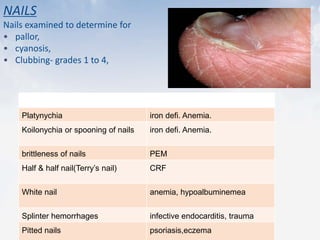
Nails examined to determine for
• pallor,
• cyanosis,
• Clubbing- grades 1 to 4,
NAIL LESION SEEN IN
Platynychia iron defi. Anemia.
Koilonychia or spooning of nails iron defi. Anemia.
brittleness of nails PEM
Half & half nail(Terry’s nail) CRF
White nail anemia, hypoalbuminemea
Splinter hemorrhages infective endocarditis, trauma
Pitted nails psoriasis,eczema
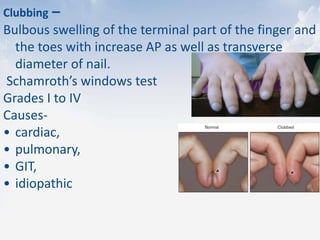
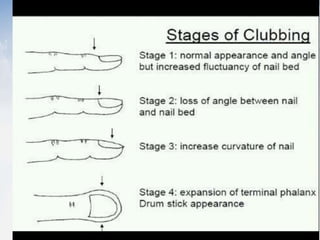
Clubbing –
Bulbous swelling of the terminal part of the finger and
the toes with increase AP as well as transverse
diameter of nail.
Schamroth’s windows test
Grades I to IV
Causes-
• cardiac,
• pulmonary,
• GIT,
• idiopathic
Anthropometry
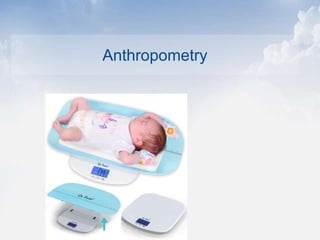
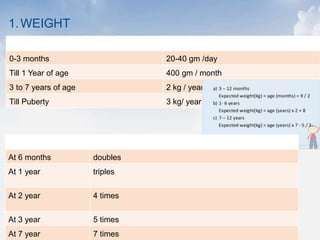
1.WEIGHT
Age Weight Gain
0-3 months 20-40 gm /day
Till 1 Year of age 400 gm / month
3 to 7 years of age 2 kg / year
Till Puberty 3 kg/ year
Age Wt. approx. (of birth weight )
At 6 months doubles
At 1 year triples
At 2 year 4 times
At 3 year 5 times
At 7 year 7 times
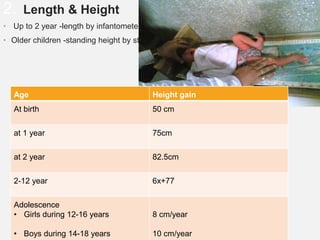
2. Length & Height
• Up to 2 year -length by infantometer.
• Older children -standing height by stadiometer.
Age Height gain
At birth 50 cm
at 1 year 75cm
at 2 year 82.5cm
2-12 year 6x+77
Adolescence
• Girls during 12-16 years
• Boys during 14-18 years
8 cm/year
10 cm/year
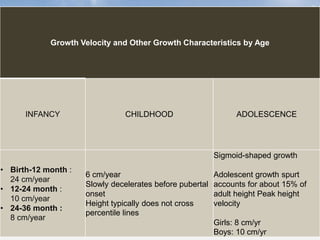
Growth Velocity and Other Growth Characteristics by Age
INFANCY CHILDHOOD ADOLESCENCE
• Birth-12 month :
24 cm/year
• 12-24 month :
10 cm/year
• 24-36 month :
8 cm/year
6 cm/year
Slowly decelerates before pubertal
onset
Height typically does not cross
percentile lines
Sigmoid-shaped growth
Adolescent growth spurt
accounts for about 15% of
adult height Peak height
velocity
Girls: 8 cm/yr
Boys: 10 cm/yr
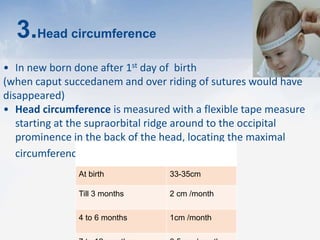
• In new born done after 1st day of birth
(when caput succedanem and over riding of sutures would have
disappeared)
• Head circumference is measured with a flexible tape measure
starting at the supraorbital ridge around to the occipital
prominence in the back of the head, locating the maximal
circumference.
3.Head circumference
Age Head
circumference
At birth 33-35cm
Till 3 months 2 cm /month
4 to 6 months 1cm /month
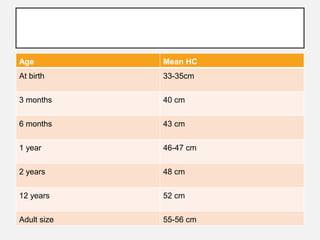
MEAN HEAD CIRCUMFERENCE
Age Mean HC
At birth 33-35cm
3 months 40 cm
6 months 43 cm
1 year 46-47 cm
2 years 48 cm
12 years 52 cm
Adult size 55-56 cm
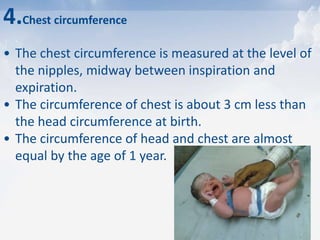
4.Chest circumference
• The chest circumference is measured at the level of
the nipples, midway between inspiration and
expiration.
• The circumference of chest is about 3 cm less than
the head circumference at birth.
• The circumference of head and chest are almost
equal by the age of 1 year.
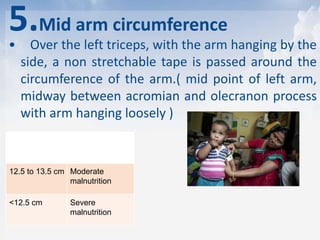
5.Mid arm circumference
• Over the left triceps, with the arm hanging by the
side, a non stretchable tape is passed around the
circumference of the arm.( mid point of left arm,
midway between acromian and olecranon process
with arm hanging loosely )
>13.5 cm Normal
12.5 to 13.5 cm Moderate
malnutrition
<12.5 cm Severe
malnutrition
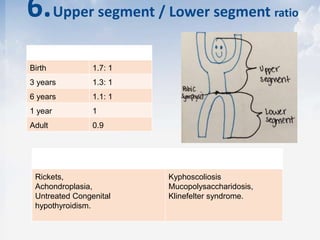
6.Upper segment / Lower segment ratio
Age US/LS ratio
Birth 1.7: 1
3 years 1.3: 1
6 years 1.1: 1
1 year 1
Adult 0.9
Increase Decrease
Rickets,
Achondroplasia,
Untreated Congenital
hypothyroidism.
Kyphoscoliosis
Mucopolysaccharidosis,
Klinefelter syndrome.
THANK YOU

GPE in paediatrics

  • 1.
    Presented by :GUIDE : DR LEELADHAR Dr. LAXMAN SIR GENERAL PHYSICAL EXAMINATION
  • 2.
    General Physical Examination EssentialTools : 1. Stethoscope 2. Thermometer 3. Sphygmomanometer (with cuff of different sizes) 4. Torch 5. Percussion hammer 6. Weighing machine 7. Measuring tape 8. Tongue depressor 9. Stop watch
  • 3.
    Position for Examination AgePosition 0 – 4 months : Examination table 4 months – 18 months : Mother’s lap 18 months – 3 years : Standing or mother’s lap After 3 years : Examination table. Adolescent girl : Presence of female attendant Well lighted, warm, colourful, comfortable room and warm hands are essential When examining a child the head and the body need to be gently immobilised .This is best achieved with the child seated in the parent’s lap. The parent restrains the child by placing one hand firmly on the child’s forehead and holding the side of the child’s head against the chest, while the other arm is placed firmly around the child’s body and both arms.
  • 4.
    Sequence of examination 1.Generalappearance 2.Vital signs 3.General features & Head to toe examination 4.Evidence of Deficiency states 5.Skin and its appendages 6.Anthropometry 7.Developmental assessment
  • 5.
  • 6.
    1. By observingthe child , the Health status may be assessed to some extend e.g. • Happy, playful, alert and interested in surrounding-normal child • Dull, not interested in surroundings, irritable-kwashiorkor • Shy and timid -overprotected child 2. Nutritional status: may indicate some chronic diseases or conditons that affect basal metabolic rate. BMI=weight(kg) / height or length(m²) 3. Posture : e.g. • Ophisthotonus seen in Tetanus • Crossing of leg(scissoring position) seen in Spastic cerebral palsy • Squatting position seen in cynotic spell 4.Facies 5.Peculiar odour GENERAL APPEARANCE
  • 7.
  • 8.
    Consciousness is apersons self awareness of self and surrounding. Drowsy : Child is sleeping but respond by light stimulus, but goes to sleep again if left alone Stupor : The child respond only to a strong stimulus (painful), localizes pain and tries to remove the painful stimulus. Delirium : Same status as stupor, pt not fully oriented to time, place, person. Level of consciousness
  • 9.
    Glasgow coma scale: EVM scale Total 15 score, < 5 score - poor prognosis. Modified coma scale for infants Coos and babbles (5), irritable (4), cries to pain (3), moans to pain (2), no response(1)
  • 10.
    Vital Signs :signs of life
  • 11.
    1. Temperature –clinician can make a rough estimate of body temperature by placing dorsum of his or her hand over the neck of the child. SITES: • Axillary – Infants and small children • Oral – Older children • Rectal – only in malnourished or very ill child • Rectal Temp > Oral Temp. >Axillary Temp. approximately by 0.7 0 F • Normal diurnal variation is 10 F • Other sites: Groin, ear canal • Clinically significant fever is defined as RECTAL temp. >= 100.4 0 F (38 0 C ) or ORAL temp. >= 99.5 0 F (37.5 0 C ) or AXILLARY temp. >= 99 0 F (37.2 0 C )
  • 12.
    Temperature ranges temperature Degreecentigrade Degree fahrenheit normal 36.6-37.2 98-99 subnormal <36.6 <98 febrile >37.2 >99 hyperpyrexia >41.6 >107 hypothermia <35 <95
  • 13.
    2. Pulse - Thecharacteristics of Pulses are: • Rate • Rhythm • Volume • Character • Radio-femoral delay • Condition of the vessel wall
  • 14.
    Main peripheral arterialpluses  Radial :Radial pulse is felt with tips of the fingers compressing the vessel against the lower end of the radius. Patient’s forearm should be slightly pronated and the wrist slightly flexed.  Carotid : Right carotid is the best examined with the left thumb and the left carotid with the right thumb. (Never examine both carotids simultaneously) Brachial: Brachial artery is compressed against the humerus just above the antecubital fossa. Femoral : The femoral arteries lie midway between the iliac crest and the pubic ramus.
  • 15.
    Posterior tibial :The posterior tibial is found 1 cm behind the medial malleolus of the tibia. Popliteal : The patient’s knees flexed at an angle of 120 degrees. The finger tips of both hands are placed in the popliteal fossae with the thumbs resting on the patient’s patella. Dorsalis pedis : The dorsalis pedis pulse compressed against the tarsal bones.
  • 16.
    Normal pulses atvarious ages AGE BEATS/MIN <6months 120-160 6-12months 110-120 1-5years 95-110 6-12years 80-100 >12years 60-100
  • 17.
    3. Respiratory rate: The breathing is mostly • abdominal or abdomino thoracic in infants & in • older children predominantly thoracic. NORMAL RESPIRATORY RATES AT VARIOUS AGES Age Normal Respiratory Rate (breaths / min) Tachypnea (breaths / min) Upto 2months 30-50 >60 2-12months 20-40 >50 12months-5years 20-30 >40 5-12years 15-20 >30 >12years 15-18 >30
  • 18.
    4. Blood Pressure Separatecuffs should be used for children of different ages. Age Cuff Width Infant 5 to 7 cm Children 7 to 9 cm Adolescence 9 to 11 cm If cuff too wide : Underestimate s BP If cuff too narrow : Overestimates BP
  • 19.
    Blood pressure(cont...) • Methodsfor measuring blood pressure: 1) Auscultatory method 2) Palpatory method 3) Flush method 4) Oscillatory method 5) Doppler method
  • 20.
    Normal blood pressurein children Age Systolic BP (mmHg) Diastolic BP (mmHg) Newborn 50-70 25-45 Upto 6months 60-80 30-50 6months-12months 60-90 50-70 1-6years 70-100 40-70 7-12years 90-110 50-70
  • 21.
    FORMULAE TO CALCULATEEXPECTED BLOOD PRESSURE IN CHILDREN : Formula used for children > 1 yr (50th percentile) • Systolic blood pressure= 90 + ( 2 X age in years) • Diastolic blood presuure=55 + (2 X age in years) • Lower limit of systolic pressure= 70 + (2 X age in years)
  • 22.
    5. CAPILLARY FILLINGTIME : • It is the most sensitive indicator of poor peripheral tissue perfusion. • The refill is determined by blanching in area of skin over the face, forehead or sternum or pulp of finger by firm compression with finger tip for 5 sec. • Note the time for the blanching to disappear. If it take >3 sec to refill it is significant.
  • 23.
    General features &Head to toe examination
  • 24.
    General features In GENERALFEATURES look for • Anaemia • Cyanosis • Jaundice • Edema • Lymphadenopathy
  • 25.
    Jaundice – examine patientunder sunlight • Yellowish discoloration of skin and sclera. Site:- • Upper bulbar conjunctiva. • Under surface of tongue, soft palate, Palms and soles • General skin surface.
  • 26.
    Cyanosis– Bluish discoloration ofthe nalis, lips and tongue due to increased amount of reduced hemoglobine in capillary blood. • Central Cyanosis – Tongue (margins, under surface), Inner aspect of lip, mucous membrane of gums, soft palate, cheek, lower palpebral conjunctiva. • Peripheral cyanosis-
  • 27.
  • 28.
    Clinical assessment ofjaundice KRAMER STAGING Area of body Zones Bilirubin levels(mg/dl) Face 1 4-6 Upper trunk 2 6-8 Lower trunk & thighs 3 8-12 Arms and lower legs 4 12-14 Palms & soles 5 > 15
  • 29.
    Oedema • Accumulation ofexcessive amount of tissue fluid in the S.C tissue. • It is assessed by applying firm pressure for 30 sec. over the area by the tip of Rt thumb. • For OEDEMA – Seen in dependent areas 1.In Ambulatory pt. - look just above medial malleolus , lower end of tibia , upper part of shin bone 2.In Bed ridden pt. – look over sacrum • Pitting / non pitting
  • 30.
    • Cardiac cause •Renal cause • Liver ds. • Myxodema • Elephantiasis • PITTING • NON PITTING
  • 31.
    Lymphadenopathy • Lymph nodesare palpated by the pads of index and middle fingers with gentle but firm pressure and moving the overlying skin in circular motion. • Peripheral LN are looked in the neck, axillae, Epitrochlear , groins and popliteal fossa. • LN should be examined for - Site, size, number, consistency, tenderness, mobility, matting, overlying skin • If LN - 1.Warm, tender gland-infection 2.Soft fluctuant gland- suppuration. 3.Matted gland- chronic inflammation ( T.B.) 4.Firm LN- Malignancy
  • 33.
    Head to toeexamination 1. Examination of Head & Face In Head LOOK for • Size • Shape • Symmetery • Bossing or prominencies • Ant. Fontanel • Sutures • Macewen’s sign • Auscultation • Transillumination of Skull
  • 34.
    Shape & Sizeof Head- • Microcephaly <3rd SD below mean • Macrocephaly >2 SD above mean • Brachycephaly –coronal suture fuses prematurely • Dolichocephaly-anterior posterior length of the skull>width • Plagiocephaly-skull is asymmetrical in shape
  • 35.
    FONTANELLE There are 6fontanels at birth.  Ant. Fontanels: 2.5 X 2.5 cm. It closes by 9-18 month of age.  Post. Fontanels: < 1 cm. It closes by about 2 month of age. ANTERIOR FONTANELS : normal / bulging / sunken open/ close o Buldging fontanels – Crying / Coughing / vomiting Increased I.C.T  meningitis, intra cranial bleed, subdural hematoma, ICSOL , hydrocephalus, pseodotumor cerebri o Sunken fontanels – Dehydration o Early closure in craniosynostosis, primary microcephaly
  • 36.
    o Disorders Associatedwith a Large Anterior Fontanel - • Hypothyroidism • Achondroplasia • Congenital rubella syndrome • Hypophosphatasia • Intrauterine growth restriction • Osteogenesis imperfecta • Prematurity • Trisomies 13, 18, and 21 • Vitamin D deficiency rickets
  • 37.
    Caput succedaneum Cephalohematoma Diffuse,baggy, soft swelling of scalp. • Seen at birth. • Cross suture line. • Disapper by 1-2 days. Sub periosteal collection of blood, • Does not cross suture lines. • Maxi. size 3rd day • Disapper by 3-6 week.
  • 38.
    Macewan’s sign orCracked pot sound:  Percussion of skull with the finger & cracked pot sound is heard.  It is indication of separated sutures ( due to Increased ICP)  Physiologically present if ant. Fontanel is open. TRANSILLUMINATION OF SKULL  Done in all infants below 1 year of age.  Done in dark room with a torch placed over the frontal region & occipital region & rim of translucency is looked for.  When translucency extend > 2 -2.5 cm in frontal area & over 1 cm in occipital region, it abnormal, and indicate subdural effusion, hematoma, hydrocephalus.
  • 39.
    2. Examination ofNose Look for- • Discharge ( watery / purulent / yellow ), • congestion or blockage, • bleeding , • polyps, • DNS , • foreign body Depressed nasal bridge- • Down syndrome • cong. Syphilis( saddle nose), • late stages of leprosy,
  • 40.
    3. Ear Should beexamined in all Children with unexplained fever , URTI, ear ache or Discharging ear. Also look for – • Preauricular sinuses • Preauricular skin tags • Partial or complete absence of pinna • Microtia
  • 41.
    4. Eyes Do notopen eyes forcibly. Look for • Anameia • Xerosis • Bitot spot (Vit. A deficiency ) • Any developmental defect –cataract, corneal opacity • Any bulging / proptosis of one or both eyes • Puffiness and infection of eyelids • Ptosis • Size of pupils & pupillary reflexes • Fundus examination Ptosis U/L in • occulomotor nerve paralysis, • Horner’s symdrome, • tumors of eyelid and B/L in • myasthenia gravis, • myotonic dystrophy
  • 42.
    5. Mouth &Throat • LIPS : Angular Stomatitis & Cheilosis (Nutritional deficiency) • Dry mouth / Dry mucosa : Dehydration, Mouth breathing, Antihistamine • Trismus (Lock jaw)- Tetanus, part of dystonia • Gums-Bleeding gums- Scurvy, gum hyperplasia • Koplik spots – pinhead sizes, white spots (like sago) with a red margin in buccal mucosa, opposite the molar teeth in measle • Thrush- White patches seen in neonates, Immuno- suppressed child, prolonged antibiotic therapy, AIDS, steroids. • Mouth Ulcers- Seen in Vit. B deficiency, children with Leukemia. Palate High arched, cleft, bifid uvula, position of uvula Throat For size of Tonsils, evidence of inflammatory memb.
  • 43.
    • Tongue examinefor colour / dry or wet /coating /papillae , tremors , symmetry , ulcer . o Beefy Red smooth tongue ( due to atrophy of papillae ) Niacin deficiency o Strawberry Tongue Scarlet fever, Kawasaki disease o Coating of Tongue – Poor oral hygience , Typhoid fever ,Uremia. o Macroglossia – Down’s syndrome, congenital hypothyroidism
  • 44.
    6. NECK : LOOKfor any • Swelling • Webbing • Hair line • JVP • Arterial and venous pulsations • Thyroid gland • Lymphnodes • Cysts • Fistula • Position of trachea  Short neck – Turner , Down, Noonan  Webbing- turner, noonan  Neck stiffness- meningitis, SAH, tetanus  Swelling of the neck- diphtheria, mumps or cellulitis.
  • 45.
    Enlargement of neckveins- measure the JVP. JVP- Pt lies supine, propped up by 45 degree, head turned slightly away to the opposite side & neck relaxed in supine position the jugular veins will be distended normally, at 45O jugular vein is just seen above the clavicles. The upper level of the vein is noted & a ruler is kept at that level , parallel to the ground. Another ruler is put perpendicular to the first ruler up to the angle of louis. The distance from the angle of louis to the first ruler give the jugular pressure normally 3-4 cm
  • 46.
    7. BONES &JOINTS Look for • Chest deformity • Localized swelling • Ends of long bones • Joint inflammation • Swelling • Mobility • Size & Symmetery of limbs • Examine hands and feet for size , shape, length of fingers and toes
  • 47.
    In septic &rheumatoid arthritis- Joint are red ,hot, swollen, tender & limited movement due to pain. In rheumatic arthritis( rheumatic fever)- there may be arthralgia (painful joints without any other sign of inflammation like heat or swelling). Arachnodactyly - unduly long fingers. Seen in marfan syndrome ,homocystinuria.
  • 48.
    8. Spine LOOK for •Any swelling (Pott’s spine), • Tenderness (Fracture of vertebrae) or • Curvature of spine (Kyphosis, Scoliosis, Lordosis etc.) • Range of movements Kyphosis – Forward bending of vertebral column ( Post. Curvature). Scoliosis – Lat. bending of vertebral column. It may be primary that cannot be obliterated (poliomyelitis ,muscular dystrophy, osteogenesis imperfecta) and secondary that is obliterated by lying down (due to compensatory phenomenon). Lordosis – Excessive backward curvature of vertebral column
  • 49.
  • 50.
  • 51.
    Vitamin Deficiency • Vit.A : Night blindness , Bitot spots , Xeropthalmia ,keratomalacia , mucosal alteration leading to frequent respiratory and GIT infections. • Vit. B : Bitot spots : Chalky grey spots on the temporal side of corneo- scleral junction. Thiamine B1 Beri-Beri Riboflavin B2 Glossitis , Cheilosis, keratitis Niacin B3 Pellagra ( diarrhoea, dermatitis , demetia ) Folic acid Megaloblastic anaemia,glossitis Cobalamine B12 Megaloblastic
  • 52.
    • Vit. C: Scurvy characterized by irritability, hemorrhages under periosteum of long bones ,gums , mucous membrane. • Vit. D :Rickets • Vit. E : Hemolytic anaemia in preterm babies • Vit. K : Hemolytic ds. Of newborn with bleeding manifestations from different sites
  • 53.
    Skin and itsappendages
  • 54.
    Skin examination shouldbe done in well lighted room. In SKIN following abnormalities should be looked for; I. Colour changes- pallor, cynosis, jaundice II. Scratch marks –seen in cholestasis III. Rashes- measles , chickenpox IV. Skin turgor- (by pinching the skin of abdomen or chest) increased in marasmus,hypernatraemic dehydration. V. Bed sore- over the sacrum, lateral malleolus, shoulder girdles, back of heel of foot ( due to loss of muscular action )
  • 55.
  • 56.
    Primary lesions dueto vascular pathology • Petechiae- small 1-2mm blood filled macular lesions due to minor haemorrhaes in skin. • Purpura- 3mm-1cm maculopapular lesions due to subdermal bleed. • Ecchymosis- subdermal bleed >1cm in size.
  • 57.
    Shape of Skinlesion • Linear Lesion - contact dermatitis , incontinentia pigmenti • Annular lesion – Ring worm Distribution of Rashes • If symmetrical lesions – endogenous cause • If asymmetrical lesions – exogenous cause Skin pigmentation • Brown or blue-black pigmentation of buccal mucosa and exposed parts of skin-in Addison’s disease • Greyish bronze coloured skin- haemochromatosis • Generalised hypopigmentation due to congenital absence of melanin-albinism • Depigmented patches in skin without any known cause-vitiligo Symmeterical Flexor distribution of lesion – Atopic dermatitis (Anterior – Atopic ) Symmeterical Extensor distribution of lesion – Psoriasis (Posterior – Psoriasis )
  • 58.
    HAIR AND NAIL ExamineScalp for– • Seborrhea • Alopecia (zinc deficincy, candidiasis, tinea capitis, polyendocrine deficiency syndrome) • Pediculosis • Flag sign (sparse, straight, thin, easily pluckable, lusterless, gray or red or alternate depigmentation and Pigment)
  • 59.
    NAILS Nails examined todetermine for • pallor, • cyanosis, • Clubbing- grades 1 to 4, NAIL LESION SEEN IN Platynychia iron defi. Anemia. Koilonychia or spooning of nails iron defi. Anemia. brittleness of nails PEM Half & half nail(Terry’s nail) CRF White nail anemia, hypoalbuminemea Splinter hemorrhages infective endocarditis, trauma Pitted nails psoriasis,eczema
  • 60.
    Clubbing – Bulbous swellingof the terminal part of the finger and the toes with increase AP as well as transverse diameter of nail. Schamroth’s windows test Grades I to IV Causes- • cardiac, • pulmonary, • GIT, • idiopathic
  • 62.
  • 63.
    1.WEIGHT Age Weight Gain 0-3months 20-40 gm /day Till 1 Year of age 400 gm / month 3 to 7 years of age 2 kg / year Till Puberty 3 kg/ year Age Wt. approx. (of birth weight ) At 6 months doubles At 1 year triples At 2 year 4 times At 3 year 5 times At 7 year 7 times
  • 64.
    2. Length &Height • Up to 2 year -length by infantometer. • Older children -standing height by stadiometer. Age Height gain At birth 50 cm at 1 year 75cm at 2 year 82.5cm 2-12 year 6x+77 Adolescence • Girls during 12-16 years • Boys during 14-18 years 8 cm/year 10 cm/year
  • 65.
    Growth Velocity andOther Growth Characteristics by Age INFANCY CHILDHOOD ADOLESCENCE • Birth-12 month : 24 cm/year • 12-24 month : 10 cm/year • 24-36 month : 8 cm/year 6 cm/year Slowly decelerates before pubertal onset Height typically does not cross percentile lines Sigmoid-shaped growth Adolescent growth spurt accounts for about 15% of adult height Peak height velocity Girls: 8 cm/yr Boys: 10 cm/yr
  • 66.
    • In newborn done after 1st day of birth (when caput succedanem and over riding of sutures would have disappeared) • Head circumference is measured with a flexible tape measure starting at the supraorbital ridge around to the occipital prominence in the back of the head, locating the maximal circumference. 3.Head circumference Age Head circumference At birth 33-35cm Till 3 months 2 cm /month 4 to 6 months 1cm /month
  • 67.
    MEAN HEAD CIRCUMFERENCE AgeMean HC At birth 33-35cm 3 months 40 cm 6 months 43 cm 1 year 46-47 cm 2 years 48 cm 12 years 52 cm Adult size 55-56 cm
  • 68.
    4.Chest circumference • Thechest circumference is measured at the level of the nipples, midway between inspiration and expiration. • The circumference of chest is about 3 cm less than the head circumference at birth. • The circumference of head and chest are almost equal by the age of 1 year.
  • 69.
    5.Mid arm circumference •Over the left triceps, with the arm hanging by the side, a non stretchable tape is passed around the circumference of the arm.( mid point of left arm, midway between acromian and olecranon process with arm hanging loosely ) >13.5 cm Normal 12.5 to 13.5 cm Moderate malnutrition <12.5 cm Severe malnutrition
  • 70.
    6.Upper segment /Lower segment ratio Age US/LS ratio Birth 1.7: 1 3 years 1.3: 1 6 years 1.1: 1 1 year 1 Adult 0.9 Increase Decrease Rickets, Achondroplasia, Untreated Congenital hypothyroidism. Kyphoscoliosis Mucopolysaccharidosis, Klinefelter syndrome.
  • 71.