GOOD MORNING!GOOD MORNING!
WELCOME TO NAT SCI I THRWELCOME TO NAT SCI I THR
2nd SEM., AY 2011-122nd SEM., AY 2011-12
DR. HENRY J. RAMOSDR. HENRY J. RAMOS
Professor of Physics, Director-PMRGO-Professor of Physics, Director-PMRGO-
OVCRDOVCRD
Tel. 920-9749 (NIP) Rm 243 NSRITel. 920-9749 (NIP) Rm 243 NSRI
VOIP: 4050 (OVCRD)VOIP: 4050 (OVCRD)
E-mail:E-mail: henry.j.ramos@gmail.comhenry.j.ramos@gmail.com
http://nsri.upd.edu.ph/downloads/hjramoshttp://nsri.upd.edu.ph/downloads/hjramos
CONSULTATION HOURS: 2-5:30 MWFCONSULTATION HOURS: 2-5:30 MWF
(Room 340 NIP New Building )(Room 340 NIP New Building )
NATURAL SCIENCE INATURAL SCIENCE I
Fundamental concepts,Fundamental concepts,
principles and theories ofprinciples and theories of
physics and chemistry.physics and chemistry.
http://www.science.upd.edu.ph/ssp/http://www.science.upd.edu.ph/ssp/
AIMS OF THE COURSEAIMS OF THE COURSE
a capacity for independent, critical and
creative thinking
to infuse a passion for learning with a high
sense of moral and intellectual integrity
help the students develop an awareness,
to cultivate understanding, and
appreciation of the various disciplines of
the natural sciences, particularly physics
and chemistry.
to broaden the student’s intellectual horizon
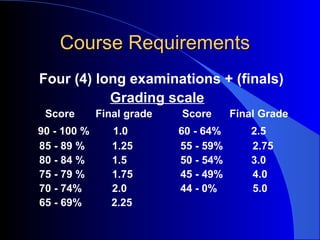
Course RequirementsCourse Requirements
Four (4) long examinations + (finals)
Grading scale
Score Final grade Score Final Grade
90 - 100 % 1.0 60 - 64% 2.5
85 - 89 % 1.25 55 - 59% 2.75
80 - 84 % 1.5 50 - 54% 3.0
75 - 79 % 1.75 45 - 49% 4.0
70 - 74% 2.0 44 - 0% 5.0
65 - 69% 2.25
OVERVIEW OF THE COURSEOVERVIEW OF THE COURSE
I. Introduction to Natural Sciences
II. Ancient Views About Nature
III.The Emergence of Physics:
Kepler, Galileo
IV. Newton’s Mechanical Synthesis
V. The Unification of Electricity,
Magnetism and Light
VI. Einstein’s Relativistic Revolution
VII. Quantum World of Uncertainties
OVERVIEW Con’t.OVERVIEW Con’t.
VIII. The Structure of Atoms
IX. Probing the Subatomic World
X. The Origin and Evolution of the
Universe
XI. The Elements of the Universe
XII. Chemical Bonds
XIII. Three States of Matter
XIV. Chemical Reactions
WHAT IS SCIENCE?
Study of nature
Cumulative body of knowledge
Deals with measurable quantities
Its method consists of
experimentation and theoretical
formulation
systematic enterprise of gathering
knowledge about the universe and
condensing that knowledge into
testable laws and theories
WHAT DO STUDENTS SAY ABOUT SCIENCE?
“science is the only field that could be exploited to improve
the well being of individuals within a society”
“science is a domain of knowledge following a method which is
deductive-nomological in structure thereby making it objective”
“science is a way of thinking that requires critical analysis and
logical reasoning, and able to withstand the rigorous process
of experimentation”
“science permeates all areas of society”
“science has this self-correcting nature that sets it apart from
other fields”
“science is the root of all the other fields”
WHAT DO STUDENTS SAY ABOUT SCIENCE?
“science is the only field that could be exploited to improve
the well being of individuals within a society”
“science is a domain of knowledge following a method which is
deductive-nomological in structure thereby making it objective”
“science is a way of thinking that requires critical analysis and
logical reasoning, and able to withstand the rigorous process
of experimentation”
“science permeates all areas of society”
“science has this self-correcting nature that sets it apart from
other fields”
“science is the root of all the other fields”
“science paves the way for discoveries and inventions”
“science relies on what is real, concrete, observable,
tangible and quantifiable”
“science offers the truth based on facts and the evidence”
“science, together with its mistress, technology, has helped
made lives easier and more convenient”
“science is a systematic body of knowledge that continually
progresses and grows and never undergoing apoptosis”
“science provides the environment for man’s growth for
critical and analytical thinking”
“science is a religion based on faith that is concrete, based on
evidence and proven”
THE VALUE OF SCIENCE
1. Scientific knowledge enables us to do
all kinds of things and to make all kinds of
things.
2. Science extends and enriches our lives,
expands our imagination, and liberates us
from the bonds of ignorance and
superstition.
3. Science is humanity’s best tool for
prying open the infinite vistas of the
unknown.
4. Science is an open system, subject to
an infinite process of all correction.
CHARACTERISTICS OF SCIENTIFIC
METHOD
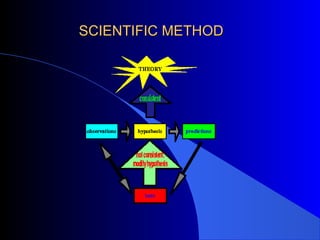
• 1. Observe some aspect of the universe.
• 2. Invent a tentative description, called a hypothesis,
that is consistent with what you have observed.
• 3. Use the hypothesis to make predictions.
• 4. Test those predictions by experiments or further
observations and modify the hypothesis in the light
of your results.
• 5. Repeat steps 3 and 4 until there are no discrepancies
between theory and experiment and/or observation.
When consistency is obtained the hypothesis becomes a
theory and provides a coherent set of propositions which
explain a class of phenomena. A theory is then a framework
within which observations are explained and predictions
are made.
SCIENTIFIC METHODSCIENTIFIC METHOD
WHAT IS PHYSICS?WHAT IS PHYSICS?
PHYSICS is the classic “hard science” whose
methods and modes of thought provide a
valuable model for most human activities.
The practice and development of physics
underpin virtually all of the other sciences.
PHYSICS is one of the major driving forces of
innovation and research: it provides the
theoretical and analytical basis, quantitative
techniques, and context of much of modern
science. Applied physics, which underlies much
of engineering, frequently provides the means of
bringing research results to bear on social, health
and economic problems.
SCIENCE AND SOCIETYSCIENCE AND SOCIETY
Ptolemy’s view of the universe influenced
medieval thought
Newton’s laws of motion and gravitation led to a
mechanistic view of the universe (expressed in
terms of ideas like Adam Smith’s laissez-faire)
Society and technology affect science by:
* setting the direction of science
* putting a limit to the development of science
SOME SCIENTIFIC REVOLUTIONS
Einstein’s gravity theory
Maxwell’s electromagnetic theory
Quantum theory
Universality of conservation laws
Theory of superfluidity
Discovery of high-temperature
superconductivity

Nat sci i_lect1[1]

  • 1.
    GOOD MORNING!GOOD MORNING! WELCOMETO NAT SCI I THRWELCOME TO NAT SCI I THR 2nd SEM., AY 2011-122nd SEM., AY 2011-12 DR. HENRY J. RAMOSDR. HENRY J. RAMOS Professor of Physics, Director-PMRGO-Professor of Physics, Director-PMRGO- OVCRDOVCRD Tel. 920-9749 (NIP) Rm 243 NSRITel. 920-9749 (NIP) Rm 243 NSRI VOIP: 4050 (OVCRD)VOIP: 4050 (OVCRD) E-mail:E-mail: henry.j.ramos@gmail.comhenry.j.ramos@gmail.com http://nsri.upd.edu.ph/downloads/hjramoshttp://nsri.upd.edu.ph/downloads/hjramos CONSULTATION HOURS: 2-5:30 MWFCONSULTATION HOURS: 2-5:30 MWF (Room 340 NIP New Building )(Room 340 NIP New Building )
  • 2.
    NATURAL SCIENCE INATURALSCIENCE I Fundamental concepts,Fundamental concepts, principles and theories ofprinciples and theories of physics and chemistry.physics and chemistry. http://www.science.upd.edu.ph/ssp/http://www.science.upd.edu.ph/ssp/
  • 3.
    AIMS OF THECOURSEAIMS OF THE COURSE a capacity for independent, critical and creative thinking to infuse a passion for learning with a high sense of moral and intellectual integrity help the students develop an awareness, to cultivate understanding, and appreciation of the various disciplines of the natural sciences, particularly physics and chemistry. to broaden the student’s intellectual horizon
  • 4.
    Course RequirementsCourse Requirements Four(4) long examinations + (finals) Grading scale Score Final grade Score Final Grade 90 - 100 % 1.0 60 - 64% 2.5 85 - 89 % 1.25 55 - 59% 2.75 80 - 84 % 1.5 50 - 54% 3.0 75 - 79 % 1.75 45 - 49% 4.0 70 - 74% 2.0 44 - 0% 5.0 65 - 69% 2.25
  • 5.
    OVERVIEW OF THECOURSEOVERVIEW OF THE COURSE I. Introduction to Natural Sciences II. Ancient Views About Nature III.The Emergence of Physics: Kepler, Galileo IV. Newton’s Mechanical Synthesis V. The Unification of Electricity, Magnetism and Light VI. Einstein’s Relativistic Revolution VII. Quantum World of Uncertainties
  • 6.
    OVERVIEW Con’t.OVERVIEW Con’t. VIII.The Structure of Atoms IX. Probing the Subatomic World X. The Origin and Evolution of the Universe XI. The Elements of the Universe XII. Chemical Bonds XIII. Three States of Matter XIV. Chemical Reactions
  • 7.
    WHAT IS SCIENCE? Studyof nature Cumulative body of knowledge Deals with measurable quantities Its method consists of experimentation and theoretical formulation systematic enterprise of gathering knowledge about the universe and condensing that knowledge into testable laws and theories
  • 8.
    WHAT DO STUDENTSSAY ABOUT SCIENCE? “science is the only field that could be exploited to improve the well being of individuals within a society” “science is a domain of knowledge following a method which is deductive-nomological in structure thereby making it objective” “science is a way of thinking that requires critical analysis and logical reasoning, and able to withstand the rigorous process of experimentation” “science permeates all areas of society” “science has this self-correcting nature that sets it apart from other fields” “science is the root of all the other fields”
  • 9.
    WHAT DO STUDENTSSAY ABOUT SCIENCE? “science is the only field that could be exploited to improve the well being of individuals within a society” “science is a domain of knowledge following a method which is deductive-nomological in structure thereby making it objective” “science is a way of thinking that requires critical analysis and logical reasoning, and able to withstand the rigorous process of experimentation” “science permeates all areas of society” “science has this self-correcting nature that sets it apart from other fields” “science is the root of all the other fields”
  • 10.
    “science paves theway for discoveries and inventions” “science relies on what is real, concrete, observable, tangible and quantifiable” “science offers the truth based on facts and the evidence” “science, together with its mistress, technology, has helped made lives easier and more convenient” “science is a systematic body of knowledge that continually progresses and grows and never undergoing apoptosis” “science provides the environment for man’s growth for critical and analytical thinking” “science is a religion based on faith that is concrete, based on evidence and proven”
  • 11.
    THE VALUE OFSCIENCE 1. Scientific knowledge enables us to do all kinds of things and to make all kinds of things. 2. Science extends and enriches our lives, expands our imagination, and liberates us from the bonds of ignorance and superstition. 3. Science is humanity’s best tool for prying open the infinite vistas of the unknown. 4. Science is an open system, subject to an infinite process of all correction.
  • 12.
    CHARACTERISTICS OF SCIENTIFIC METHOD •1. Observe some aspect of the universe. • 2. Invent a tentative description, called a hypothesis, that is consistent with what you have observed. • 3. Use the hypothesis to make predictions. • 4. Test those predictions by experiments or further observations and modify the hypothesis in the light of your results. • 5. Repeat steps 3 and 4 until there are no discrepancies between theory and experiment and/or observation. When consistency is obtained the hypothesis becomes a theory and provides a coherent set of propositions which explain a class of phenomena. A theory is then a framework within which observations are explained and predictions are made.
  • 13.
  • 14.
    WHAT IS PHYSICS?WHATIS PHYSICS? PHYSICS is the classic “hard science” whose methods and modes of thought provide a valuable model for most human activities. The practice and development of physics underpin virtually all of the other sciences. PHYSICS is one of the major driving forces of innovation and research: it provides the theoretical and analytical basis, quantitative techniques, and context of much of modern science. Applied physics, which underlies much of engineering, frequently provides the means of bringing research results to bear on social, health and economic problems.
  • 15.
    SCIENCE AND SOCIETYSCIENCEAND SOCIETY Ptolemy’s view of the universe influenced medieval thought Newton’s laws of motion and gravitation led to a mechanistic view of the universe (expressed in terms of ideas like Adam Smith’s laissez-faire) Society and technology affect science by: * setting the direction of science * putting a limit to the development of science
  • 16.
    SOME SCIENTIFIC REVOLUTIONS Einstein’sgravity theory Maxwell’s electromagnetic theory Quantum theory Universality of conservation laws Theory of superfluidity Discovery of high-temperature superconductivity