Moving Interacting Problem-solving Decision Making
Communicating
What is PDHPE for?
• Personal Development, Health and
Physical Education focus on the
development of the student as a
whole person, not only
encouraging physical activity but
supporting social and emotional
growth.
• PDHPE nurtures positive attitudes
towards lifelong healthy and active
lifestyles.
What does PDHPE do for
me?
• PDHPE adopts a healthy life that
promotes a positive wellbeing by
incorporating a balanced lifestyle.
• Helps to build competence and
confidence, by developing values and
skills to continuously progress in.
• Strengthens sense of self by being
able to make decisions and take
actions to promote health, nutrition,
safety and physical activity.
• Encourages an understanding and
value individually and of others.
The Facts!
• Physically active children are more inclined to reach their academic
potential and have positive behaviours in the classroom which promotes
a healthy mind.
• All children need to do at least 60 minutes of physical activity everyday
and schools are a great venue to make sure it happens.
• Encourages interpersonal relationships with peers promoting teamwork
and communicating conflict or negotiations.
• Able to recognise safe environments and know what to do in risky
situations.
• Understanding of nutrition is developed for healthy decisions to be made
and knowledge of long term benefits.
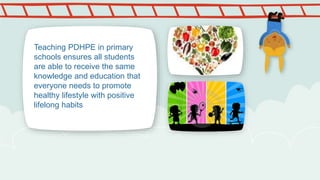
Teaching PDHPE in primary
schools ensures all students
are able to receive the same
knowledge and education that
everyone needs to promote
healthy lifestyle with positive
lifelong habits
References
ACARA. (2014). The Australian curriculum: Health and physical education (F-10).
Sydney, Australia: Australian Curriculum Assessment and Reporting Authority.
Achterstraat, P. (2001). Physical activity in government primary schools. Sydney,
Australia: Audit Office of New South Wales, Department of Education and
Communities.
Board of Studies, NSW. (2007). Personal development, health and physical
education K-6 syllabus. Retrieved March 7, 2014, from
http://k6.boardofstudies.nsw.edu.au/wps/wcm/connect/330e5ccb-782a-432b-
8ce5-122a8c42967e/k6_pdhpe_syl.pdf?MOD=AJPERES
New South Wales Department of Education and Communities. (2011). Curriculum
support. Retrieved May 7, 2014, from
http://www.curriculumsupport.education.nsw.gov.au/primary/pdhpe/htm

Pdhpe powerpoint

  • 1.
    Moving Interacting Problem-solvingDecision Making Communicating
  • 2.
    What is PDHPEfor? • Personal Development, Health and Physical Education focus on the development of the student as a whole person, not only encouraging physical activity but supporting social and emotional growth. • PDHPE nurtures positive attitudes towards lifelong healthy and active lifestyles.
  • 3.
    What does PDHPEdo for me? • PDHPE adopts a healthy life that promotes a positive wellbeing by incorporating a balanced lifestyle. • Helps to build competence and confidence, by developing values and skills to continuously progress in. • Strengthens sense of self by being able to make decisions and take actions to promote health, nutrition, safety and physical activity. • Encourages an understanding and value individually and of others.
  • 4.
    The Facts! • Physicallyactive children are more inclined to reach their academic potential and have positive behaviours in the classroom which promotes a healthy mind. • All children need to do at least 60 minutes of physical activity everyday and schools are a great venue to make sure it happens. • Encourages interpersonal relationships with peers promoting teamwork and communicating conflict or negotiations. • Able to recognise safe environments and know what to do in risky situations. • Understanding of nutrition is developed for healthy decisions to be made and knowledge of long term benefits.
  • 5.
    Teaching PDHPE inprimary schools ensures all students are able to receive the same knowledge and education that everyone needs to promote healthy lifestyle with positive lifelong habits
  • 6.
    References ACARA. (2014). TheAustralian curriculum: Health and physical education (F-10). Sydney, Australia: Australian Curriculum Assessment and Reporting Authority. Achterstraat, P. (2001). Physical activity in government primary schools. Sydney, Australia: Audit Office of New South Wales, Department of Education and Communities. Board of Studies, NSW. (2007). Personal development, health and physical education K-6 syllabus. Retrieved March 7, 2014, from http://k6.boardofstudies.nsw.edu.au/wps/wcm/connect/330e5ccb-782a-432b- 8ce5-122a8c42967e/k6_pdhpe_syl.pdf?MOD=AJPERES New South Wales Department of Education and Communities. (2011). Curriculum support. Retrieved May 7, 2014, from http://www.curriculumsupport.education.nsw.gov.au/primary/pdhpe/htm