PDHPE Rationale
Why is PDHPE Important in Primary School?
By Miss Rochelle Callow
5R
What are the Issues?
• Research demonstrates that 1 in 4 children in Australia aged
between 5-17 are overweight or obese. (National Health Survey, 07-08)
• On average, children between 5-17 years are spending twice as
much time participating in on-screen activities than in physical
activity. (abs.gov.au, 2011)
• Primary school children require a balanced nutritional diet to
meet the needs of their growing bodies and minds.
• Lifelong eating and physical activity habits are formed in a
child’s primary school years. (heart.org)
How does PDHPE help?
• The PDHPE syllabus is designed to ‘develop knowledge and
understanding, skills and values and attitudes needed to lead
healthy, active and fulfilling lives’ (NSW Board of Studies, 2007)
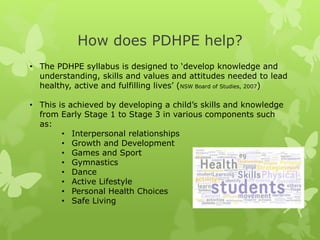
• This is achieved by developing a child’s skills and knowledge
from Early Stage 1 to Stage 3 in various components such
as:
• Interpersonal relationships
• Growth and Development
• Games and Sport
• Gymnastics
• Dance
• Active Lifestyle
• Personal Health Choices
• Safe Living
There is more to PDHPE than Sport!?
YES!!!!!
PDHPE includes many subjects that are important in ensuring
children develop well rounded skills that they require in all
aspects of life. Topics such as personal safety, road safety,
relationships, environmental health, personal identity and
nutrition are all covered in the PDHPE syllabus.
Ultimately, we want to ensure students acquire these skills:
• Moving
• Problem-solving
• Communicating
• Interacting
• Decision-making
How will these skills help?
• By engaging in active lifestyles, making personal health
choices, improving physical ability, skills as well as learning
about social and environmental issues, children can become
supportive members of the community and positively
influence those around them to achieve positive health.
• PDHPE therefore improves the overall health of children by
nurturing their mental, physical, social and spiritual
wellbeing.
What can parents do?
• Embrace and support the varied subjects that are learned in
PDHPE.
• Students may be inspired to change their behaviour (or
yours!) as a result of their learning in PDHPE. This may
range from trying new food in their lunch box to switching
off the lights at home.
• The benefits of PDHPE are clear, so please let us combine
the support of families, teachers and the school to create a
healthy, happy and supportive school environment.

Pdhpe rationale

  • 1.
    PDHPE Rationale Why isPDHPE Important in Primary School? By Miss Rochelle Callow 5R
  • 2.
    What are theIssues? • Research demonstrates that 1 in 4 children in Australia aged between 5-17 are overweight or obese. (National Health Survey, 07-08) • On average, children between 5-17 years are spending twice as much time participating in on-screen activities than in physical activity. (abs.gov.au, 2011) • Primary school children require a balanced nutritional diet to meet the needs of their growing bodies and minds. • Lifelong eating and physical activity habits are formed in a child’s primary school years. (heart.org)
  • 3.
    How does PDHPEhelp? • The PDHPE syllabus is designed to ‘develop knowledge and understanding, skills and values and attitudes needed to lead healthy, active and fulfilling lives’ (NSW Board of Studies, 2007) • This is achieved by developing a child’s skills and knowledge from Early Stage 1 to Stage 3 in various components such as: • Interpersonal relationships • Growth and Development • Games and Sport • Gymnastics • Dance • Active Lifestyle • Personal Health Choices • Safe Living
  • 4.
    There is moreto PDHPE than Sport!? YES!!!!! PDHPE includes many subjects that are important in ensuring children develop well rounded skills that they require in all aspects of life. Topics such as personal safety, road safety, relationships, environmental health, personal identity and nutrition are all covered in the PDHPE syllabus. Ultimately, we want to ensure students acquire these skills: • Moving • Problem-solving • Communicating • Interacting • Decision-making
  • 5.
    How will theseskills help? • By engaging in active lifestyles, making personal health choices, improving physical ability, skills as well as learning about social and environmental issues, children can become supportive members of the community and positively influence those around them to achieve positive health. • PDHPE therefore improves the overall health of children by nurturing their mental, physical, social and spiritual wellbeing.
  • 6.
    What can parentsdo? • Embrace and support the varied subjects that are learned in PDHPE. • Students may be inspired to change their behaviour (or yours!) as a result of their learning in PDHPE. This may range from trying new food in their lunch box to switching off the lights at home. • The benefits of PDHPE are clear, so please let us combine the support of families, teachers and the school to create a healthy, happy and supportive school environment.