Ergonomic Issue in Industry 
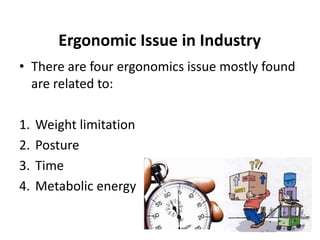
• There are four ergonomics issue mostly found 
are related to: 
1. Weight limitation 
2. Posture 
3. Time 
4. Metabolic energy
Recommended weight limit 
• The recommended weight limit is used to 
assess a lifting task and by given the 
conditions. 
• The equation for RWL is: 
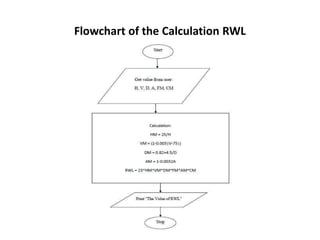
RWL = LC x HM x VM x DM x AM x FM x CM 
LC, the load constant = 23 kg.
The other factors in the equation are: 
• HM, the Horizontal Multiplier factor 
• VM, the Vertical Multiplier factor 
• DM, the Distance Multiplier factor 
• FM, the Frequency Multiplier factor 
• AM, the Asymmetric Multiplier factor 
• CM, the Coupling Multiplier factor
Posture 
• Working posture. 
– The working posture and task should be designed 
to avoid strain and damage to any part of the 
body such as the tendons, muscles, ligaments, and 
especially the back (Dahalan J, 2005) 
– knowledge of the context and type of posture is 
necessary in order to examine their associations 
with health related outcomes (Taylor et al. 2005)
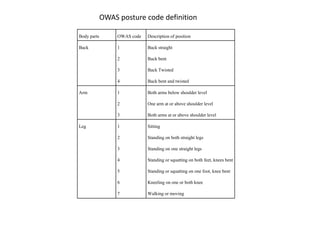
OWAS posture code definition 
Body parts OWAS code Description of position 
Back 1 
2 
3 
4 
Back straight 
Back bent 
Back Twisted 
Back bent and twisted 
Arm 1 
2 
3 
Both arms below shoulder level 
One arm at or above shoulder level 
Both arms at or above shoulder level 
Leg 1 
2 
3 
4 
5 
6 
7 
Sitting 
Standing on both straight legs 
Standing on one straight legs 
Standing or squatting on both feet, knees bent 
Standing or squatting on one foot, knee bent 
Kneeling on one or both knee 
Walking or moving
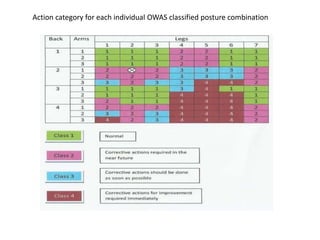
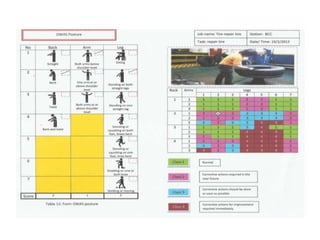
Action category for each individual OWAS classified posture combination
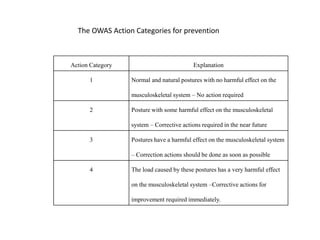
The OWAS Action Categories for prevention 
Action Category Explanation 
1 Normal and natural postures with no harmful effect on the 
musculoskeletal system – No action required 
2 Posture with some harmful effect on the musculoskeletal 
system – Corrective actions required in the near future 
3 Postures have a harmful effect on the musculoskeletal system 
– Correction actions should be done as soon as possible 
4 The load caused by these postures has a very harmful effect 
on the musculoskeletal system –Corrective actions for 
improvement required immediately.
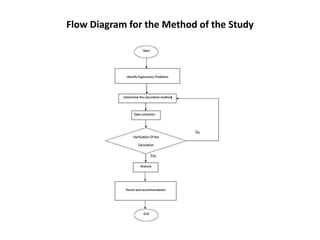
Flow Diagram for the Method of the Study
Flowchart of the Calculation RWL
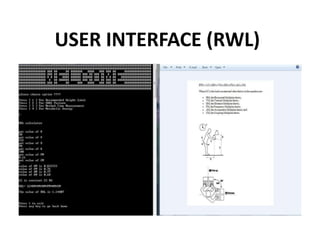
USER INTERFACE (RWL)
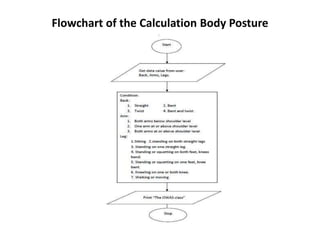
Flowchart of the Calculation Body Posture
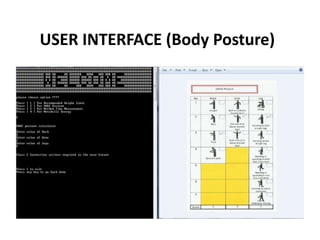
USER INTERFACE (Body Posture)
Ergonomics workcard drawing flow diagram

Ergonomics workcard drawing flow diagram

  • 1.
    Ergonomic Issue inIndustry • There are four ergonomics issue mostly found are related to: 1. Weight limitation 2. Posture 3. Time 4. Metabolic energy
  • 2.
    Recommended weight limit • The recommended weight limit is used to assess a lifting task and by given the conditions. • The equation for RWL is: RWL = LC x HM x VM x DM x AM x FM x CM LC, the load constant = 23 kg.
  • 3.
    The other factorsin the equation are: • HM, the Horizontal Multiplier factor • VM, the Vertical Multiplier factor • DM, the Distance Multiplier factor • FM, the Frequency Multiplier factor • AM, the Asymmetric Multiplier factor • CM, the Coupling Multiplier factor
  • 4.
    Posture • Workingposture. – The working posture and task should be designed to avoid strain and damage to any part of the body such as the tendons, muscles, ligaments, and especially the back (Dahalan J, 2005) – knowledge of the context and type of posture is necessary in order to examine their associations with health related outcomes (Taylor et al. 2005)
  • 5.
    OWAS posture codedefinition Body parts OWAS code Description of position Back 1 2 3 4 Back straight Back bent Back Twisted Back bent and twisted Arm 1 2 3 Both arms below shoulder level One arm at or above shoulder level Both arms at or above shoulder level Leg 1 2 3 4 5 6 7 Sitting Standing on both straight legs Standing on one straight legs Standing or squatting on both feet, knees bent Standing or squatting on one foot, knee bent Kneeling on one or both knee Walking or moving
  • 6.
    Action category foreach individual OWAS classified posture combination
  • 7.
    The OWAS ActionCategories for prevention Action Category Explanation 1 Normal and natural postures with no harmful effect on the musculoskeletal system – No action required 2 Posture with some harmful effect on the musculoskeletal system – Corrective actions required in the near future 3 Postures have a harmful effect on the musculoskeletal system – Correction actions should be done as soon as possible 4 The load caused by these postures has a very harmful effect on the musculoskeletal system –Corrective actions for improvement required immediately.
  • 8.
    Flow Diagram forthe Method of the Study
  • 9.
    Flowchart of theCalculation RWL
  • 10.
  • 11.
    Flowchart of theCalculation Body Posture
  • 12.