DEPARTMENT OF
MANUFACTURING AND
MATERIALS ENGINEERING
MME 4116
PRODUCT DESIGN AND
DEVELOPMENT
BY:
DR MOHD RADZI BIN HAJI CHE DAUD
CHAPTER 2
PRODUCT DEVELOPMENT
PROCESS
2.1 Introduction
What is the product development
process?
3
Dieter/Schmidt, Engineering Design 5e.
©2013. The McGraw-Hill Companies
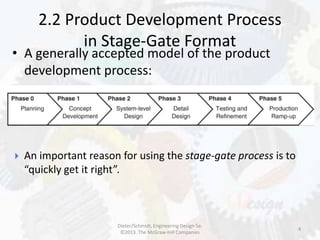
2.2 Product Development Process
in Stage-Gate Format
4
• A generally accepted model of the product
development process:
 An important reason for using the stage-gate process is to
“quickly get it right”.
Dieter/Schmidt, Engineering Design 5e.
©2013. The McGraw-Hill Companies
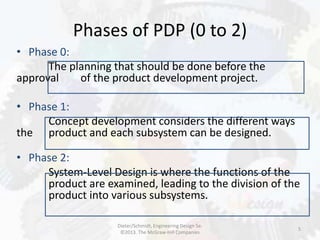
Phases of PDP (0 to 2)
5
• Phase 0:
The planning that should be done before the
approval of the product development project.
• Phase 1:
Concept development considers the different ways
the product and each subsystem can be designed.
• Phase 2:
System-Level Design is where the functions of the
product are examined, leading to the division of the
product into various subsystems.
Dieter/Schmidt, Engineering Design 5e.
©2013. The McGraw-Hill Companies
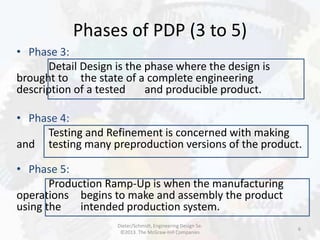
Phases of PDP (3 to 5)
6
• Phase 3:
Detail Design is the phase where the design is
brought to the state of a complete engineering
description of a tested and producible product.
• Phase 4:
Testing and Refinement is concerned with making
and testing many preproduction versions of the product.
• Phase 5:
Production Ramp-Up is when the manufacturing
operations begins to make and assembly the product
using the intended production system.
Dieter/Schmidt, Engineering Design 5e.
©2013. The McGraw-Hill Companies
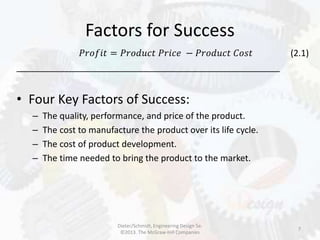
Factors for Success
7
𝑃𝑟𝑜𝑓𝑖𝑡 = 𝑃𝑟𝑜𝑑𝑢𝑐𝑡 𝑃𝑟𝑖𝑐𝑒 − 𝑃𝑟𝑜𝑑𝑢𝑐𝑡 𝐶𝑜𝑠𝑡 (2.1)
______________________________________________________
• Four Key Factors of Success:
– The quality, performance, and price of the product.
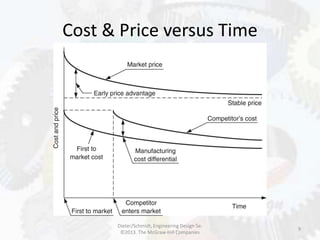
– The cost to manufacture the product over its life cycle.
– The cost of product development.
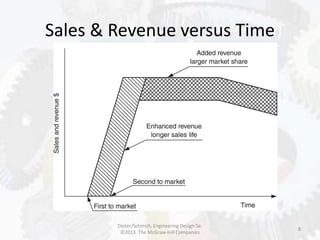
– The time needed to bring the product to the market.
Dieter/Schmidt, Engineering Design 5e.
©2013. The McGraw-Hill Companies
Sales & Revenue versus Time
8
Dieter/Schmidt, Engineering Design 5e.
©2013. The McGraw-Hill Companies
Cost & Price versus Time
9
Dieter/Schmidt, Engineering Design 5e.
©2013. The McGraw-Hill Companies
Static Versus Dynamic Products
10
• Static Product: The changes in their design take place
over long time periods through incremental changes
occurring at the subsystem and component levels.
– Automobiles
– Appliances: refrigerators, dishwashers
• Dynamic Products: Customers are willing to, and may
even demand, change.
– Wireless mobile phones
– Digital video recorders and players
– Software
Dieter/Schmidt, Engineering Design 5e.
©2013. The McGraw-Hill Companies
Variations on the Generic PDP
11
• Platform Product is built around a preexisting
technological subsystem.
– Apple Macintosh operating system
– Black & Decker doubly insulated universal motor
• Customized Products are those in which variations
in configuration and content are created in
response to a specific order of a customer.
• In a highly competitive world marketplace, mass
customization appears to be one of the future
trends.
Dieter/Schmidt, Engineering Design 5e.
©2013. The McGraw-Hill Companies
2.3 Product And Process Cycles
What are the stages of product and
process cycles?
12
Dieter/Schmidt, Engineering Design 5e.
©2013. The McGraw-Hill Companies
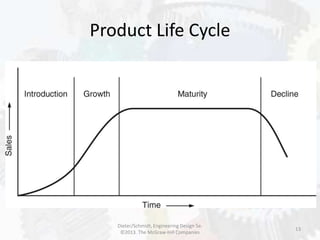
Product Life Cycle
13
Dieter/Schmidt, Engineering Design 5e.
©2013. The McGraw-Hill Companies
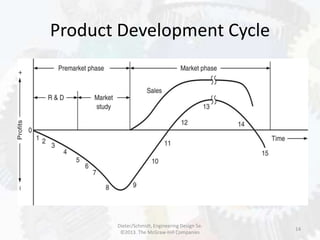
Product Development Cycle
14
Dieter/Schmidt, Engineering Design 5e.
©2013. The McGraw-Hill Companies
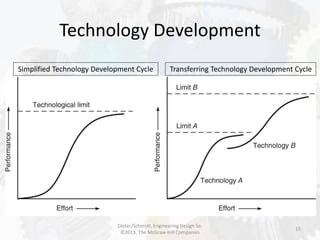
Technology Development
15
Transferring Technology Development CycleSimplified Technology Development Cycle
Dieter/Schmidt, Engineering Design 5e.
©2013. The McGraw-Hill Companies
2.4 Organization For Design and
Product Development
How can an organization affect the
design and product development?
16
Dieter/Schmidt, Engineering Design 5e.
©2013. The McGraw-Hill Companies
Organization’s Effect on Design &
Product Development
17
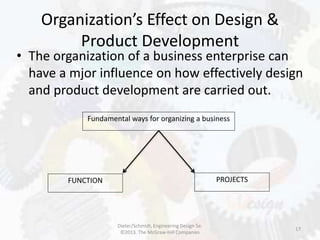
• The organization of a business enterprise can
have a mjor influence on how effectively design
and product development are carried out.
Fundamental ways for organizing a business
FUNCTION PROJECTS
Dieter/Schmidt, Engineering Design 5e.
©2013. The McGraw-Hill Companies
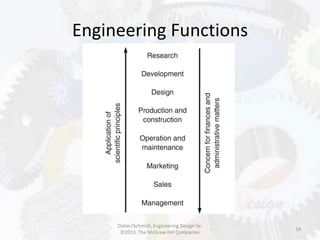
Engineering Functions
18
Dieter/Schmidt, Engineering Design 5e.
©2013. The McGraw-Hill Companies
Links Between Individuals
19
• Reporting Relationships:
A subordinate is concerned about who his or her
supervisor is, since the supervisor influences evaluations,
salary increases, promotions, and work assignments.
• Financial Arrangements:
Another type of link is budgetary. The source of funds to
advance the project, and who controls these funds, is a vital
consideration.
• Physical Arrangements:
Studies have shown that communication between individuals is
enhanced if their offices are within 50 feet of each other!
Dieter/Schmidt, Engineering Design 5e.
©2013. The McGraw-Hill Companies
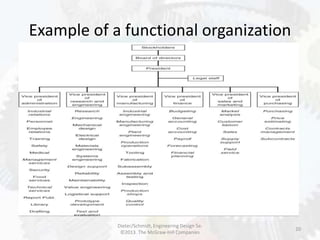
Example of a functional organization
20
Dieter/Schmidt, Engineering Design 5e.
©2013. The McGraw-Hill Companies
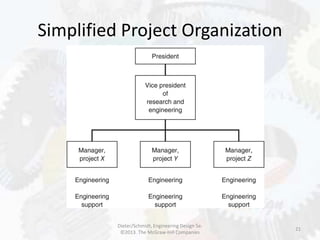
Simplified Project Organization
21
Dieter/Schmidt, Engineering Design 5e.
©2013. The McGraw-Hill Companies
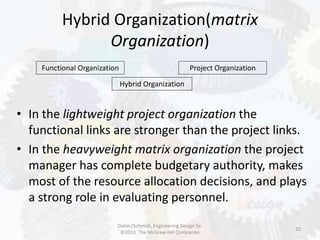
Hybrid Organization(matrix
Organization)
22
Functional Organization Project Organization
Hybrid Organization
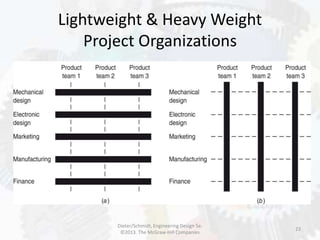
• In the lightweight project organization the
functional links are stronger than the project links.
• In the heavyweight matrix organization the project
manager has complete budgetary authority, makes
most of the resource allocation decisions, and plays
a strong role in evaluating personnel.
Dieter/Schmidt, Engineering Design 5e.
©2013. The McGraw-Hill Companies
Lightweight & Heavy Weight
Project Organizations
23
Dieter/Schmidt, Engineering Design 5e.
©2013. The McGraw-Hill Companies
2.5 Markets and Marketing
How can we describe the market and
marketing for engineered products?
24
Dieter/Schmidt, Engineering Design 5e.
©2013. The McGraw-Hill Companies
Markets
25
• Marketing is concerned with the interaction between the
corporation and the customer.
• We need to differentiate between the customer and the
user of the product.
• Market is an economic construct to identify those
persons or organizations that have an interest in
purchasing or selling a particular product, and to create
an arena for their transactions.
– Stock Market: Prototypical Market
• Strong brand names evolved as a way of building
customer recognition and loyalty.
Dieter/Schmidt, Engineering Design 5e.
©2013. The McGraw-Hill Companies
Market Segmentation
26
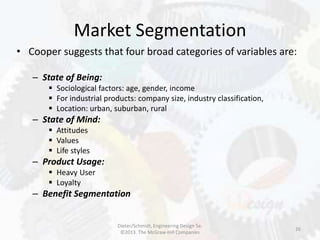
• Cooper suggests that four broad categories of variables are:
– State of Being:
 Sociological factors: age, gender, income
 For industrial products: company size, industry classification,
 Location: urban, suburban, rural
– State of Mind:
 Attitudes
 Values
 Life styles
– Product Usage:
 Heavy User
 Loyalty
– Benefit Segmentation
Dieter/Schmidt, Engineering Design 5e.
©2013. The McGraw-Hill Companies
Marketing Department
27
• Function:
– The marketing department in a company creates and
manages the company’s relationship with its customers.
• Expected Tasks:
– Preliminary marketing assessment
– Quick scoping of the potential sales
– Competition
– Market share at the early stages of the product planning
– Detailed market study
– Assisting with the introduction of the product into the
marketplace
– Providing product support system
Dieter/Schmidt, Engineering Design 5e.
©2013. The McGraw-Hill Companies
Marketing Plan
28
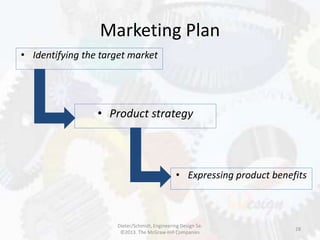
• Identifying the target market
• Product strategy
• Expressing product benefits
Dieter/Schmidt, Engineering Design 5e.
©2013. The McGraw-Hill Companies
Marketing Plan(2)
29
• Marketing plan should contain:
 Evaluation of market segments
 Identification of competitive products
 Identification of early product adopters
 Clear understanding of benefits of product to customers
 Estimation of the market size in terms of dollars and units
sold
 Determination of the breadth of the product line
 Estimation of product life
 Determination of the product volume/price relationships
 Complete financial plan including time to market
Dieter/Schmidt, Engineering Design 5e.
©2013. The McGraw-Hill Companies
2.6 Technological Innovation
How does technological innovation
happen?
30
Dieter/Schmidt, Engineering Design 5e.
©2013. The McGraw-Hill Companies
Invention, Innovation, and
Diffusion
31
• Invention:
– The creative act whereby an idea is conceived,
articulated, and recorded.
• Innovation:
– The process by which an invention or idea is brought
into successful practice and is utilized by the
economy.
• Diffusion:
– The successive and widespread implementation and
adoption of successful innovations.
Dieter/Schmidt, Engineering Design 5e.
©2013. The McGraw-Hill Companies
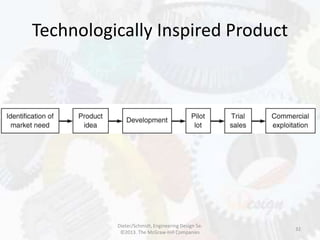
Technologically Inspired Product
32
Dieter/Schmidt, Engineering Design 5e.
©2013. The McGraw-Hill Companies
Business Strategies Related to
Innovation and Product Development
33
• Star businesses:
– High sales growth potential, high market share
potential
• Wildcat businesses:
– High sales growth potential, low market share
• Cash-cow businesses:
– Low growth potential, high market share
• Dog businesses:
– Low growth potential, low market share
Dieter/Schmidt, Engineering Design 5e.
©2013. The McGraw-Hill Companies
Characteristics of Innovative
People
34
• Idea generator:
– The creative individual
• Entrepreneur:
– The person who “carries the ball” and takes the risks
• Gatekeepers:
– People who provide technical communication from
outsife to inside the product development
organization.
• Program manager:
– The person who manages without inhibiting
creativity
• Sponsor:
Dieter/Schmidt, Engineering Design 5e.
©2013. The McGraw-Hill Companies
Types of Technology Innovation
35
• Need-driven innovation:
– where the development team seeks to fill an
identified gap in performance or product cost
(technology pull)
• Radical innovation:
– which leads to widespread change and a whole new
technology, and arises from basic research
(technology push)
Dieter/Schmidt, Engineering Design 5e.
©2013. The McGraw-Hill Companies
THANK YOU

Chapter 2 2014

  • 1.
    DEPARTMENT OF MANUFACTURING AND MATERIALSENGINEERING MME 4116 PRODUCT DESIGN AND DEVELOPMENT BY: DR MOHD RADZI BIN HAJI CHE DAUD
  • 2.
  • 3.
    2.1 Introduction What isthe product development process? 3 Dieter/Schmidt, Engineering Design 5e. ©2013. The McGraw-Hill Companies
  • 4.
    2.2 Product DevelopmentProcess in Stage-Gate Format 4 • A generally accepted model of the product development process:  An important reason for using the stage-gate process is to “quickly get it right”. Dieter/Schmidt, Engineering Design 5e. ©2013. The McGraw-Hill Companies
  • 5.
    Phases of PDP(0 to 2) 5 • Phase 0: The planning that should be done before the approval of the product development project. • Phase 1: Concept development considers the different ways the product and each subsystem can be designed. • Phase 2: System-Level Design is where the functions of the product are examined, leading to the division of the product into various subsystems. Dieter/Schmidt, Engineering Design 5e. ©2013. The McGraw-Hill Companies
  • 6.
    Phases of PDP(3 to 5) 6 • Phase 3: Detail Design is the phase where the design is brought to the state of a complete engineering description of a tested and producible product. • Phase 4: Testing and Refinement is concerned with making and testing many preproduction versions of the product. • Phase 5: Production Ramp-Up is when the manufacturing operations begins to make and assembly the product using the intended production system. Dieter/Schmidt, Engineering Design 5e. ©2013. The McGraw-Hill Companies
  • 7.
    Factors for Success 7 𝑃𝑟𝑜𝑓𝑖𝑡= 𝑃𝑟𝑜𝑑𝑢𝑐𝑡 𝑃𝑟𝑖𝑐𝑒 − 𝑃𝑟𝑜𝑑𝑢𝑐𝑡 𝐶𝑜𝑠𝑡 (2.1) ______________________________________________________ • Four Key Factors of Success: – The quality, performance, and price of the product. – The cost to manufacture the product over its life cycle. – The cost of product development. – The time needed to bring the product to the market. Dieter/Schmidt, Engineering Design 5e. ©2013. The McGraw-Hill Companies
  • 8.
    Sales & Revenueversus Time 8 Dieter/Schmidt, Engineering Design 5e. ©2013. The McGraw-Hill Companies
  • 9.
    Cost & Priceversus Time 9 Dieter/Schmidt, Engineering Design 5e. ©2013. The McGraw-Hill Companies
  • 10.
    Static Versus DynamicProducts 10 • Static Product: The changes in their design take place over long time periods through incremental changes occurring at the subsystem and component levels. – Automobiles – Appliances: refrigerators, dishwashers • Dynamic Products: Customers are willing to, and may even demand, change. – Wireless mobile phones – Digital video recorders and players – Software Dieter/Schmidt, Engineering Design 5e. ©2013. The McGraw-Hill Companies
  • 11.
    Variations on theGeneric PDP 11 • Platform Product is built around a preexisting technological subsystem. – Apple Macintosh operating system – Black & Decker doubly insulated universal motor • Customized Products are those in which variations in configuration and content are created in response to a specific order of a customer. • In a highly competitive world marketplace, mass customization appears to be one of the future trends. Dieter/Schmidt, Engineering Design 5e. ©2013. The McGraw-Hill Companies
  • 12.
    2.3 Product AndProcess Cycles What are the stages of product and process cycles? 12 Dieter/Schmidt, Engineering Design 5e. ©2013. The McGraw-Hill Companies
  • 13.
    Product Life Cycle 13 Dieter/Schmidt,Engineering Design 5e. ©2013. The McGraw-Hill Companies
  • 14.
    Product Development Cycle 14 Dieter/Schmidt,Engineering Design 5e. ©2013. The McGraw-Hill Companies
  • 15.
    Technology Development 15 Transferring TechnologyDevelopment CycleSimplified Technology Development Cycle Dieter/Schmidt, Engineering Design 5e. ©2013. The McGraw-Hill Companies
  • 16.
    2.4 Organization ForDesign and Product Development How can an organization affect the design and product development? 16 Dieter/Schmidt, Engineering Design 5e. ©2013. The McGraw-Hill Companies
  • 17.
    Organization’s Effect onDesign & Product Development 17 • The organization of a business enterprise can have a mjor influence on how effectively design and product development are carried out. Fundamental ways for organizing a business FUNCTION PROJECTS Dieter/Schmidt, Engineering Design 5e. ©2013. The McGraw-Hill Companies
  • 18.
    Engineering Functions 18 Dieter/Schmidt, EngineeringDesign 5e. ©2013. The McGraw-Hill Companies
  • 19.
    Links Between Individuals 19 •Reporting Relationships: A subordinate is concerned about who his or her supervisor is, since the supervisor influences evaluations, salary increases, promotions, and work assignments. • Financial Arrangements: Another type of link is budgetary. The source of funds to advance the project, and who controls these funds, is a vital consideration. • Physical Arrangements: Studies have shown that communication between individuals is enhanced if their offices are within 50 feet of each other! Dieter/Schmidt, Engineering Design 5e. ©2013. The McGraw-Hill Companies
  • 20.
    Example of afunctional organization 20 Dieter/Schmidt, Engineering Design 5e. ©2013. The McGraw-Hill Companies
  • 21.
    Simplified Project Organization 21 Dieter/Schmidt,Engineering Design 5e. ©2013. The McGraw-Hill Companies
  • 22.
    Hybrid Organization(matrix Organization) 22 Functional OrganizationProject Organization Hybrid Organization • In the lightweight project organization the functional links are stronger than the project links. • In the heavyweight matrix organization the project manager has complete budgetary authority, makes most of the resource allocation decisions, and plays a strong role in evaluating personnel. Dieter/Schmidt, Engineering Design 5e. ©2013. The McGraw-Hill Companies
  • 23.
    Lightweight & HeavyWeight Project Organizations 23 Dieter/Schmidt, Engineering Design 5e. ©2013. The McGraw-Hill Companies
  • 24.
    2.5 Markets andMarketing How can we describe the market and marketing for engineered products? 24 Dieter/Schmidt, Engineering Design 5e. ©2013. The McGraw-Hill Companies
  • 25.
    Markets 25 • Marketing isconcerned with the interaction between the corporation and the customer. • We need to differentiate between the customer and the user of the product. • Market is an economic construct to identify those persons or organizations that have an interest in purchasing or selling a particular product, and to create an arena for their transactions. – Stock Market: Prototypical Market • Strong brand names evolved as a way of building customer recognition and loyalty. Dieter/Schmidt, Engineering Design 5e. ©2013. The McGraw-Hill Companies
  • 26.
    Market Segmentation 26 • Coopersuggests that four broad categories of variables are: – State of Being:  Sociological factors: age, gender, income  For industrial products: company size, industry classification,  Location: urban, suburban, rural – State of Mind:  Attitudes  Values  Life styles – Product Usage:  Heavy User  Loyalty – Benefit Segmentation Dieter/Schmidt, Engineering Design 5e. ©2013. The McGraw-Hill Companies
  • 27.
    Marketing Department 27 • Function: –The marketing department in a company creates and manages the company’s relationship with its customers. • Expected Tasks: – Preliminary marketing assessment – Quick scoping of the potential sales – Competition – Market share at the early stages of the product planning – Detailed market study – Assisting with the introduction of the product into the marketplace – Providing product support system Dieter/Schmidt, Engineering Design 5e. ©2013. The McGraw-Hill Companies
  • 28.
    Marketing Plan 28 • Identifyingthe target market • Product strategy • Expressing product benefits Dieter/Schmidt, Engineering Design 5e. ©2013. The McGraw-Hill Companies
  • 29.
    Marketing Plan(2) 29 • Marketingplan should contain:  Evaluation of market segments  Identification of competitive products  Identification of early product adopters  Clear understanding of benefits of product to customers  Estimation of the market size in terms of dollars and units sold  Determination of the breadth of the product line  Estimation of product life  Determination of the product volume/price relationships  Complete financial plan including time to market Dieter/Schmidt, Engineering Design 5e. ©2013. The McGraw-Hill Companies
  • 30.
    2.6 Technological Innovation Howdoes technological innovation happen? 30 Dieter/Schmidt, Engineering Design 5e. ©2013. The McGraw-Hill Companies
  • 31.
    Invention, Innovation, and Diffusion 31 •Invention: – The creative act whereby an idea is conceived, articulated, and recorded. • Innovation: – The process by which an invention or idea is brought into successful practice and is utilized by the economy. • Diffusion: – The successive and widespread implementation and adoption of successful innovations. Dieter/Schmidt, Engineering Design 5e. ©2013. The McGraw-Hill Companies
  • 32.
    Technologically Inspired Product 32 Dieter/Schmidt,Engineering Design 5e. ©2013. The McGraw-Hill Companies
  • 33.
    Business Strategies Relatedto Innovation and Product Development 33 • Star businesses: – High sales growth potential, high market share potential • Wildcat businesses: – High sales growth potential, low market share • Cash-cow businesses: – Low growth potential, high market share • Dog businesses: – Low growth potential, low market share Dieter/Schmidt, Engineering Design 5e. ©2013. The McGraw-Hill Companies
  • 34.
    Characteristics of Innovative People 34 •Idea generator: – The creative individual • Entrepreneur: – The person who “carries the ball” and takes the risks • Gatekeepers: – People who provide technical communication from outsife to inside the product development organization. • Program manager: – The person who manages without inhibiting creativity • Sponsor: Dieter/Schmidt, Engineering Design 5e. ©2013. The McGraw-Hill Companies

  • 35.
    Types of TechnologyInnovation 35 • Need-driven innovation: – where the development team seeks to fill an identified gap in performance or product cost (technology pull) • Radical innovation: – which leads to widespread change and a whole new technology, and arises from basic research (technology push) Dieter/Schmidt, Engineering Design 5e. ©2013. The McGraw-Hill Companies
  • 36.