Prepared by:
Isra’a Abu Romman
Project Assignment
 Original Study – Literature Review
 RULA Procedure
 Using the RULA – Example step-by-step guides
 Assessment of the validity and reliability of RULA
 RULA Strengths
 RULA Limitations
 Application of RULA
 Conclusion
Table of Contents
RULA Original Study/Literature Review
 RULA is a posture, force and muscle use assessment tool
developed by McAtamney and Corlett(1993) of University
of Nottingham’s Institute for Occupational Ergonomics.
 Use in ergonomic investigations of workplaces is a risk of
musculoskeletal disorders (MSDs).
 The risk factors under investigation are in an effort to
assess four external load factors of number of movements,
static muscle work, force and postures. RULA focuses on
the neck, trunk and upper limbs.
The development of RULA
occurred in three phases.
1. Development for the method
of recording the working
posture
2. Scoring System Development
3. Development of the scale of
action levels which provide a
guide to the Risk level
RULA Procedure
 Observing the task and selecting the posture(s) to assess:
 The evaluator should prepare for the assessment by
interviewing the worker , understand the job tasks and
demands, and observing the worker’s movements and
postures during several work cycles.
 Selection of the postures to be evaluated should be based on:
1) the most difficult postures and work tasks.
2) the posture sustained for the longest period of time.
3) the posture where the highest force loads occur.
Cont. RULA Procedure
 Calculate RULA Score determine the associated
Action Level
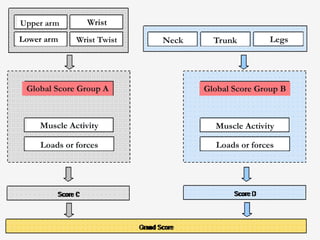
 The traditional RULA sheet [Appendix A] uses body
posture diagrams and three scoring tables. The human body
is divided in two groups, Group A for upper arm, lower
arm, and wrist position, and Group B for neck and trunk
analysis. A scoring system is used to assign scores at every
level, with a score of 1 indicating the best posture/case.
Upper arm
Lower arm
Upper arm Wrist
Wrist Twist Neck Trunk Legs
Muscle ActivityMuscle Activity
Loads or forcesLoads or forces
Global Score Group BGlobal Score Group A
Using the RULA –
Example step-by-step guides
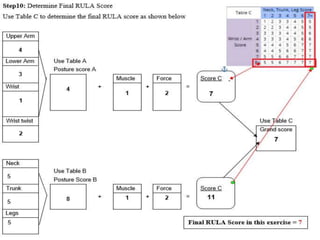
 To illustrate how RULA scores is calculated from the
RULA traditional worksheet [Appendix A] , I re- produce
a research results* for working
postures of small scale forging
industry in Ludhiana and Jalandhar
Region.
* Jaspreet Singh, Harvinder Lal, Gautam Kocher, 2012
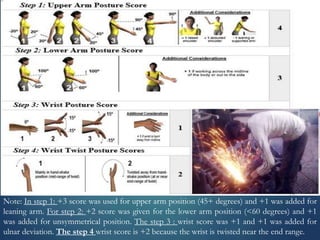
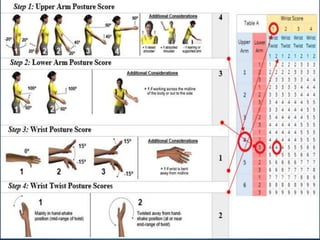
Note: In step 1: +3 score was used for upper arm position (45+ degrees) and +1 was added for
leaning arm. For step 2: +2 score was given for the lower arm position (<60 degrees) and +1
was added for unsymmetrical position. The step 3 : wrist score was +1 and +1 was added for
ulnar deviation. The step 4 wrist score is +2 because the wrist is twisted near the end range.
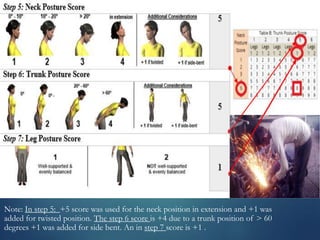
Note: In step 5: +5 score was used for the neck position in extension and +1 was
added for twisted position. The step 6 score is +4 due to a trunk position of > 60
degrees +1 was added for side bent. An in step 7 score is +1 .
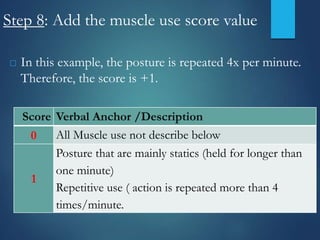
Step 8: Add the muscle use score value
Score Verbal Anchor /Description
0 All Muscle use not describe below
1
Posture that are mainly statics (held for longer than
one minute)
Repetitive use ( action is repeated more than 4
times/minute.
 In this example, the posture is repeated 4x per minute.
Therefore, the score is +1.
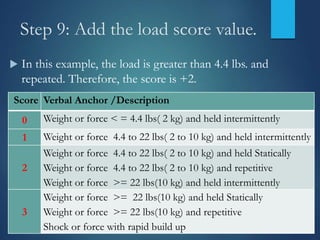
Step 9: Add the load score value.
 In this example, the load is greater than 4.4 lbs. and
repeated. Therefore, the score is +2.
Score Verbal Anchor /Description
0 Weight or force < = 4.4 lbs( 2 kg) and held intermittently
1 Weight or force 4.4 to 22 lbs( 2 to 10 kg) and held intermittently
2
Weight or force 4.4 to 22 lbs( 2 to 10 kg) and held Statically
Weight or force 4.4 to 22 lbs( 2 to 10 kg) and repetitive
Weight or force >= 22 lbs(10 kg) and held intermittently
3
Weight or force >= 22 lbs(10 kg) and held Statically
Weight or force >= 22 lbs(10 kg) and repetitive
Shock or force with rapid build up
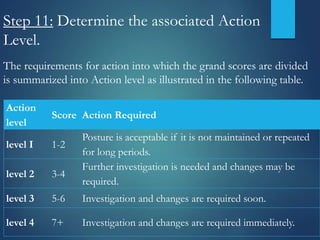
Step 11: Determine the associated Action
Level.
The requirements for action into which the grand scores are divided
is summarized into Action level as illustrated in the following table.
Action
level
Score Action Required
level I 1-2
Posture is acceptable if it is not maintained or repeated
for long periods.
level 2 3-4
Further investigation is needed and changes may be
required.
level 3 5-6 Investigation and changes are required soon.
level 4 7+ Investigation and changes are required immediately.
Assessment of the validity and reliability
of RULA
 McAtamney and Corlett examined the validity and
reliability of RULA in their original research by using a
data-entry computer task as a model. They investigated the
relationship between RULA’s risk categories and
psychophysiological measures and used self-reports of
perceived discomfort as physical measures.
Cont. RULA assessment
*** Twenty participants with a mean age of 32 (range 21 to 55) each performed a 30-min
typing task on a computer in three working postures based on RULA’s scoring system
Leslie J.K Fountian (2003) conducted an experimental research
to examine RULA’s postural scoring system with selected
physiological and psychophysiological measures (2003)
Cont. RULA aassessment
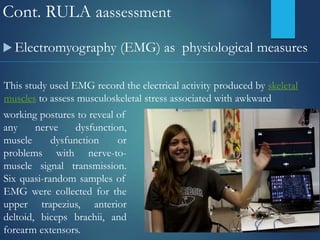
 Electromyography (EMG) as physiological measures
This study used EMG record the electrical activity produced by skeletal
muscles to assess musculoskeletal stress associated with awkward
working postures to reveal of
any nerve dysfunction,
muscle dysfunction or
problems with nerve-to-
muscle signal transmission.
Six quasi-random samples of
EMG were collected for the
upper trapezius, anterior
deltoid, biceps brachii, and
forearm extensors.
Cont. : Psychophysiological Measures
 Body discomfort survey (BDS)
Participants were asked to rate their perceived level of discomfort
based on a Likert scale of 0 to 7 in body discomfort survey (BDS)
where 0 represented no discomfort and 7 represented extreme
discomfort.
 Job Attitude Questionnaire (JAQ)
JAQ used a Likert scale and measured four factors: specific job
satisfaction, general job satisfaction, job involvement, and work
motivation.
Cont. Assessment of the validity and reliability
of RULA methodology Results
 In terms of the physiological measures, multi-way repeated
measures ANOVA was used to analyses the EMG data. A
statistically significant difference was found in performance
from posture 1 to 3, as well as posture 2 and 3, but not
between postures 1 and 2.
 Whereas for perceived psychophysiological measurement
for discomfort and performance calculated from the on-site
BDS and JAQ, one-way repeated measures ANOVA was
used and it’s result demonstrated a significant difference in
perceived discomfort and a significant difference in word
count across the three working postures.
 RULA Strengths
 RULA still influential in the ergonomic field
 No need for special equipment.
 Quickly and easy to complete without need for an advanced
degree in ergonomics.
 RULA scores indicate the level of intervention required to
reduce MSD risks.
 Perfectly matches the selection criteria for most studies, ideally
for sedentary working fields (quantitative, subjective, self
reporting potential, posture-based).
 RULA Limitations
 When using RULA, only the right or left side is assessed at a time
 RULA does not include assessment of the fingers and thumb .
 RULA does not provide exact engineering controls or work
activity change. It gives a total job assessment.
 RULA does not provide an integrated assessment of all
biomechanical risk factors.
 RULA’s scoring system may be too general in nature to
differentiate various levels of risk (low, moderate, and high).
Application of RULA
 Extensive studies have also been carried out for
each risk factor identified for Work related
Musculoskeletal disorder (WR-MSD). These
studies have been generalized in RULA to make it
quick and easy to implement. RULA is ideal for
sedentary workers e.g. computer workplaces,
service industries. In referred to many researches in
the ergonomic field, I summarize a selected
interesting application of RULA as following:
 RULA and Productivity Optimization
 In contrary for those studies that conducted under
epidemiological prims, three professors from university of a
coruna, spain conducted a study which link ergonomics with
productivity.
 In this study, RULA analysis is carried out by means of a
digital Human Model (DHM) as a tool to simulate the whole
proposed design for slate splitter plant. Precise and complete
set of tasks and Moves to Posture (MTPS) were evaluated
for the current tasks using RULA aiming at quantifying the
level of ergonomics risk
Cont. RULA and Productivity Optimization
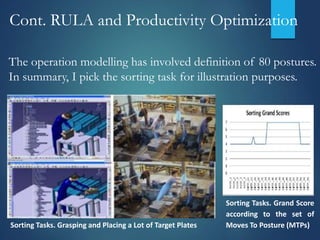
The operation modelling has involved definition of 80 postures.
In summary, I pick the sorting task for illustration purposes.
Sorting Tasks. Grasping and Placing a Lot of Target Plates
Sorting Tasks. Grand Score
according to the set of
Moves To Posture (MTPs)
Cont. RULA and Productivity Optimization
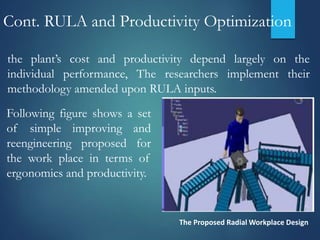
the plant’s cost and productivity depend largely on the
individual performance, The researchers implement their
methodology amended upon RULA inputs.
The Proposed Radial Workplace Design
Following figure shows a set
of simple improving and
reengineering proposed for
the work place in terms of
ergonomics and productivity.
 RULA in Simulation Module.
 Imtiyaz Shaikh, 2003 integrate RULA algorithm as
ergonomic analysis tool in an immersive environment to
study risk factors that identified for work related
musculoskeletal disorder.
 The assembly process was simulated in a virtual assembly
tool (VADE)
 As the user goes through the assembly task, his/her
motions are monitored by RULA. If the RULA score goes
beyond an acceptable value, a warning is flashed to the
user as shown in figure 5, so that the user can correct his
position.
Cont. RULA in Simulation Module.
Human Model
Ring-assembly Station
RULA warning
Assembly of piston rings- actual assembly plant
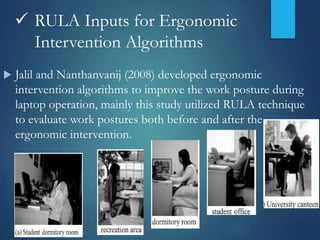
 RULA Inputs for Ergonomic
Intervention Algorithms
 Jalil and Nanthanvanij (2008) developed ergonomic
intervention algorithms to improve the work posture during
laptop operation, mainly this study utilized RULA technique
to evaluate work postures both before and after the
ergonomic intervention.
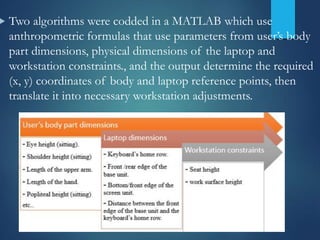
 Two algorithms were codded in a MATLAB which use
anthropometric formulas that use parameters from user’s body
part dimensions, physical dimensions of the laptop and
workstation constraints., and the output determine the required
(x, y) coordinates of body and laptop reference points, then
translate it into necessary workstation adjustments.
Cont. RULA Inputs for Ergonomic
Intervention Algorithms
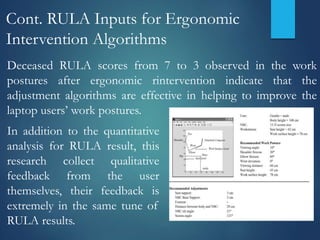
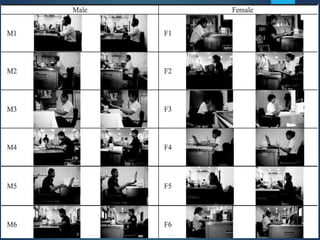
Deceased RULA scores from 7 to 3 observed in the work
postures after ergonomic rintervention indicate that the
adjustment algorithms are effective in helping to improve the
laptop users’ work postures.
In addition to the quantitative
analysis for RULA result, this
research collect qualitative
feedback from the user
themselves, their feedback is
extremely in the same tune of
RULA results.
Conclusion
 RULA is a popular ergonomic assessment method to
identify risk factors of the posture, force and muscle risk
factors for work related musculoskeletal disorder. RULA
considers biomechanical and postural load requirements
of job tasks/demands on the neck, trunk and upper
extremities.
References
 [1] McAtamney, L. & Corlett, E.N. (1993), RULA: a survey method for the
investigation of work-related upper limb disorders, Applied Ergonomics, 24, 91-
99.
 [2] Leslie J.K Fountian (2003), Examining RULA’s Postural Scoring System With
Selected Physiological and Psychophysiological Measures, International Journal of
Occupational Safety and Ergonomics(JOSE) VOL. 9, NO. 383-392
 [3] Jaspreet Singh, Harvinder Lal, Gautam Kocher (2012), Musculoskeletal
Disorder Risk Assessment in small scale forging Industry by using RULA Method,
International Journal of Engineering and Advanced Technology (IJEAT), ISSN:
2249 – 8958
 [4] Shaikh Imtiyaz (2003), Integrating ergonomic analysis functionality with an
immersive environmen, Thesis (M.S.)--Washington State University.
 [5] Syazwan Aizat Ismail, Shamsul Bahri Mohd. Tamrin, Mohd. Rafee
Baharudin, Juliana Jalaludin and Zailina Hashim (2010), Evaluation of Two
Ergonomics Intervention Programs in Reducing Ergonomics Risk Factors of
Musculoskeletal Disorder among School Children,Research Journal of Medical
Science 4(1):1-10,2010, ISSN:1815-9346
 [6] Nuchrawee Jamjumrus and Suebsak Nanthavanij(2008), Ergonomics
Intervention for
 Improving Work Postures during Notebook Computer Operation, J. Human
Ergol., 37: 23
Thank You 
Any Questions!

Rapid Upper Limb Assessment (RULA) - Human Factors

  • 1.
    Prepared by: Isra’a AbuRomman Project Assignment
  • 2.
     Original Study– Literature Review  RULA Procedure  Using the RULA – Example step-by-step guides  Assessment of the validity and reliability of RULA  RULA Strengths  RULA Limitations  Application of RULA  Conclusion Table of Contents
  • 3.
    RULA Original Study/LiteratureReview  RULA is a posture, force and muscle use assessment tool developed by McAtamney and Corlett(1993) of University of Nottingham’s Institute for Occupational Ergonomics.  Use in ergonomic investigations of workplaces is a risk of musculoskeletal disorders (MSDs).  The risk factors under investigation are in an effort to assess four external load factors of number of movements, static muscle work, force and postures. RULA focuses on the neck, trunk and upper limbs.
  • 4.
    The development ofRULA occurred in three phases. 1. Development for the method of recording the working posture 2. Scoring System Development 3. Development of the scale of action levels which provide a guide to the Risk level
  • 5.
    RULA Procedure  Observingthe task and selecting the posture(s) to assess:  The evaluator should prepare for the assessment by interviewing the worker , understand the job tasks and demands, and observing the worker’s movements and postures during several work cycles.  Selection of the postures to be evaluated should be based on: 1) the most difficult postures and work tasks. 2) the posture sustained for the longest period of time. 3) the posture where the highest force loads occur.
  • 6.
    Cont. RULA Procedure Calculate RULA Score determine the associated Action Level  The traditional RULA sheet [Appendix A] uses body posture diagrams and three scoring tables. The human body is divided in two groups, Group A for upper arm, lower arm, and wrist position, and Group B for neck and trunk analysis. A scoring system is used to assign scores at every level, with a score of 1 indicating the best posture/case.
  • 7.
    Upper arm Lower arm Upperarm Wrist Wrist Twist Neck Trunk Legs Muscle ActivityMuscle Activity Loads or forcesLoads or forces Global Score Group BGlobal Score Group A
  • 8.
    Using the RULA– Example step-by-step guides  To illustrate how RULA scores is calculated from the RULA traditional worksheet [Appendix A] , I re- produce a research results* for working postures of small scale forging industry in Ludhiana and Jalandhar Region. * Jaspreet Singh, Harvinder Lal, Gautam Kocher, 2012
  • 9.
    Note: In step1: +3 score was used for upper arm position (45+ degrees) and +1 was added for leaning arm. For step 2: +2 score was given for the lower arm position (<60 degrees) and +1 was added for unsymmetrical position. The step 3 : wrist score was +1 and +1 was added for ulnar deviation. The step 4 wrist score is +2 because the wrist is twisted near the end range.
  • 11.
    Note: In step5: +5 score was used for the neck position in extension and +1 was added for twisted position. The step 6 score is +4 due to a trunk position of > 60 degrees +1 was added for side bent. An in step 7 score is +1 .
  • 12.
    Step 8: Addthe muscle use score value Score Verbal Anchor /Description 0 All Muscle use not describe below 1 Posture that are mainly statics (held for longer than one minute) Repetitive use ( action is repeated more than 4 times/minute.  In this example, the posture is repeated 4x per minute. Therefore, the score is +1.
  • 13.
    Step 9: Addthe load score value.  In this example, the load is greater than 4.4 lbs. and repeated. Therefore, the score is +2. Score Verbal Anchor /Description 0 Weight or force < = 4.4 lbs( 2 kg) and held intermittently 1 Weight or force 4.4 to 22 lbs( 2 to 10 kg) and held intermittently 2 Weight or force 4.4 to 22 lbs( 2 to 10 kg) and held Statically Weight or force 4.4 to 22 lbs( 2 to 10 kg) and repetitive Weight or force >= 22 lbs(10 kg) and held intermittently 3 Weight or force >= 22 lbs(10 kg) and held Statically Weight or force >= 22 lbs(10 kg) and repetitive Shock or force with rapid build up
  • 15.
    Step 11: Determinethe associated Action Level. The requirements for action into which the grand scores are divided is summarized into Action level as illustrated in the following table. Action level Score Action Required level I 1-2 Posture is acceptable if it is not maintained or repeated for long periods. level 2 3-4 Further investigation is needed and changes may be required. level 3 5-6 Investigation and changes are required soon. level 4 7+ Investigation and changes are required immediately.
  • 16.
    Assessment of thevalidity and reliability of RULA  McAtamney and Corlett examined the validity and reliability of RULA in their original research by using a data-entry computer task as a model. They investigated the relationship between RULA’s risk categories and psychophysiological measures and used self-reports of perceived discomfort as physical measures.
  • 17.
    Cont. RULA assessment ***Twenty participants with a mean age of 32 (range 21 to 55) each performed a 30-min typing task on a computer in three working postures based on RULA’s scoring system Leslie J.K Fountian (2003) conducted an experimental research to examine RULA’s postural scoring system with selected physiological and psychophysiological measures (2003)
  • 18.
    Cont. RULA aassessment Electromyography (EMG) as physiological measures This study used EMG record the electrical activity produced by skeletal muscles to assess musculoskeletal stress associated with awkward working postures to reveal of any nerve dysfunction, muscle dysfunction or problems with nerve-to- muscle signal transmission. Six quasi-random samples of EMG were collected for the upper trapezius, anterior deltoid, biceps brachii, and forearm extensors.
  • 19.
    Cont. : PsychophysiologicalMeasures  Body discomfort survey (BDS) Participants were asked to rate their perceived level of discomfort based on a Likert scale of 0 to 7 in body discomfort survey (BDS) where 0 represented no discomfort and 7 represented extreme discomfort.  Job Attitude Questionnaire (JAQ) JAQ used a Likert scale and measured four factors: specific job satisfaction, general job satisfaction, job involvement, and work motivation.
  • 20.
    Cont. Assessment ofthe validity and reliability of RULA methodology Results  In terms of the physiological measures, multi-way repeated measures ANOVA was used to analyses the EMG data. A statistically significant difference was found in performance from posture 1 to 3, as well as posture 2 and 3, but not between postures 1 and 2.  Whereas for perceived psychophysiological measurement for discomfort and performance calculated from the on-site BDS and JAQ, one-way repeated measures ANOVA was used and it’s result demonstrated a significant difference in perceived discomfort and a significant difference in word count across the three working postures.
  • 21.
     RULA Strengths RULA still influential in the ergonomic field  No need for special equipment.  Quickly and easy to complete without need for an advanced degree in ergonomics.  RULA scores indicate the level of intervention required to reduce MSD risks.  Perfectly matches the selection criteria for most studies, ideally for sedentary working fields (quantitative, subjective, self reporting potential, posture-based).
  • 22.
     RULA Limitations When using RULA, only the right or left side is assessed at a time  RULA does not include assessment of the fingers and thumb .  RULA does not provide exact engineering controls or work activity change. It gives a total job assessment.  RULA does not provide an integrated assessment of all biomechanical risk factors.  RULA’s scoring system may be too general in nature to differentiate various levels of risk (low, moderate, and high).
  • 23.
    Application of RULA Extensive studies have also been carried out for each risk factor identified for Work related Musculoskeletal disorder (WR-MSD). These studies have been generalized in RULA to make it quick and easy to implement. RULA is ideal for sedentary workers e.g. computer workplaces, service industries. In referred to many researches in the ergonomic field, I summarize a selected interesting application of RULA as following:
  • 24.
     RULA andProductivity Optimization  In contrary for those studies that conducted under epidemiological prims, three professors from university of a coruna, spain conducted a study which link ergonomics with productivity.  In this study, RULA analysis is carried out by means of a digital Human Model (DHM) as a tool to simulate the whole proposed design for slate splitter plant. Precise and complete set of tasks and Moves to Posture (MTPS) were evaluated for the current tasks using RULA aiming at quantifying the level of ergonomics risk
  • 25.
    Cont. RULA andProductivity Optimization The operation modelling has involved definition of 80 postures. In summary, I pick the sorting task for illustration purposes. Sorting Tasks. Grasping and Placing a Lot of Target Plates Sorting Tasks. Grand Score according to the set of Moves To Posture (MTPs)
  • 26.
    Cont. RULA andProductivity Optimization the plant’s cost and productivity depend largely on the individual performance, The researchers implement their methodology amended upon RULA inputs. The Proposed Radial Workplace Design Following figure shows a set of simple improving and reengineering proposed for the work place in terms of ergonomics and productivity.
  • 27.
     RULA inSimulation Module.  Imtiyaz Shaikh, 2003 integrate RULA algorithm as ergonomic analysis tool in an immersive environment to study risk factors that identified for work related musculoskeletal disorder.  The assembly process was simulated in a virtual assembly tool (VADE)  As the user goes through the assembly task, his/her motions are monitored by RULA. If the RULA score goes beyond an acceptable value, a warning is flashed to the user as shown in figure 5, so that the user can correct his position.
  • 28.
    Cont. RULA inSimulation Module. Human Model Ring-assembly Station RULA warning Assembly of piston rings- actual assembly plant
  • 29.
     RULA Inputsfor Ergonomic Intervention Algorithms  Jalil and Nanthanvanij (2008) developed ergonomic intervention algorithms to improve the work posture during laptop operation, mainly this study utilized RULA technique to evaluate work postures both before and after the ergonomic intervention.
  • 30.
     Two algorithmswere codded in a MATLAB which use anthropometric formulas that use parameters from user’s body part dimensions, physical dimensions of the laptop and workstation constraints., and the output determine the required (x, y) coordinates of body and laptop reference points, then translate it into necessary workstation adjustments.
  • 31.
    Cont. RULA Inputsfor Ergonomic Intervention Algorithms Deceased RULA scores from 7 to 3 observed in the work postures after ergonomic rintervention indicate that the adjustment algorithms are effective in helping to improve the laptop users’ work postures. In addition to the quantitative analysis for RULA result, this research collect qualitative feedback from the user themselves, their feedback is extremely in the same tune of RULA results.
  • 33.
    Conclusion  RULA isa popular ergonomic assessment method to identify risk factors of the posture, force and muscle risk factors for work related musculoskeletal disorder. RULA considers biomechanical and postural load requirements of job tasks/demands on the neck, trunk and upper extremities.
  • 34.
    References  [1] McAtamney,L. & Corlett, E.N. (1993), RULA: a survey method for the investigation of work-related upper limb disorders, Applied Ergonomics, 24, 91- 99.  [2] Leslie J.K Fountian (2003), Examining RULA’s Postural Scoring System With Selected Physiological and Psychophysiological Measures, International Journal of Occupational Safety and Ergonomics(JOSE) VOL. 9, NO. 383-392  [3] Jaspreet Singh, Harvinder Lal, Gautam Kocher (2012), Musculoskeletal Disorder Risk Assessment in small scale forging Industry by using RULA Method, International Journal of Engineering and Advanced Technology (IJEAT), ISSN: 2249 – 8958  [4] Shaikh Imtiyaz (2003), Integrating ergonomic analysis functionality with an immersive environmen, Thesis (M.S.)--Washington State University.  [5] Syazwan Aizat Ismail, Shamsul Bahri Mohd. Tamrin, Mohd. Rafee Baharudin, Juliana Jalaludin and Zailina Hashim (2010), Evaluation of Two Ergonomics Intervention Programs in Reducing Ergonomics Risk Factors of Musculoskeletal Disorder among School Children,Research Journal of Medical Science 4(1):1-10,2010, ISSN:1815-9346  [6] Nuchrawee Jamjumrus and Suebsak Nanthavanij(2008), Ergonomics Intervention for  Improving Work Postures during Notebook Computer Operation, J. Human Ergol., 37: 23
  • 35.