An Introduction to Visual Inspection
© 2021 John G. Shabushnig
Visual Inspection of Injectable
Products:
More than Sorting Good
from Bad …
John G. Shabushnig, Ph.D.
Insight Pharma Consulting, LLC
johnshabushnig@aol.com
October 2021
An Introduction to Visual Inspection
© 2021 John G. Shabushnig
Agenda
• Patient Risk / Foreign Matter Concerns
• US FDA
• US Pharmacopeia (USP)
• EC GMP’s
• European Pharmacopeia (EP) / Pharm Eur
• Other Standards
2
An Introduction to Visual Inspection
© 2021 John G. Shabushnig
3
An Introduction to Visual Inspection
© 2021 John G. Shabushnig
4
Why inspect?
An Introduction to Visual Inspection
© 2021 John G. Shabushnig
Why Inspect?
• Patient Risk
– Physiological Implications
– Chemical and Microbiological Implications
• Compendial Requirements
• Regulatory Requirements
• Process Knowledge and Continuous Process
Improvement
5
An Introduction to Visual Inspection
© 2021 John G. Shabushnig
Particulate Matter Concerns
• Patient Risk Factors to Consider:
– Particle Size
• Is the size in the range that will pass through the needle?
– Quantity
• Many vs. Single
– Composition
• Single 100 µm particle in 1mL dose is equivalent to an
impurity level of 4 ppm (v/v)
– Generally not a tox concern
• Extrinsic vs. Intrinsic
• Inert?
• Biological?
6
An Introduction to Visual Inspection
© 2021 John G. Shabushnig
Particulate Matter Concerns (cont.)
– Sterility
• Extrinsic vs. Intrinsic
• Aseptic Process vs. Terminal Sterilization
– Duration of Exposure
• Chronic vs. Single Dose
– Route of Administration
• IV vs. IM vs. Sub-Q
• Intrathecal, Intraocular
– Antigenic Potential
• 1-10µm protein particles
– Intended Patient Population
• Infant vs. Adult • Compromised vs. Healthy
7
An Introduction to Visual Inspection
© 2021 John G. Shabushnig
Particulate Size Ranges
8
Nanometer Sub-visible Visible
1 - 100 µm
<100 nm >100 µm
• SEC (Size Exclusion
Chromatography)
• FFF (Field Flow
Fractionation)
• SDS-Page Gels
• AUC (Analytical Ultra-
Centrifugation)
• Light Obscuration
• Microscopy
• Flow Microscopy
• Coulter Counter
• Manual / Human
• Semi-Automated
• Automated
Narhi, et al. J Pharm Sci, 2012
Sub-micron
100 - 1,000 nm
An Introduction to Visual Inspection
© 2021 John G. Shabushnig
Particulate Matter Definitions
• Extrinsic (from outside the process,
uncontrolled)
– Environmental Contaminants
• insect parts, hair, fibers, paint, rust
• Intrinsic (from within the process, unplanned)
– Processing Equipment, Primary Package
• qualified product contact materials (e.g. stainless steel,
glass, rubber, silicone oil)
• Inherent (part of the formulation, controlled
and expected)
– Protein agglomerates
9
RISK
An Introduction to Visual Inspection
© 2021 John G. Shabushnig
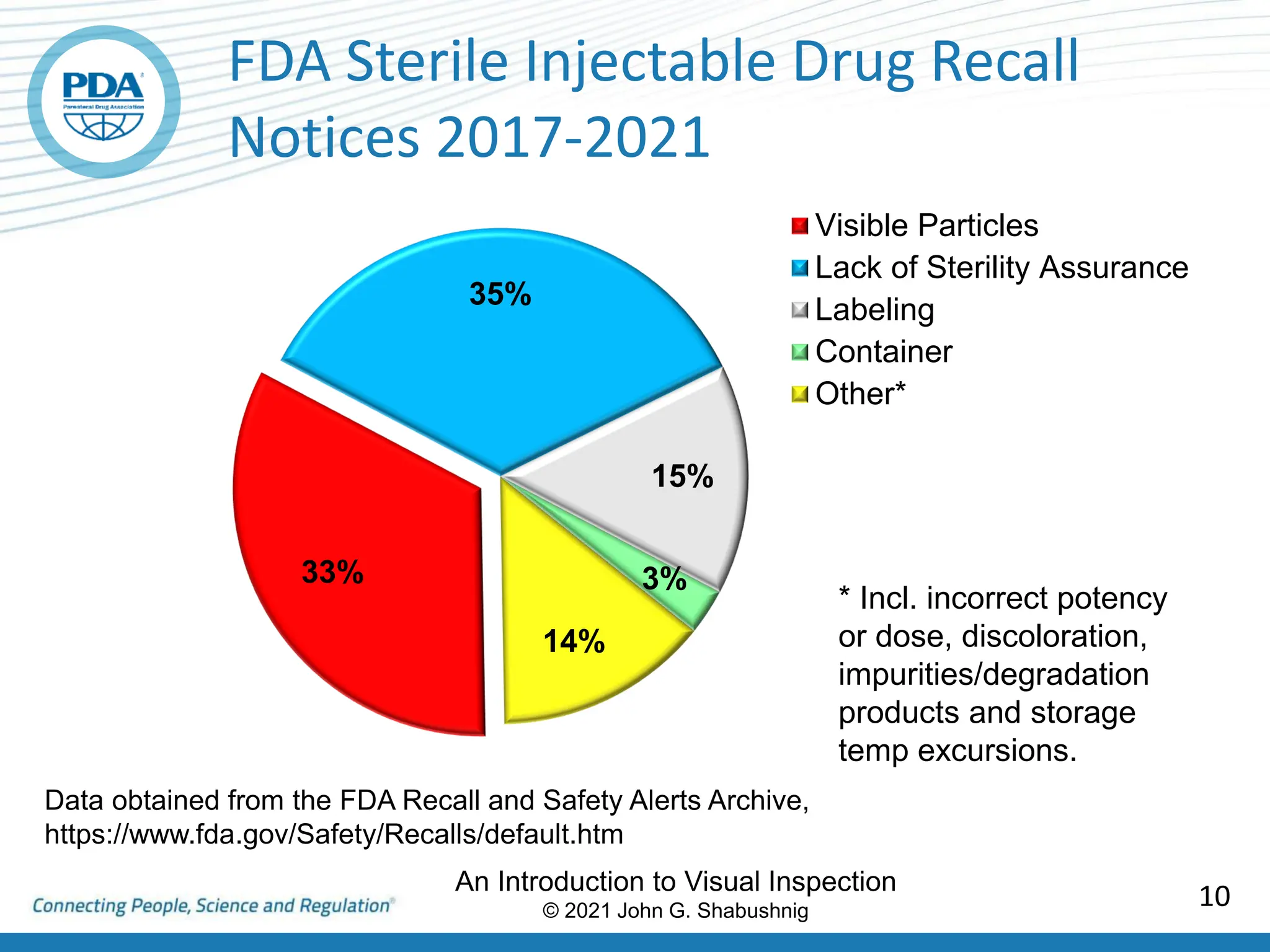
FDA Sterile Injectable Drug Recall
Notices 2017-2021
33%
35%
15%
3%
14%
Visible Particles
Lack of Sterility Assurance
Labeling
Container
Other*
10
* Incl. incorrect potency
or dose, discoloration,
impurities/degradation
products and storage
temp excursions.
Data obtained from the FDA Recall and Safety Alerts Archive,
https://www.fda.gov/Safety/Recalls/default.htm
An Introduction to Visual Inspection
© 2021 John G. Shabushnig
11
Visible Particulate Recall Notices
10
12
11
21
25
12
11
8 8
9
6
5
0
10
20
30
Recall
Events
Year
Data obtained from the FDA Recall and Safety Alerts Archive,
https://www.fda.gov/Safety/Recalls/default.htm
An Introduction to Visual Inspection
© 2021 John G. Shabushnig
Recent FDA Recalls
• 1-8-2019 Sun Pharmaceutical Industries, Inc. Issues Voluntary
Nationwide Recall of Vecuronium Bromide for Injection Due to the
Presence of Particulate Matter Identified as Glass
– Glass particles
• 1-5-2019 Lupin Pharmaceuticals, Inc. Issue Voluntary Recall of
Ceftriaxone for Injection USP, 250mg, 500mg, 1g and 2g
– Rubber particles
• 6-4-2018 Hospira Issues a Voluntary Nationwide Recall for Two Lots of
Naloxone Hydrochloride Injection, USP, in the Carpuject™ Syringe
System due to the Potential Presence of Particulate Matter
– Loose and embedded particles
• 1-16-2018 Baxter Expands Voluntary Nationwide Recall to Include
Second Lot of Nexterone Injection Due to Presence of Particulate
Matter
– Polyethylene particles
12
An Introduction to Visual Inspection
© 2021 John G. Shabushnig
US FDA 483 Themes
• Must establish a maximum allowable reject rate.
• Must control reinspection of product, including
when appropriate, inspection conditions and
number of reinspections permitted.
• Inspectors must be trained and training
documented.
• Inspectors must be periodically recertified.
• Training and certification conditions must align
with routine 100% inspection conditions.
• Address inspection fatigue during qualification.
13
An Introduction to Visual Inspection
© 2021 John G. Shabushnig
US FDA 483 Themes
• Must conduct thorough investigations. Identify
particulate matter when performing investigations.
• Must use statistically sound sampling plan(s) for
AQL inspection.
14
An Introduction to Visual Inspection
© 2021 John G. Shabushnig
US FDA FD&C Act
• Food Drug and Cosmetic (FD&C) Act
– 501(a)(1): “if it consists in whole or in part of any filthy,
putrid, or decomposed substance”
– 501(a)(2)(A): “if it has been prepared, packed, or held
under insanitary conditions whereby it may have been
contaminated with filth, or whereby it may have been
rendered injurious to health”
– 501(a)(2)(B): “if it is a drug and the methods used in, or
the facilities or controls used for, its manufacture,
processing, packing, or holding do not conform to or are
not operated or administered in conformity with current
good manufacturing practice”
15
An Introduction to Visual Inspection
© 2021 John G. Shabushnig
US FDA CFR
• Code of Federal Regulations (CFR)
– 21 CFR 211.94 Drug Product Containers and Closures
• (a) Drug product containers and closures shall not be reactive,
additive, or absorptive …
• (b) Container closure systems shall provide adequate
protection …
• (c) Drug product containers and closures shall be clean …
– 21 CFR 211.165 Testing and Release for Distribution
• (f) Drug products failing to meet established standards or
specifications and any other relevant quality control criteria
shall be rejected. Reprocessing may be performed. Prior to
acceptance and use, reprocessed material must meet
appropriate standards, specifications, and any other relevant
criteria.
16
An Introduction to Visual Inspection
© 2021 John G. Shabushnig
US FDA Compliance Program
Guidance Manual 7356.002A
• 100% Inspection of Injectable Products
– Verify written procedures that define the defects
removed and actions taken if the number of critical
defects exceeds a pre-determined level.
– Defect categories should be identified. Results of
inspection of each batch should be compared to
established levels.
– Evaluate appropriateness of pre-determined action
levels.
– Evaluate firms investigations, including units rejected
for cracks and visible particulates.
17
An Introduction to Visual Inspection
© 2021 John G. Shabushnig
US FDA Compliance Program
Guidance Manual 7356.002A
– Observe the inspection process.
– Challenge inspection rates through observation.
– Evaluate adequacy of written procedures.
– Evaluate personnel qualification and requalification and
equipment qualifications. Evaluate personnel
qualification including the use of reference samples.
– Evaluate the firm’s program for sampling and
examination of inspected vials.
– Evaluate the firm’s assessment of units rejected during
filling or any separate inspection prior to 100%
inspection, established alert/action limits and
investigations where appropriate.
18
An Introduction to Visual Inspection
© 2021 John G. Shabushnig
US FDA Compliance Program
Guidance Manual 7356.002A
• The following list of deficiencies represents
examples of practices that CDER believes could
warrant regulatory and/or administrative action:
– Failure to provide adequate training to employees
who work in critical operations, such as … those who
perform the 100% inspection of filled injectable
products.
– Failure to perform adequate 100% inspection of
injectable products for particulate matter and other
defects.
19
An Introduction to Visual Inspection
© 2021 John G. Shabushnig
Pharmacopeial Requirements
USP <790> EP 2.9.20 JP 6.06
Illumination
Intensity (lux)
2,000-3,750 2,000-3,750 2,000-3,750 lux
(8,000-10,000)*
Inspection
Time (sec)
10 sec 10 sec 10 sec
Background Black/White Black/White Black/White
Acceptance
Criteria
“essentially free
from visible
particulates”
ANSI/ASQ Z1.4
AQL=0.65%
“clear and
practically
particle-free”
“free of readily
detectable
foreign insoluble
matter”
20
* Illumination intensity for plastic containers
An Introduction to Visual Inspection
© 2021 John G. Shabushnig
United States Pharmacopoeia USP 43
• USP <1> Injections and Implanted Drug Products
(Parenterals) – Product Quality Tests
– Foreign and particulate matter: Articles intended for
parenteral administration should be prepared in a
manner designed to exclude particulate matter … Each
final container of all parenteral preparations should be
inspected to the extent possible for the presence of
observable foreign and particulate matter (hereafter
termed visible particulates) in its contents. The
inspection process should be designed and qualified to
ensure that every lot of all parenteral preparations is
essentially free from visible particulates …
21
An Introduction to Visual Inspection
© 2021 John G. Shabushnig
United States Pharmacopoeia USP 43
• USP <1> Injections and Implanted Drug Products
(Parenterals) – Product Quality Tests
– Qualification of the inspection process should be
performed with reference to particulates in the visible
range and those particulates that might emanate from
the manufacturing or filling process. Every container in
which the contents show evidence of visible
particulates must be rejected. The inspection for visible
particulates may take place during examination for
other critical defects such as cracked or defective
containers or seals or when characterizing the
appearance of a lyophilized product.
22
An Introduction to Visual Inspection
© 2021 John G. Shabushnig
United States Pharmacopeia USP 43
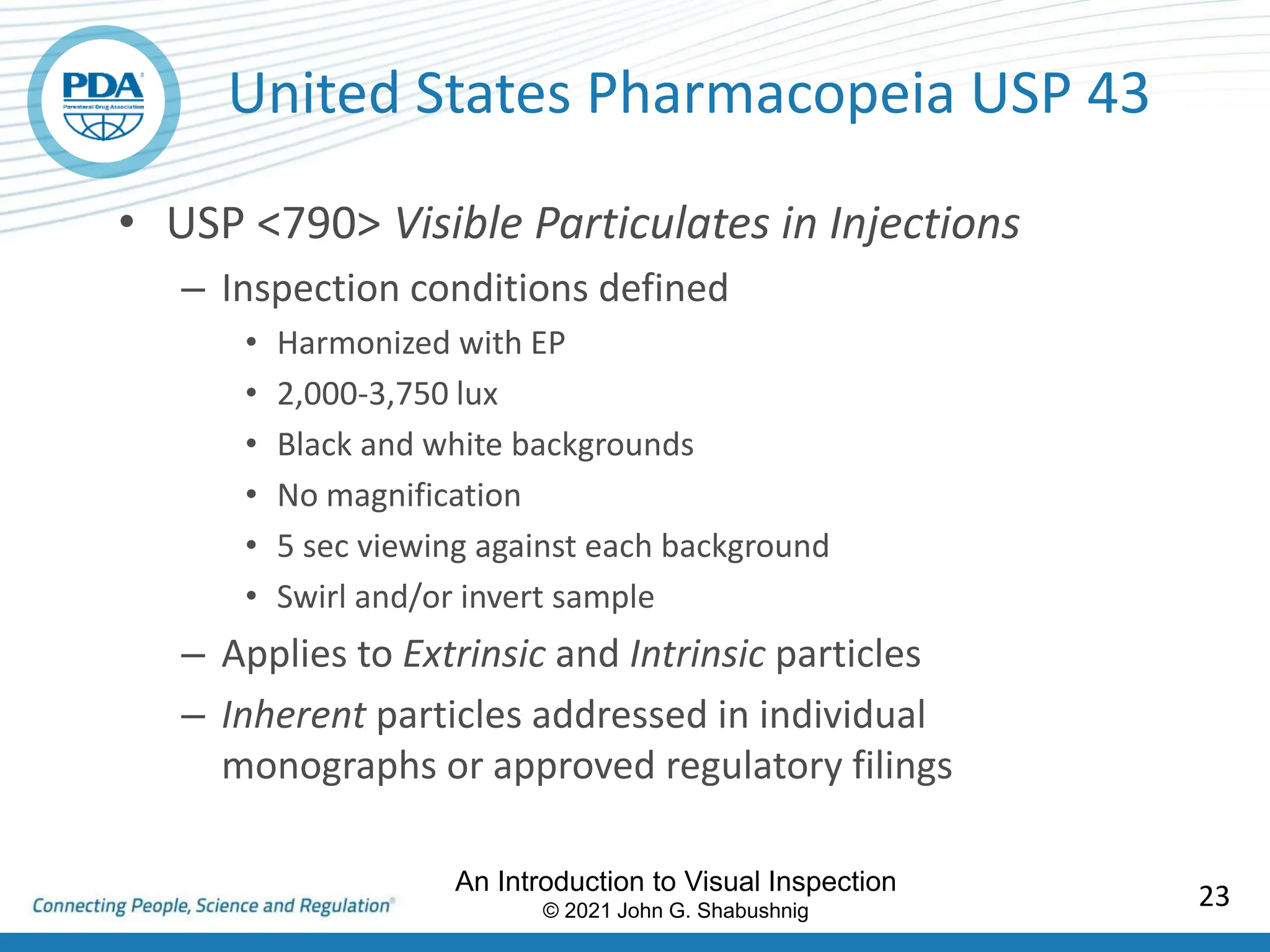
• USP <790> Visible Particulates in Injections
– Inspection conditions defined
• Harmonized with EP
• 2,000-3,750 lux
• Black and white backgrounds
• No magnification
• 5 sec viewing against each background
• Swirl and/or invert sample
– Applies to Extrinsic and Intrinsic particles
– Inherent particles addressed in individual
monographs or approved regulatory filings
23
An Introduction to Visual Inspection
© 2021 John G. Shabushnig
USP <790> Acceptance Criteria
• At Time of Batch Release
– 100% inspection followed by acceptance sampling
– ANSI/ASQ Z1.4 or ISO 2859
– AQL= 0.65%, UQL= 2.3-3.3% typical
– Alternate and equivalent plans acceptable
• For Product in Distribution
– n = 20, a = 0
– AQL= 0.26%, UQL= 10.9%
24
An Introduction to Visual Inspection
© 2021 John G. Shabushnig
USP <790> Acceptance Criteria
• Supplemental Inspection
– Where the nature of the contents or the container–
closure system permits only limited capability for
inspection of the total contents, the 100% inspection of
a batch shall be supplemented with the inspection of
constituted (e.g., dried) or withdrawn (e.g., dark amber
container, suspensions, highly colored liquids) contents
of a sample of containers from the batch. The
destructive nature of these tests requires the use of a
sample smaller than those traditionally used for non-
destructive acceptance sampling after 100% inspection.
25
An Introduction to Visual Inspection
© 2021 John G. Shabushnig
USP <790> Acceptance Criteria
• At Time of Batch Release
– 100% inspection followed by acceptance sampling
– ANSI/ASQ Z1.4 or ISO 2859
– AQL= 0.65%, UQL= 2.3-3.3% typical
– Alternate and equivalent plans acceptable
• For Product in Distribution
– n = 20, a = 0
– AQL= 0.26%, UQL= 10.9%
26
An Introduction to Visual Inspection
© 2021 John G. Shabushnig
USP <1790>
• <1790> Visual Inspection of Injections
– Information Chapter
– Key elements of an inspection process
• Patient Risk
• Elements of a good inspection process
• Lifecycle / Continuous Improvement
• Visible Defect Types
– Extrinsic, Intrinsic and Inherent
• Inspection Technologies
– Published in USP 40 1st Supplement
• Official Aug 2017
27
An Introduction to Visual Inspection
© 2021 John G. Shabushnig
USP <1790>
28
Filling
100%
Inspection
Packaging
Acceptance
Sampling
and Testing
Analyze and
Trend Rejects
Rejected
Units
Supplemental
Testing
Accepted
Units
An Introduction to Visual Inspection
© 2021 John G. Shabushnig
Other USP Related Chapters
• Related Chapters
– <771> Ophthalmic Products – Quality Tests
– <787> Subvisible Particulate Matter in Therapeutic
Protein Injections
– <788> Particulate Matter in Injections
– <789> Particulate Matter in Ophthalmic Solutions
– <1787> Measurement of Subvisible Particulate Matter
in Therapeutic Protein Injections
– <1788> Methods for the Determination of Particulate
Matter in Injections and Ophthalmic Solutions
29
An Introduction to Visual Inspection
© 2021 John G. Shabushnig
EC GMP Annex 1 / WHO Annex 6
• Finishing of Sterile Products
EC 124 / WHO 11.3. Filled containers of parenteral
products should be inspected individually for extraneous
contamination or other defects. When inspection is done
visually, it should be done under suitable and controlled
conditions of illumination and background. Operators
doing the inspection should pass regular eye-sight checks,
with spectacles if worn, and be allowed frequent breaks
from inspection. …
30
An Introduction to Visual Inspection
© 2021 John G. Shabushnig
EC GMP Annex 1 / WHO Annex 6
• Finishing of Sterile Products
EC 124 / WHO 11.3. … Where other methods of
inspection are used, the process should be validated and
the performance of the equipment checked at intervals.
Results should be recorded.
31
An Introduction to Visual Inspection
© 2021 John G. Shabushnig
Proposed Revisions to Annex 1
Manufacture of Sterile Medicinal Products
Published Dec 20, 2017
Additional comments requested Feb 18, 2020
8. Finishing of Sterile Products
8.21 Sealing/Container Integrity
8.29 General Visual Inspection
8.30 Manual Inspection
8.31 Automated Inspection
8.32 Trending
32
An Introduction to Visual Inspection
© 2021 John G. Shabushnig
8.21 Sealing/Container Integrity
• Containers should be closed by an appropriate
validated method
• Containers closed by fusion (BFS, FFS, flex bags, glass
or plastic ampoules) should be 100% integrity tested
• A sample of other containers should be checked for
integrity using a validated method
• A statistically valid sampling plan should be used
• “… visual inspection alone is not considered an acceptable
integrity test method.”
33
An Introduction to Visual Inspection
© 2021 John G. Shabushnig
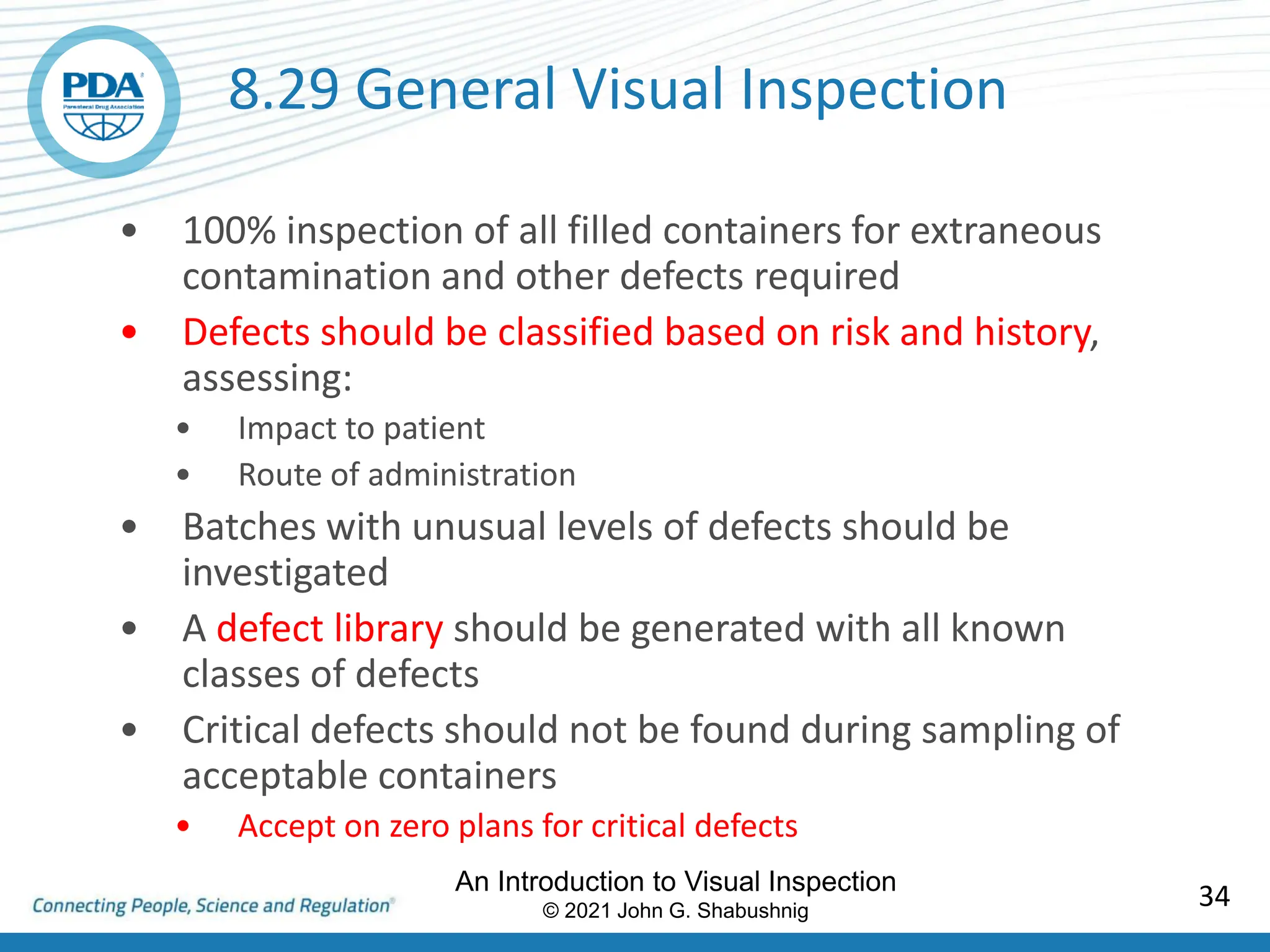
8.29 General Visual Inspection
• 100% inspection of all filled containers for extraneous
contamination and other defects required
• Defects should be classified based on risk and history,
assessing:
• Impact to patient
• Route of administration
• Batches with unusual levels of defects should be
investigated
• A defect library should be generated with all known
classes of defects
• Critical defects should not be found during sampling of
acceptable containers
• Accept on zero plans for critical defects
34
An Introduction to Visual Inspection
© 2021 John G. Shabushnig
8.30 Manual Inspection
• Inspection should be done under suitable and controlled
conditions
• EP 2.9.20 provides reference conditions
• Operators must be qualified and requalified at least
annually
• Should address worst-case inspection rate/speed, component
size and fatigue
• Eyesight checks should be performed as part of requalification
• Operators should be given frequent breaks
35
An Introduction to Visual Inspection
© 2021 John G. Shabushnig
8.31 Automated Inspection
• Automated methods should be validated with known
defects
• Method should provide sensitivity equal to or better
than manual inspection
• Equipment should be checked prior to start-up and at
regular intervals
36
An Introduction to Visual Inspection
© 2021 John G. Shabushnig
8.32 Trending
• Reject rates for various defect types should be trended
• Adverse trends should be investigated
• Impact to product on the market should be assessed as pat of
investigation
37
An Introduction to Visual Inspection
© 2021 John G. Shabushnig
European Pharmacopeia
• EP 10.0 Parenteral Preparations - Parenteralia
Containers for parenteral preparations are made as far as
possible from materials that are sufficiently transparent
to permit the visual inspection of the contents, except for
implants and in other justified and authorised cases.
• EP 10.0 Parenteral Preparations - Injections
Solutions for injection, examined under suitable
conditions of visibility, are clear and practically free from
particles.
38
An Introduction to Visual Inspection
© 2021 John G. Shabushnig
European Pharmacopeia
• EP 2.9.20 Particulate Contamination: Visible
Particles
Particulate contamination consists of mobile undissolved
substances other than gas bubbles, unintentionally
present in liquid preparations.
The test is intended to provide a simple procedure for the
visual assessment of the quality of liquid preparations, if
applicable after reconstitution, as regards visible particles.
39
An Introduction to Visual Inspection
© 2021 John G. Shabushnig
European Pharmacopeia
• Apparatus
– Vertical matte black panel
– Vertical non-glare white panel next to black panel
– Lamp holder … with … shaded, white light source and …
diffuser (… two 13W fluorescent tubes, each 525 mm
(20.7 in) in length, or an … LED light source). …
illumination at the viewing point is … between 2000
and 3750 lux, although higher values may be required
for for coloured glass and plastic containers and for
coloured or turbid preparations.
40
An Introduction to Visual Inspection
© 2021 John G. Shabushnig
European Pharmacopeia
41
An Introduction to Visual Inspection
© 2021 John G. Shabushnig
European Pharmacopeia
• Changes …
– Official Jan 2020
– Applicable to reconstituted solutions
– Increased light levels for turbid or colored solutions, as
well as plastic or colored glass containers
– Transfer to clear containers for evaluation when
needed
– Addition of LED as acceptable light source
42
An Introduction to Visual Inspection
© 2021 John G. Shabushnig
European Pharmacopeia (cont.)
Chapter 5.17.2 Recommendations on Testing of
Particulate Contamination: Visible Particles (new)
• Official Jan 2021
• General considerations and workflow agree with
recommendations in USP <1790>.
• Definitions of Extrinsic and Intrinsic particles do not
align with USP <790> and <1790>.
• Those derived from primary packaging and equipment are
considered extrinsic
• Those resulting from the formulation are intrinsic
• No inherent particle definition
43
An Introduction to Visual Inspection
© 2021 John G. Shabushnig
EP 5.17.2
• “… although there is little supporting evidence generated
by clinical studies, visible particles are … a potential safety
concern, and their presence should … be minimized as far
as possible in any product … for humans or animals.”
• Recommend ISO 2859-1 sampling plans for acceptance
sampling (AQL inspection) but no specific
recommendations for AQL values are made.
• Visible particles should be classified as “at least a major
defect”.
• Inspector training and qualification with prepared defect
sets is described.
• Probabilistic nature of inspection is discussed.
44
An Introduction to Visual Inspection
© 2021 John G. Shabushnig
Other Standards
• World Health Organization
– International Pharmacopeia
• Other National Pharmacopeia
– Chinese Pharmacopeia
– British Pharmacopeia
• Guidelines for Particulate Matter Control in
Injections (1998)
– Legislation of the Russian Federation
45
An Introduction to Visual Inspection
© 2021 John G. Shabushnig
Conclusions
• High concern with visible particulates by global
authorities.
• Requirements are often ambiguous (but getting
better).
• Movement towards global harmonization of
manual inspection conditions.
46
An Introduction to Visual Inspection
© 2021 John G. Shabushnig
Acknowledgements
• USP Visual Inspection Expert Panel
- D. Scott Aldrich - Ultramikro
- John Ayres - Pharma Safety Solutions
- Roy Cherris - Bridge Associates International
- Mary Lee Ciolkowski - Bausch & Lomb
- Desmond Hunt - USP
- Steve Langille - ValSource
- Russell Madsen - The Williamsburg Group
- John Shabushnig (Chair) - Insight Pharma Consulting
- Deborah Shnek - Alder Biopharmaceuticals
- Hailin Wang – FDA
- Neal Zupec - Baxter
47
An Introduction to Visual Inspection
© 2021 John G. Shabushnig
Questions?
48

Visual inspection of parenteral dosage forms

  • 1.
    An Introduction toVisual Inspection © 2021 John G. Shabushnig Visual Inspection of Injectable Products: More than Sorting Good from Bad … John G. Shabushnig, Ph.D. Insight Pharma Consulting, LLC johnshabushnig@aol.com October 2021
  • 2.
    An Introduction toVisual Inspection © 2021 John G. Shabushnig Agenda • Patient Risk / Foreign Matter Concerns • US FDA • US Pharmacopeia (USP) • EC GMP’s • European Pharmacopeia (EP) / Pharm Eur • Other Standards 2
  • 3.
    An Introduction toVisual Inspection © 2021 John G. Shabushnig 3
  • 4.
    An Introduction toVisual Inspection © 2021 John G. Shabushnig 4 Why inspect?
  • 5.
    An Introduction toVisual Inspection © 2021 John G. Shabushnig Why Inspect? • Patient Risk – Physiological Implications – Chemical and Microbiological Implications • Compendial Requirements • Regulatory Requirements • Process Knowledge and Continuous Process Improvement 5
  • 6.
    An Introduction toVisual Inspection © 2021 John G. Shabushnig Particulate Matter Concerns • Patient Risk Factors to Consider: – Particle Size • Is the size in the range that will pass through the needle? – Quantity • Many vs. Single – Composition • Single 100 µm particle in 1mL dose is equivalent to an impurity level of 4 ppm (v/v) – Generally not a tox concern • Extrinsic vs. Intrinsic • Inert? • Biological? 6
  • 7.
    An Introduction toVisual Inspection © 2021 John G. Shabushnig Particulate Matter Concerns (cont.) – Sterility • Extrinsic vs. Intrinsic • Aseptic Process vs. Terminal Sterilization – Duration of Exposure • Chronic vs. Single Dose – Route of Administration • IV vs. IM vs. Sub-Q • Intrathecal, Intraocular – Antigenic Potential • 1-10µm protein particles – Intended Patient Population • Infant vs. Adult • Compromised vs. Healthy 7
  • 8.
    An Introduction toVisual Inspection © 2021 John G. Shabushnig Particulate Size Ranges 8 Nanometer Sub-visible Visible 1 - 100 µm <100 nm >100 µm • SEC (Size Exclusion Chromatography) • FFF (Field Flow Fractionation) • SDS-Page Gels • AUC (Analytical Ultra- Centrifugation) • Light Obscuration • Microscopy • Flow Microscopy • Coulter Counter • Manual / Human • Semi-Automated • Automated Narhi, et al. J Pharm Sci, 2012 Sub-micron 100 - 1,000 nm
  • 9.
    An Introduction toVisual Inspection © 2021 John G. Shabushnig Particulate Matter Definitions • Extrinsic (from outside the process, uncontrolled) – Environmental Contaminants • insect parts, hair, fibers, paint, rust • Intrinsic (from within the process, unplanned) – Processing Equipment, Primary Package • qualified product contact materials (e.g. stainless steel, glass, rubber, silicone oil) • Inherent (part of the formulation, controlled and expected) – Protein agglomerates 9 RISK
  • 10.
    An Introduction toVisual Inspection © 2021 John G. Shabushnig FDA Sterile Injectable Drug Recall Notices 2017-2021 33% 35% 15% 3% 14% Visible Particles Lack of Sterility Assurance Labeling Container Other* 10 * Incl. incorrect potency or dose, discoloration, impurities/degradation products and storage temp excursions. Data obtained from the FDA Recall and Safety Alerts Archive, https://www.fda.gov/Safety/Recalls/default.htm
  • 11.
    An Introduction toVisual Inspection © 2021 John G. Shabushnig 11 Visible Particulate Recall Notices 10 12 11 21 25 12 11 8 8 9 6 5 0 10 20 30 Recall Events Year Data obtained from the FDA Recall and Safety Alerts Archive, https://www.fda.gov/Safety/Recalls/default.htm
  • 12.
    An Introduction toVisual Inspection © 2021 John G. Shabushnig Recent FDA Recalls • 1-8-2019 Sun Pharmaceutical Industries, Inc. Issues Voluntary Nationwide Recall of Vecuronium Bromide for Injection Due to the Presence of Particulate Matter Identified as Glass – Glass particles • 1-5-2019 Lupin Pharmaceuticals, Inc. Issue Voluntary Recall of Ceftriaxone for Injection USP, 250mg, 500mg, 1g and 2g – Rubber particles • 6-4-2018 Hospira Issues a Voluntary Nationwide Recall for Two Lots of Naloxone Hydrochloride Injection, USP, in the Carpuject™ Syringe System due to the Potential Presence of Particulate Matter – Loose and embedded particles • 1-16-2018 Baxter Expands Voluntary Nationwide Recall to Include Second Lot of Nexterone Injection Due to Presence of Particulate Matter – Polyethylene particles 12
  • 13.
    An Introduction toVisual Inspection © 2021 John G. Shabushnig US FDA 483 Themes • Must establish a maximum allowable reject rate. • Must control reinspection of product, including when appropriate, inspection conditions and number of reinspections permitted. • Inspectors must be trained and training documented. • Inspectors must be periodically recertified. • Training and certification conditions must align with routine 100% inspection conditions. • Address inspection fatigue during qualification. 13
  • 14.
    An Introduction toVisual Inspection © 2021 John G. Shabushnig US FDA 483 Themes • Must conduct thorough investigations. Identify particulate matter when performing investigations. • Must use statistically sound sampling plan(s) for AQL inspection. 14
  • 15.
    An Introduction toVisual Inspection © 2021 John G. Shabushnig US FDA FD&C Act • Food Drug and Cosmetic (FD&C) Act – 501(a)(1): “if it consists in whole or in part of any filthy, putrid, or decomposed substance” – 501(a)(2)(A): “if it has been prepared, packed, or held under insanitary conditions whereby it may have been contaminated with filth, or whereby it may have been rendered injurious to health” – 501(a)(2)(B): “if it is a drug and the methods used in, or the facilities or controls used for, its manufacture, processing, packing, or holding do not conform to or are not operated or administered in conformity with current good manufacturing practice” 15
  • 16.
    An Introduction toVisual Inspection © 2021 John G. Shabushnig US FDA CFR • Code of Federal Regulations (CFR) – 21 CFR 211.94 Drug Product Containers and Closures • (a) Drug product containers and closures shall not be reactive, additive, or absorptive … • (b) Container closure systems shall provide adequate protection … • (c) Drug product containers and closures shall be clean … – 21 CFR 211.165 Testing and Release for Distribution • (f) Drug products failing to meet established standards or specifications and any other relevant quality control criteria shall be rejected. Reprocessing may be performed. Prior to acceptance and use, reprocessed material must meet appropriate standards, specifications, and any other relevant criteria. 16
  • 17.
    An Introduction toVisual Inspection © 2021 John G. Shabushnig US FDA Compliance Program Guidance Manual 7356.002A • 100% Inspection of Injectable Products – Verify written procedures that define the defects removed and actions taken if the number of critical defects exceeds a pre-determined level. – Defect categories should be identified. Results of inspection of each batch should be compared to established levels. – Evaluate appropriateness of pre-determined action levels. – Evaluate firms investigations, including units rejected for cracks and visible particulates. 17
  • 18.
    An Introduction toVisual Inspection © 2021 John G. Shabushnig US FDA Compliance Program Guidance Manual 7356.002A – Observe the inspection process. – Challenge inspection rates through observation. – Evaluate adequacy of written procedures. – Evaluate personnel qualification and requalification and equipment qualifications. Evaluate personnel qualification including the use of reference samples. – Evaluate the firm’s program for sampling and examination of inspected vials. – Evaluate the firm’s assessment of units rejected during filling or any separate inspection prior to 100% inspection, established alert/action limits and investigations where appropriate. 18
  • 19.
    An Introduction toVisual Inspection © 2021 John G. Shabushnig US FDA Compliance Program Guidance Manual 7356.002A • The following list of deficiencies represents examples of practices that CDER believes could warrant regulatory and/or administrative action: – Failure to provide adequate training to employees who work in critical operations, such as … those who perform the 100% inspection of filled injectable products. – Failure to perform adequate 100% inspection of injectable products for particulate matter and other defects. 19
  • 20.
    An Introduction toVisual Inspection © 2021 John G. Shabushnig Pharmacopeial Requirements USP <790> EP 2.9.20 JP 6.06 Illumination Intensity (lux) 2,000-3,750 2,000-3,750 2,000-3,750 lux (8,000-10,000)* Inspection Time (sec) 10 sec 10 sec 10 sec Background Black/White Black/White Black/White Acceptance Criteria “essentially free from visible particulates” ANSI/ASQ Z1.4 AQL=0.65% “clear and practically particle-free” “free of readily detectable foreign insoluble matter” 20 * Illumination intensity for plastic containers
  • 21.
    An Introduction toVisual Inspection © 2021 John G. Shabushnig United States Pharmacopoeia USP 43 • USP <1> Injections and Implanted Drug Products (Parenterals) – Product Quality Tests – Foreign and particulate matter: Articles intended for parenteral administration should be prepared in a manner designed to exclude particulate matter … Each final container of all parenteral preparations should be inspected to the extent possible for the presence of observable foreign and particulate matter (hereafter termed visible particulates) in its contents. The inspection process should be designed and qualified to ensure that every lot of all parenteral preparations is essentially free from visible particulates … 21
  • 22.
    An Introduction toVisual Inspection © 2021 John G. Shabushnig United States Pharmacopoeia USP 43 • USP <1> Injections and Implanted Drug Products (Parenterals) – Product Quality Tests – Qualification of the inspection process should be performed with reference to particulates in the visible range and those particulates that might emanate from the manufacturing or filling process. Every container in which the contents show evidence of visible particulates must be rejected. The inspection for visible particulates may take place during examination for other critical defects such as cracked or defective containers or seals or when characterizing the appearance of a lyophilized product. 22
  • 23.
    An Introduction toVisual Inspection © 2021 John G. Shabushnig United States Pharmacopeia USP 43 • USP <790> Visible Particulates in Injections – Inspection conditions defined • Harmonized with EP • 2,000-3,750 lux • Black and white backgrounds • No magnification • 5 sec viewing against each background • Swirl and/or invert sample – Applies to Extrinsic and Intrinsic particles – Inherent particles addressed in individual monographs or approved regulatory filings 23
  • 24.
    An Introduction toVisual Inspection © 2021 John G. Shabushnig USP <790> Acceptance Criteria • At Time of Batch Release – 100% inspection followed by acceptance sampling – ANSI/ASQ Z1.4 or ISO 2859 – AQL= 0.65%, UQL= 2.3-3.3% typical – Alternate and equivalent plans acceptable • For Product in Distribution – n = 20, a = 0 – AQL= 0.26%, UQL= 10.9% 24
  • 25.
    An Introduction toVisual Inspection © 2021 John G. Shabushnig USP <790> Acceptance Criteria • Supplemental Inspection – Where the nature of the contents or the container– closure system permits only limited capability for inspection of the total contents, the 100% inspection of a batch shall be supplemented with the inspection of constituted (e.g., dried) or withdrawn (e.g., dark amber container, suspensions, highly colored liquids) contents of a sample of containers from the batch. The destructive nature of these tests requires the use of a sample smaller than those traditionally used for non- destructive acceptance sampling after 100% inspection. 25
  • 26.
    An Introduction toVisual Inspection © 2021 John G. Shabushnig USP <790> Acceptance Criteria • At Time of Batch Release – 100% inspection followed by acceptance sampling – ANSI/ASQ Z1.4 or ISO 2859 – AQL= 0.65%, UQL= 2.3-3.3% typical – Alternate and equivalent plans acceptable • For Product in Distribution – n = 20, a = 0 – AQL= 0.26%, UQL= 10.9% 26
  • 27.
    An Introduction toVisual Inspection © 2021 John G. Shabushnig USP <1790> • <1790> Visual Inspection of Injections – Information Chapter – Key elements of an inspection process • Patient Risk • Elements of a good inspection process • Lifecycle / Continuous Improvement • Visible Defect Types – Extrinsic, Intrinsic and Inherent • Inspection Technologies – Published in USP 40 1st Supplement • Official Aug 2017 27
  • 28.
    An Introduction toVisual Inspection © 2021 John G. Shabushnig USP <1790> 28 Filling 100% Inspection Packaging Acceptance Sampling and Testing Analyze and Trend Rejects Rejected Units Supplemental Testing Accepted Units
  • 29.
    An Introduction toVisual Inspection © 2021 John G. Shabushnig Other USP Related Chapters • Related Chapters – <771> Ophthalmic Products – Quality Tests – <787> Subvisible Particulate Matter in Therapeutic Protein Injections – <788> Particulate Matter in Injections – <789> Particulate Matter in Ophthalmic Solutions – <1787> Measurement of Subvisible Particulate Matter in Therapeutic Protein Injections – <1788> Methods for the Determination of Particulate Matter in Injections and Ophthalmic Solutions 29
  • 30.
    An Introduction toVisual Inspection © 2021 John G. Shabushnig EC GMP Annex 1 / WHO Annex 6 • Finishing of Sterile Products EC 124 / WHO 11.3. Filled containers of parenteral products should be inspected individually for extraneous contamination or other defects. When inspection is done visually, it should be done under suitable and controlled conditions of illumination and background. Operators doing the inspection should pass regular eye-sight checks, with spectacles if worn, and be allowed frequent breaks from inspection. … 30
  • 31.
    An Introduction toVisual Inspection © 2021 John G. Shabushnig EC GMP Annex 1 / WHO Annex 6 • Finishing of Sterile Products EC 124 / WHO 11.3. … Where other methods of inspection are used, the process should be validated and the performance of the equipment checked at intervals. Results should be recorded. 31
  • 32.
    An Introduction toVisual Inspection © 2021 John G. Shabushnig Proposed Revisions to Annex 1 Manufacture of Sterile Medicinal Products Published Dec 20, 2017 Additional comments requested Feb 18, 2020 8. Finishing of Sterile Products 8.21 Sealing/Container Integrity 8.29 General Visual Inspection 8.30 Manual Inspection 8.31 Automated Inspection 8.32 Trending 32
  • 33.
    An Introduction toVisual Inspection © 2021 John G. Shabushnig 8.21 Sealing/Container Integrity • Containers should be closed by an appropriate validated method • Containers closed by fusion (BFS, FFS, flex bags, glass or plastic ampoules) should be 100% integrity tested • A sample of other containers should be checked for integrity using a validated method • A statistically valid sampling plan should be used • “… visual inspection alone is not considered an acceptable integrity test method.” 33
  • 34.
    An Introduction toVisual Inspection © 2021 John G. Shabushnig 8.29 General Visual Inspection • 100% inspection of all filled containers for extraneous contamination and other defects required • Defects should be classified based on risk and history, assessing: • Impact to patient • Route of administration • Batches with unusual levels of defects should be investigated • A defect library should be generated with all known classes of defects • Critical defects should not be found during sampling of acceptable containers • Accept on zero plans for critical defects 34
  • 35.
    An Introduction toVisual Inspection © 2021 John G. Shabushnig 8.30 Manual Inspection • Inspection should be done under suitable and controlled conditions • EP 2.9.20 provides reference conditions • Operators must be qualified and requalified at least annually • Should address worst-case inspection rate/speed, component size and fatigue • Eyesight checks should be performed as part of requalification • Operators should be given frequent breaks 35
  • 36.
    An Introduction toVisual Inspection © 2021 John G. Shabushnig 8.31 Automated Inspection • Automated methods should be validated with known defects • Method should provide sensitivity equal to or better than manual inspection • Equipment should be checked prior to start-up and at regular intervals 36
  • 37.
    An Introduction toVisual Inspection © 2021 John G. Shabushnig 8.32 Trending • Reject rates for various defect types should be trended • Adverse trends should be investigated • Impact to product on the market should be assessed as pat of investigation 37
  • 38.
    An Introduction toVisual Inspection © 2021 John G. Shabushnig European Pharmacopeia • EP 10.0 Parenteral Preparations - Parenteralia Containers for parenteral preparations are made as far as possible from materials that are sufficiently transparent to permit the visual inspection of the contents, except for implants and in other justified and authorised cases. • EP 10.0 Parenteral Preparations - Injections Solutions for injection, examined under suitable conditions of visibility, are clear and practically free from particles. 38
  • 39.
    An Introduction toVisual Inspection © 2021 John G. Shabushnig European Pharmacopeia • EP 2.9.20 Particulate Contamination: Visible Particles Particulate contamination consists of mobile undissolved substances other than gas bubbles, unintentionally present in liquid preparations. The test is intended to provide a simple procedure for the visual assessment of the quality of liquid preparations, if applicable after reconstitution, as regards visible particles. 39
  • 40.
    An Introduction toVisual Inspection © 2021 John G. Shabushnig European Pharmacopeia • Apparatus – Vertical matte black panel – Vertical non-glare white panel next to black panel – Lamp holder … with … shaded, white light source and … diffuser (… two 13W fluorescent tubes, each 525 mm (20.7 in) in length, or an … LED light source). … illumination at the viewing point is … between 2000 and 3750 lux, although higher values may be required for for coloured glass and plastic containers and for coloured or turbid preparations. 40
  • 41.
    An Introduction toVisual Inspection © 2021 John G. Shabushnig European Pharmacopeia 41
  • 42.
    An Introduction toVisual Inspection © 2021 John G. Shabushnig European Pharmacopeia • Changes … – Official Jan 2020 – Applicable to reconstituted solutions – Increased light levels for turbid or colored solutions, as well as plastic or colored glass containers – Transfer to clear containers for evaluation when needed – Addition of LED as acceptable light source 42
  • 43.
    An Introduction toVisual Inspection © 2021 John G. Shabushnig European Pharmacopeia (cont.) Chapter 5.17.2 Recommendations on Testing of Particulate Contamination: Visible Particles (new) • Official Jan 2021 • General considerations and workflow agree with recommendations in USP <1790>. • Definitions of Extrinsic and Intrinsic particles do not align with USP <790> and <1790>. • Those derived from primary packaging and equipment are considered extrinsic • Those resulting from the formulation are intrinsic • No inherent particle definition 43
  • 44.
    An Introduction toVisual Inspection © 2021 John G. Shabushnig EP 5.17.2 • “… although there is little supporting evidence generated by clinical studies, visible particles are … a potential safety concern, and their presence should … be minimized as far as possible in any product … for humans or animals.” • Recommend ISO 2859-1 sampling plans for acceptance sampling (AQL inspection) but no specific recommendations for AQL values are made. • Visible particles should be classified as “at least a major defect”. • Inspector training and qualification with prepared defect sets is described. • Probabilistic nature of inspection is discussed. 44
  • 45.
    An Introduction toVisual Inspection © 2021 John G. Shabushnig Other Standards • World Health Organization – International Pharmacopeia • Other National Pharmacopeia – Chinese Pharmacopeia – British Pharmacopeia • Guidelines for Particulate Matter Control in Injections (1998) – Legislation of the Russian Federation 45
  • 46.
    An Introduction toVisual Inspection © 2021 John G. Shabushnig Conclusions • High concern with visible particulates by global authorities. • Requirements are often ambiguous (but getting better). • Movement towards global harmonization of manual inspection conditions. 46
  • 47.
    An Introduction toVisual Inspection © 2021 John G. Shabushnig Acknowledgements • USP Visual Inspection Expert Panel - D. Scott Aldrich - Ultramikro - John Ayres - Pharma Safety Solutions - Roy Cherris - Bridge Associates International - Mary Lee Ciolkowski - Bausch & Lomb - Desmond Hunt - USP - Steve Langille - ValSource - Russell Madsen - The Williamsburg Group - John Shabushnig (Chair) - Insight Pharma Consulting - Deborah Shnek - Alder Biopharmaceuticals - Hailin Wang – FDA - Neal Zupec - Baxter 47
  • 48.
    An Introduction toVisual Inspection © 2021 John G. Shabushnig Questions? 48