Zhen Wang, Shafei Ye, Jingjing Li, Bo Zheng, Manzhu Bao and Guogui
Ning
BioMed Central(BMC) Biotechnology
Volume No. 11 :109
2011
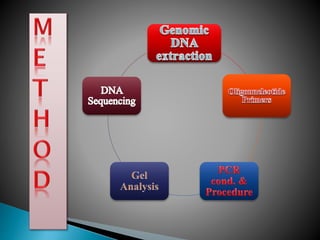
 Extraction of Genomic DNA of seven “Rosaceace” species.
 Genomic DNA of tobacco, Petunia hybrida, Arabidopsis and
rice. [20]
 From young leaves by NaOH fast extraction. [21]
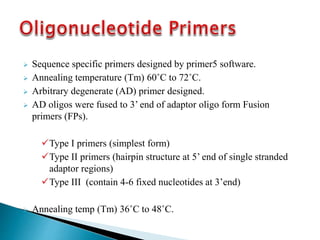
 Sequence specific primers designed by primer5 software.
 Annealing temperature (Tm) 60˚C to 72˚C.
 Arbitrary degenerate (AD) primer designed.
 AD oligos were fused to 3’ end of adaptor oligo form Fusion
primers (FPs).
Type I primers (simplest form)
Type II primers (hairpin structure at 5’ end of single stranded
adaptor regions)
Type III (contain 4-6 fixed nucleotides at 3’end)
 Annealing temp (Tm) 36˚C to 48˚C.
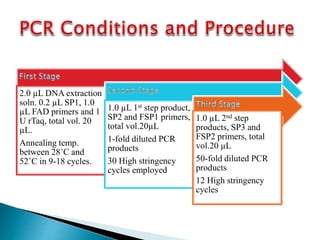
2.0 µL DNA extraction
soln. 0.2 µL SP1, 1.0
µL FAD primers and 1
U rTaq, total vol. 20
µL.
Annealing temp.
between 28˚C and
52˚C in 9-18 cycles.
1.0 µL 1st step product,
SP2 and FSP1 primers,
total vol.20µL
1-fold diluted PCR
products
30 High stringency
cycles employed
1.0 µL 2nd step
products, SP3 and
FSP2 primers, total
vol.20 µL
50-fold diluted PCR
products
12 High stringency
cycles
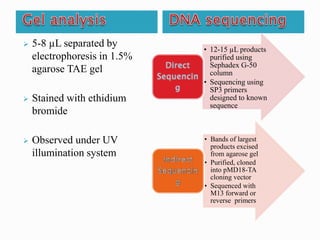
 5-8 µL separated by
electrophoresis in 1.5%
agarose TAE gel
 Stained with ethidium
bromide
 Observed under UV
illumination system
• 12-15 µL products
purified using
Sephadex G-50
column
• Sequencing using
SP3 primers
designed to known
sequence
• Bands of largest
products excised
from agarose gel
• Purified, cloned
into pMD18-TA
cloning vector
• Sequenced with
M13 forward or
reverse primers
 Using FPNI-PCR, isolated 21 genomic sequences .
 Nine fusion primers in conjunction of sequence-specific primers.
 These gene sequences deposited into Genbank library.
 Amplify various lengths of products expected flanking regions of 3
different gene of rice and Arabidopsis.
 Small DNA molecular size of vector flanking DNA successfully amplified.
 Amplified DNA fragments showed 100% accuracy to target products.
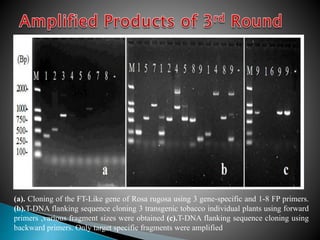
(a). Cloning of the FT-Like gene of Rosa rugosa using 3 gene-specific and 1-8 FP primers.
(b).T-DNA flanking sequence cloning 3 transgenic tobacco individual plants using forward
primers ,various fragment sizes were obtained (c).T-DNA flanking sequence cloning using
backward primers. Only target specific fragments were amplified
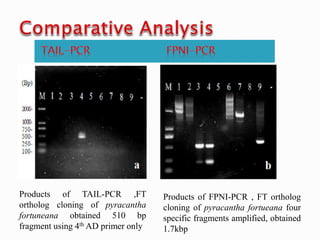
Products of TAIL-PCR ,FT
ortholog cloning of pyracantha
fortuneana obtained 510 bp
fragment using 4th AD primer only
Products of FPNI-PCR , FT ortholog
cloning of pyracantha fortueana four
specific fragments amplified, obtained
1.7kbp
TAIL-PCR FPNI-PCR
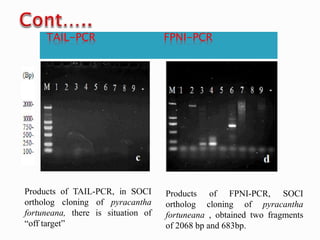
Products of TAIL-PCR, in SOCI
ortholog cloning of pyracantha
fortuneana, there is situation of
“off target”
Products of FPNI-PCR, SOCI
ortholog cloning of pyracantha
fortuneana , obtained two fragments
of 2068 bp and 683bp.
 Rapid identification of target genomic sequence, reducing
input of time and effort
 No difference found between direct sequencing and indirect
sequencing of cloned products within vector
 Can be proceed 1st step to 2nd without prior dilution of
products
 In 2nd PCR reaction can achieve > 85% positive cloning of
target products
 Amplify target products using 42-45 cycles, completed less
than 3 hours from start of extraction
 Proceeding through 3rd PCR & final sequencing steps, provide
100% positive results
 Total procedure was completed in just 54-57 cycles, in less
than 4 hours
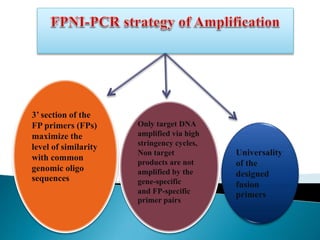
3’ section of the
FP primers (FPs)
maximize the
level of similarity
with common
genomic oligo
sequences
Universality
of the
designed
fusion
primers
Only target DNA
amplified via high
stringency cycles,
Non target
products are not
amplified by the
gene-specific
and FP-specific
primer pairs
 Yield small DNA fragments
 2 rounds of laborious DNA dilutions
 Uneconomical for primer designing
 Just 60% of reactions yielded specific
products [3]
 Take a whole working day
 Demand only extremely modest
levels of quantity and purity of the
template DNA
 FPNI-PCR reactions yielded DNA
fragments larger than 1.0 kb [6]
 Less complicated and easy to
manipulate
 100% specific product amplification
through high and low annealing T
[1,3]
 42-45 cycles take only 2 hours
 Demand only extremely modest
levels of quantity and purity of the
template DNA
1. [1] Liu YG, Mitsukawa N, Oosumi T, Whittier RF: Efficient isolation and mapping of
Arabidopsis thaliana T-DNA insert junctions by thermal asymmetric interlaced PCR. The
Plant Journal 1995, 8:457-463.
2. [2] Ji JB, Braam J: Restriction Site Extension PCR: A Novel Method for HighThroughput
Characterization of Tagged DNA Fragments and Genome Walking. Plos One 2010, 5:1-5.
3. [3] Liu YG, Chen YL: High-efficiency thermal asymmetric interlaced PCR for
amplification of unknown flanking sequences. BioTechniques 2007, 43:649-656.
4. [4] Reddy PS, Mahanty S, Kaul T, Nair S, Sopory SK, Reddy MK: A highthroughput
genome-walking method and its use for cloning unknown flanking sequences. Analytical
Biochemistry 2008, 381:248-253.
5. [15] Liu FY, Ma B, Zhao Y: Characterization of the gene encoding glycoprotein C of duck
enteritis virus. Virus Genes 2008, 37:328-332.
6. [20] Yang C, Zhang J, Xu Q, Xiong C, Bao M: Establishment of AFLP technique and
assessment of primer combinations for Mei Flower. Plant Molecular Biology Reporter
2005, 23:790-791.
7. [21] He YH, Ning GG, Sun YL, Qi YC, Bao MZ: Identification of a SCAR marker linked
to a recessive male sterile gene (Tems) and its application in breeding of marigold (Tagetes
erecta L.). Plant breeding 2009, 128:92-96
1. [20] Yang C, Zhang J, Xu Q, Xiong C, Bao M: Establishment of AFLP
technique and assessment of primer combinations for Mei Flower. Plant
Molecular Biology Reporter 2005, 23:790-791.
2. [21] He YH, Ning GG, Sun YL, Qi YC, Bao MZ: Identification of a
SCAR marker linked to a recessive male sterile gene (Tems) and its
application in breeding of marigold (Tagetes erecta L.). Plant breeding
2009, 128:92-96

Nested PCR,Fusion primers, Integrated PCR

  • 1.
    Zhen Wang, ShafeiYe, Jingjing Li, Bo Zheng, Manzhu Bao and Guogui Ning BioMed Central(BMC) Biotechnology Volume No. 11 :109 2011
  • 4.
     Extraction ofGenomic DNA of seven “Rosaceace” species.  Genomic DNA of tobacco, Petunia hybrida, Arabidopsis and rice. [20]  From young leaves by NaOH fast extraction. [21]
  • 5.
     Sequence specificprimers designed by primer5 software.  Annealing temperature (Tm) 60˚C to 72˚C.  Arbitrary degenerate (AD) primer designed.  AD oligos were fused to 3’ end of adaptor oligo form Fusion primers (FPs). Type I primers (simplest form) Type II primers (hairpin structure at 5’ end of single stranded adaptor regions) Type III (contain 4-6 fixed nucleotides at 3’end)  Annealing temp (Tm) 36˚C to 48˚C.
  • 6.
    2.0 µL DNAextraction soln. 0.2 µL SP1, 1.0 µL FAD primers and 1 U rTaq, total vol. 20 µL. Annealing temp. between 28˚C and 52˚C in 9-18 cycles. 1.0 µL 1st step product, SP2 and FSP1 primers, total vol.20µL 1-fold diluted PCR products 30 High stringency cycles employed 1.0 µL 2nd step products, SP3 and FSP2 primers, total vol.20 µL 50-fold diluted PCR products 12 High stringency cycles
  • 7.
     5-8 µLseparated by electrophoresis in 1.5% agarose TAE gel  Stained with ethidium bromide  Observed under UV illumination system • 12-15 µL products purified using Sephadex G-50 column • Sequencing using SP3 primers designed to known sequence • Bands of largest products excised from agarose gel • Purified, cloned into pMD18-TA cloning vector • Sequenced with M13 forward or reverse primers
  • 9.
     Using FPNI-PCR,isolated 21 genomic sequences .  Nine fusion primers in conjunction of sequence-specific primers.  These gene sequences deposited into Genbank library.  Amplify various lengths of products expected flanking regions of 3 different gene of rice and Arabidopsis.  Small DNA molecular size of vector flanking DNA successfully amplified.  Amplified DNA fragments showed 100% accuracy to target products.
  • 10.
    (a). Cloning ofthe FT-Like gene of Rosa rugosa using 3 gene-specific and 1-8 FP primers. (b).T-DNA flanking sequence cloning 3 transgenic tobacco individual plants using forward primers ,various fragment sizes were obtained (c).T-DNA flanking sequence cloning using backward primers. Only target specific fragments were amplified
  • 12.
    Products of TAIL-PCR,FT ortholog cloning of pyracantha fortuneana obtained 510 bp fragment using 4th AD primer only Products of FPNI-PCR , FT ortholog cloning of pyracantha fortueana four specific fragments amplified, obtained 1.7kbp
  • 13.
    TAIL-PCR FPNI-PCR Products ofTAIL-PCR, in SOCI ortholog cloning of pyracantha fortuneana, there is situation of “off target” Products of FPNI-PCR, SOCI ortholog cloning of pyracantha fortuneana , obtained two fragments of 2068 bp and 683bp.
  • 14.
     Rapid identificationof target genomic sequence, reducing input of time and effort  No difference found between direct sequencing and indirect sequencing of cloned products within vector  Can be proceed 1st step to 2nd without prior dilution of products  In 2nd PCR reaction can achieve > 85% positive cloning of target products
  • 15.
     Amplify targetproducts using 42-45 cycles, completed less than 3 hours from start of extraction  Proceeding through 3rd PCR & final sequencing steps, provide 100% positive results  Total procedure was completed in just 54-57 cycles, in less than 4 hours
  • 16.
    3’ section ofthe FP primers (FPs) maximize the level of similarity with common genomic oligo sequences Universality of the designed fusion primers Only target DNA amplified via high stringency cycles, Non target products are not amplified by the gene-specific and FP-specific primer pairs
  • 17.
     Yield smallDNA fragments  2 rounds of laborious DNA dilutions  Uneconomical for primer designing  Just 60% of reactions yielded specific products [3]  Take a whole working day  Demand only extremely modest levels of quantity and purity of the template DNA  FPNI-PCR reactions yielded DNA fragments larger than 1.0 kb [6]  Less complicated and easy to manipulate  100% specific product amplification through high and low annealing T [1,3]  42-45 cycles take only 2 hours  Demand only extremely modest levels of quantity and purity of the template DNA
  • 19.
    1. [1] LiuYG, Mitsukawa N, Oosumi T, Whittier RF: Efficient isolation and mapping of Arabidopsis thaliana T-DNA insert junctions by thermal asymmetric interlaced PCR. The Plant Journal 1995, 8:457-463. 2. [2] Ji JB, Braam J: Restriction Site Extension PCR: A Novel Method for HighThroughput Characterization of Tagged DNA Fragments and Genome Walking. Plos One 2010, 5:1-5. 3. [3] Liu YG, Chen YL: High-efficiency thermal asymmetric interlaced PCR for amplification of unknown flanking sequences. BioTechniques 2007, 43:649-656. 4. [4] Reddy PS, Mahanty S, Kaul T, Nair S, Sopory SK, Reddy MK: A highthroughput genome-walking method and its use for cloning unknown flanking sequences. Analytical Biochemistry 2008, 381:248-253. 5. [15] Liu FY, Ma B, Zhao Y: Characterization of the gene encoding glycoprotein C of duck enteritis virus. Virus Genes 2008, 37:328-332. 6. [20] Yang C, Zhang J, Xu Q, Xiong C, Bao M: Establishment of AFLP technique and assessment of primer combinations for Mei Flower. Plant Molecular Biology Reporter 2005, 23:790-791. 7. [21] He YH, Ning GG, Sun YL, Qi YC, Bao MZ: Identification of a SCAR marker linked to a recessive male sterile gene (Tems) and its application in breeding of marigold (Tagetes erecta L.). Plant breeding 2009, 128:92-96
  • 20.
    1. [20] YangC, Zhang J, Xu Q, Xiong C, Bao M: Establishment of AFLP technique and assessment of primer combinations for Mei Flower. Plant Molecular Biology Reporter 2005, 23:790-791. 2. [21] He YH, Ning GG, Sun YL, Qi YC, Bao MZ: Identification of a SCAR marker linked to a recessive male sterile gene (Tems) and its application in breeding of marigold (Tagetes erecta L.). Plant breeding 2009, 128:92-96