PBIS
Secondary & Tertiary
Classroom Interventions
Presented By
Tory Lawrence
Some Fast Facts
About Behavior
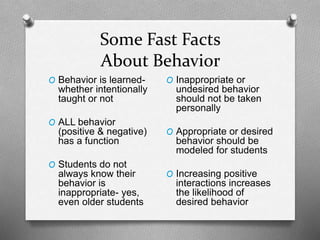
O Behavior is learned-
whether intentionally
taught or not
O ALL behavior
(positive & negative)
has a function
O Students do not
always know their
behavior is
inappropriate- yes,
even older students
O Inappropriate or
undesired behavior
should not be taken
personally
O Appropriate or desired
behavior should be
modeled for students
O Increasing positive
interactions increases
the likelihood of
desired behavior
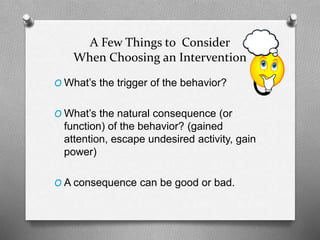
A Few Things to Consider
When Choosing an Intervention
O What’s the trigger of the behavior?
O What’s the natural consequence (or
function) of the behavior? (gained
attention, escape undesired activity, gain
power)
O A consequence can be good or bad.
Secondary PBIS Practices:
Implementing Secondary
Interventions
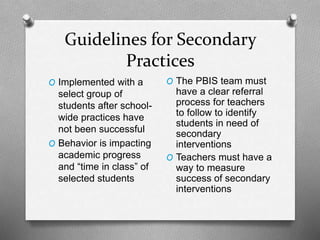
Guidelines for Secondary
Practices
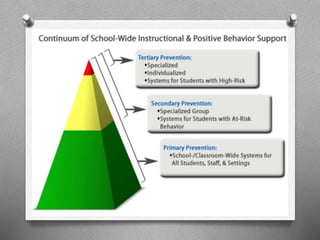
O Implemented with a
select group of
students after school-
wide practices have
not been successful
O Behavior is impacting
academic progress
and “time in class” of
selected students
O The PBIS team must
have a clear referral
process for teachers
to follow to identify
students in need of
secondary
interventions
O Teachers must have a
way to measure
success of secondary
interventions
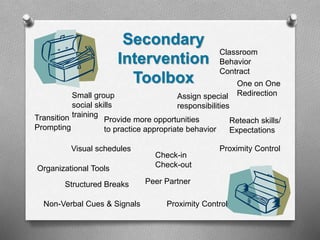
Secondary
Intervention
Toolbox
Classroom
Behavior
Contract
Transition
Prompting
Structured Breaks
Small group
social skills
training
Peer Partner
Proximity ControlVisual schedules
Assign special
responsibilities
Organizational Tools
Non-Verbal Cues & Signals
Provide more opportunities
to practice appropriate behavior
Reteach skills/
Expectations
Check-in
Check-out
Program
Mentoring
Program
Red = implemented school-wide Black = classroom implementation
Secondary Intervention
Practice
Small Group Time!
• In small groups, we will discuss the
following student scenario.
• Considering what we have discussed, create
a plan of intervention a classroom teacher
could implement.
• Include a specific intervention, how it will be used,
for how long, and how progress would be
monitored.
• Groups will be prompted to share an
intervention with everyone.
Scenario 1
Jasmine enters class visibly upset slams down her books
an plops into her seat. Jasmine begins mumbling
negative comments about school and the class. She yells
at a peer “what are you looking at?” The teacher provides
Jasmine with a verbal warning about her disruption and
instructs her to prepare for class. Rolling her eyes,
Jasmine states “This is stupid. I don’t want to be here.”
The teacher provides a 2nd redirection to which Jasmine
rolled her eyes again and states “why should I listen to
you?”
Data indicates that Jasmine has displays disruptive
behavior within the classroom setting at a rate of 3-4
times a month despite universal PBIS practices.
Now let’s plan interventions for some
problem behaviors you identified!
Tertiary PBIS Practices:
Implementing Tertiary
Interventions
Would you expect a place kicker to
play quarter back at the same ability
level as the starting quarter back?
Is the skill set the same?
Is there a difference between typical students
displaying problem behavior and students with
chronic behavioral difficulties or those
identified with a social or behavioral disability?
Is the skill set the same?
Same behavior expectations; Coaching style may be different;
Defense tacit may look different; Attempt to level the playing field
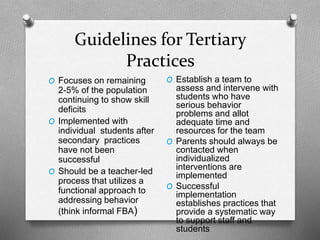
Guidelines for Tertiary
Practices
O Focuses on remaining
2-5% of the population
continuing to show skill
deficits
O Implemented with
individual students after
secondary practices
have not been
successful
O Should be a teacher-led
process that utilizes a
functional approach to
addressing behavior
(think informal FBA)
O Establish a team to
assess and intervene with
students who have
serious behavior
problems and allot
adequate time and
resources for the team
O Parents should always be
contacted when
individualized
interventions are
implemented
O Successful
implementation
establishes practices that
provide a systematic way
to support staff and
students
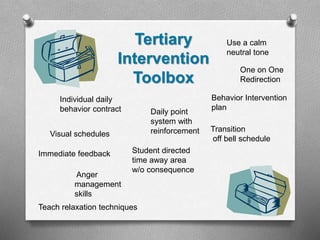
Tertiary
Intervention
Toolbox
Individual daily
behavior contract Daily point
system with
reinforcement
Anger
management
skills
Use a calm
neutral tone
One on One
Redirection
Teach relaxation techniques
Student directed
time away area
w/o consequence
Immediate feedback
Transition
off bell schedule or
separate from peers
Individualized Behavior
Intervention Plan (BIP)
Red = implemented school-wide Black = classroom implementation
Tertiary Intervention
Practice
Small Group Time!
• In small groups, we will discuss the
following student scenarios.
• Considering what we have discussed, create
a plan of intervention a classroom teacher
could implement.
• Include a specific intervention, how it will be used,
for how long, and how progress would be
monitored.
• Groups will be prompted to share an
intervention with everyone.
Scenario 3
James is an intelligent young man but rarely is interested
in completing classroom tasks. He is not afraid to share
his opinions with his peers or with adults. He often
questions the intelligence of peers and teachers. James
enjoys being a leader in class activities of his choice.
James was referred for secondary interventions where it
was determined that a check-in check-out system would
be put into place. This plan has been in effect for 2 weeks.
However, it is becoming more difficult to engage him in
many of the daily classroom tasks. When given an
undesired directive, James will question the reason for
the directive or will make negative comments loudly in
front of his peers. When redirected, James will become
argumentative with adults and make disrespectful
comments using inappropriate language.
Now let’s plan interventions for some
problem behaviors you identified!
Let’s take a look at some
resources
http://www.pbisworld.com/
http://www.interventioncentral.org/home
https://sites.google.com/a/ccs.k12.nc.us/tiered-
behavior-interventions/
Final Thoughts
O Not every intervention will work for every
behavior or child- trial and error.
O Express disappoint in the behavior
demonstrated- not the child.
O Protect your own triggers and avoid the
power struggle trap!
O Be consistent with praise and
consequences.
O Train yourself to concentrate on the
positive.
O Your not alone! Seek out assistance!
Sources
O Akin-Little, K., Eckert, T., Lovett, B., & Little, S. (2004). Extrinsic
reinforcement in the classroom: Bribery or best practice. School
Psychology Review, 33, 344–362.
O Horner, R.H. (July 14, 2009). Using rewards within school-wide
PBS. Presentation at Maryland team training. Retrieved from
http://www.pbis.org/presentations/default.aspx
O Walker, H.M., Ramsey, E., & Gresham, F.M. (2004). Antisocial
behavior in school: Evidence-based practices (2nd ed.). Belmont,
CA: Wadsworth/Thomson Learning.
O Positive Behavior Intervention and Support website
http://www.pbis.org
O Dr. Mac’s behavior management site
http://www.behavioradvisor.com/TrainingVideo.html
Additional Resources
pbisworld.com
www.intervention central.org

Pbis secondary & tertiary classroom interventions

  • 1.
    PBIS Secondary & Tertiary ClassroomInterventions Presented By Tory Lawrence
  • 3.
    Some Fast Facts AboutBehavior O Behavior is learned- whether intentionally taught or not O ALL behavior (positive & negative) has a function O Students do not always know their behavior is inappropriate- yes, even older students O Inappropriate or undesired behavior should not be taken personally O Appropriate or desired behavior should be modeled for students O Increasing positive interactions increases the likelihood of desired behavior
  • 4.
    A Few Thingsto Consider When Choosing an Intervention O What’s the trigger of the behavior? O What’s the natural consequence (or function) of the behavior? (gained attention, escape undesired activity, gain power) O A consequence can be good or bad.
  • 5.
  • 6.
    Guidelines for Secondary Practices OImplemented with a select group of students after school- wide practices have not been successful O Behavior is impacting academic progress and “time in class” of selected students O The PBIS team must have a clear referral process for teachers to follow to identify students in need of secondary interventions O Teachers must have a way to measure success of secondary interventions
  • 7.
    Secondary Intervention Toolbox Classroom Behavior Contract Transition Prompting Structured Breaks Small group socialskills training Peer Partner Proximity ControlVisual schedules Assign special responsibilities Organizational Tools Non-Verbal Cues & Signals Provide more opportunities to practice appropriate behavior Reteach skills/ Expectations Check-in Check-out Program Mentoring Program Red = implemented school-wide Black = classroom implementation
  • 8.
    Secondary Intervention Practice Small GroupTime! • In small groups, we will discuss the following student scenario. • Considering what we have discussed, create a plan of intervention a classroom teacher could implement. • Include a specific intervention, how it will be used, for how long, and how progress would be monitored. • Groups will be prompted to share an intervention with everyone.
  • 9.
    Scenario 1 Jasmine entersclass visibly upset slams down her books an plops into her seat. Jasmine begins mumbling negative comments about school and the class. She yells at a peer “what are you looking at?” The teacher provides Jasmine with a verbal warning about her disruption and instructs her to prepare for class. Rolling her eyes, Jasmine states “This is stupid. I don’t want to be here.” The teacher provides a 2nd redirection to which Jasmine rolled her eyes again and states “why should I listen to you?” Data indicates that Jasmine has displays disruptive behavior within the classroom setting at a rate of 3-4 times a month despite universal PBIS practices.
  • 10.
    Now let’s planinterventions for some problem behaviors you identified!
  • 11.
  • 12.
    Would you expecta place kicker to play quarter back at the same ability level as the starting quarter back? Is the skill set the same?
  • 13.
    Is there adifference between typical students displaying problem behavior and students with chronic behavioral difficulties or those identified with a social or behavioral disability? Is the skill set the same? Same behavior expectations; Coaching style may be different; Defense tacit may look different; Attempt to level the playing field
  • 14.
    Guidelines for Tertiary Practices OFocuses on remaining 2-5% of the population continuing to show skill deficits O Implemented with individual students after secondary practices have not been successful O Should be a teacher-led process that utilizes a functional approach to addressing behavior (think informal FBA) O Establish a team to assess and intervene with students who have serious behavior problems and allot adequate time and resources for the team O Parents should always be contacted when individualized interventions are implemented O Successful implementation establishes practices that provide a systematic way to support staff and students
  • 15.
    Tertiary Intervention Toolbox Individual daily behavior contractDaily point system with reinforcement Anger management skills Use a calm neutral tone One on One Redirection Teach relaxation techniques Student directed time away area w/o consequence Immediate feedback Transition off bell schedule or separate from peers Individualized Behavior Intervention Plan (BIP) Red = implemented school-wide Black = classroom implementation
  • 16.
    Tertiary Intervention Practice Small GroupTime! • In small groups, we will discuss the following student scenarios. • Considering what we have discussed, create a plan of intervention a classroom teacher could implement. • Include a specific intervention, how it will be used, for how long, and how progress would be monitored. • Groups will be prompted to share an intervention with everyone.
  • 17.
    Scenario 3 James isan intelligent young man but rarely is interested in completing classroom tasks. He is not afraid to share his opinions with his peers or with adults. He often questions the intelligence of peers and teachers. James enjoys being a leader in class activities of his choice. James was referred for secondary interventions where it was determined that a check-in check-out system would be put into place. This plan has been in effect for 2 weeks. However, it is becoming more difficult to engage him in many of the daily classroom tasks. When given an undesired directive, James will question the reason for the directive or will make negative comments loudly in front of his peers. When redirected, James will become argumentative with adults and make disrespectful comments using inappropriate language.
  • 18.
    Now let’s planinterventions for some problem behaviors you identified!
  • 19.
    Let’s take alook at some resources http://www.pbisworld.com/ http://www.interventioncentral.org/home https://sites.google.com/a/ccs.k12.nc.us/tiered- behavior-interventions/
  • 20.
    Final Thoughts O Notevery intervention will work for every behavior or child- trial and error. O Express disappoint in the behavior demonstrated- not the child. O Protect your own triggers and avoid the power struggle trap! O Be consistent with praise and consequences. O Train yourself to concentrate on the positive. O Your not alone! Seek out assistance!
  • 21.
    Sources O Akin-Little, K.,Eckert, T., Lovett, B., & Little, S. (2004). Extrinsic reinforcement in the classroom: Bribery or best practice. School Psychology Review, 33, 344–362. O Horner, R.H. (July 14, 2009). Using rewards within school-wide PBS. Presentation at Maryland team training. Retrieved from http://www.pbis.org/presentations/default.aspx O Walker, H.M., Ramsey, E., & Gresham, F.M. (2004). Antisocial behavior in school: Evidence-based practices (2nd ed.). Belmont, CA: Wadsworth/Thomson Learning. O Positive Behavior Intervention and Support website http://www.pbis.org O Dr. Mac’s behavior management site http://www.behavioradvisor.com/TrainingVideo.html Additional Resources pbisworld.com www.intervention central.org