EFFECTIVE PAYROLL CONTROLS, RISK
MANAGEMENT AND FRAUD PREVENTION
STRATEGIES
PARK INN HOTEL, SANDTON
CHARLES COTTER
5 OCTOBER 2016
 Applying the payroll risk management process
 Applying payroll internal controls – types and process
 Payroll fraud prevention strategies
 Analyzing and applying case studies
PRESENTATION OVERVIEW
 Individual activity:
 Complete the statement by inserting one (1) word only. In
order to exercise effective control measures of the payroll, I
need to/to be .…………………………………..
 Now find other learners with the same word as you.
 Jot these words down on the flip-chart.
 Each learner will have the opportunity to elaborate on their
chosen word.
INTRODUCTORY LEARNING ACTIVITY
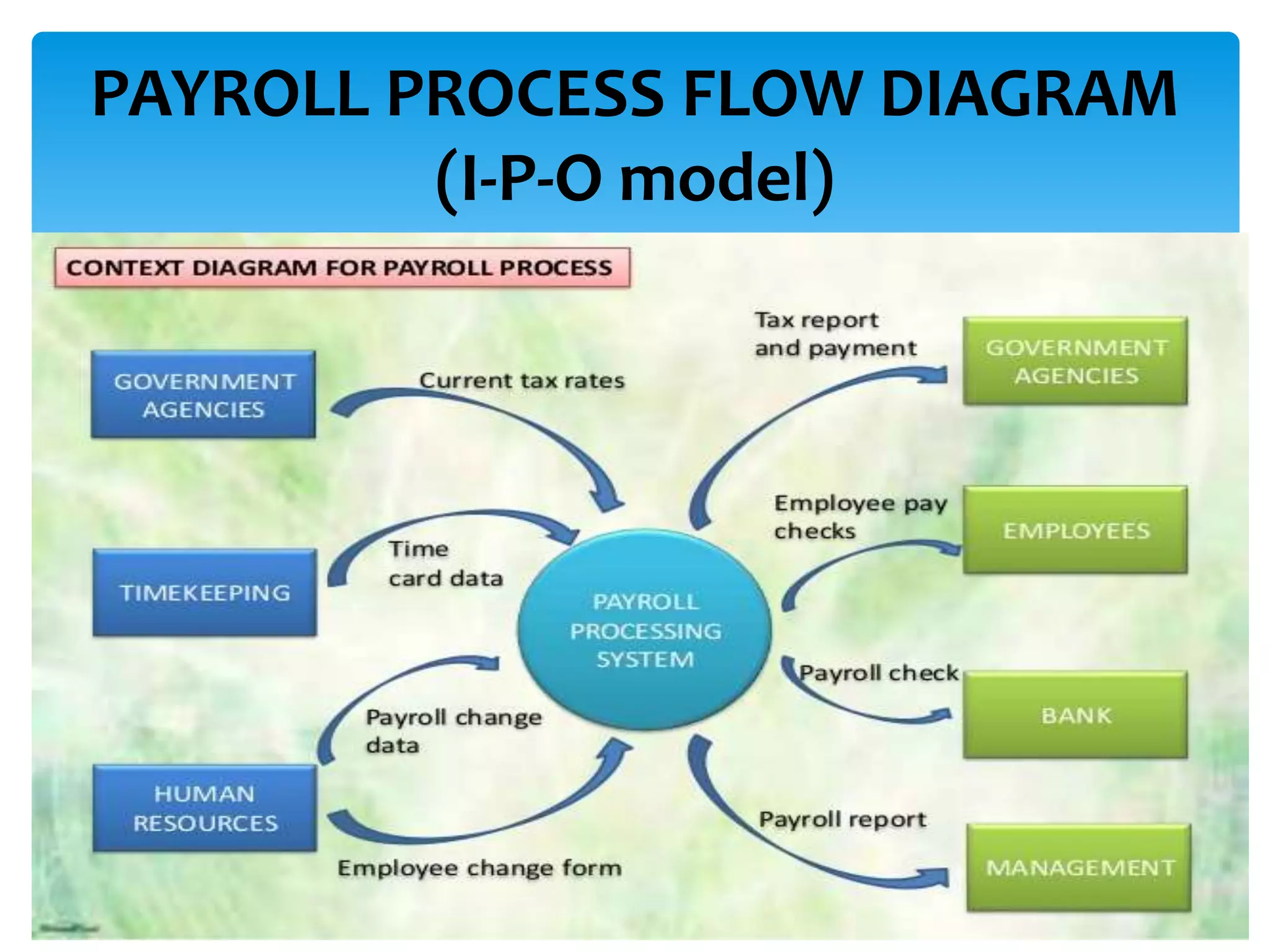
PAYROLL PROCESS FLOW DIAGRAM
(I-P-O model)
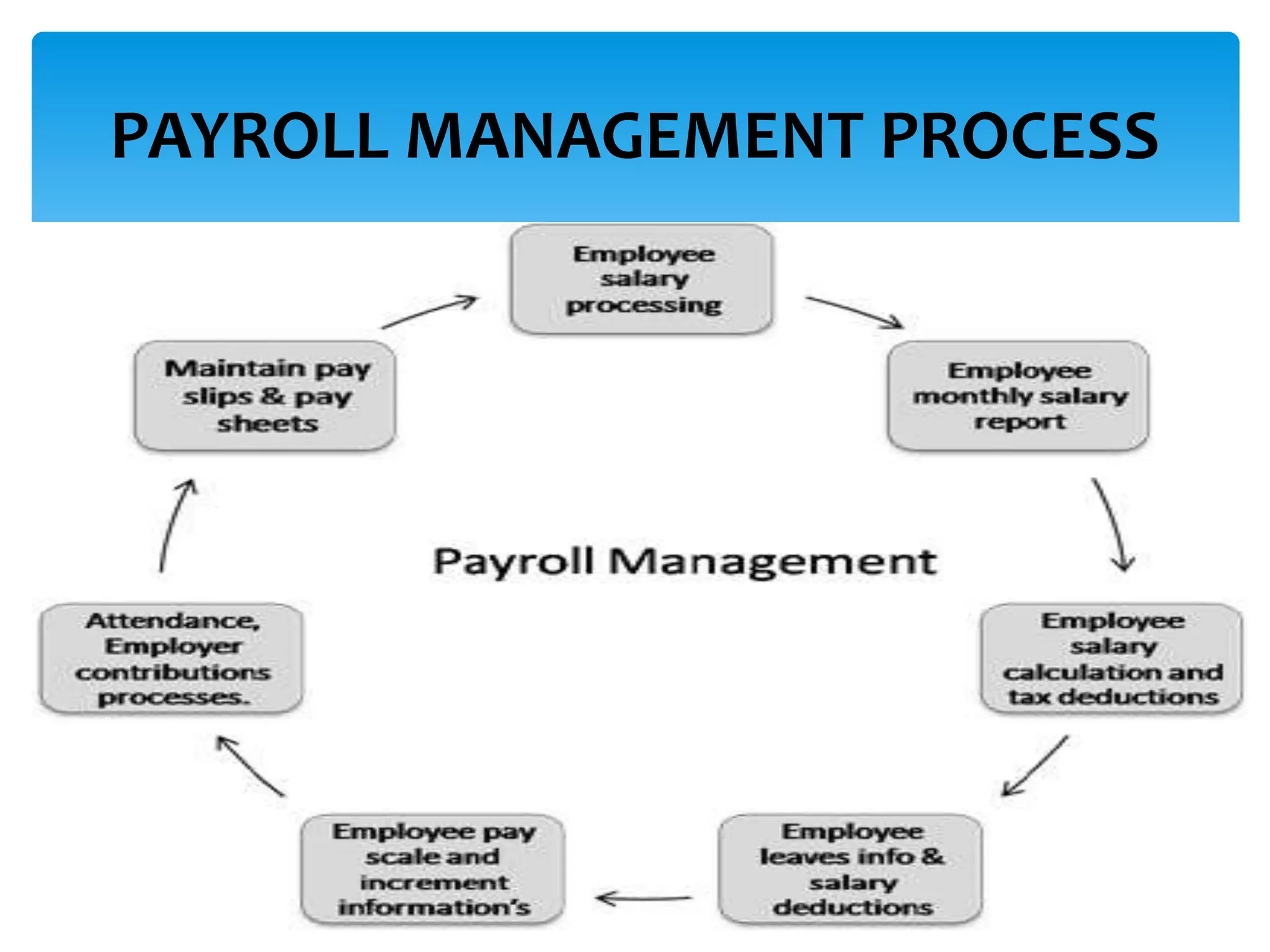
PAYROLL MANAGEMENT PROCESS
ILLUSTRATION: PAYROLL RISK
MANAGEMENT PROCESS
PAYROLL RISK MANAGEMENT PROCESS
 Step 1: Payroll Risk Identification
 Step 2: Payroll Risk Analysis
 Step 3: Payroll Risk Prioritization
 Step 4: Payroll Risk Response
 Step 5: Payroll Risk Evaluation
PAYROLL RISK MATRIX
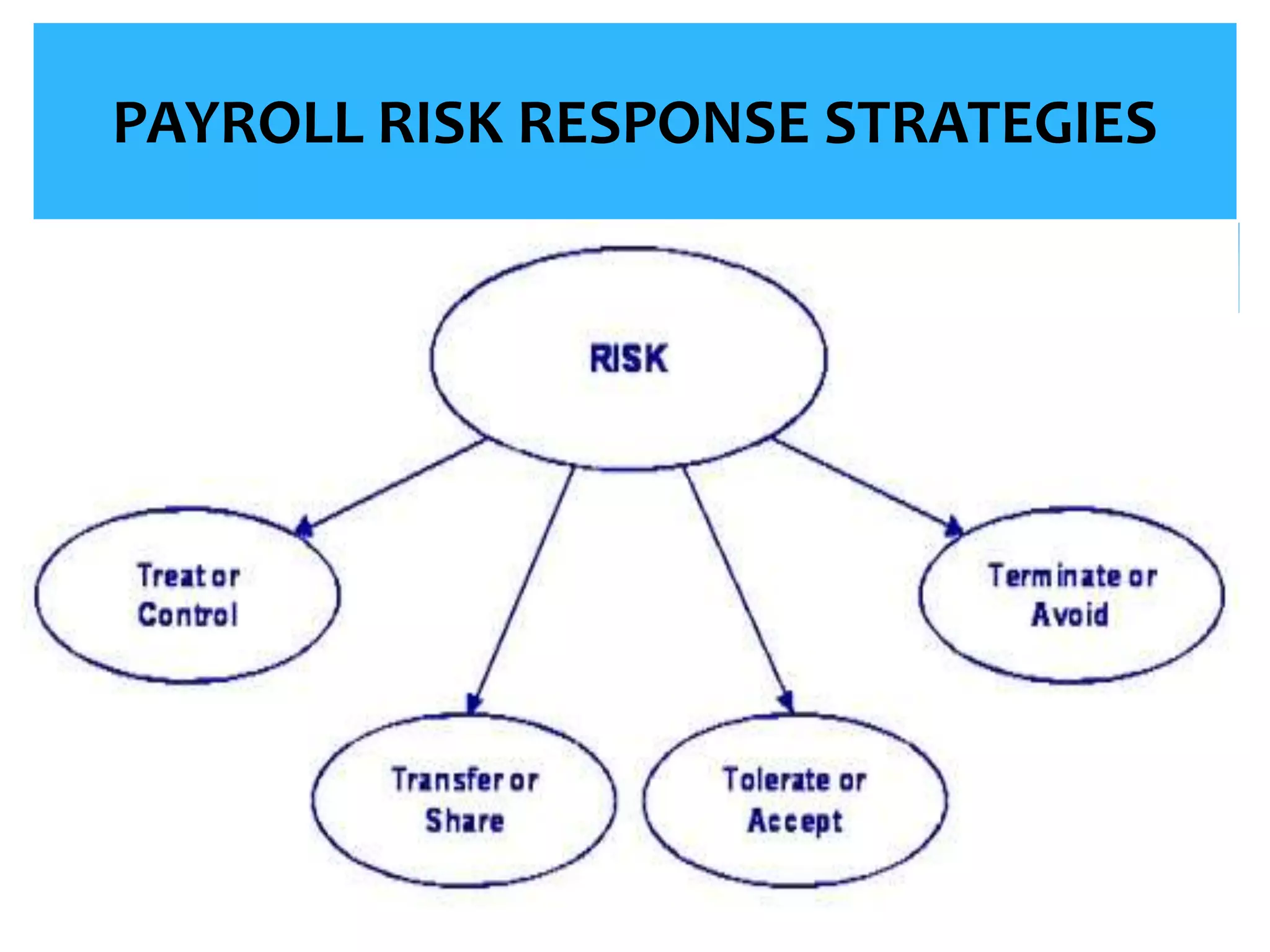
PAYROLL RISK RESPONSE STRATEGIES
 Apply the 5-step risk management process to payroll
management and administration.
SYNDICATE GROUP LEARNING
ACTIVITY 1
 Internal control #1: Split duties between the person doing the
monthly processing and the person doing the salary payments
 Internal control #2: Bring about processes for change and
adjustment to payroll systems
 Internal control #3: Implement checks and cross-checks to
ensure the calculations are done correctly
 Internal control #4: Reconcile actual bank account payments to
the payroll system on a monthly basis
INTERNAL CONTROLS
INTERNAL CONTROL PROCESS
HIERARCHY
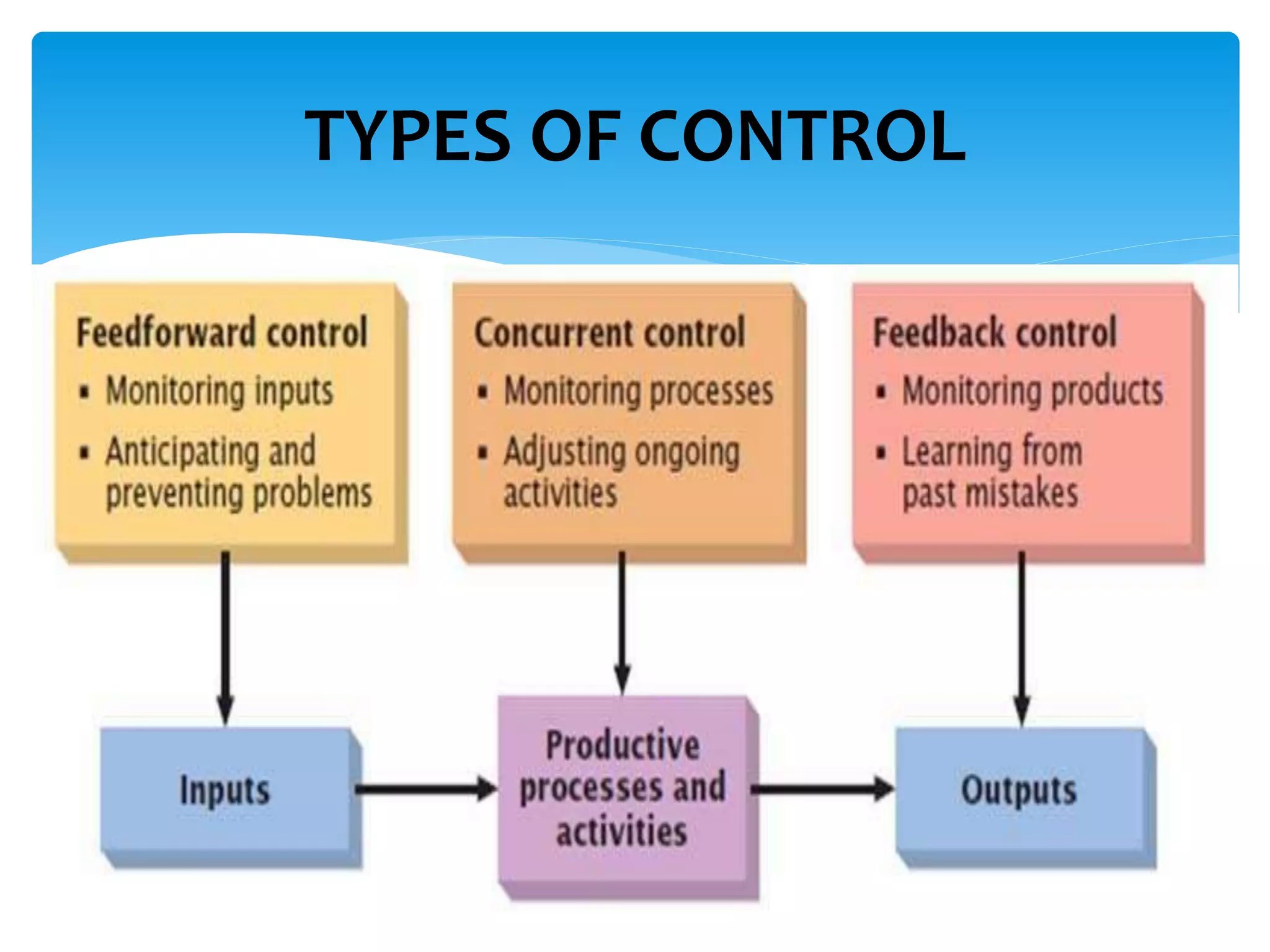
TYPES OF CONTROL
APPLYING THE CONTROL PROCESS
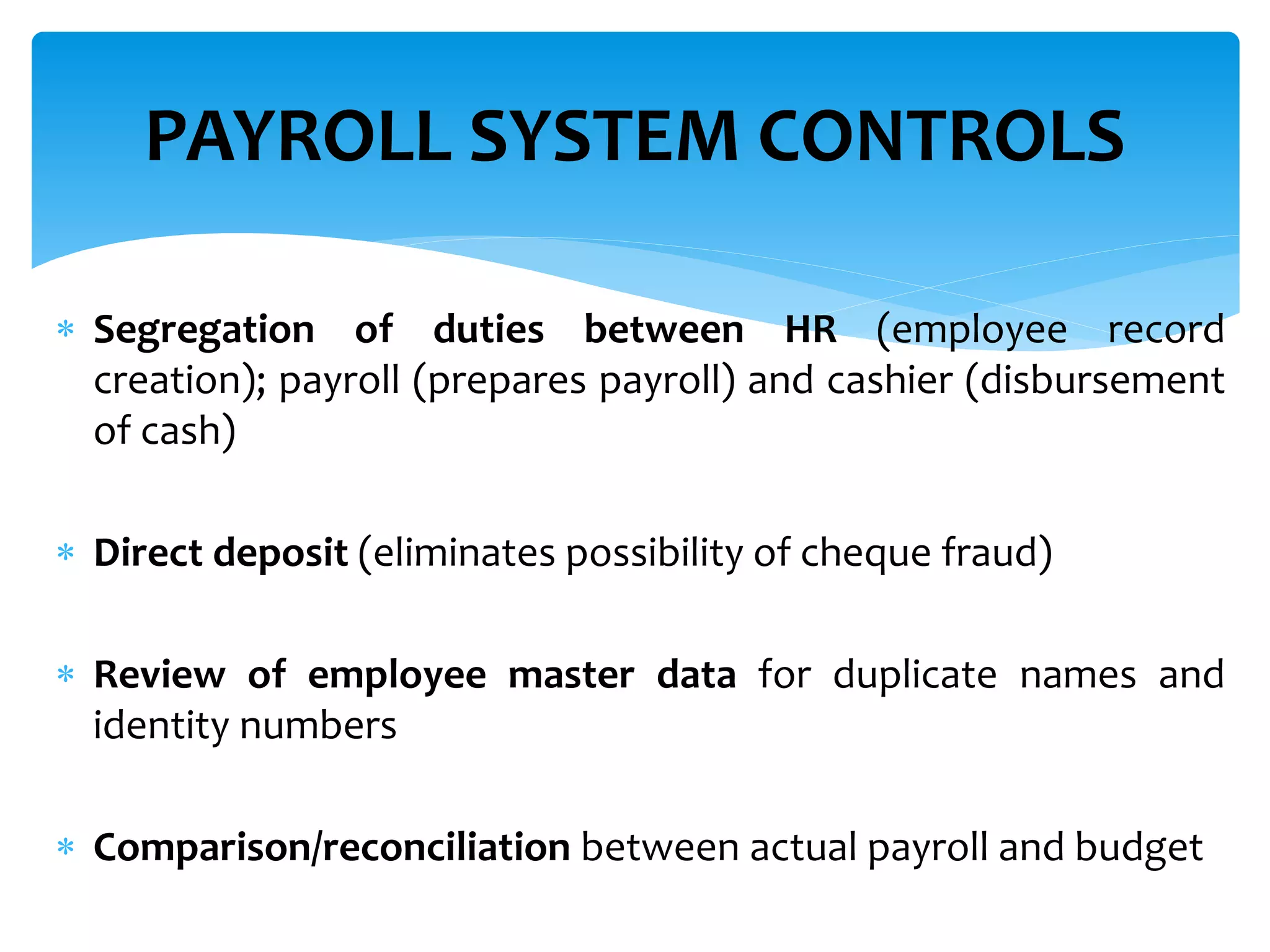
 Segregation of duties between HR (employee record
creation); payroll (prepares payroll) and cashier (disbursement
of cash)
 Direct deposit (eliminates possibility of cheque fraud)
 Review of employee master data for duplicate names and
identity numbers
 Comparison/reconciliation between actual payroll and budget
PAYROLL SYSTEM CONTROLS
REMUNERATION MONITORING &
REVIEW PROCESS
 Forensic Accounting utilizes accounting, auditing, and
investigative skills to conduct an examination into a
company's financial statements.
 This provides an accounting analysis that is suitable for a court
of law.
FORENSIC ACCOUNTING
 The main steps in forensic analytics are:
Step 1: Data collection
Step 2: Data preparation and examination
Step 3: Data analysis
Step 4: Reporting
FORENSIC ACCOUNTING PROCESS
 Apply the internal control and forensic accounting/auditing
processes to payroll management and administration.
SYNDICATE GROUP LEARNING
ACTIVITY 2
 Payroll fraud involves an intention by a member of a business
or organization to misappropriate funds. Payroll fraud occurs
when the fraudster causes the organization to issue a payment
by making false claims of compensation.
 Payroll fraud is most simply defined as employees cheating the
payroll system at their place of employment in order to receive
funds to which they are not entitled.
DEFINING PAYROLL FRAUD
 According to Sage HR & Payroll MD Anton van Heerden, payroll fraud is one of
the biggest risks facing companies, with losses bigger than those of cash-in-
transit heists. "The worst part about payroll fraud is cases often go unreported
by the business, due to embarrassment. Instead of laying a charge against the
guilty party, they're simply let go. Without prosecution, the fraudster will go to
another company and do the same there, creating a vicious cycle.“
 The only statistics available on payroll fraud in South Africa are dated 2011 from
Alexander Forbes, who stated that payroll fraud costs South African companies
more than cash in transit heists: R100 million is lost in SA annually to these
heists.
 More than 9% of workplace fraud in the Africa is associated with payroll fraud
 It can take up to 36 months to discover a fraud scheme from the time it was
first started
 Payroll Fraud happens in 27% of all businesses
PAYROLL FRAUD STATISTICS -
PLUNDERS AND BLUNDERS
Ghost workers
Time-sheet/Falsified work hours
Commission schemes
Workman’s compensation (IOD) schemes
Leave balance manipulation (that involve kickbacks or bribes within
companies)
Re-imbursement fraud
TYPES OF PAYROLL FRAUD
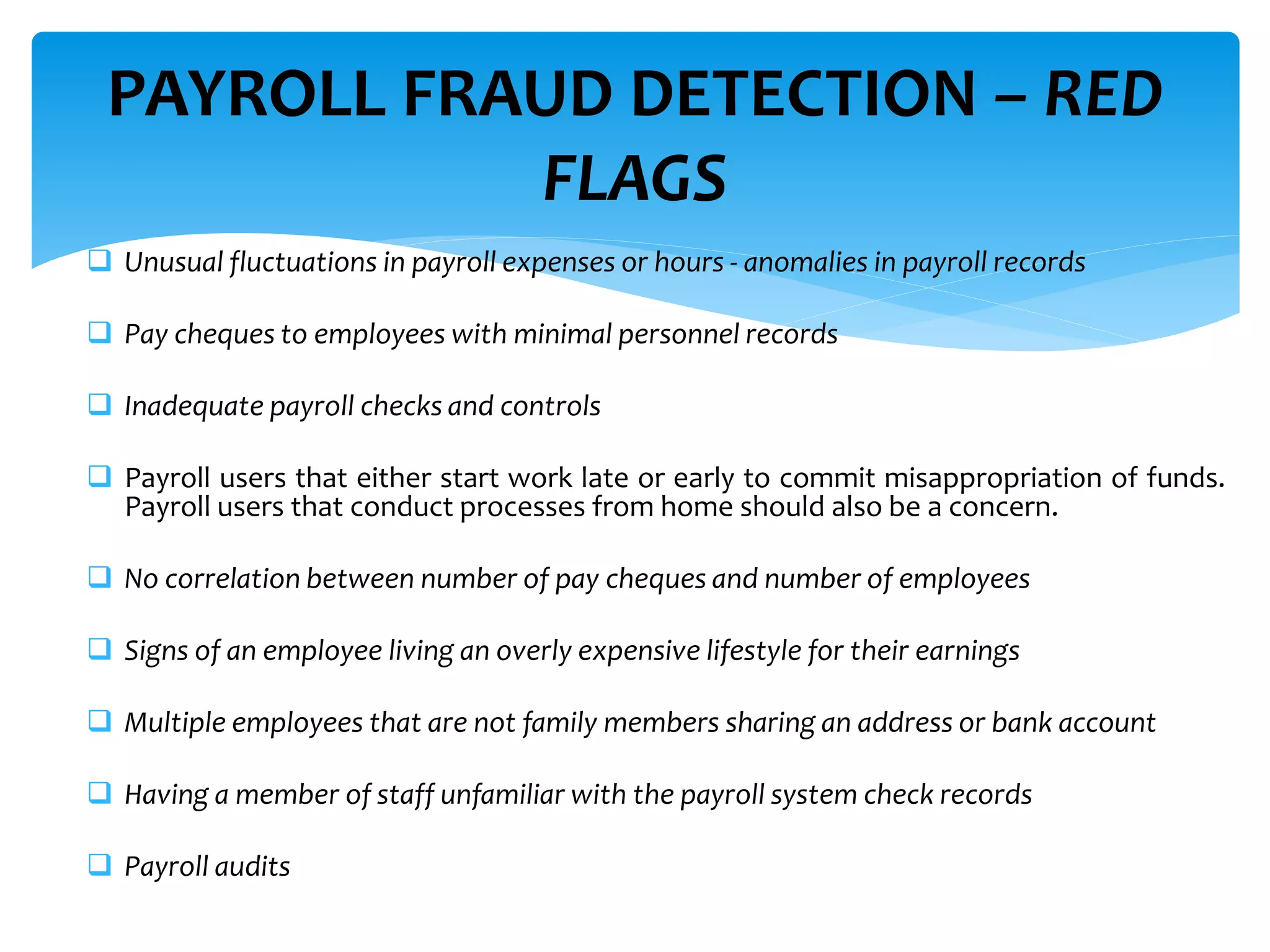
 Unusual fluctuations in payroll expenses or hours - anomalies in payroll records
 Pay cheques to employees with minimal personnel records
 Inadequate payroll checks and controls
 Payroll users that either start work late or early to commit misappropriation of funds.
Payroll users that conduct processes from home should also be a concern.
 No correlation between number of pay cheques and number of employees
 Signs of an employee living an overly expensive lifestyle for their earnings
 Multiple employees that are not family members sharing an address or bank account
 Having a member of staff unfamiliar with the payroll system check records
 Payroll audits
PAYROLL FRAUD DETECTION – RED
FLAGS
 Cross reference list of employees from payroll records to other
sources
 Review HR records for anomolies
 Data mining resources
 Identify employees with missing or duplicate master file
information
HOW TO DETECT GHOST WORKERS?
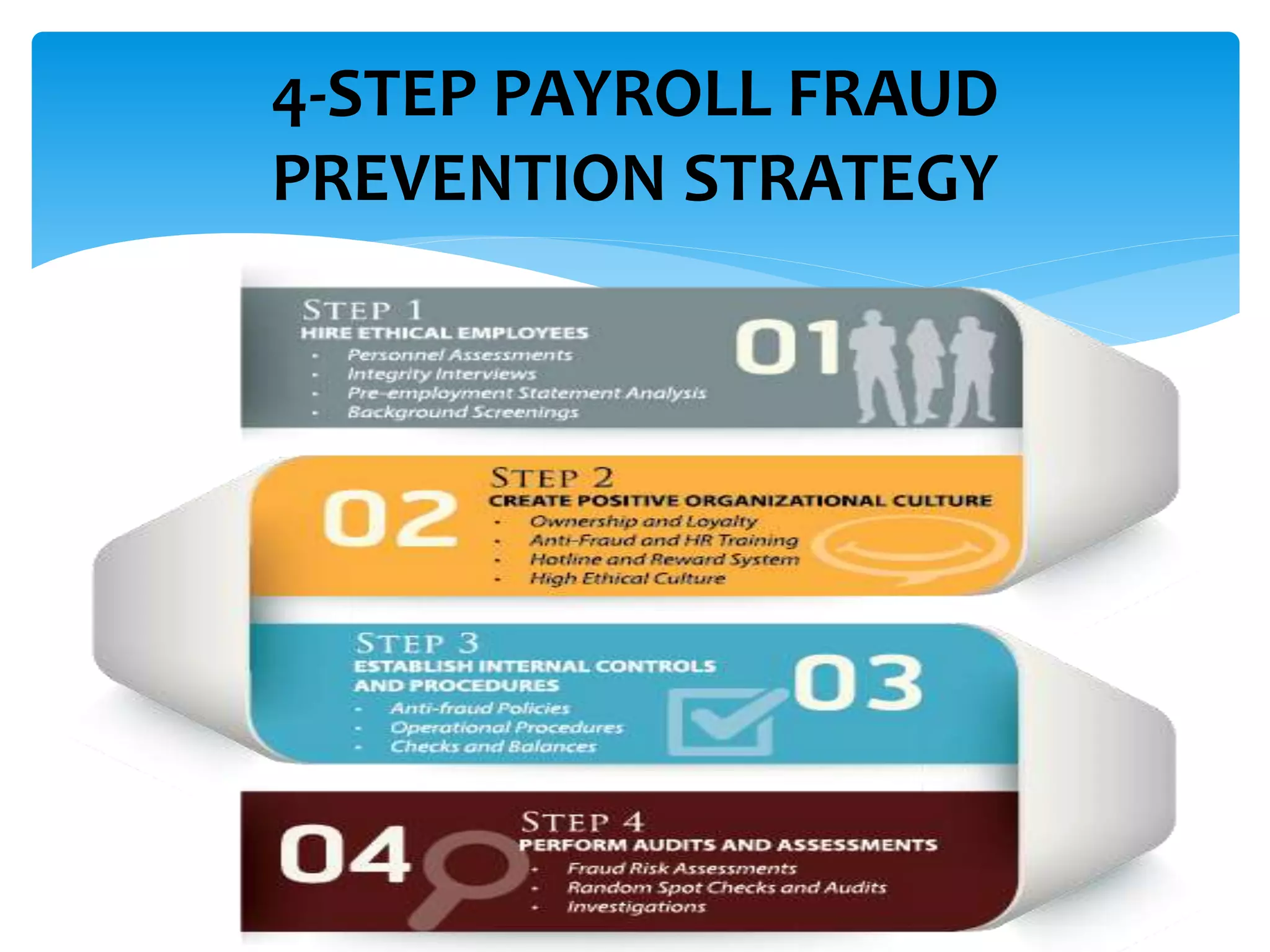
4-STEP PAYROLL FRAUD
PREVENTION STRATEGY
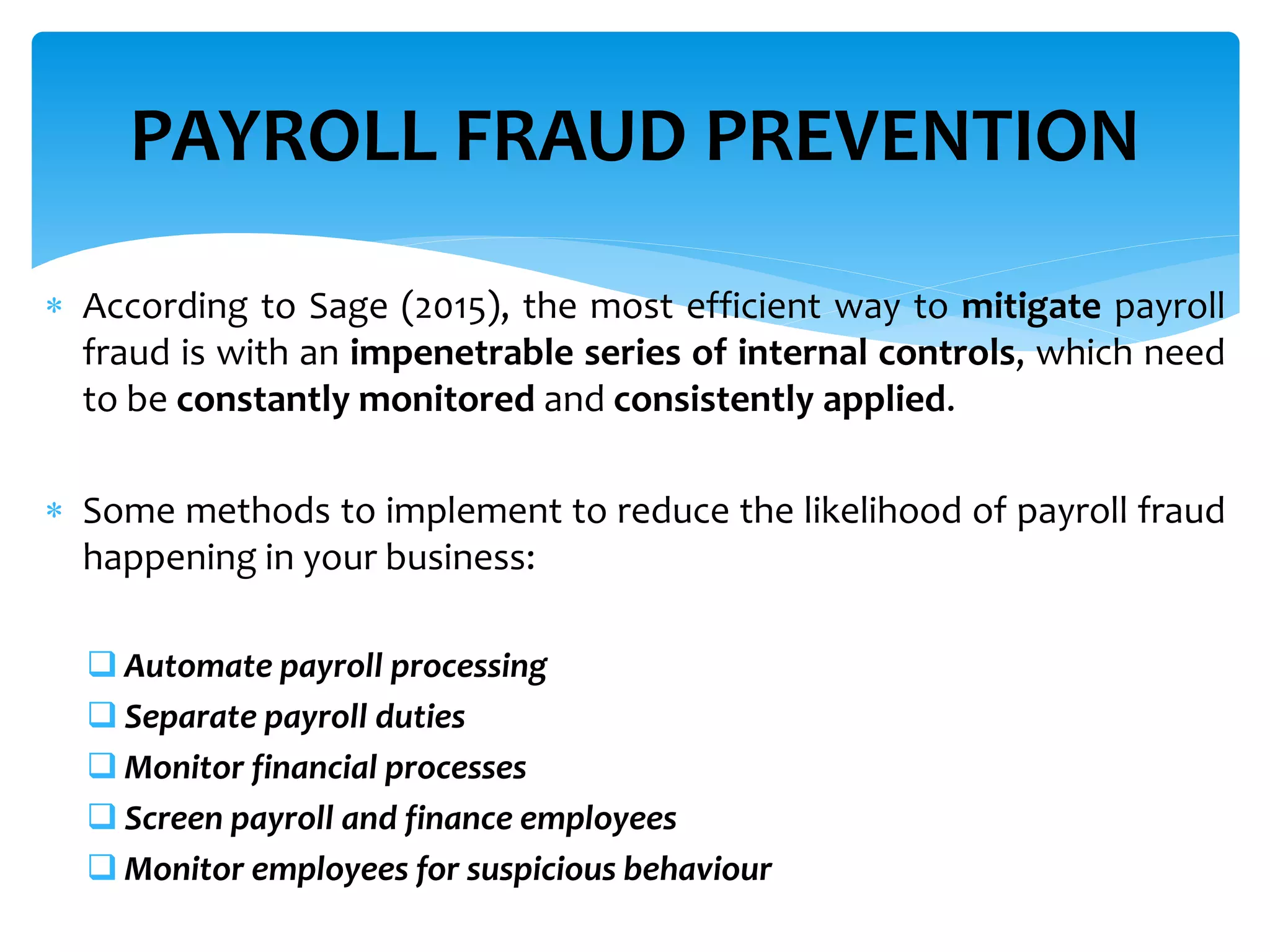
 According to Sage (2015), the most efficient way to mitigate payroll
fraud is with an impenetrable series of internal controls, which need
to be constantly monitored and consistently applied.
 Some methods to implement to reduce the likelihood of payroll fraud
happening in your business:
 Automate payroll processing
 Separate payroll duties
 Monitor financial processes
 Screen payroll and finance employees
 Monitor employees for suspicious behaviour
PAYROLL FRAUD PREVENTION
 Sage HR & Payroll MD Anton van Heerden suggests the following:
 Access control: Controlling who can access what, and restricting what
certain users can do on a particular system.
 ID verifications online: Checking against the Home Affairs database to
ensure IDs are legitimate.
 Bank account verification: Verifying bank account details to ensure account
number and account holder match.
 Direct link to banking system: Instead of imputing an electronic file into the
banking system, a direct link to the banking system can be implemented,
ensuring no files can be tampered with en route.
PAYROLL FRAUD PREVENTION
 Yolande Schoültz, risk and fraud management division manager at Sage VIP
(South Africa) recommends the following payroll fraud prevention measures:
 Advice regarding a payroll system:
 Access control should be aligned to segregation of duties
 When checking and signing off the payroll, print your own reports
 Activate a “stop further entry” function after the payroll has been processed by the
administrators, but before checking
 Bank account and ID number validation and verification should be done
 Income verification should be linked to South Africa’s four major banks
 Advice regarding the payroll, human resources and finance departments:
 Segregation of duties should be clearly defined
 The bank statement should always be reconciled back to the payroll system
 A senior manager in finance should be responsible for payroll sign off
PAYROLL FRAUD PREVENTION
TAKING ACTION AGAINST PAYROLL
FRAUDSTERS
 Develop and implement a policy for handling suspected dishonest and
fraudulent activities, including termination and reporting to law
enforcement.
 Communicate such policy to all employees, agents, vendors, contractors,
and other interested parties.
 Develop and implement a code of ethics for employees, clearly defining
acceptable and unacceptable activities.
 Develop and implement codes, guidelines, and organizational policies
designed to prohibit conflicts of interest. Consider requiring employees to
disclose possible conflicts of interest involving other employees.
 Require all vendors and contractors to agree in writing as apart of the
contract process, to abide by the codes described in points above.
ZERO TOLERANCE – PROSECUTE ALL
PAYROLL FRAUDSTERS
 Creating a fraud awareness culture
 Ensuring that you have appropriate guardians in your business
 Be involved and understand what controls are in place
 Review and monitor with an element of surprise
 Reward compliance
 Introduce controls and procedure certification
 Employee rotation programs
PRO-ACTIVE MANAGEMENT OF
PAYROLL FRAUD
 Employee leave policy
 Development of code of conduct/ethics
 Fraud / corruption control plan
 Review annual effectiveness of above-mentioned policies
 Vendor tender programs
 Consult annually with specialist to review your progress
 Consider formal whistleblower arrangements
PRO-ACTIVE MANAGEMENT OF
PAYROLL FRAUD
3-PRONG PAYROLL FRAUD
PREVENTION STRATEGY
 Detection: Identify the most common forms of payroll fraud in
your organization.
 Prevention: For each of these forms of payroll fraud, develop
prevention strategies and/or counter-measures.
 Control: Identify feedforward; concurrent and feedback types
of control to mitigate payroll fraud.
SYNDICATE GROUP LEARNING
ACTIVITY 3
 Make sure all employee details are correct
 Conduct regular, ongoing audits
 Institute a transparent payroll policy
 Seek employee input to improve payroll process effectiveness
 Don’t ignore payroll requirement deadlines
 Know payroll tax policies and rules
 Review your reporting process
MINIMIZING PAYROLL ERRORS
 Describe the procedure/s to minimize payroll errors and the
process of correcting overpayments.
 Describe your organization’s policy and procedure regarding
payroll fraudsters.
 What (disciplinary) actions are taken against perpetrating
managers and employees?
SYNDICATE GROUP LEARNING
ACTIVITY 4
 A Surrey bookkeeper who committed more than £20,000 in payroll fraud has been sentenced to 15
months imprisonment.
 Judith Auclair, 60, regularly submitted PAYE tax returns to HMRC on her employer’s behalf. However,
she began to add false employee details to the company’s payroll and claimed they were owed tax
refunds. She then paid the money into her own bank account.
 Auclair falsely claimed £17,254 in tax refunds and pocketed a further £4,927 of tax and National
Insurance contributions which had been falsely deducted from other employees’ wages between April
2009 and March 2012.
 Auclair also paid herself £14,223, falsely stating the money had been used to pay for goods and
services.
 After a director became suspicious and the company’s accountant asked for its tax records, Auclair
resigned from her job in December 2011.
 Auclair was arrested on 7 March 2013 on suspicion of fraud. However, shortly after her arrest she
transferred a further £3,398 from her employer’s bank account into her own account.
 She was later charged with fraud by false representation and being knowingly concerned in the
fraudulent evasion of income tax. She pleaded guilty to 15 fraud charges.
CASE STUDY 4: SURREY
BOOKKEEPER
 Review the four case studies. Describe what payroll fraud
detection, prevention and control lessons can be extracted
from these case studies? Try to relate each case study to the
Fraud Triangle.
SYNDICATE GROUP LEARNING
ACTIVITY 5
 Andrew Firth http://www.slideshare.net/rushmoregroup/payroll-fraud
(accessed 3 April 2016) – Case Studies 1-3
 http://www.dorkingandleatherheadadvertiser.co.uk/Surrey-bookkeeper-
jailed-obtaining-37k-tax-fraud/story-22980825-detail/story.html (accessed 3
April 2016) – Case Study 4
 http://fspbusiness.co.za/articles/accounting/use-these-4-internal-controls-to-
prevent-payroll-fraud-7977.html (accessed 3 April 2016)
 http://www.labourguide.co.za/most-recent/1900-employer-deductions-
from-employee-remuneration (accessed 3 April 2016)
 http://www.sage.com/za/newsroom/sage-hr-and-payroll/2015/06/01/sage-
pastel-payroll-and-hr-5-ways-to-detect-and-prevent-payroll-fraud (accessed
3 April 2016)
ACKNOWLEDGEMENTS
 Summary of the key learning points
 Questions
 Conclusion
 Good luck with the implementation of effective payroll control
measures and risk management processes and strategies.
CONCLUSION
CONTACT DETAILS
 Charles Cotter
 (+27) 84 562 9446
 charlescot@polka.co.za
 LinkedIn
 Twitter: Charles_Cotter
 http://www.slideshare.net/CharlesCotter

Payroll Control, Risk Management & Fraud Prevention

  • 1.
    EFFECTIVE PAYROLL CONTROLS,RISK MANAGEMENT AND FRAUD PREVENTION STRATEGIES PARK INN HOTEL, SANDTON CHARLES COTTER 5 OCTOBER 2016
  • 2.
     Applying thepayroll risk management process  Applying payroll internal controls – types and process  Payroll fraud prevention strategies  Analyzing and applying case studies PRESENTATION OVERVIEW
  • 4.
     Individual activity: Complete the statement by inserting one (1) word only. In order to exercise effective control measures of the payroll, I need to/to be .…………………………………..  Now find other learners with the same word as you.  Jot these words down on the flip-chart.  Each learner will have the opportunity to elaborate on their chosen word. INTRODUCTORY LEARNING ACTIVITY
  • 5.
    PAYROLL PROCESS FLOWDIAGRAM (I-P-O model)
  • 6.
  • 7.
  • 8.
    PAYROLL RISK MANAGEMENTPROCESS  Step 1: Payroll Risk Identification  Step 2: Payroll Risk Analysis  Step 3: Payroll Risk Prioritization  Step 4: Payroll Risk Response  Step 5: Payroll Risk Evaluation
  • 9.
  • 10.
  • 11.
     Apply the5-step risk management process to payroll management and administration. SYNDICATE GROUP LEARNING ACTIVITY 1
  • 13.
     Internal control#1: Split duties between the person doing the monthly processing and the person doing the salary payments  Internal control #2: Bring about processes for change and adjustment to payroll systems  Internal control #3: Implement checks and cross-checks to ensure the calculations are done correctly  Internal control #4: Reconcile actual bank account payments to the payroll system on a monthly basis INTERNAL CONTROLS
  • 14.
  • 15.
  • 16.
  • 17.
     Segregation ofduties between HR (employee record creation); payroll (prepares payroll) and cashier (disbursement of cash)  Direct deposit (eliminates possibility of cheque fraud)  Review of employee master data for duplicate names and identity numbers  Comparison/reconciliation between actual payroll and budget PAYROLL SYSTEM CONTROLS
  • 19.
  • 20.
     Forensic Accountingutilizes accounting, auditing, and investigative skills to conduct an examination into a company's financial statements.  This provides an accounting analysis that is suitable for a court of law. FORENSIC ACCOUNTING
  • 21.
     The mainsteps in forensic analytics are: Step 1: Data collection Step 2: Data preparation and examination Step 3: Data analysis Step 4: Reporting FORENSIC ACCOUNTING PROCESS
  • 22.
     Apply theinternal control and forensic accounting/auditing processes to payroll management and administration. SYNDICATE GROUP LEARNING ACTIVITY 2
  • 24.
     Payroll fraudinvolves an intention by a member of a business or organization to misappropriate funds. Payroll fraud occurs when the fraudster causes the organization to issue a payment by making false claims of compensation.  Payroll fraud is most simply defined as employees cheating the payroll system at their place of employment in order to receive funds to which they are not entitled. DEFINING PAYROLL FRAUD
  • 27.
     According toSage HR & Payroll MD Anton van Heerden, payroll fraud is one of the biggest risks facing companies, with losses bigger than those of cash-in- transit heists. "The worst part about payroll fraud is cases often go unreported by the business, due to embarrassment. Instead of laying a charge against the guilty party, they're simply let go. Without prosecution, the fraudster will go to another company and do the same there, creating a vicious cycle.“  The only statistics available on payroll fraud in South Africa are dated 2011 from Alexander Forbes, who stated that payroll fraud costs South African companies more than cash in transit heists: R100 million is lost in SA annually to these heists.  More than 9% of workplace fraud in the Africa is associated with payroll fraud  It can take up to 36 months to discover a fraud scheme from the time it was first started  Payroll Fraud happens in 27% of all businesses PAYROLL FRAUD STATISTICS - PLUNDERS AND BLUNDERS
  • 28.
    Ghost workers Time-sheet/Falsified workhours Commission schemes Workman’s compensation (IOD) schemes Leave balance manipulation (that involve kickbacks or bribes within companies) Re-imbursement fraud TYPES OF PAYROLL FRAUD
  • 29.
     Unusual fluctuationsin payroll expenses or hours - anomalies in payroll records  Pay cheques to employees with minimal personnel records  Inadequate payroll checks and controls  Payroll users that either start work late or early to commit misappropriation of funds. Payroll users that conduct processes from home should also be a concern.  No correlation between number of pay cheques and number of employees  Signs of an employee living an overly expensive lifestyle for their earnings  Multiple employees that are not family members sharing an address or bank account  Having a member of staff unfamiliar with the payroll system check records  Payroll audits PAYROLL FRAUD DETECTION – RED FLAGS
  • 30.
     Cross referencelist of employees from payroll records to other sources  Review HR records for anomolies  Data mining resources  Identify employees with missing or duplicate master file information HOW TO DETECT GHOST WORKERS?
  • 31.
  • 32.
     According toSage (2015), the most efficient way to mitigate payroll fraud is with an impenetrable series of internal controls, which need to be constantly monitored and consistently applied.  Some methods to implement to reduce the likelihood of payroll fraud happening in your business:  Automate payroll processing  Separate payroll duties  Monitor financial processes  Screen payroll and finance employees  Monitor employees for suspicious behaviour PAYROLL FRAUD PREVENTION
  • 33.
     Sage HR& Payroll MD Anton van Heerden suggests the following:  Access control: Controlling who can access what, and restricting what certain users can do on a particular system.  ID verifications online: Checking against the Home Affairs database to ensure IDs are legitimate.  Bank account verification: Verifying bank account details to ensure account number and account holder match.  Direct link to banking system: Instead of imputing an electronic file into the banking system, a direct link to the banking system can be implemented, ensuring no files can be tampered with en route. PAYROLL FRAUD PREVENTION
  • 34.
     Yolande Schoültz,risk and fraud management division manager at Sage VIP (South Africa) recommends the following payroll fraud prevention measures:  Advice regarding a payroll system:  Access control should be aligned to segregation of duties  When checking and signing off the payroll, print your own reports  Activate a “stop further entry” function after the payroll has been processed by the administrators, but before checking  Bank account and ID number validation and verification should be done  Income verification should be linked to South Africa’s four major banks  Advice regarding the payroll, human resources and finance departments:  Segregation of duties should be clearly defined  The bank statement should always be reconciled back to the payroll system  A senior manager in finance should be responsible for payroll sign off PAYROLL FRAUD PREVENTION
  • 35.
    TAKING ACTION AGAINSTPAYROLL FRAUDSTERS
  • 36.
     Develop andimplement a policy for handling suspected dishonest and fraudulent activities, including termination and reporting to law enforcement.  Communicate such policy to all employees, agents, vendors, contractors, and other interested parties.  Develop and implement a code of ethics for employees, clearly defining acceptable and unacceptable activities.  Develop and implement codes, guidelines, and organizational policies designed to prohibit conflicts of interest. Consider requiring employees to disclose possible conflicts of interest involving other employees.  Require all vendors and contractors to agree in writing as apart of the contract process, to abide by the codes described in points above. ZERO TOLERANCE – PROSECUTE ALL PAYROLL FRAUDSTERS
  • 37.
     Creating afraud awareness culture  Ensuring that you have appropriate guardians in your business  Be involved and understand what controls are in place  Review and monitor with an element of surprise  Reward compliance  Introduce controls and procedure certification  Employee rotation programs PRO-ACTIVE MANAGEMENT OF PAYROLL FRAUD
  • 38.
     Employee leavepolicy  Development of code of conduct/ethics  Fraud / corruption control plan  Review annual effectiveness of above-mentioned policies  Vendor tender programs  Consult annually with specialist to review your progress  Consider formal whistleblower arrangements PRO-ACTIVE MANAGEMENT OF PAYROLL FRAUD
  • 39.
  • 40.
     Detection: Identifythe most common forms of payroll fraud in your organization.  Prevention: For each of these forms of payroll fraud, develop prevention strategies and/or counter-measures.  Control: Identify feedforward; concurrent and feedback types of control to mitigate payroll fraud. SYNDICATE GROUP LEARNING ACTIVITY 3
  • 41.
     Make sureall employee details are correct  Conduct regular, ongoing audits  Institute a transparent payroll policy  Seek employee input to improve payroll process effectiveness  Don’t ignore payroll requirement deadlines  Know payroll tax policies and rules  Review your reporting process MINIMIZING PAYROLL ERRORS
  • 42.
     Describe theprocedure/s to minimize payroll errors and the process of correcting overpayments.  Describe your organization’s policy and procedure regarding payroll fraudsters.  What (disciplinary) actions are taken against perpetrating managers and employees? SYNDICATE GROUP LEARNING ACTIVITY 4
  • 47.
     A Surreybookkeeper who committed more than £20,000 in payroll fraud has been sentenced to 15 months imprisonment.  Judith Auclair, 60, regularly submitted PAYE tax returns to HMRC on her employer’s behalf. However, she began to add false employee details to the company’s payroll and claimed they were owed tax refunds. She then paid the money into her own bank account.  Auclair falsely claimed £17,254 in tax refunds and pocketed a further £4,927 of tax and National Insurance contributions which had been falsely deducted from other employees’ wages between April 2009 and March 2012.  Auclair also paid herself £14,223, falsely stating the money had been used to pay for goods and services.  After a director became suspicious and the company’s accountant asked for its tax records, Auclair resigned from her job in December 2011.  Auclair was arrested on 7 March 2013 on suspicion of fraud. However, shortly after her arrest she transferred a further £3,398 from her employer’s bank account into her own account.  She was later charged with fraud by false representation and being knowingly concerned in the fraudulent evasion of income tax. She pleaded guilty to 15 fraud charges. CASE STUDY 4: SURREY BOOKKEEPER
  • 48.
     Review thefour case studies. Describe what payroll fraud detection, prevention and control lessons can be extracted from these case studies? Try to relate each case study to the Fraud Triangle. SYNDICATE GROUP LEARNING ACTIVITY 5
  • 49.
     Andrew Firthhttp://www.slideshare.net/rushmoregroup/payroll-fraud (accessed 3 April 2016) – Case Studies 1-3  http://www.dorkingandleatherheadadvertiser.co.uk/Surrey-bookkeeper- jailed-obtaining-37k-tax-fraud/story-22980825-detail/story.html (accessed 3 April 2016) – Case Study 4  http://fspbusiness.co.za/articles/accounting/use-these-4-internal-controls-to- prevent-payroll-fraud-7977.html (accessed 3 April 2016)  http://www.labourguide.co.za/most-recent/1900-employer-deductions- from-employee-remuneration (accessed 3 April 2016)  http://www.sage.com/za/newsroom/sage-hr-and-payroll/2015/06/01/sage- pastel-payroll-and-hr-5-ways-to-detect-and-prevent-payroll-fraud (accessed 3 April 2016) ACKNOWLEDGEMENTS
  • 50.
     Summary ofthe key learning points  Questions  Conclusion  Good luck with the implementation of effective payroll control measures and risk management processes and strategies. CONCLUSION
  • 51.
    CONTACT DETAILS  CharlesCotter  (+27) 84 562 9446  charlescot@polka.co.za  LinkedIn  Twitter: Charles_Cotter  http://www.slideshare.net/CharlesCotter