1
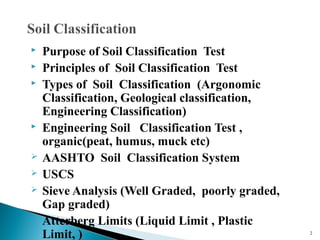
 Purpose of Soil Classification Test
 Principles of Soil Classification Test
 Types of Soil Classification (Argonomic
Classification, Geological classification,
Engineering Classification)
 Engineering Soil Classification Test ,
organic(peat, humus, muck etc)
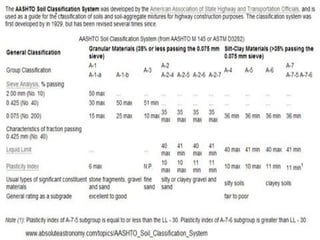
 AASHTO Soil Classification System
 USCS
 Sieve Analysis (Well Graded, poorly graded,
Gap graded)
 Atterberg Limits (Liquid Limit , Plastic
Limit, ) 2
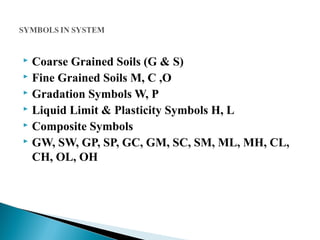
 Coarse Grained Soils (G & S)
 Fine Grained Soils M, C ,O
 Gradation Symbols W, P
 Liquid Limit & Plasticity Symbols H, L
 Composite Symbols
 GW, SW, GP, SP, GC, GM, SC, SM, ML, MH, CL,
CH, OL, OH
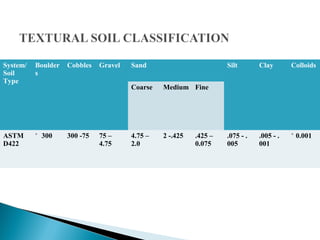
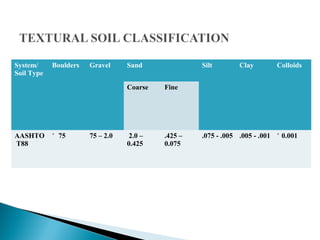
System/
Soil
Type
Boulder
s
Cobbles Gravel Sand Silt Clay Colloids
Coarse Medium Fine
ASTM
D422
300˃ 300 -75 75 –
4.75
4.75 –
2.0
2 -.425 .425 –
0.075
.075 - .
005
.005 - .
001
0.001˂
System/
Soil Type
Boulders Gravel Sand Silt Clay Colloids
Coarse Fine
AASHTO
T88
75˃ 75 – 2.0 2.0 –
0.425
.425 –
0.075
.075 - .005 .005 - .001 0.001˂
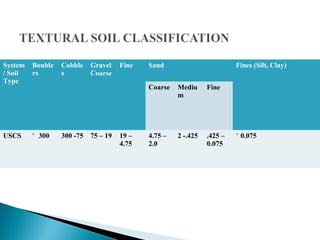
System
/ Soil
Type
Boulde
rs
Cobble
s
Gravel
Coarse
Fine Sand Fines (Silt, Clay)
Coarse Mediu
m
Fine
USCS 300˃ 300 -75 75 – 19 19 –
4.75
4.75 –
2.0
2 -.425 .425 –
0.075
0.075˂
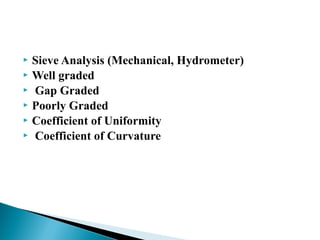
 Sieve Analysis (Mechanical, Hydrometer)
 Well graded
 Gap Graded
 Poorly Graded
 Coefficient of Uniformity
 Coefficient of Curvature
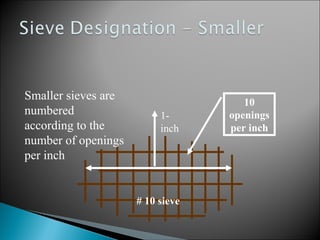
10
openings
per inch
# 10 sieve
1-
inch
Smaller sieves are
numbered
according to the
number of openings
per inch
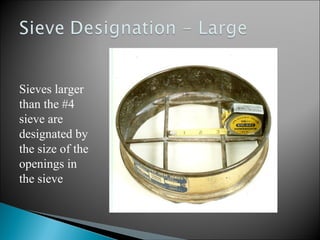
Sieves larger
than the #4
sieve are
designated by
the size of the
openings in
the sieve
0.0001 0.001 0.01 0.1 1 10 100
0
20
40
60
80
100
Particle size (mm)
%Finer
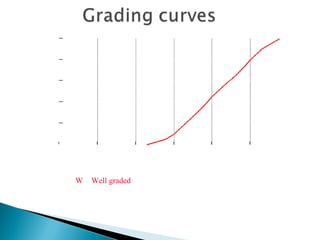
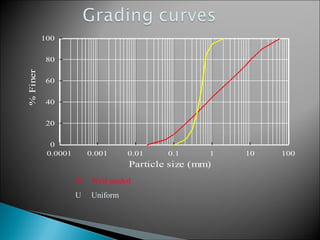
W Well graded
0.0001 0.001 0.01 0.1 1 10 100
0
20
40
60
80
100
Particle size (mm)
%Finer
W Well graded
U Uniform
Grading curves
0.0001 0.001 0.01 0.1 1 10 100
0
20
40
60
80
100
Particle size (mm)
%Finer
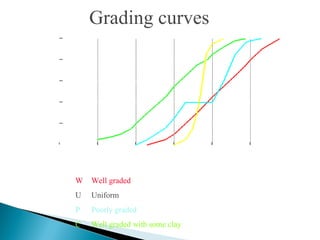
W Well graded
U Uniform
P Poorly graded
Grading curves
0.0001 0.001 0.01 0.1 1 10 100
0
20
40
60
80
100
Particle size (mm)
%Finer
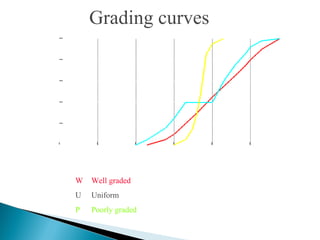
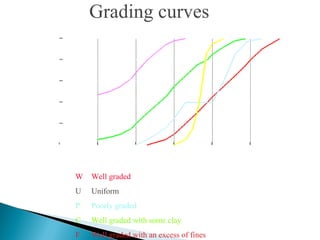
W Well graded
U Uniform
P Poorly graded
C Well graded with some clay
Grading curves
0.0001 0.001 0.01 0.1 1 10 100
0
20
40
60
80
100
Particle size (mm)
%Finer
W Well graded
U Uniform
P Poorly graded
C Well graded with some clay
F Well graded with an excess of fines
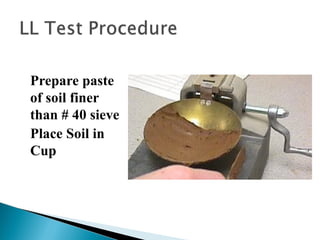
Prepare paste
of soil finer
than # 40 sieve
Place Soil in
Cup
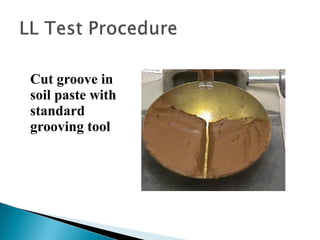
Cut groove in
soil paste with
standard
grooving tool
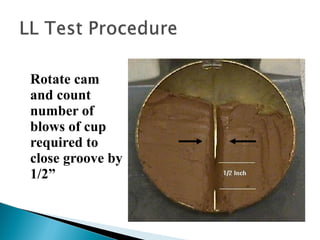
Rotate cam
and count
number of
blows of cup
required to
close groove by
1/2”
18
Das, 1998
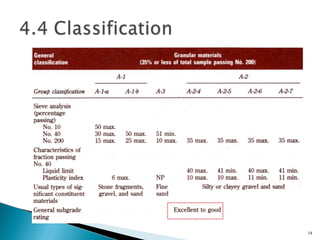
19
Das, 1998
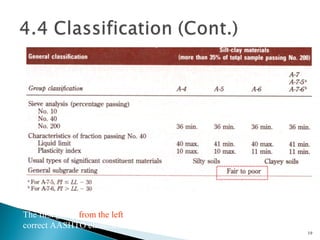
Note:
The first group from the left to fit the test data is the
correct AASHTO classification.
20
Passing No.200 86%
LL=70, PI=32
LL-30=40 > PI=32
[ ]
3347.33
)10PI)(15F(01.0
)40LL(005.02.0)35F(GI
200
200
≅=
−−+
−+−=
Round off A-7-5(33)
Passing No.200 86%
LL=70, PI=32
LL-30=40 > PI=32
21
(Holtz and Kovacs, 1981)
LL
PI
HL
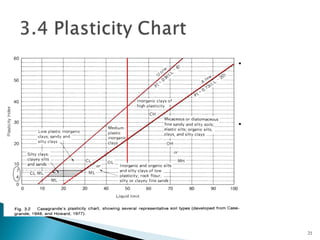
•The A-line generally
separates the more
claylike materials
from silty materials,
and the organics
from the inorganics.
•The U-line indicates
the upper bound for
general soils.
Note: If the measured
limits of soils are on
the left of U-line,
they should be
rechecked.
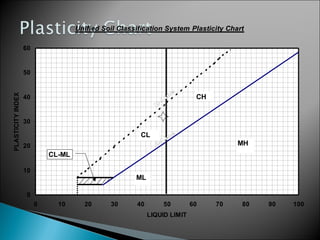
Unified Soil Classification System Plasticity Chart
0
10
20
30
40
50
60
0 10 20 30 40 50 60 70 80 90 100
LIQUID LIMIT
PLASTICITYINDEX
CH
CL
ML
MH
CL-ML
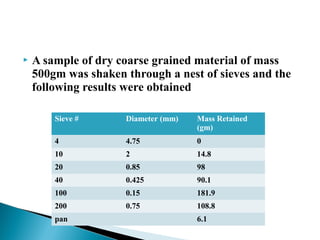
 A sample of dry coarse grained material of mass
500gm was shaken through a nest of sieves and the
following results were obtained
Sieve # Diameter (mm) Mass Retained
(gm)
4 4.75 0
10 2 14.8
20 0.85 98
40 0.425 90.1
100 0.15 181.9
200 0.75 108.8
pan 6.1
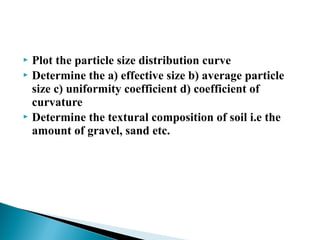
 Plot the particle size distribution curve
 Determine the a) effective size b) average particle
size c) uniformity coefficient d) coefficient of
curvature
 Determine the textural composition of soil i.e the
amount of gravel, sand etc.
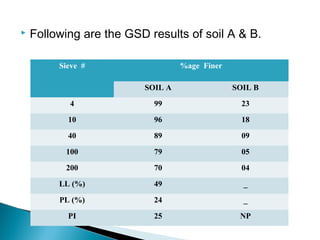
 Following are the GSD results of soil A & B.
Sieve # %age Finer
SOIL A SOIL B
4 99 23
10 96 18
40 89 09
100 79 05
200 70 04
LL (%) 49 _
PL (%) 24 _
PI 25 NP
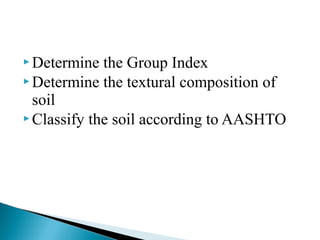
 Determine the Group Index
 Determine the textural composition of
soil
 Classify the soil according to AASHTO
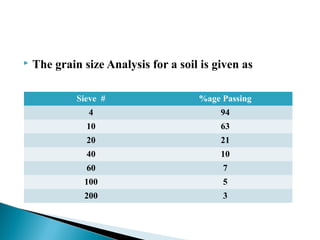
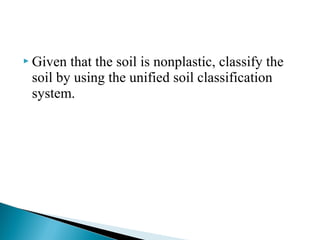
 The grain size Analysis for a soil is given as
Sieve # %age Passing
4 94
10 63
20 21
40 10
60 7
100 5
200 3
 Given that the soil is nonplastic, classify the
soil by using the unified soil classification
system.
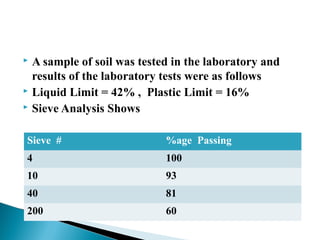
 A sample of soil was tested in the laboratory and
results of the laboratory tests were as follows
 Liquid Limit = 42% , Plastic Limit = 16%
 Sieve Analysis Shows
Sieve # %age Passing
4 100
10 93
40 81
200 60
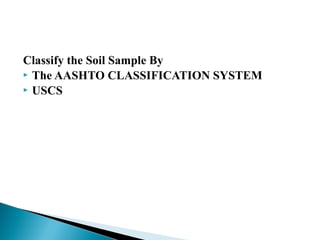
Classify the Soil Sample By
 The AASHTO CLASSIFICATION SYSTEM
 USCS
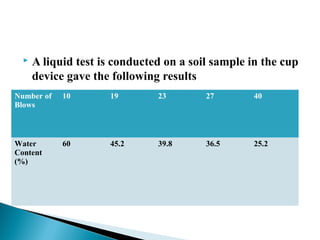
 A liquid test is conducted on a soil sample in the cup
device gave the following results
Number of
Blows
10 19 23 27 40
Water
Content
(%)
60 45.2 39.8 36.5 25.2
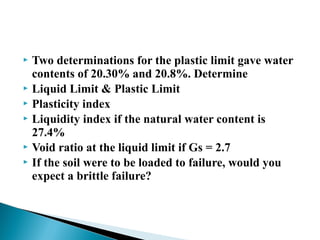
 Two determinations for the plastic limit gave water
contents of 20.30% and 20.8%. Determine
 Liquid Limit & Plastic Limit
 Plasticity index
 Liquidity index if the natural water content is
27.4%
 Void ratio at the liquid limit if Gs = 2.7
 If the soil were to be loaded to failure, would you
expect a brittle failure?

Soil classification 1

  • 1.
  • 2.
     Purpose ofSoil Classification Test  Principles of Soil Classification Test  Types of Soil Classification (Argonomic Classification, Geological classification, Engineering Classification)  Engineering Soil Classification Test , organic(peat, humus, muck etc)  AASHTO Soil Classification System  USCS  Sieve Analysis (Well Graded, poorly graded, Gap graded)  Atterberg Limits (Liquid Limit , Plastic Limit, ) 2
  • 3.
     Coarse GrainedSoils (G & S)  Fine Grained Soils M, C ,O  Gradation Symbols W, P  Liquid Limit & Plasticity Symbols H, L  Composite Symbols  GW, SW, GP, SP, GC, GM, SC, SM, ML, MH, CL, CH, OL, OH
  • 4.
    System/ Soil Type Boulder s Cobbles Gravel SandSilt Clay Colloids Coarse Medium Fine ASTM D422 300˃ 300 -75 75 – 4.75 4.75 – 2.0 2 -.425 .425 – 0.075 .075 - . 005 .005 - . 001 0.001˂
  • 5.
    System/ Soil Type Boulders GravelSand Silt Clay Colloids Coarse Fine AASHTO T88 75˃ 75 – 2.0 2.0 – 0.425 .425 – 0.075 .075 - .005 .005 - .001 0.001˂
  • 6.
    System / Soil Type Boulde rs Cobble s Gravel Coarse Fine SandFines (Silt, Clay) Coarse Mediu m Fine USCS 300˃ 300 -75 75 – 19 19 – 4.75 4.75 – 2.0 2 -.425 .425 – 0.075 0.075˂
  • 7.
     Sieve Analysis(Mechanical, Hydrometer)  Well graded  Gap Graded  Poorly Graded  Coefficient of Uniformity  Coefficient of Curvature
  • 8.
    10 openings per inch # 10sieve 1- inch Smaller sieves are numbered according to the number of openings per inch
  • 9.
    Sieves larger than the#4 sieve are designated by the size of the openings in the sieve
  • 10.
    0.0001 0.001 0.010.1 1 10 100 0 20 40 60 80 100 Particle size (mm) %Finer W Well graded
  • 11.
    0.0001 0.001 0.010.1 1 10 100 0 20 40 60 80 100 Particle size (mm) %Finer W Well graded U Uniform
  • 12.
    Grading curves 0.0001 0.0010.01 0.1 1 10 100 0 20 40 60 80 100 Particle size (mm) %Finer W Well graded U Uniform P Poorly graded
  • 13.
    Grading curves 0.0001 0.0010.01 0.1 1 10 100 0 20 40 60 80 100 Particle size (mm) %Finer W Well graded U Uniform P Poorly graded C Well graded with some clay
  • 14.
    Grading curves 0.0001 0.0010.01 0.1 1 10 100 0 20 40 60 80 100 Particle size (mm) %Finer W Well graded U Uniform P Poorly graded C Well graded with some clay F Well graded with an excess of fines
  • 15.
    Prepare paste of soilfiner than # 40 sieve Place Soil in Cup
  • 16.
    Cut groove in soilpaste with standard grooving tool
  • 17.
    Rotate cam and count numberof blows of cup required to close groove by 1/2”
  • 18.
  • 19.
    19 Das, 1998 Note: The firstgroup from the left to fit the test data is the correct AASHTO classification.
  • 20.
    20 Passing No.200 86% LL=70,PI=32 LL-30=40 > PI=32 [ ] 3347.33 )10PI)(15F(01.0 )40LL(005.02.0)35F(GI 200 200 ≅= −−+ −+−= Round off A-7-5(33) Passing No.200 86% LL=70, PI=32 LL-30=40 > PI=32
  • 21.
    21 (Holtz and Kovacs,1981) LL PI HL •The A-line generally separates the more claylike materials from silty materials, and the organics from the inorganics. •The U-line indicates the upper bound for general soils. Note: If the measured limits of soils are on the left of U-line, they should be rechecked.
  • 22.
    Unified Soil ClassificationSystem Plasticity Chart 0 10 20 30 40 50 60 0 10 20 30 40 50 60 70 80 90 100 LIQUID LIMIT PLASTICITYINDEX CH CL ML MH CL-ML
  • 23.
     A sampleof dry coarse grained material of mass 500gm was shaken through a nest of sieves and the following results were obtained Sieve # Diameter (mm) Mass Retained (gm) 4 4.75 0 10 2 14.8 20 0.85 98 40 0.425 90.1 100 0.15 181.9 200 0.75 108.8 pan 6.1
  • 24.
     Plot theparticle size distribution curve  Determine the a) effective size b) average particle size c) uniformity coefficient d) coefficient of curvature  Determine the textural composition of soil i.e the amount of gravel, sand etc.
  • 25.
     Following arethe GSD results of soil A & B. Sieve # %age Finer SOIL A SOIL B 4 99 23 10 96 18 40 89 09 100 79 05 200 70 04 LL (%) 49 _ PL (%) 24 _ PI 25 NP
  • 26.
     Determine theGroup Index  Determine the textural composition of soil  Classify the soil according to AASHTO
  • 28.
     The grainsize Analysis for a soil is given as Sieve # %age Passing 4 94 10 63 20 21 40 10 60 7 100 5 200 3
  • 29.
     Given thatthe soil is nonplastic, classify the soil by using the unified soil classification system.
  • 30.
     A sampleof soil was tested in the laboratory and results of the laboratory tests were as follows  Liquid Limit = 42% , Plastic Limit = 16%  Sieve Analysis Shows Sieve # %age Passing 4 100 10 93 40 81 200 60
  • 31.
    Classify the SoilSample By  The AASHTO CLASSIFICATION SYSTEM  USCS
  • 32.
     A liquidtest is conducted on a soil sample in the cup device gave the following results Number of Blows 10 19 23 27 40 Water Content (%) 60 45.2 39.8 36.5 25.2
  • 33.
     Two determinationsfor the plastic limit gave water contents of 20.30% and 20.8%. Determine  Liquid Limit & Plastic Limit  Plasticity index  Liquidity index if the natural water content is 27.4%  Void ratio at the liquid limit if Gs = 2.7  If the soil were to be loaded to failure, would you expect a brittle failure?

Editor's Notes

  • #19 A-1 materials are well graded, whereas A-3 soils are clean, poorly graded sands. A-2 materials are also granular (less than 35% passing the No.200 sieve), but they contain a significant amount of silts and clays. A-4 to A-7 are fine-grained soils, the silt-clay materials. They are differentiated on the basis of their Atterberg Limits.
  • #20 Tell them the figure in the handout.
  • #21 The group index is round off to the nearest whole number.
  • #22 The A-line generally separates the more claylike materials from those that are silty and also the organics from the inorganics. The U-line indicates the upper range for natural soils