S.GAYATHRI
MSFBI1506
PERL
III MSC BIOINFORMATICS
 A pattern is composed of a set of Atom,
Quantifiers, Assertions.
 Atoms are the individual characters that make up
the pattern, quantifiers are phrases that control
how many atoms are seen, and assertions control
where the atoms are found.
 Together, the three aspects of patterns make for
an incredibly rich and powerful language.
 The character string represents a series of atoms,
which are the basic single character matching
substrate.
 For example, when searching for the start codon, we
created a pattern of three atoms: A, T, and G.
 The regular expression operator then looked for
those three atoms in the specified order.
 Any character that Perl recognizes can be used as an
atom. That includes letters, numbers, and spaces.
Each character matches itself once, unless it is
quantified.
 Characters protected with a backslash match that
character, with the following exceptions:
 c followed by a character matches the corresponding
control character.
 For example, cD matches the Control-D character;
 x followed by a two-digit hexadecimal number matches
the character having that hexadecimal value;
 0 used as a two- or three-digit octal value matches the
character with that octal value;
 n matches a newline;
 r matches a return;
 f matches a form feed;
 t matches a tab;
 A . matches any character except the n character.
So the pattern A.G
 matches ATG, ACG, AAG, and AGG, as well as
any other triplet of letters that
 starts with A and ends with G.
 Some ranges are so useful that Perl defines some
backslash-escaped characters that match a
specific class
 d matches any digit, the same as [0–9]
 D matches any nondigit, the same as [ˆ0–9]
 w matches any alphanumeric character, the same as
[0-9a-zA-Z]
 W matches any nonalphanumeric character, the same
as [ˆ0-9a-zA-Z]
 s matches any white-space character, the same as
[tnrf]
 S matches any non-white-space character, the same
as [ˆ tnrf]
 Note that w is not equivalent to S, and W is not
equivalent to s.
 This is because there are symbol and control
characters that won’t match the w or s atom, but will
match the W and S atom.
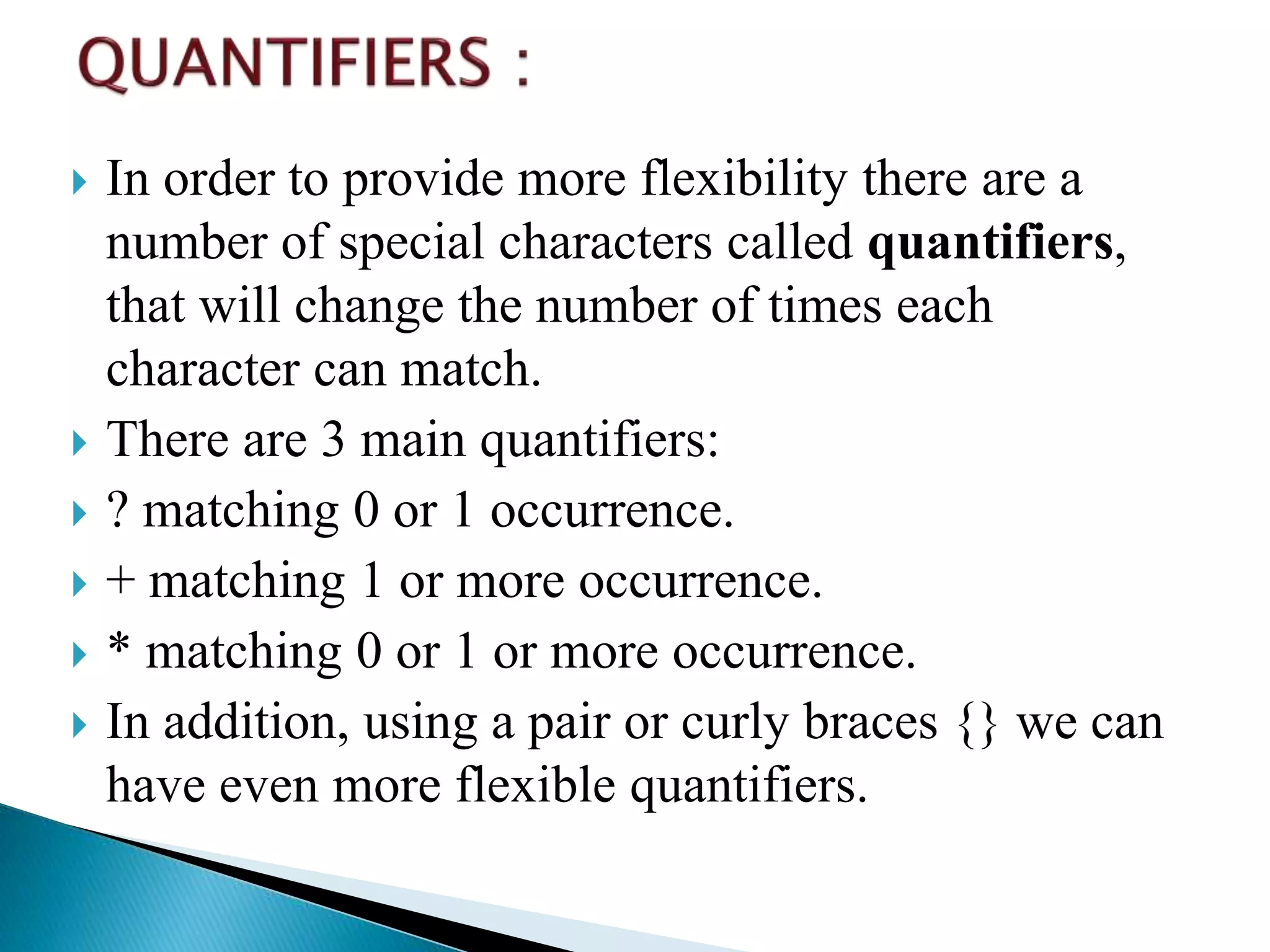
 In order to provide more flexibility there are a
number of special characters called quantifiers,
that will change the number of times each
character can match.
 There are 3 main quantifiers:
 ? matching 0 or 1 occurrence.
 + matching 1 or more occurrence.
 * matching 0 or 1 or more occurrence.
 In addition, using a pair or curly braces {} we can
have even more flexible quantifiers.
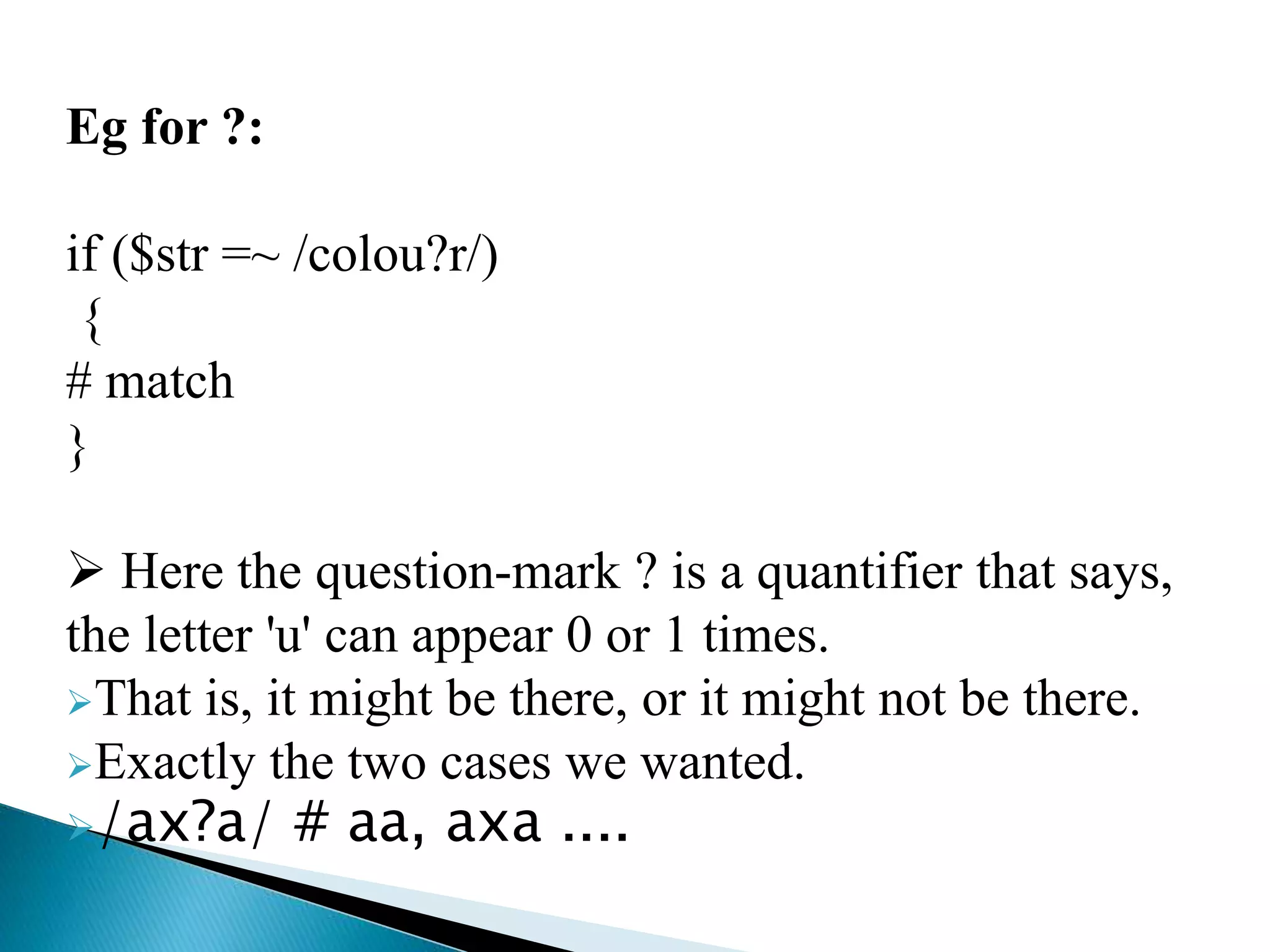
Eg for ?:
if ($str =~ /colou?r/)
{
# match
}
 Here the question-mark ? is a quantifier that says,
the letter 'u' can appear 0 or 1 times.
That is, it might be there, or it might not be there.
Exactly the two cases we wanted.
/ax?a/ # aa, axa ....
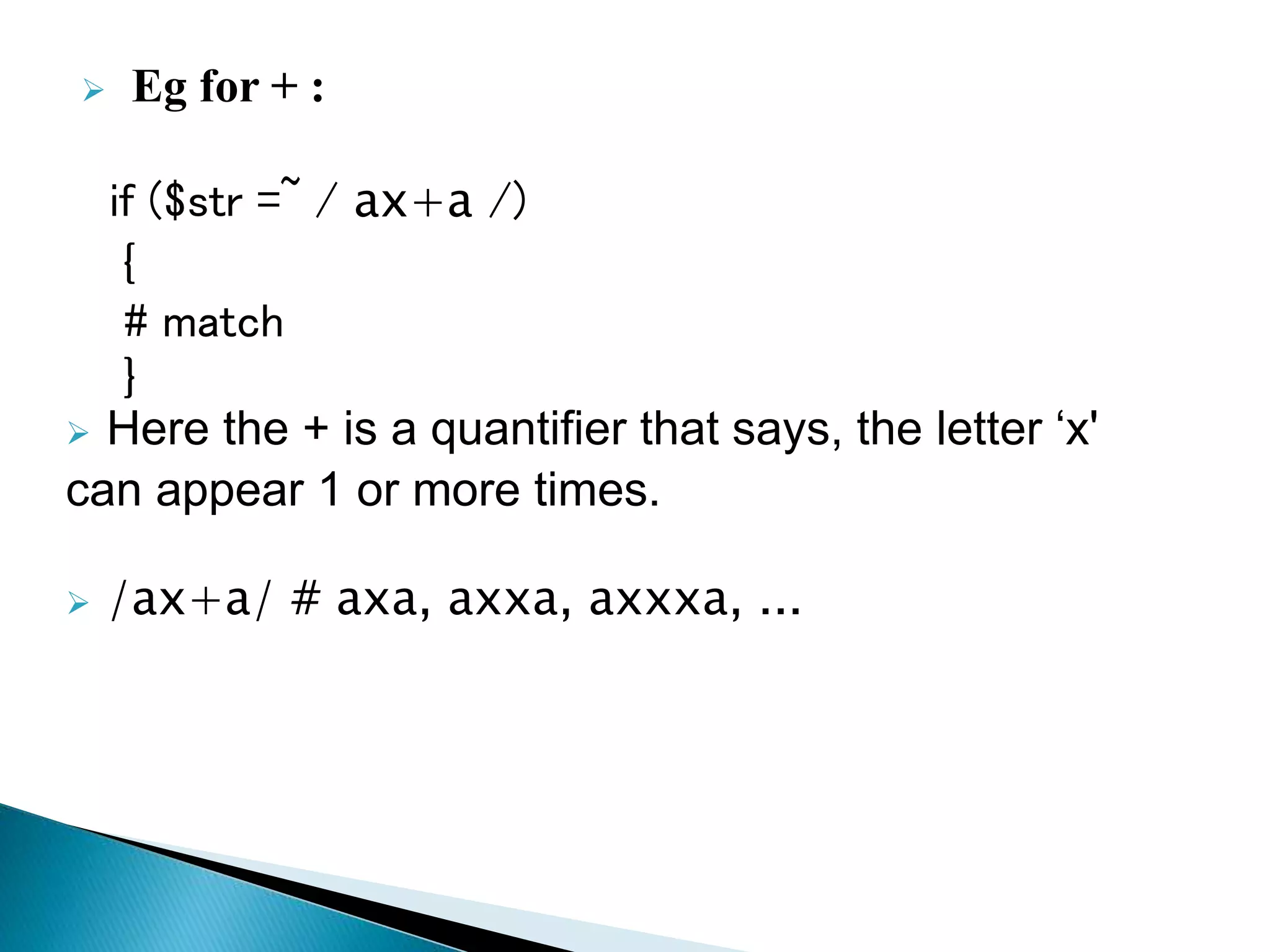
 Eg for + :
if ($str =~ / ax+a /)
{
# match
}
 Here the + is a quantifier that says, the letter ‘x'
can appear 1 or more times.
 /ax+a/ # axa, axxa, axxxa, ...
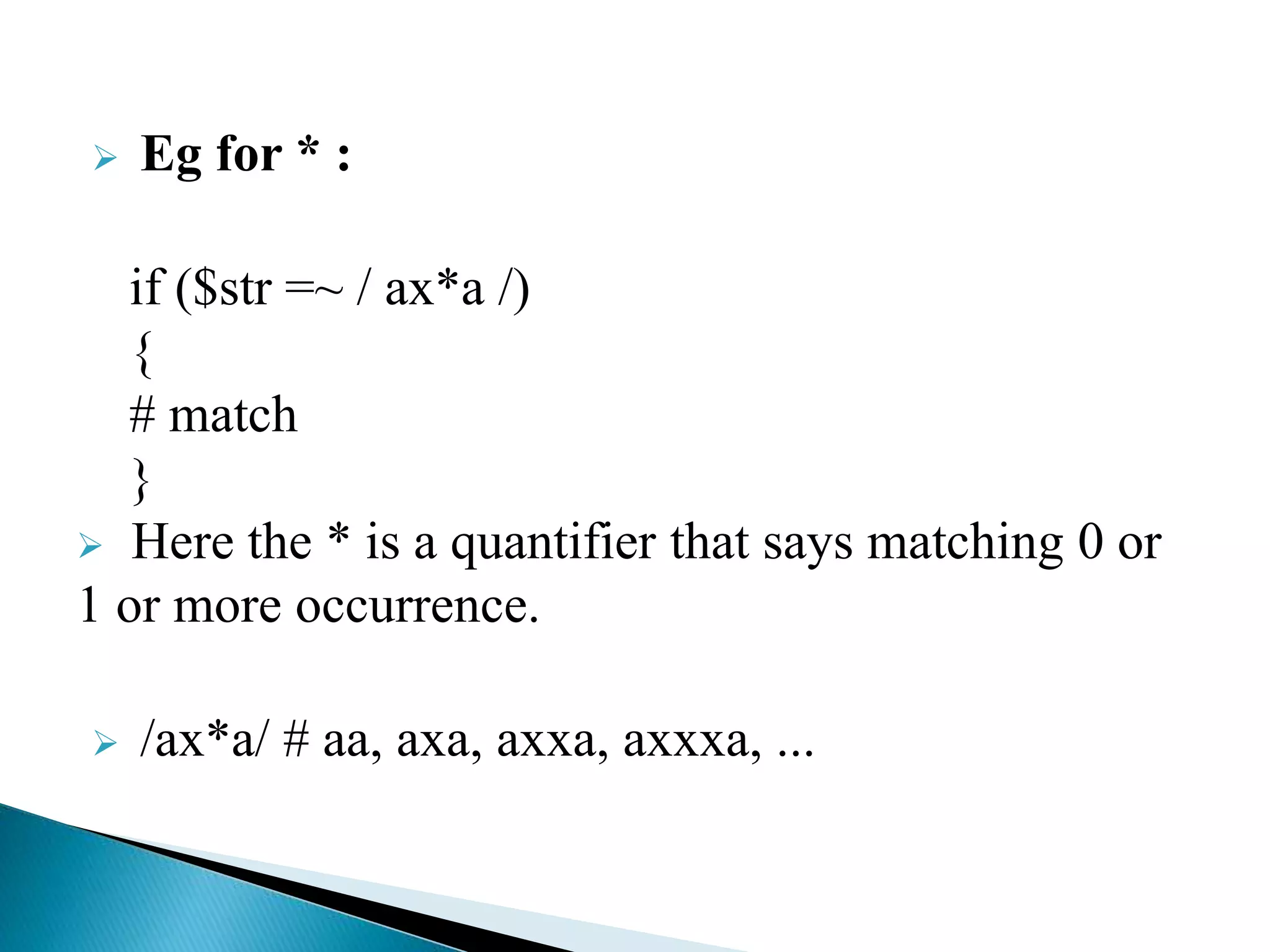
 Eg for * :
if ($str =~ / ax*a /)
{
# match
}
 Here the * is a quantifier that says matching 0 or
1 or more occurrence.
 /ax*a/ # aa, axa, axxa, axxxa, ...
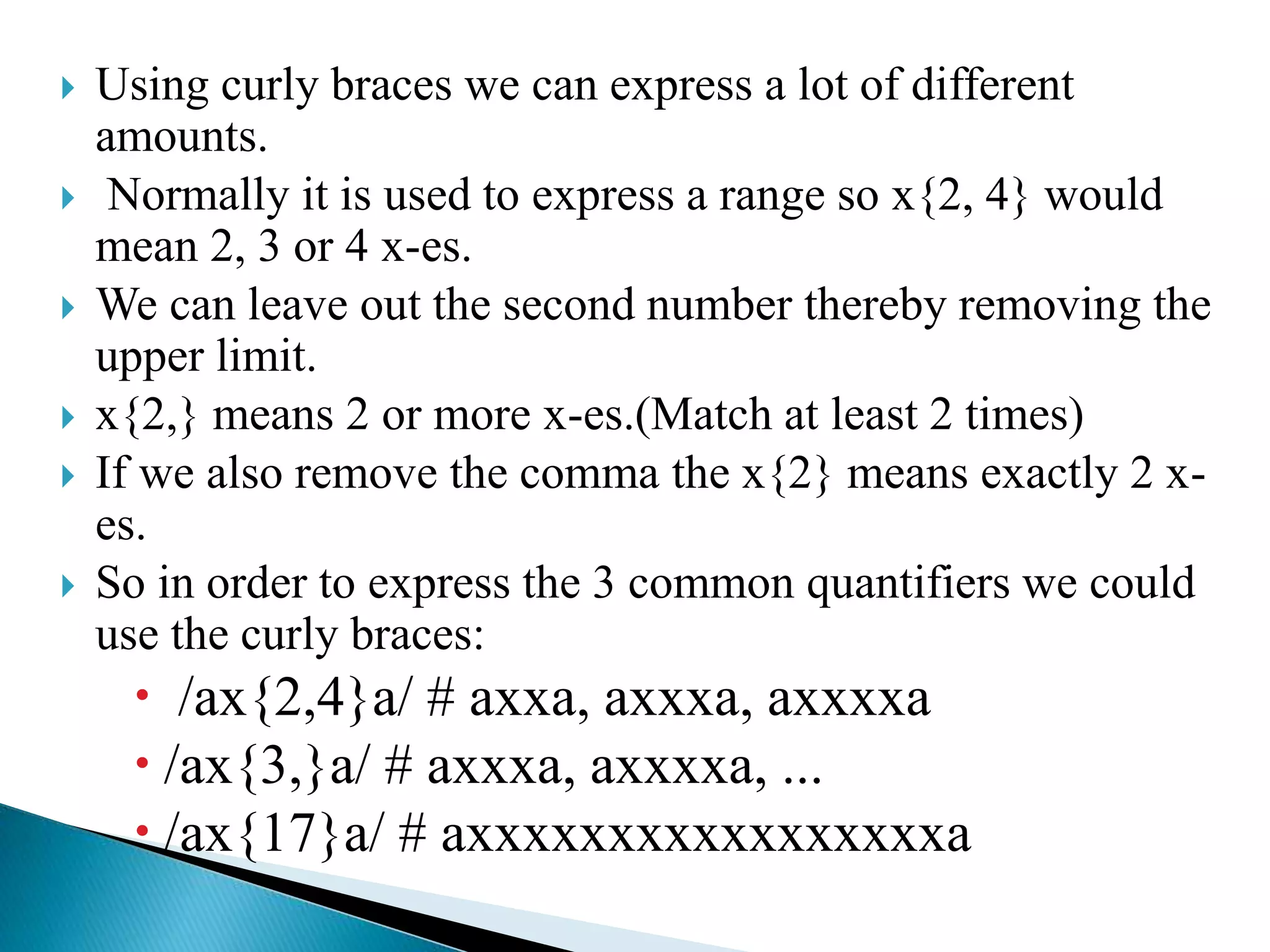
 Using curly braces we can express a lot of different
amounts.
 Normally it is used to express a range so x{2, 4} would
mean 2, 3 or 4 x-es.
 We can leave out the second number thereby removing the
upper limit.
 x{2,} means 2 or more x-es.(Match at least 2 times)
 If we also remove the comma the x{2} means exactly 2 x-
es.
 So in order to express the 3 common quantifiers we could
use the curly braces:
 /ax{2,4}a/ # axxa, axxxa, axxxxa
 /ax{3,}a/ # axxxa, axxxxa, ...
 /ax{17}a/ # axxxxxxxxxxxxxxxxxa
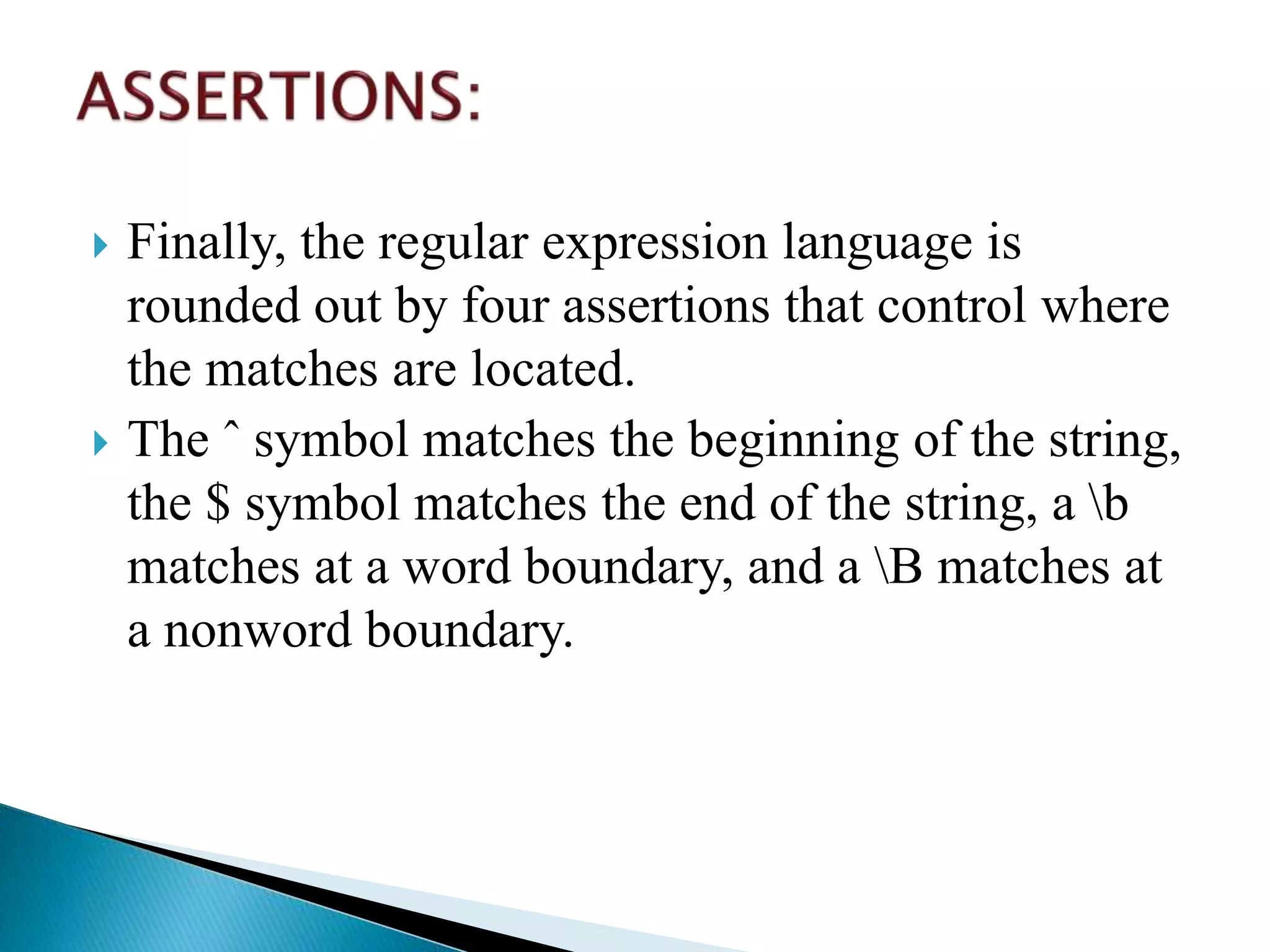
 Finally, the regular expression language is
rounded out by four assertions that control where
the matches are located.
 The ˆ symbol matches the beginning of the string,
the $ symbol matches the end of the string, a b
matches at a word boundary, and a B matches at
a nonword boundary.
 Note that the ˆ and the $ have other meanings as
well, and it is important to check the context of
the symbol:
 $seq =∼ /^[AUCG]*A{100, 200}$/
 is a way to validate that $seq contains a mRNA
sequence, whereas
 $seq =∼ /[^AUCG]*A{100, 200}$/
 makes sure there are no A, U, C, or G characters
in the match, which more than likely is not what
the programmer intended.
Patterns

Patterns

  • 1.
  • 2.
     A patternis composed of a set of Atom, Quantifiers, Assertions.  Atoms are the individual characters that make up the pattern, quantifiers are phrases that control how many atoms are seen, and assertions control where the atoms are found.  Together, the three aspects of patterns make for an incredibly rich and powerful language.
  • 3.
     The characterstring represents a series of atoms, which are the basic single character matching substrate.  For example, when searching for the start codon, we created a pattern of three atoms: A, T, and G.  The regular expression operator then looked for those three atoms in the specified order.  Any character that Perl recognizes can be used as an atom. That includes letters, numbers, and spaces. Each character matches itself once, unless it is quantified.
  • 4.
     Characters protectedwith a backslash match that character, with the following exceptions:  c followed by a character matches the corresponding control character.  For example, cD matches the Control-D character;  x followed by a two-digit hexadecimal number matches the character having that hexadecimal value;  0 used as a two- or three-digit octal value matches the character with that octal value;  n matches a newline;  r matches a return;  f matches a form feed;  t matches a tab;
  • 5.
     A .matches any character except the n character. So the pattern A.G  matches ATG, ACG, AAG, and AGG, as well as any other triplet of letters that  starts with A and ends with G.  Some ranges are so useful that Perl defines some backslash-escaped characters that match a specific class  d matches any digit, the same as [0–9]  D matches any nondigit, the same as [ˆ0–9]
  • 6.
     w matchesany alphanumeric character, the same as [0-9a-zA-Z]  W matches any nonalphanumeric character, the same as [ˆ0-9a-zA-Z]  s matches any white-space character, the same as [tnrf]  S matches any non-white-space character, the same as [ˆ tnrf]  Note that w is not equivalent to S, and W is not equivalent to s.  This is because there are symbol and control characters that won’t match the w or s atom, but will match the W and S atom.
  • 7.
     In orderto provide more flexibility there are a number of special characters called quantifiers, that will change the number of times each character can match.  There are 3 main quantifiers:  ? matching 0 or 1 occurrence.  + matching 1 or more occurrence.  * matching 0 or 1 or more occurrence.  In addition, using a pair or curly braces {} we can have even more flexible quantifiers.
  • 8.
    Eg for ?: if($str =~ /colou?r/) { # match }  Here the question-mark ? is a quantifier that says, the letter 'u' can appear 0 or 1 times. That is, it might be there, or it might not be there. Exactly the two cases we wanted. /ax?a/ # aa, axa ....
  • 9.
     Eg for+ : if ($str =~ / ax+a /) { # match }  Here the + is a quantifier that says, the letter ‘x' can appear 1 or more times.  /ax+a/ # axa, axxa, axxxa, ...
  • 10.
     Eg for* : if ($str =~ / ax*a /) { # match }  Here the * is a quantifier that says matching 0 or 1 or more occurrence.  /ax*a/ # aa, axa, axxa, axxxa, ...
  • 11.
     Using curlybraces we can express a lot of different amounts.  Normally it is used to express a range so x{2, 4} would mean 2, 3 or 4 x-es.  We can leave out the second number thereby removing the upper limit.  x{2,} means 2 or more x-es.(Match at least 2 times)  If we also remove the comma the x{2} means exactly 2 x- es.  So in order to express the 3 common quantifiers we could use the curly braces:  /ax{2,4}a/ # axxa, axxxa, axxxxa  /ax{3,}a/ # axxxa, axxxxa, ...  /ax{17}a/ # axxxxxxxxxxxxxxxxxa
  • 12.
     Finally, theregular expression language is rounded out by four assertions that control where the matches are located.  The ˆ symbol matches the beginning of the string, the $ symbol matches the end of the string, a b matches at a word boundary, and a B matches at a nonword boundary.
  • 13.
     Note thatthe ˆ and the $ have other meanings as well, and it is important to check the context of the symbol:  $seq =∼ /^[AUCG]*A{100, 200}$/  is a way to validate that $seq contains a mRNA sequence, whereas  $seq =∼ /[^AUCG]*A{100, 200}$/  makes sure there are no A, U, C, or G characters in the match, which more than likely is not what the programmer intended.