Bayesian Regression
An Introduction Using R
J Guzmán, PhD
January 2011
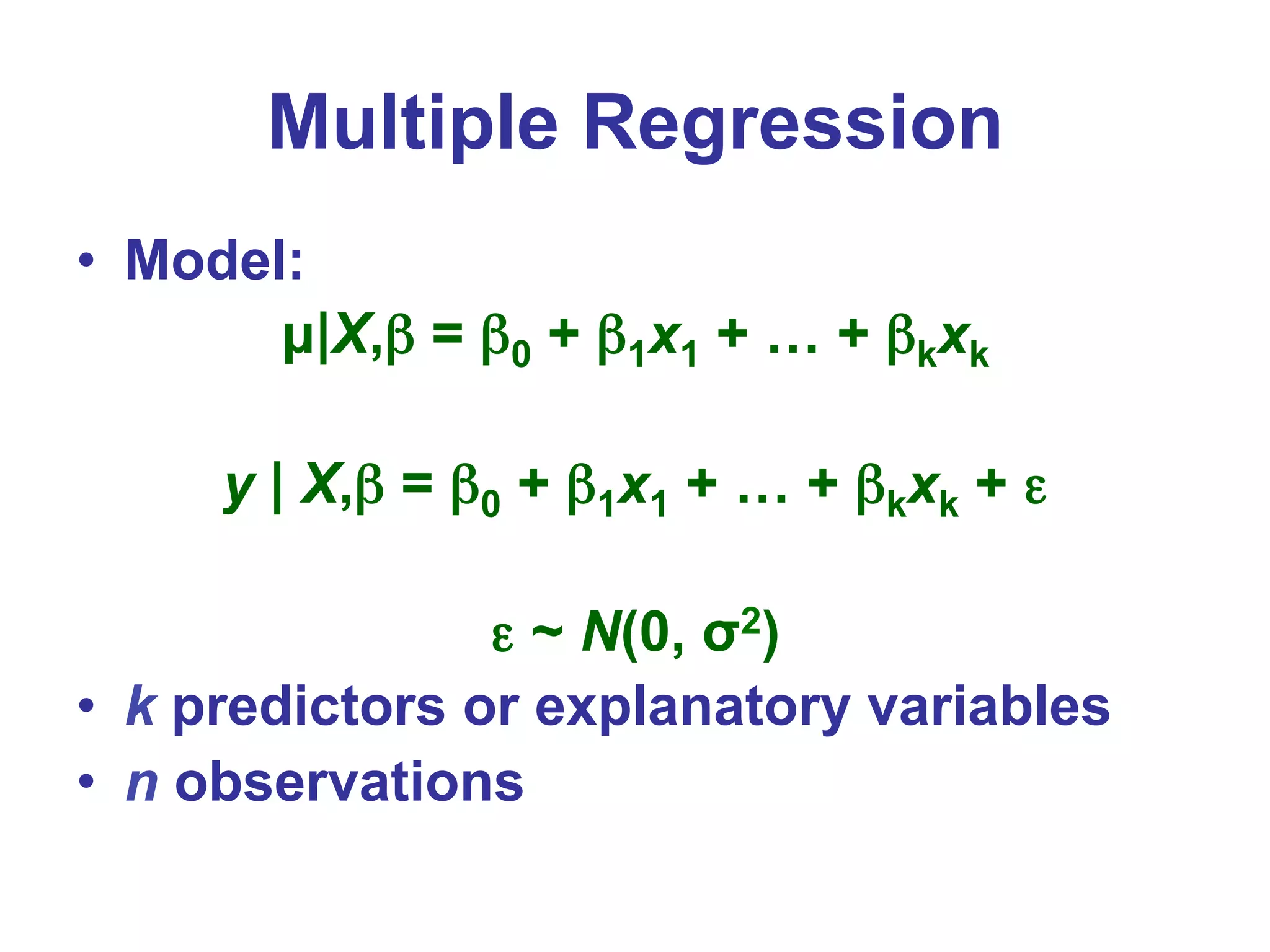
Multiple Regression
•  Model:
µ|X,β = β0 + β1x1 + … + βkxk
y | X,β = β0 + β1x1 + … + βkxk + ε
ε ~ N(0, σ2)
•  k predictors or explanatory variables
•  n observations
Multiple Regression
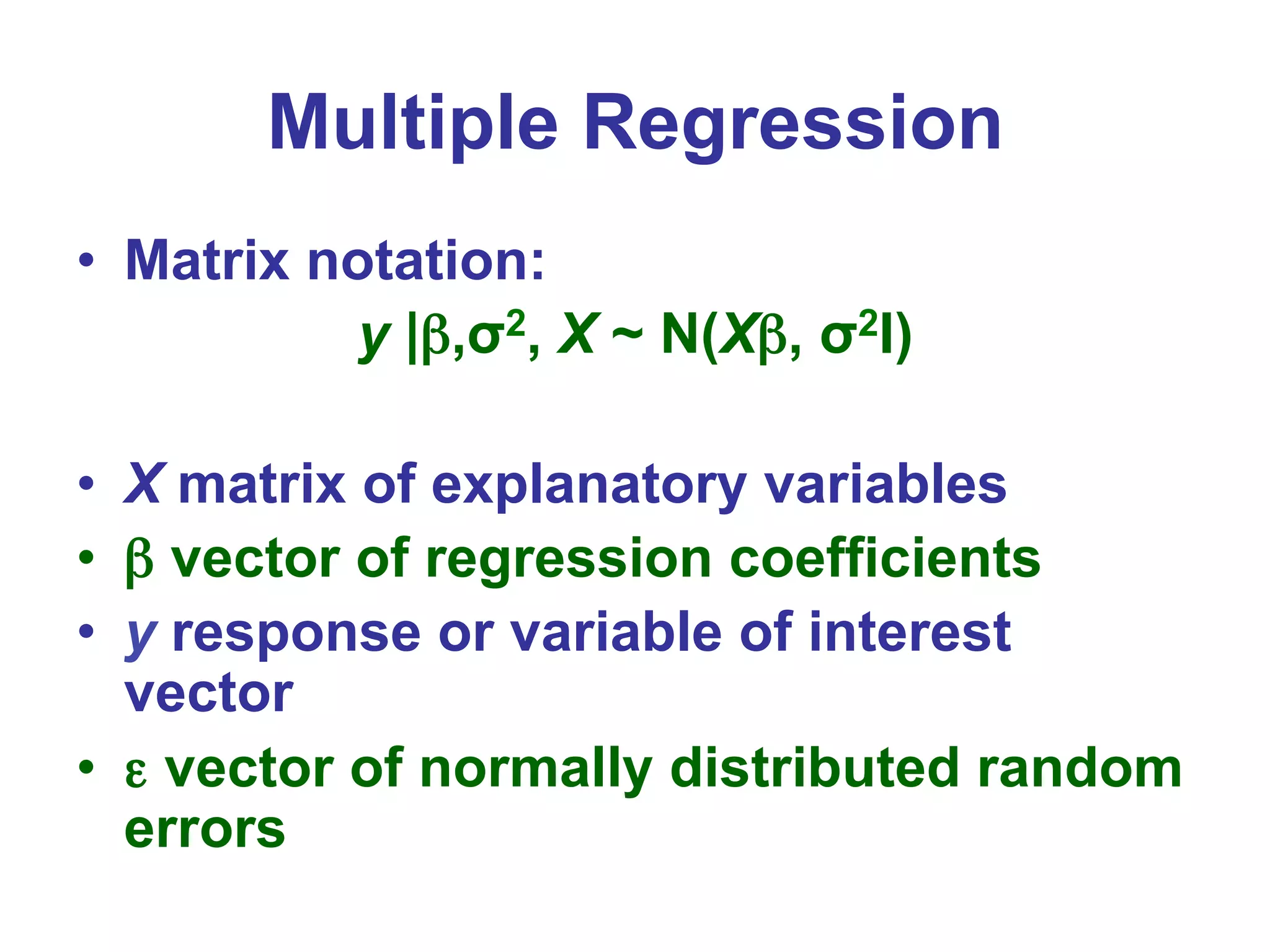
•  Matrix notation:
y |β,σ2, X ~ N(Xβ, σ2I)
•  X matrix of explanatory variables
•  β vector of regression coefficients
•  y response or variable of interest
vector
•  ε vector of normally distributed random
errors
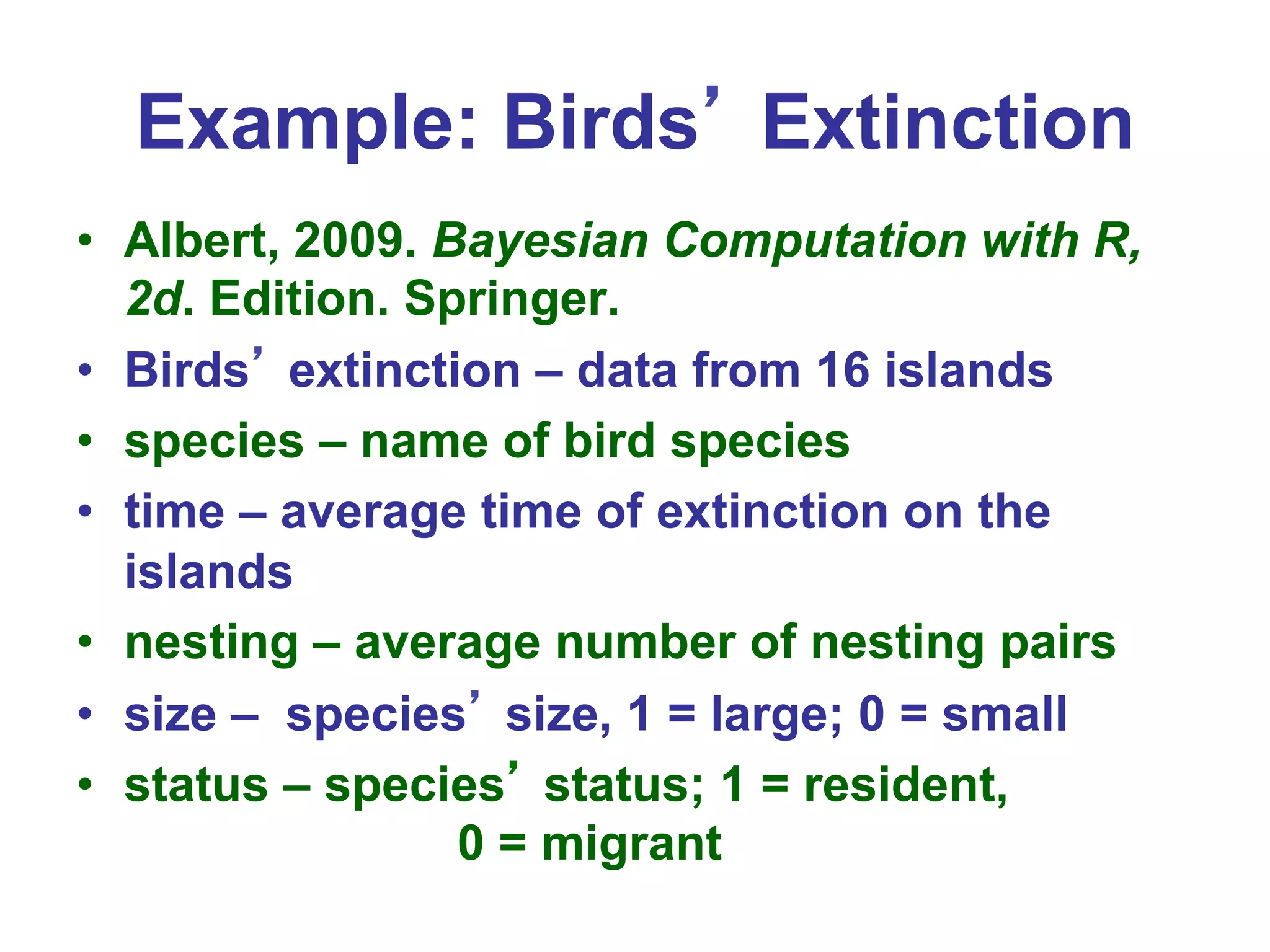
Example: Birds’ Extinction
•  Albert, 2009. Bayesian Computation with R,
2d. Edition. Springer.
•  Birds’ extinction – data from 16 islands
•  species – name of bird species
•  time – average time of extinction on the
islands
•  nesting – average number of nesting pairs
•  size – species’ size, 1 = large; 0 = small
•  status – species’ status; 1 = resident,
0 = migrant
Example
library(LearnBayes)
data(birdextinct)
attach(birdextinct)
birdextinct[1:15, ]
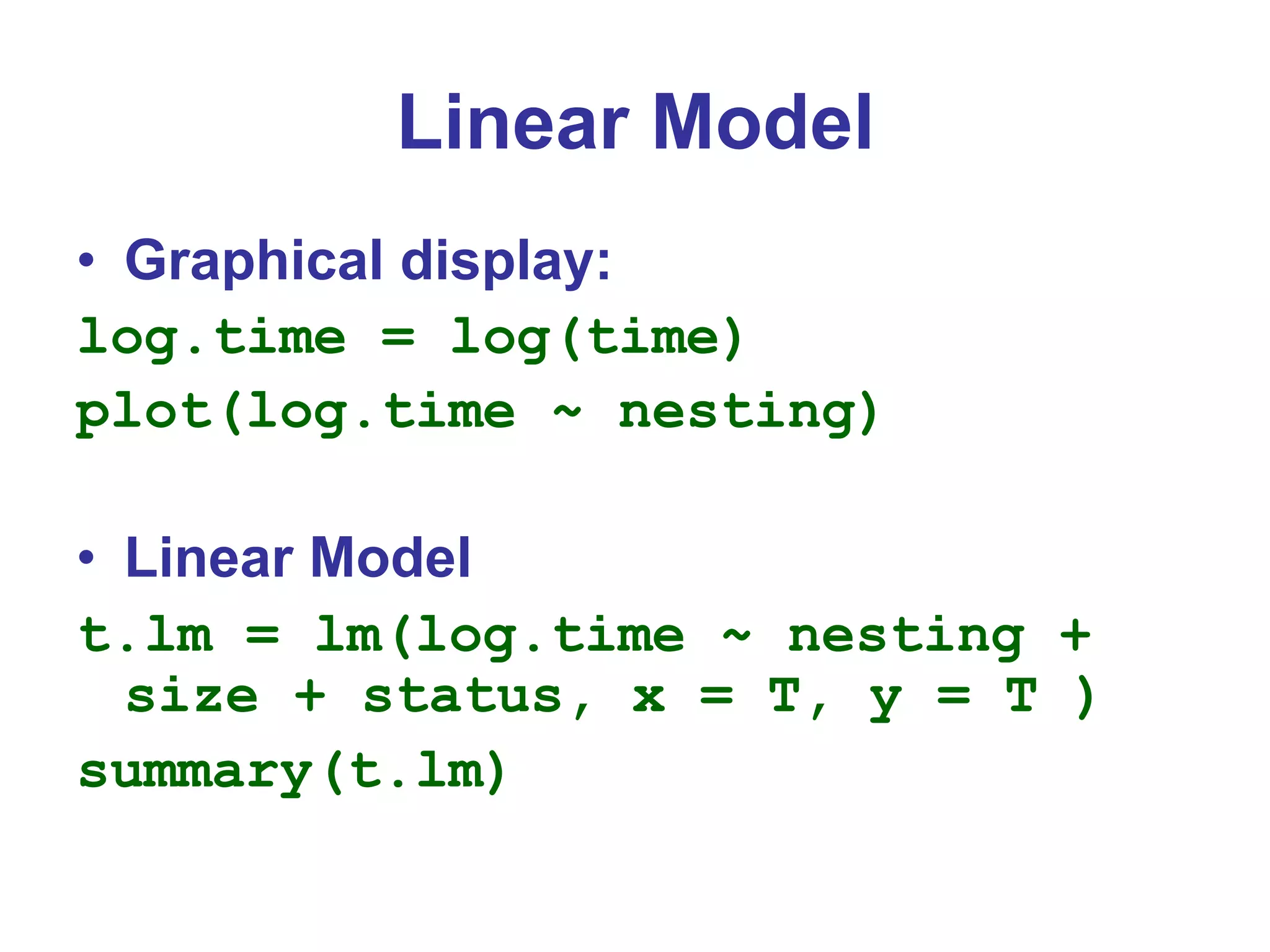
Linear Model
•  Graphical display:
log.time = log(time)
plot(log.time ~ nesting)
•  Linear Model
t.lm = lm(log.time ~ nesting +
size + status, x = T, y = T )
summary(t.lm)
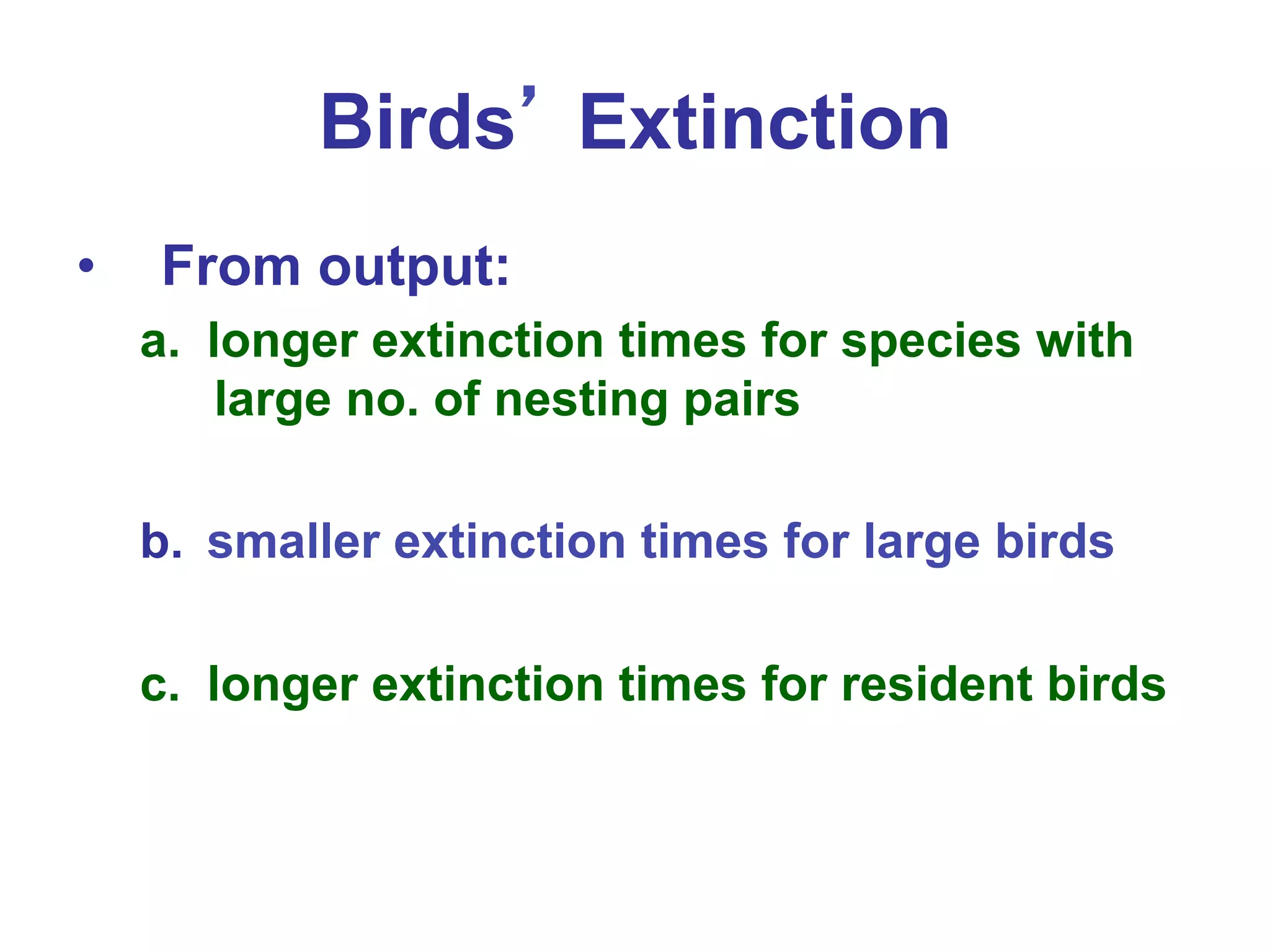
Birds’ Extinction
•  From output:
a.  longer extinction times for species with
large no. of nesting pairs
b.  smaller extinction times for large birds
c.  longer extinction times for resident birds
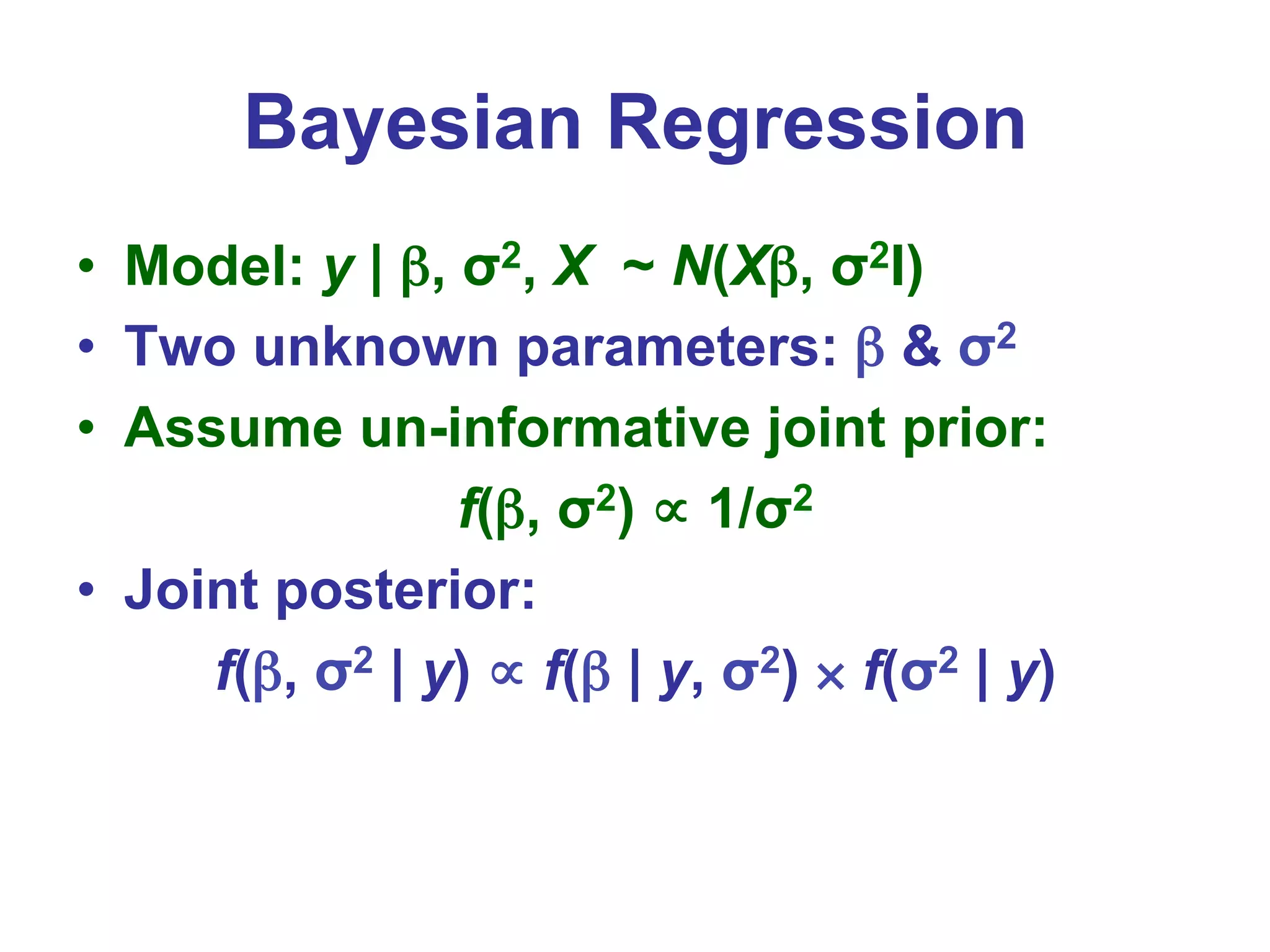
Bayesian Regression
•  Model: y | β, σ2, X ~ N(Xβ, σ2I)
•  Two unknown parameters: β & σ2
•  Assume un-informative joint prior:
f(β, σ2) ∝ 1/σ2
•  Joint posterior:
f(β, σ2 | y) ∝ f(β | y, σ2) × f(σ2 | y)
Bayesian Regression
•  Marginal posterior distribution of β,
conditional on error variance σ2 is
Multivariate Normal with:
Mean = b = (XtX)-1Xty
var(β) = σ2 ⋅ (XtX)-1
•  Marginal posterior distribution of σ2 is
Inverse Gamma[(n - k)/2, S/2]
S = (y - Xb)t (y - Xb)
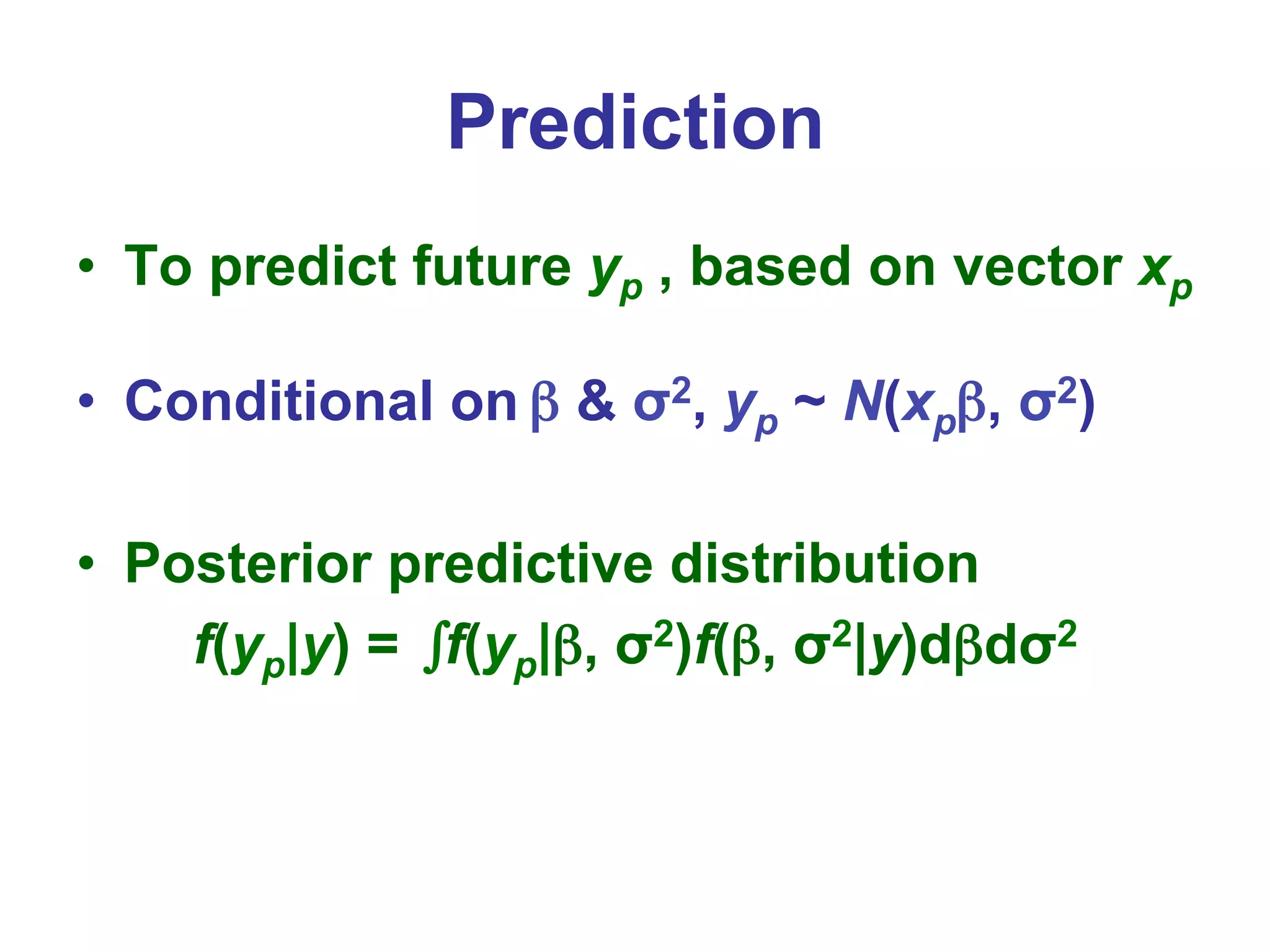
Prediction
•  To predict future yp , based on vector xp
•  Conditional on β & σ2, yp ~ N(xpβ, σ2)
•  Posterior predictive distribution
f(yp|y) = ∫f(yp|β, σ2)f(β, σ2|y)dβdσ2
Computation
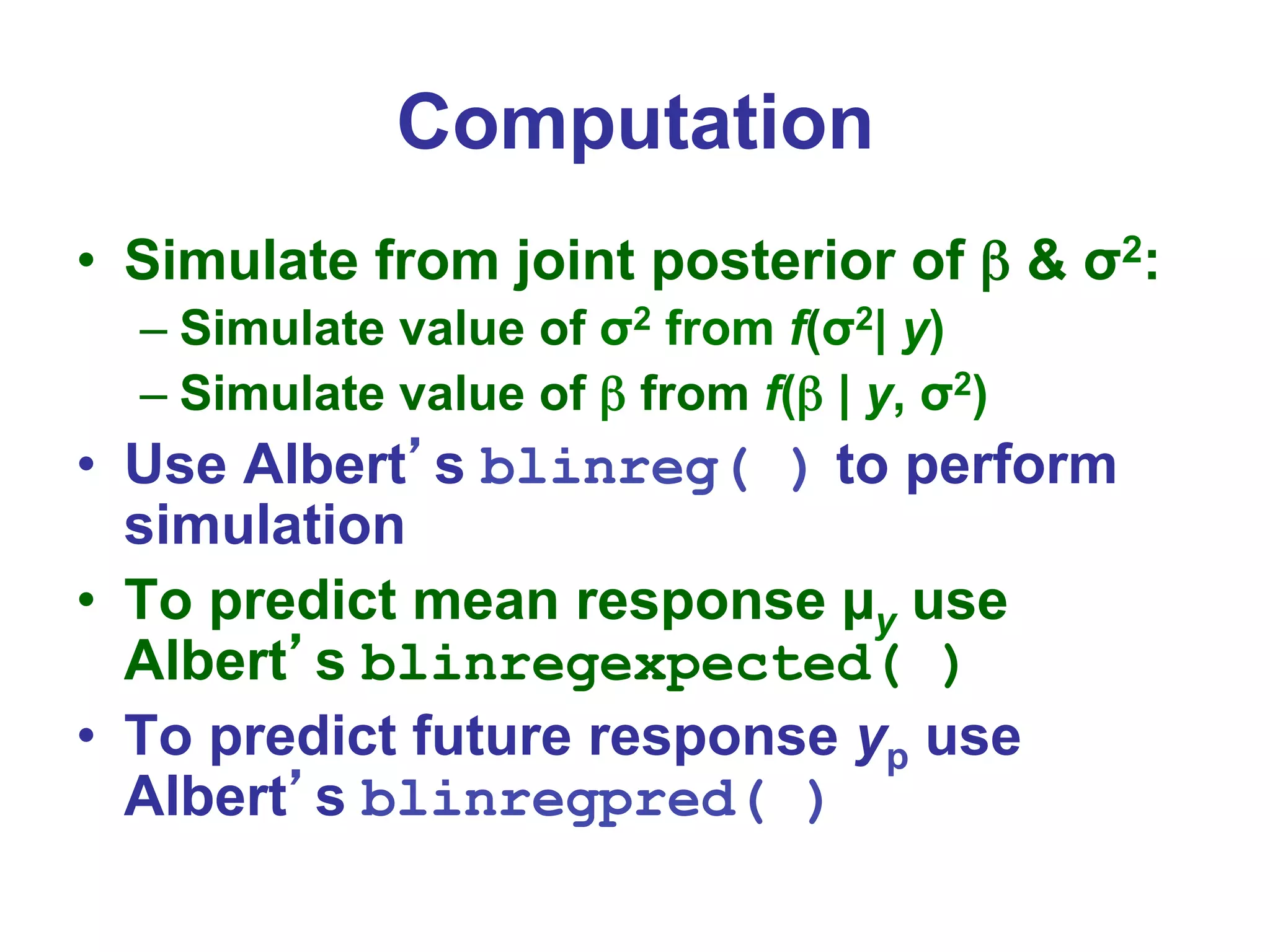
•  Simulate from joint posterior of β & σ2:
– Simulate value of σ2 from f(σ2| y)
– Simulate value of β from f(β | y, σ2)
•  Use Albert’s blinreg( ) to perform
simulation
•  To predict mean response µy use
Albert’s blinregexpected( )
•  To predict future response yp use
Albert’s blinregpred( )
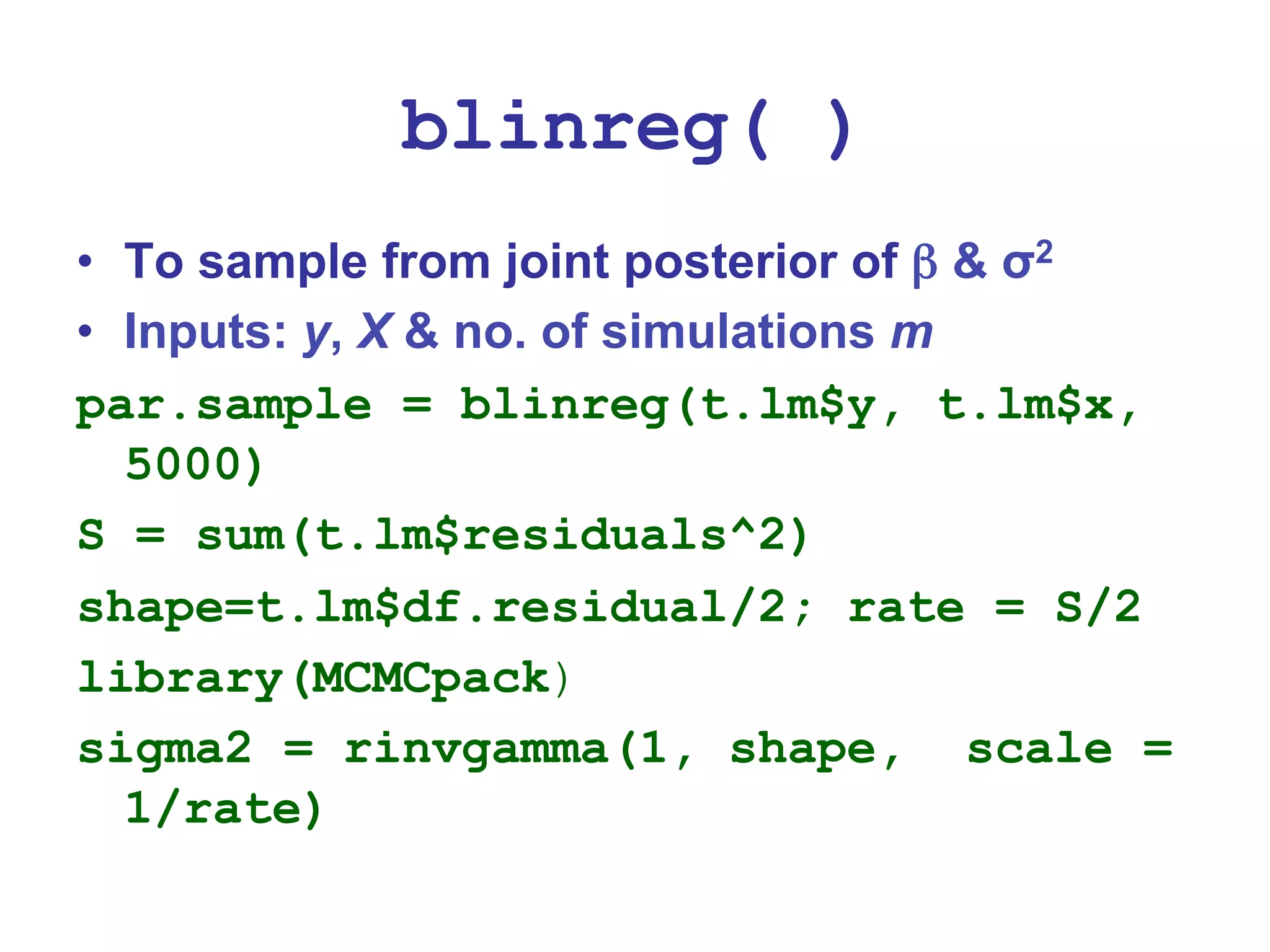
blinreg( )
•  To sample from joint posterior of β & σ2
•  Inputs: y, X & no. of simulations m
par.sample = blinreg(t.lm$y, t.lm$x,
5000)
S = sum(t.lm$residuals^2)
shape=t.lm$df.residual/2; rate = S/2
library(MCMCpack)
sigma2 = rinvgamma(1, shape, scale =
1/rate)
Computation
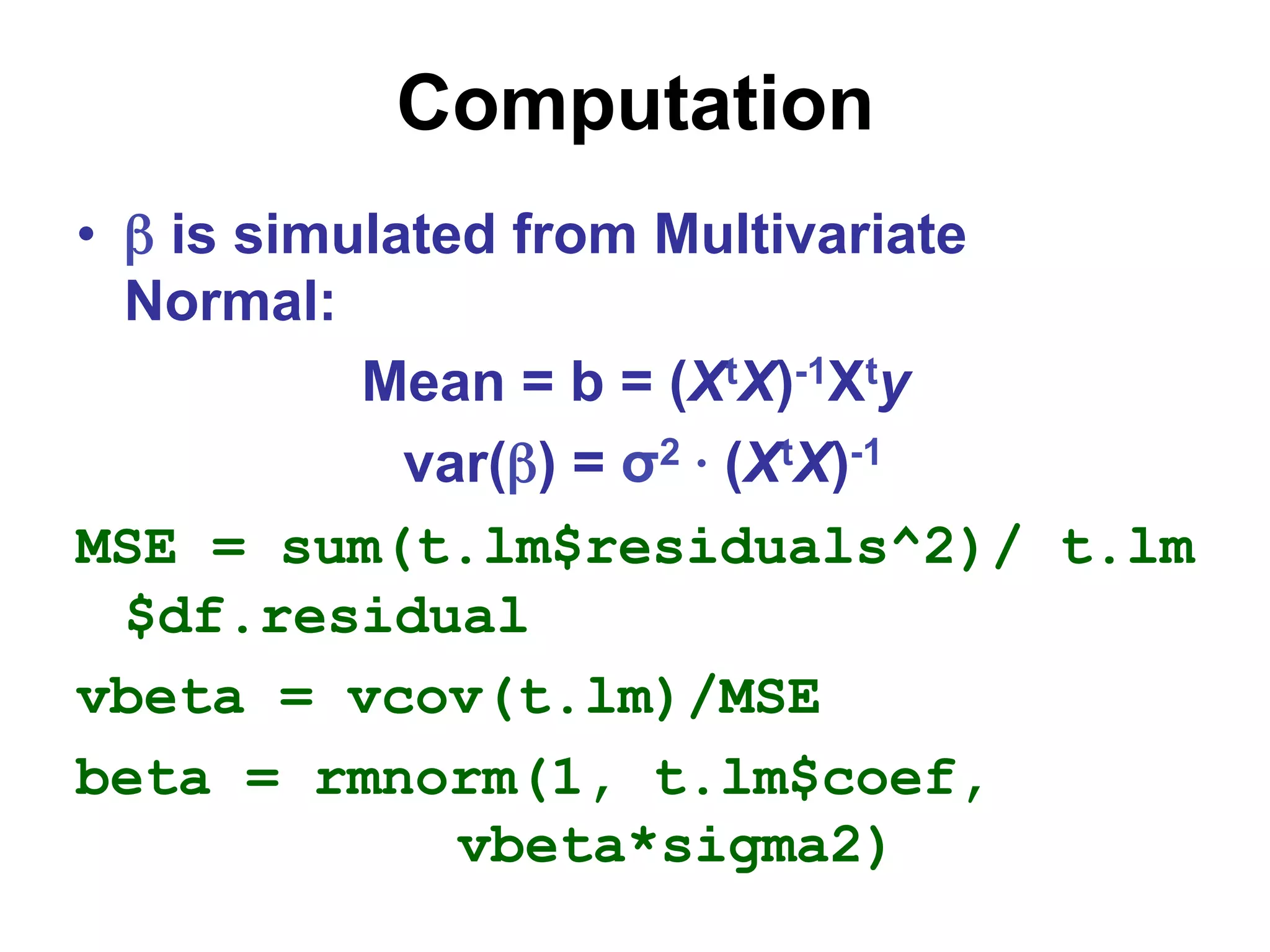
•  β is simulated from Multivariate
Normal:
Mean = b = (XtX)-1Xty
var(β) = σ2 ⋅ (XtX)-1
MSE = sum(t.lm$residuals^2)/ t.lm
$df.residual
vbeta = vcov(t.lm)/MSE
beta = rmnorm(1, t.lm$coef,
vbeta*sigma2)
Graphical Display
op = par(mfrow = c(2,2))
hist(par.sample$beta[, 2],
main= "Nesting",
xlab=expression(beta[1]))
hist(par.sample$beta[, 3],
main= "Size",
xlab=expression(beta[2]))
Graphical Display
hist(par.sample$beta[, 4],
main= "Status",
xlab = expression(beta[3]))
hist(par.sample$sigma,
main= "Error SD",
xlab=expression(sigma))
par(op)
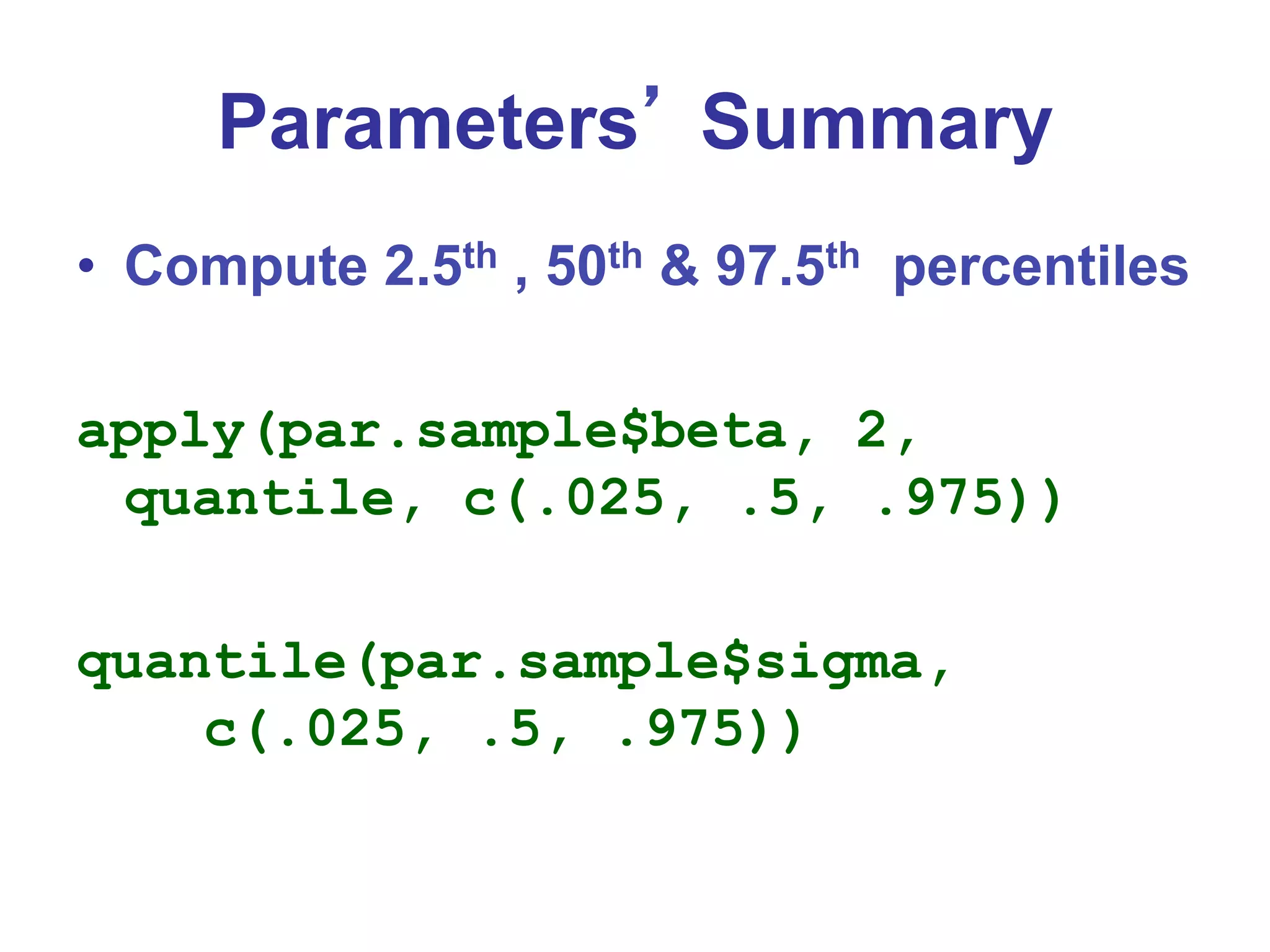
Parameters’ Summary
•  Compute 2.5th , 50th & 97.5th percentiles
apply(par.sample$beta, 2,
quantile, c(.025, .5, .975))
quantile(par.sample$sigma,
c(.025, .5, .975))
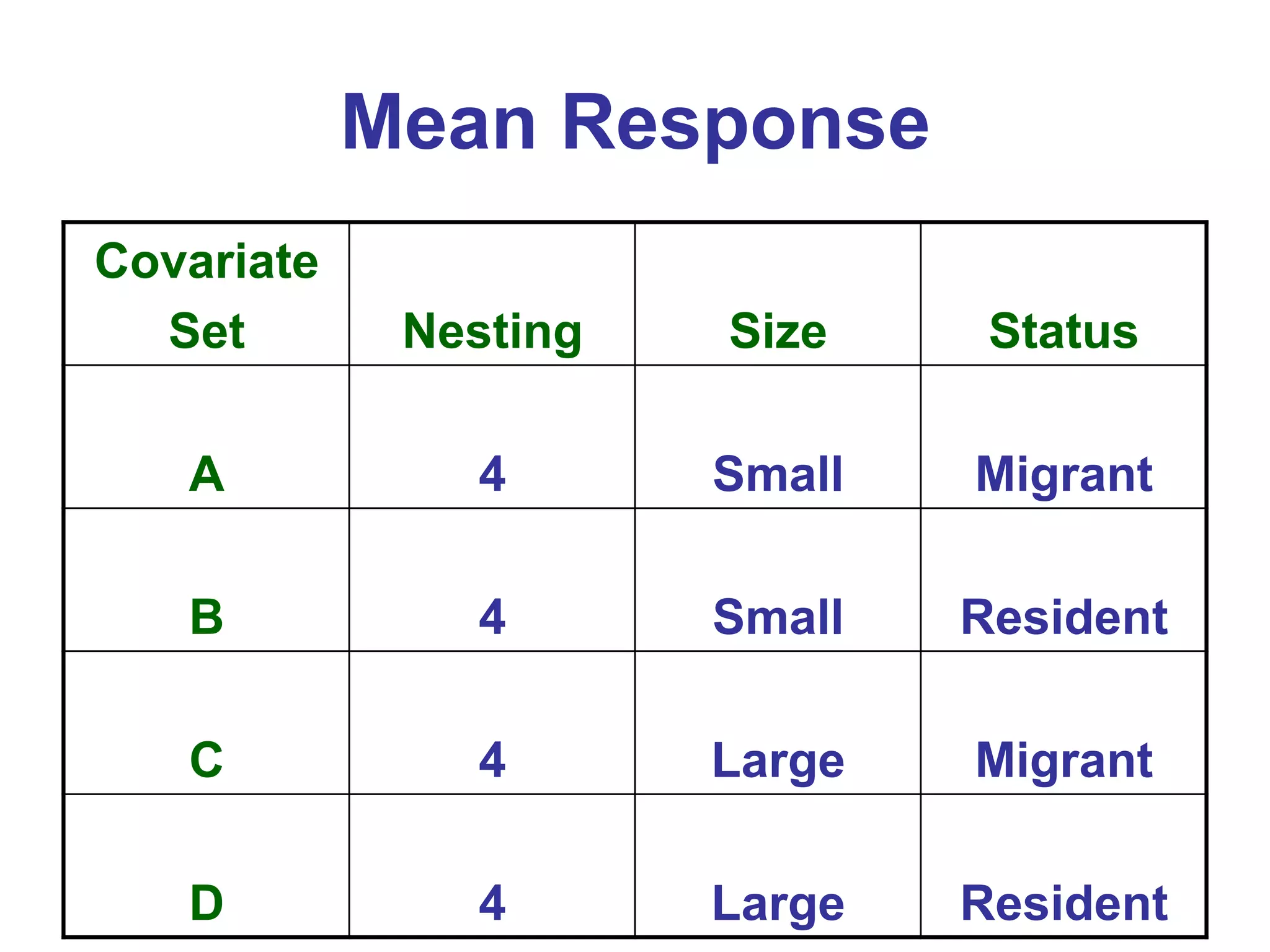
Mean Response
Covariate
Set Nesting Size Status
A 4 Small Migrant
B 4 Small Resident
C 4 Large Migrant
D 4 Large Resident
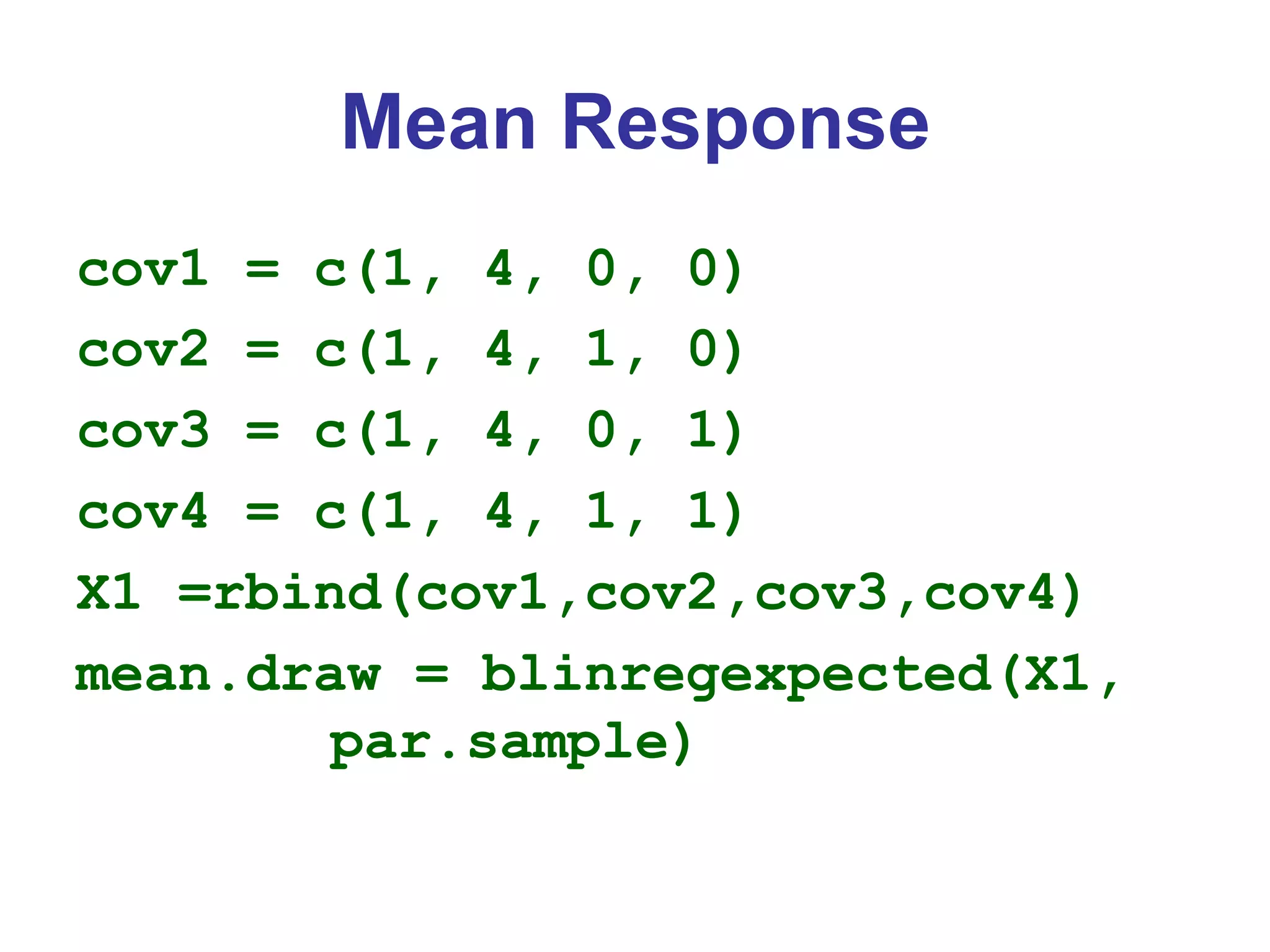
Mean Response
cov1 = c(1, 4, 0, 0)
cov2 = c(1, 4, 1, 0)
cov3 = c(1, 4, 0, 1)
cov4 = c(1, 4, 1, 1)
X1 =rbind(cov1,cov2,cov3,cov4)
mean.draw = blinregexpected(X1,
par.sample)
Mean Response
op = par(mfrow = c(2,2))
hist(mean.draw[, 1],
main = "Covariate Set A",
xlab = "Log Time")
hist(mean.draw[, 2],
main = "Covariate Set B",
xlab = "Log Time")
Mean Response
hist(mean.draw[, 3],
main = "Covariate Set C",
xlab = "Log Time")
hist(mean.draw[, 4],
main="Covariate Set D",
xlab="Log Time")
par(op)
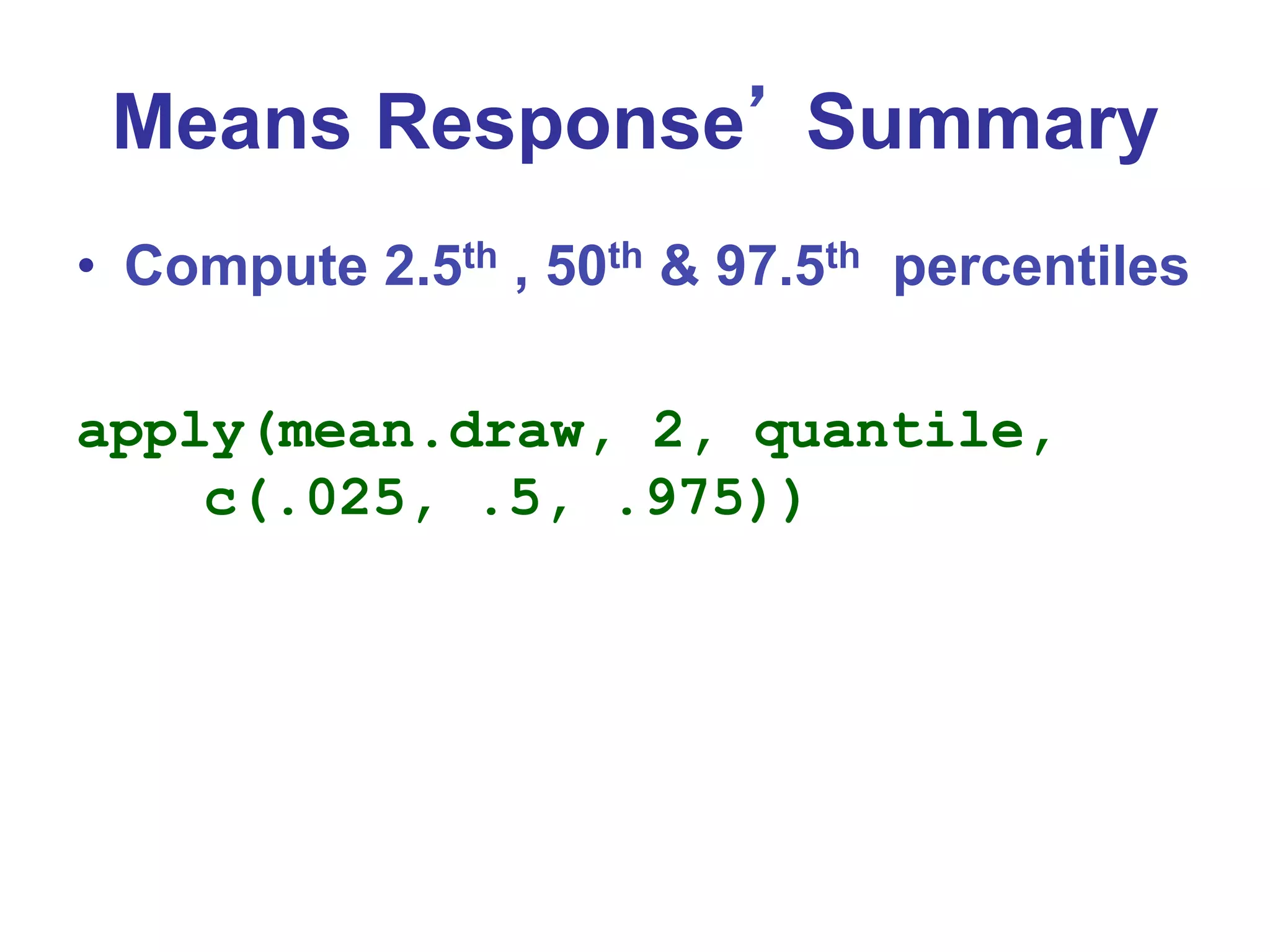
Means Response’ Summary
•  Compute 2.5th , 50th & 97.5th percentiles
apply(mean.draw, 2, quantile,
c(.025, .5, .975))
Future Response
pred.draw=blinregpred(X1, par.sample)
op = par(mfrow = c(2,2))
hist(pred.draw[, 1], main="Covariate
Set A", xlab="Log Time")
hist(pred.draw[, 2], main="Covariate
Set B", xlab="Log Time")
Future Response
hist(pred.draw[, 3],
main="Covariate Set C",
xlab="Log Time")
hist(pred.draw[, 2],
main="Covariate Set D",
xlab="Log Time")
par(op)
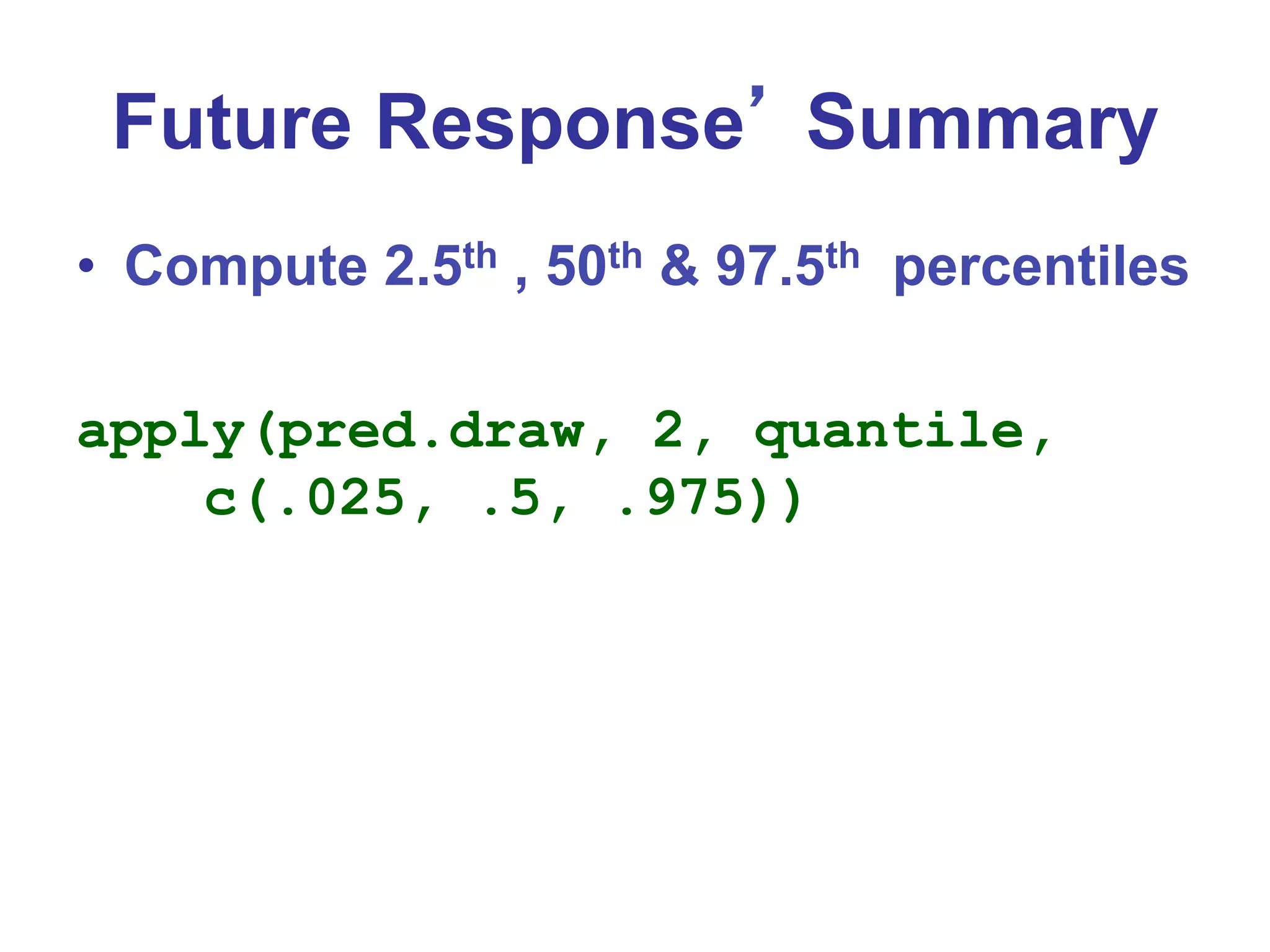
Future Response’ Summary
•  Compute 2.5th , 50th & 97.5th percentiles
apply(pred.draw, 2, quantile,
c(.025, .5, .975))

Bayesian regression intro with r

  • 1.
    Bayesian Regression An IntroductionUsing R J Guzmán, PhD January 2011
  • 2.
    Multiple Regression •  Model: µ|X,β= β0 + β1x1 + … + βkxk y | X,β = β0 + β1x1 + … + βkxk + ε ε ~ N(0, σ2) •  k predictors or explanatory variables •  n observations
  • 3.
    Multiple Regression •  Matrixnotation: y |β,σ2, X ~ N(Xβ, σ2I) •  X matrix of explanatory variables •  β vector of regression coefficients •  y response or variable of interest vector •  ε vector of normally distributed random errors
  • 4.
    Example: Birds’ Extinction • Albert, 2009. Bayesian Computation with R, 2d. Edition. Springer. •  Birds’ extinction – data from 16 islands •  species – name of bird species •  time – average time of extinction on the islands •  nesting – average number of nesting pairs •  size – species’ size, 1 = large; 0 = small •  status – species’ status; 1 = resident, 0 = migrant
  • 5.
  • 6.
    Linear Model •  Graphicaldisplay: log.time = log(time) plot(log.time ~ nesting) •  Linear Model t.lm = lm(log.time ~ nesting + size + status, x = T, y = T ) summary(t.lm)
  • 7.
    Birds’ Extinction •  Fromoutput: a.  longer extinction times for species with large no. of nesting pairs b.  smaller extinction times for large birds c.  longer extinction times for resident birds
  • 8.
    Bayesian Regression •  Model:y | β, σ2, X ~ N(Xβ, σ2I) •  Two unknown parameters: β & σ2 •  Assume un-informative joint prior: f(β, σ2) ∝ 1/σ2 •  Joint posterior: f(β, σ2 | y) ∝ f(β | y, σ2) × f(σ2 | y)
  • 9.
    Bayesian Regression •  Marginalposterior distribution of β, conditional on error variance σ2 is Multivariate Normal with: Mean = b = (XtX)-1Xty var(β) = σ2 ⋅ (XtX)-1 •  Marginal posterior distribution of σ2 is Inverse Gamma[(n - k)/2, S/2] S = (y - Xb)t (y - Xb)
  • 10.
    Prediction •  To predictfuture yp , based on vector xp •  Conditional on β & σ2, yp ~ N(xpβ, σ2) •  Posterior predictive distribution f(yp|y) = ∫f(yp|β, σ2)f(β, σ2|y)dβdσ2
  • 11.
    Computation •  Simulate fromjoint posterior of β & σ2: – Simulate value of σ2 from f(σ2| y) – Simulate value of β from f(β | y, σ2) •  Use Albert’s blinreg( ) to perform simulation •  To predict mean response µy use Albert’s blinregexpected( ) •  To predict future response yp use Albert’s blinregpred( )
  • 12.
    blinreg( ) •  Tosample from joint posterior of β & σ2 •  Inputs: y, X & no. of simulations m par.sample = blinreg(t.lm$y, t.lm$x, 5000) S = sum(t.lm$residuals^2) shape=t.lm$df.residual/2; rate = S/2 library(MCMCpack) sigma2 = rinvgamma(1, shape, scale = 1/rate)
  • 13.
    Computation •  β issimulated from Multivariate Normal: Mean = b = (XtX)-1Xty var(β) = σ2 ⋅ (XtX)-1 MSE = sum(t.lm$residuals^2)/ t.lm $df.residual vbeta = vcov(t.lm)/MSE beta = rmnorm(1, t.lm$coef, vbeta*sigma2)
  • 14.
    Graphical Display op =par(mfrow = c(2,2)) hist(par.sample$beta[, 2], main= "Nesting", xlab=expression(beta[1])) hist(par.sample$beta[, 3], main= "Size", xlab=expression(beta[2]))
  • 15.
    Graphical Display hist(par.sample$beta[, 4], main="Status", xlab = expression(beta[3])) hist(par.sample$sigma, main= "Error SD", xlab=expression(sigma)) par(op)
  • 16.
    Parameters’ Summary •  Compute2.5th , 50th & 97.5th percentiles apply(par.sample$beta, 2, quantile, c(.025, .5, .975)) quantile(par.sample$sigma, c(.025, .5, .975))
  • 17.
    Mean Response Covariate Set NestingSize Status A 4 Small Migrant B 4 Small Resident C 4 Large Migrant D 4 Large Resident
  • 18.
    Mean Response cov1 =c(1, 4, 0, 0) cov2 = c(1, 4, 1, 0) cov3 = c(1, 4, 0, 1) cov4 = c(1, 4, 1, 1) X1 =rbind(cov1,cov2,cov3,cov4) mean.draw = blinregexpected(X1, par.sample)
  • 19.
    Mean Response op =par(mfrow = c(2,2)) hist(mean.draw[, 1], main = "Covariate Set A", xlab = "Log Time") hist(mean.draw[, 2], main = "Covariate Set B", xlab = "Log Time")
  • 20.
    Mean Response hist(mean.draw[, 3], main= "Covariate Set C", xlab = "Log Time") hist(mean.draw[, 4], main="Covariate Set D", xlab="Log Time") par(op)
  • 21.
    Means Response’ Summary • Compute 2.5th , 50th & 97.5th percentiles apply(mean.draw, 2, quantile, c(.025, .5, .975))
  • 22.
    Future Response pred.draw=blinregpred(X1, par.sample) op= par(mfrow = c(2,2)) hist(pred.draw[, 1], main="Covariate Set A", xlab="Log Time") hist(pred.draw[, 2], main="Covariate Set B", xlab="Log Time")
  • 23.
    Future Response hist(pred.draw[, 3], main="CovariateSet C", xlab="Log Time") hist(pred.draw[, 2], main="Covariate Set D", xlab="Log Time") par(op)
  • 24.
    Future Response’ Summary • Compute 2.5th , 50th & 97.5th percentiles apply(pred.draw, 2, quantile, c(.025, .5, .975))