










A D R I A N P. K A L I N G A G , P T R P
THERAPEUTIC EXERCISE
PATIENT MANAGEMENT AND CLINICAL DECISION
MAKING: AN INTERACTIVE RELATIONSHIP
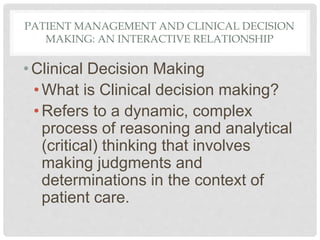
•Clinical Decision Making
• What is Clinical decision making?
• Refers to a dynamic, complex
process of reasoning and analytical
(critical) thinking that involves
making judgments and
determinations in the context of
patient care.
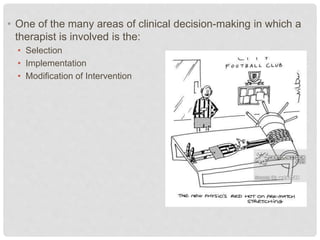
• One of the many areas of clinical decision-making in which a
therapist is involved is the:
• Selection
• Implementation
• Modification of Intervention
EVIDENCED BASED PRACTICE
• “the conscientious, explicit, and judicious use of current
best evidence in making decisions about the care of an
individual patient.”
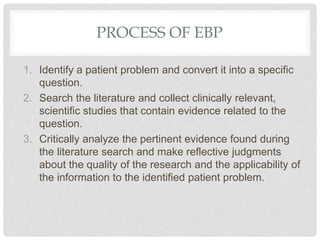
PROCESS OF EBP
1. Identify a patient problem and convert it into a specific
question.
2. Search the literature and collect clinically relevant,
scientific studies that contain evidence related to the
question.
3. Critically analyze the pertinent evidence found during
the literature search and make reflective judgments
about the quality of the research and the applicability of
the information to the identified patient problem.
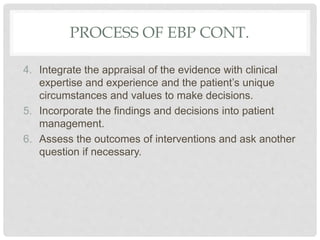
PROCESS OF EBP CONT.
4. Integrate the appraisal of the evidence with clinical
expertise and experience and the patient’s unique
circumstances and values to make decisions.
5. Incorporate the findings and decisions into patient
management.
6. Assess the outcomes of interventions and ask another
question if necessary.
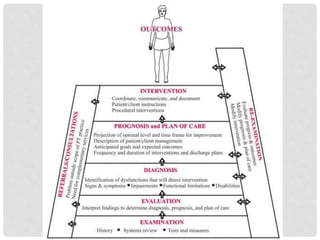
A PATIENT MANAGEMENT MODEL
• The physical therapy profession has developed a
comprehensive approach to patient management
designed to guide a practitioner through a systematic
series of steps and decisions for the purpose of helping
a patient achieve the highest level of functioning
possible.
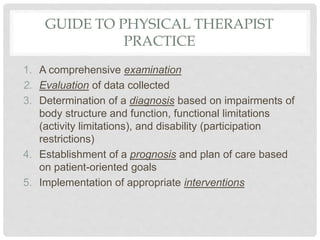
GUIDE TO PHYSICAL THERAPIST
PRACTICE
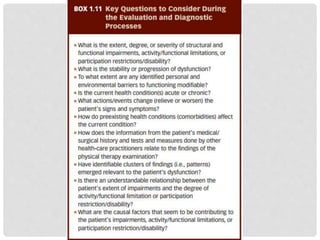
1. A comprehensive examination
2. Evaluation of data collected
3. Determination of a diagnosis based on impairments of
body structure and function, functional limitations
(activity limitations), and disability (participation
restrictions)
4. Establishment of a prognosis and plan of care based
on patient-oriented goals
5. Implementation of appropriate interventions
BREAK 15MINS!
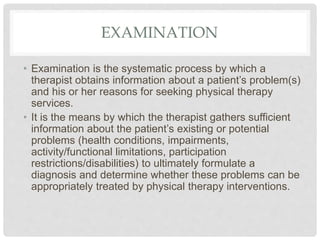
EXAMINATION
• Examination is the systematic process by which a
therapist obtains information about a patient’s problem(s)
and his or her reasons for seeking physical therapy
services.
• It is the means by which the therapist gathers sufficient
information about the patient’s existing or potential
problems (health conditions, impairments,
activity/functional limitations, participation
restrictions/disabilities) to ultimately formulate a
diagnosis and determine whether these problems can be
appropriately treated by physical therapy interventions.
• There are three distinct elements of a comprehensive
examination
• The patient’s health history
• A relevant systems review
• Specific tests and measures
HISTORY
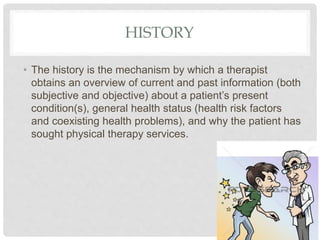
• The history is the mechanism by which a therapist
obtains an overview of current and past information (both
subjective and objective) about a patient’s present
condition(s), general health status (health risk factors
and coexisting health problems), and why the patient has
sought physical therapy services.
SOURCES OF INFORMATION ABOUT
THE PATIENT’S HISTORY:
• Self-report health history questionnaires filled out prior to
or during the initial visit.
• Interviews with the patient, family, or other significant
individuals involved in patient care.
• Review of the medical record.
• Reports from the referral source, consultants, or other
health-care team members.
HISTORY CONT.
• The interview is crucial for determining a patient’s chief
concerns and functional status—past, current, and
desired.
• For example, a patient might report, “My elbow really
hurts when I pick up something heavy” or “I’m having
trouble playing tennis (or bowling or unloading groceries
from the car).”
• During the interview, questions that relate to symptoms (in this
case, elbow pain) should identify location, intensity, description,
and factors that provoke (aggravate) or alleviate symptoms in a
24-hour period.
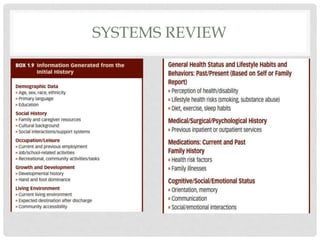
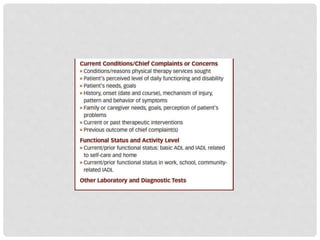
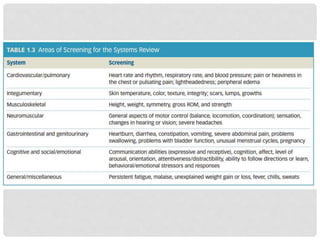
SYSTEMS REVIEW
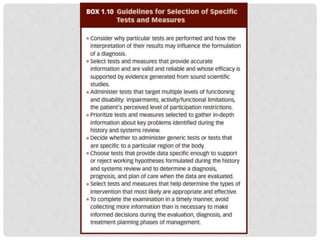
SPECIFIC TESTS AND MEASURES
• Once it has been decided that a patient’s
problems/conditions are most likely amenable to physical
therapy intervention, the next determination a therapist
must make during the examination process is to decide
which aspects of physical function require further
investigation through the use of specific tests and
measures.
SPECIFIC TESTS AND MEASURES CONT.
• The specificity of these tests enables a therapist to
support or refute the working hypotheses formulated
while taking the patient’s health history and performing
the systems review.
• In addition, the data generated from these definitive tests
are the means by which the therapist ascertains the
possible underlying causes of a patient’s impairments
and functional deficits
• These tests also give the therapist a clearer picture of a
patient’s current condition(s) and may reveal information
about the patient not previously identified during the
history and systems review.
TEST AND MEASURE CONT.
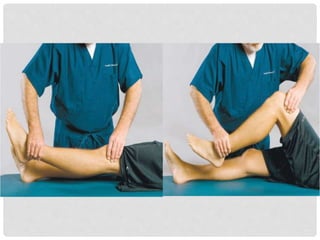
• Examples of specific tests and measures that identify
musculoskeletal and neuromuscular impairments are noted
here. They include but are not limited to:
• Assessment of pain
• Goniometry and flexibility testing
• Joint mobility, stability, and integrity tests (including ligamentous
testing)
• Tests of muscle performance (manual muscle testing, dynamometry)
• Posture analysis
• Assessment of balance, proprioception, neuromuscular control
• Gait analysis
• Assessment of assistive, adaptive, or orthotic devices
EVALUATION
• Evaluation is a process characterized by the
interpretation of collected data.
• The process involves analysis and integration of
information to form opinions by means of a series of
sound clinical decisions.
• Interpretation of relevant data, one of the more
challenging aspects of patient management, is
fundamental to the determination of a diagnosis of
dysfunction and prognosis of functional outcomes
• By pulling together and sorting out subjective and
objective data from the examination, a therapist should
be able to determine the following:
EVALUATION CONT.
• A patient’s general health status and its impact on current and
potential function
• The acuity or chronicity and severity of the current condition(s)
• The extent of structural and functional impairments of body systems
and impact on functional abilities
• Which impairments are related to which activity limitations
• A patient’s current, overall level of physical functioning (limitations
and abilities) compared with the functional abilities needed,
expected, or desired by the patient
• The impact of physical dysfunction on social/emotional function
• The impact of the physical environment on a patient’s function
• A patient’s social support systems and their impact on current,
desired, and potential function
DIAGNOSIS
• The term diagnosis can be used in two ways—it refers to
either a process or a category (label) within a
classification system.
• Both usages of the word are relevant to physical therapy
practice. The diagnosis is an essential element of patient
management because it directs the physical therapy
prognosis (including the plan of care) and interventions.
THE DIAGNOSTIC PROCESS
• The collection of data (examination)
• The analysis and interpretation of all relevant data
collected, leading to the generation of working
hypotheses (evaluation)
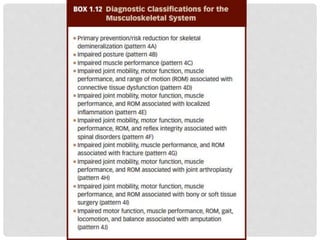
• Organization of data, recognition of clustering of data (a
pattern of findings), formation of a diagnostic hypothesis,
and subsequent classification of data into categories
(impairment-based diagnoses)
• Through the diagnostic process a physical therapist
classifies dysfunction (most often, movement
dysfunction), whereas a physician identifies disease.
PROGNOSIS AND PLAN OF CARE
• A prognosis is a prediction of a patient’s optimal level of
function expected as the result of a plan for treatment
during an episode of care and the anticipated length of
time needed to reach specified functional outcomes.
• Ex: Pt. will be able to return to function, and will be able to do
ADL’s without pain and discomfort p 24Rx session.
PLAN OF CARE
• Anticipated goals.
• Expected functional outcomes that are meaningful,
utilitarian, sustainable, and measurable.
• Extent of improvement predicted and length of time
necessary to reach that level.
• Specific interventions.
• Proposed frequency and duration of interventions.
• Specific discharge plans.
INTERVENTION
• Intervention, a component of patient management, refers
to any purposeful interaction a therapist has that directly
relates to a patient’s care.
• Coordination,Communication, and Documentation
• The physical therapist is the coordinator of physical therapy care and
services and must continually communicate verbally and through written
documentation with all individuals involved in the care of a patient.
• This aspect of intervention encompasses many patient-related
administrative tasks and professional responsibilities, such as writing
reports (evaluations, plans of care, discharge summaries); designing
home exercise programs; keeping records; contacting third-party payers,
other health-care practitioners, or community-based resources; and
participating in team conferences.
PROCEDURAL INTERVENTIONS
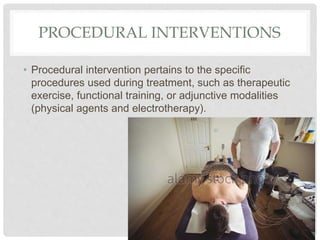
• Procedural intervention pertains to the specific
procedures used during treatment, such as therapeutic
exercise, functional training, or adjunctive modalities
(physical agents and electrotherapy).
OUTCOMES
• Simply stated, outcomes are results. Collection and analysis
of outcome data related to health-care services are
necessities, not options.
• Measurement of outcomes is a means by which quality,
efficacy, and cost-effectiveness of services can be assessed
• Evaluation of information generated from periodic re-
examination and re-evaluation of a patient’s response to
treatment enables a therapist to ascertain if the anticipated
goals and expected outcomes in the plan of care are being
met and if the interventions that have been implemented are
producing the intended results
OUTCOMES CONT.
• It may well be that the goals and expected outcomes
must be adjusted based on the extent of change or lack
of change in a patient’s function as determined by the
level of the interim outcomes. This information also helps
the therapist decide if, when, and to what extent to
modify the goals, expected outcomes, and interventions
in the patient’s plan of care
FUNCTIONAL OUTCOMES
• The key to the justification of physical therapy services in
today’s cost-conscious health-care environment is the
identification and documentation of successful patient-
centered, functional outcomes that can be attributed to
interventions. Functional outcomes must be meaningful,
practical, and sustainable.
• Outcomes that have an impact on a patient’s ability to function
at work, in the home, or in the community in ways that have
been identified as important by the patient, family, significant
others, caregivers, or employers are considered meaningful.
MEASURING OUTCOMES
• The expected outcomes identified in a physical therapy
plan of care must be measurable.
• More specifically, changes in a patient’s status over time
must be quantifiable.
• Many of the specific tests and measures used by
physical therapists traditionally have focused on
measurement of impairments (i.e., ROM, muscle
performance, joint mobility/stability, balance).
• Impact of interventions on patient-related, functional
outcomes
• Patient satisfaction
DISCHARGE PLANNING
• Planning for discharge begins early in the rehabilitation
process.
• A patient is discharged from physical therapy services
when the anticipated goals and expected outcomes have
been attained.
• The discharge plan often includes some type of home
program, appropriate follow up, possible referral to
community resources, or re-initiation of physical therapy
services (an additional episode of care) if the patient’s
needs change over time and if additional services are
approved.
STRATEGIES FOR EFFECTIVE EXERCISE
AND TASK-SPECIFIC INSTRUCTION
• Preparation for Exercise Instruction
• Effective exercise instruction is also based on knowing a
patient’s learning style—that is, if he or she prefers to
learn by watching, reading about, or doing an activity.
• Does the patient believe exercise will lessen symptoms
or improve function?
• Is the patient concerned that exercising will be
uncomfortable?
• Is the patient accustomed to engaging in regular
exercise?
CONCEPTS OF MOTOR LEARNING: A
FOUNDATION FOR EXERCISE AND TASK-
SPECIFIC INSTRUCTION
• Motor learning is a complex set of internal processes
that involves the acquisition and relatively permanent
retention of a skilled movement or task through practice.
• Performance involves acquisition of the ability to carry
out a skill, whereas learning involves both acquisition
and retention.
TYPES OF MOTOR TASKS
• Discrete task
• A discrete task involves an action or movement with a
recognizable beginning and end. Isolating and contracting a
specific muscle group (as in a quadriceps setting exercise),
grasping an object, doing a push-up, locking a wheelchair, and
kicking a ball are examples of discrete motor tasks. Almost all
exercises, such as lifting and lowering a weight or performing a
self-stretching maneuver, can be categorized as discrete motor
tasks.
• Serial task
• A serial task is composed of a series of discrete movements that
are combined in a particular sequence. For example, to eat with a
fork, a person must be able to grasp the fork, hold it in the correct
position, pierce or scoop up the food, and lift the fork to the
mouth. Many functional tasks in the work setting, for instance, are
serial tasks with simple as well as complex components. Some
serial tasks require specific timing between each segment of the
task or momentum during the task.
• Continuous task
• A continuous task involves repetitive, uninterrupted movements
that have no distinct beginning and ending. Examples include
walking, ascending and descending stairs, and cycling.
• Recognizing the type of skilled movements a patient must learn to
do helps a therapist decide which instructional strategies will be
most beneficial for acquiring specific functional skills.
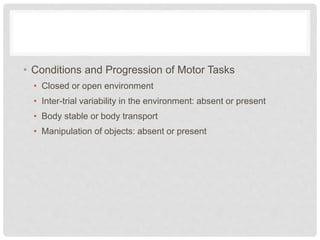
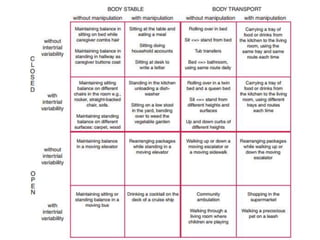
• Conditions and Progression of Motor Tasks
• Closed or open environment
• Inter-trial variability in the environment: absent or present
• Body stable or body transport
• Manipulation of objects: absent or present
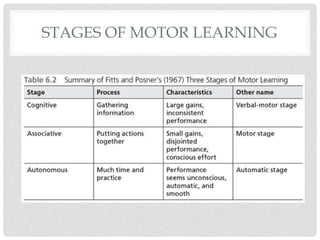
STAGES OF MOTOR LEARNING
VARIABLES THAT INFLUENCE MOTOR LEARNING—
CONSIDERATIONS FOR EXERCISE INSTRUCTION AND
FUNCTIONAL TRAINING
• Pre-Practice Considerations
• A patient’s understanding of the purpose of an exercise or task,
as well as interest in the task, affects skill acquisition and
retention. The more meaningful a task is to a patient, the more
likely it is that learning will occur.
• Practice
• Practice is probably the single most important variable in learning
a motor skill. The amount, type, and variability of practice directly
affect the extent of skill acquisition and retention.
PART VERSUS WHOLE PRACTICE
• Part practice has been shown to be most effective in the early
stage of learning for acquisition of complex serial skills that have
simple and difficult components.
• Whole practice is more effective than part practice for acquiring
continuous skills, such as walking and climbing stairs, or serial
tasks in which momentum or timing of the components is the
central focus of the learning process.
PRACTICE ORDER—BLOCKED,
RANDOM, AND RANDOM/BLOCKED
• During the initial (cognitive) stage of learning in which a new
motor skill is acquired, blocked-order practice is the appropriate
choice because it rapidly improves performance of skilled
movements.
• A transition to random-order or random/blocked-order practice
should be made as soon as possible to introduce variability into
the learning process. Variability of practice refers to making slight
adjustments (variations) in the conditions of a task—for example,
by varying the support surface or the surroundings where a task
is performed
FEEDBACK
• Feedback is sensory information that is received and
processed by the learner during or after performing or
attempting to perform a motor skill
• Intrinsic feedback
• Augmented feedback
• Knowledge of performance versus knowledge of results
• The feedback schedule: timing and frequency of augmented
feedback
INTRINSIC FEEDBACK
• Intrinsic feedback comes from all of the sensory systems
of the learner, not from the therapist, and is outcomes
(results) of a task, specifically if the goal of a task was
achieved. In everyday life, intrinsic feedback is a
continuous source of information that provides
knowledge of performance (KP) and knowledge of
results (KR) as a person performs routine activities or
tries to learn new motor skills.
AUGMENTED FEEDBACK
• It is also referred to as extrinsic feedback. Unlike intrinsic
feedback, a therapist has control of the type, timing, and
frequency of augmented feedback a patient receives
during practice. Augmented/ extrinsic feedback can be
provided during or at the conclusion of a task to give
information about the quality of the performance (KP) or
the quality of the outcome of a task (KR).
I’LL LEAVE THIS TO YOU
• Application of Motor Learning Principles for Exercise
Instruction
• Adherence to Exercise
• Independent Learning Activities

Thera ex

  • 1.
    A D RI A N P. K A L I N G A G , P T R P THERAPEUTIC EXERCISE
  • 2.
    PATIENT MANAGEMENT ANDCLINICAL DECISION MAKING: AN INTERACTIVE RELATIONSHIP •Clinical Decision Making • What is Clinical decision making? • Refers to a dynamic, complex process of reasoning and analytical (critical) thinking that involves making judgments and determinations in the context of patient care.
  • 3.
    • One ofthe many areas of clinical decision-making in which a therapist is involved is the: • Selection • Implementation • Modification of Intervention
  • 5.
    EVIDENCED BASED PRACTICE •“the conscientious, explicit, and judicious use of current best evidence in making decisions about the care of an individual patient.”
  • 6.
    PROCESS OF EBP 1.Identify a patient problem and convert it into a specific question. 2. Search the literature and collect clinically relevant, scientific studies that contain evidence related to the question. 3. Critically analyze the pertinent evidence found during the literature search and make reflective judgments about the quality of the research and the applicability of the information to the identified patient problem.
  • 7.
    PROCESS OF EBPCONT. 4. Integrate the appraisal of the evidence with clinical expertise and experience and the patient’s unique circumstances and values to make decisions. 5. Incorporate the findings and decisions into patient management. 6. Assess the outcomes of interventions and ask another question if necessary.
  • 9.
    A PATIENT MANAGEMENTMODEL • The physical therapy profession has developed a comprehensive approach to patient management designed to guide a practitioner through a systematic series of steps and decisions for the purpose of helping a patient achieve the highest level of functioning possible.
  • 10.
    GUIDE TO PHYSICALTHERAPIST PRACTICE 1. A comprehensive examination 2. Evaluation of data collected 3. Determination of a diagnosis based on impairments of body structure and function, functional limitations (activity limitations), and disability (participation restrictions) 4. Establishment of a prognosis and plan of care based on patient-oriented goals 5. Implementation of appropriate interventions
  • 12.
  • 13.
    EXAMINATION • Examination isthe systematic process by which a therapist obtains information about a patient’s problem(s) and his or her reasons for seeking physical therapy services. • It is the means by which the therapist gathers sufficient information about the patient’s existing or potential problems (health conditions, impairments, activity/functional limitations, participation restrictions/disabilities) to ultimately formulate a diagnosis and determine whether these problems can be appropriately treated by physical therapy interventions.
  • 14.
    • There arethree distinct elements of a comprehensive examination • The patient’s health history • A relevant systems review • Specific tests and measures
  • 16.
    HISTORY • The historyis the mechanism by which a therapist obtains an overview of current and past information (both subjective and objective) about a patient’s present condition(s), general health status (health risk factors and coexisting health problems), and why the patient has sought physical therapy services.
  • 17.
    SOURCES OF INFORMATIONABOUT THE PATIENT’S HISTORY: • Self-report health history questionnaires filled out prior to or during the initial visit. • Interviews with the patient, family, or other significant individuals involved in patient care. • Review of the medical record. • Reports from the referral source, consultants, or other health-care team members.
  • 18.
    HISTORY CONT. • Theinterview is crucial for determining a patient’s chief concerns and functional status—past, current, and desired. • For example, a patient might report, “My elbow really hurts when I pick up something heavy” or “I’m having trouble playing tennis (or bowling or unloading groceries from the car).” • During the interview, questions that relate to symptoms (in this case, elbow pain) should identify location, intensity, description, and factors that provoke (aggravate) or alleviate symptoms in a 24-hour period.
  • 19.
  • 22.
    SPECIFIC TESTS ANDMEASURES • Once it has been decided that a patient’s problems/conditions are most likely amenable to physical therapy intervention, the next determination a therapist must make during the examination process is to decide which aspects of physical function require further investigation through the use of specific tests and measures.
  • 23.
    SPECIFIC TESTS ANDMEASURES CONT. • The specificity of these tests enables a therapist to support or refute the working hypotheses formulated while taking the patient’s health history and performing the systems review. • In addition, the data generated from these definitive tests are the means by which the therapist ascertains the possible underlying causes of a patient’s impairments and functional deficits • These tests also give the therapist a clearer picture of a patient’s current condition(s) and may reveal information about the patient not previously identified during the history and systems review.
  • 24.
    TEST AND MEASURECONT. • Examples of specific tests and measures that identify musculoskeletal and neuromuscular impairments are noted here. They include but are not limited to: • Assessment of pain • Goniometry and flexibility testing • Joint mobility, stability, and integrity tests (including ligamentous testing) • Tests of muscle performance (manual muscle testing, dynamometry) • Posture analysis • Assessment of balance, proprioception, neuromuscular control • Gait analysis • Assessment of assistive, adaptive, or orthotic devices
  • 27.
    EVALUATION • Evaluation isa process characterized by the interpretation of collected data. • The process involves analysis and integration of information to form opinions by means of a series of sound clinical decisions. • Interpretation of relevant data, one of the more challenging aspects of patient management, is fundamental to the determination of a diagnosis of dysfunction and prognosis of functional outcomes • By pulling together and sorting out subjective and objective data from the examination, a therapist should be able to determine the following:
  • 28.
    EVALUATION CONT. • Apatient’s general health status and its impact on current and potential function • The acuity or chronicity and severity of the current condition(s) • The extent of structural and functional impairments of body systems and impact on functional abilities • Which impairments are related to which activity limitations • A patient’s current, overall level of physical functioning (limitations and abilities) compared with the functional abilities needed, expected, or desired by the patient • The impact of physical dysfunction on social/emotional function • The impact of the physical environment on a patient’s function • A patient’s social support systems and their impact on current, desired, and potential function
  • 30.
    DIAGNOSIS • The termdiagnosis can be used in two ways—it refers to either a process or a category (label) within a classification system. • Both usages of the word are relevant to physical therapy practice. The diagnosis is an essential element of patient management because it directs the physical therapy prognosis (including the plan of care) and interventions.
  • 31.
    THE DIAGNOSTIC PROCESS •The collection of data (examination) • The analysis and interpretation of all relevant data collected, leading to the generation of working hypotheses (evaluation) • Organization of data, recognition of clustering of data (a pattern of findings), formation of a diagnostic hypothesis, and subsequent classification of data into categories (impairment-based diagnoses) • Through the diagnostic process a physical therapist classifies dysfunction (most often, movement dysfunction), whereas a physician identifies disease.
  • 33.
    PROGNOSIS AND PLANOF CARE • A prognosis is a prediction of a patient’s optimal level of function expected as the result of a plan for treatment during an episode of care and the anticipated length of time needed to reach specified functional outcomes. • Ex: Pt. will be able to return to function, and will be able to do ADL’s without pain and discomfort p 24Rx session.
  • 34.
    PLAN OF CARE •Anticipated goals. • Expected functional outcomes that are meaningful, utilitarian, sustainable, and measurable. • Extent of improvement predicted and length of time necessary to reach that level. • Specific interventions. • Proposed frequency and duration of interventions. • Specific discharge plans.
  • 36.
    INTERVENTION • Intervention, acomponent of patient management, refers to any purposeful interaction a therapist has that directly relates to a patient’s care. • Coordination,Communication, and Documentation • The physical therapist is the coordinator of physical therapy care and services and must continually communicate verbally and through written documentation with all individuals involved in the care of a patient. • This aspect of intervention encompasses many patient-related administrative tasks and professional responsibilities, such as writing reports (evaluations, plans of care, discharge summaries); designing home exercise programs; keeping records; contacting third-party payers, other health-care practitioners, or community-based resources; and participating in team conferences.
  • 37.
    PROCEDURAL INTERVENTIONS • Proceduralintervention pertains to the specific procedures used during treatment, such as therapeutic exercise, functional training, or adjunctive modalities (physical agents and electrotherapy).
  • 38.
    OUTCOMES • Simply stated,outcomes are results. Collection and analysis of outcome data related to health-care services are necessities, not options. • Measurement of outcomes is a means by which quality, efficacy, and cost-effectiveness of services can be assessed • Evaluation of information generated from periodic re- examination and re-evaluation of a patient’s response to treatment enables a therapist to ascertain if the anticipated goals and expected outcomes in the plan of care are being met and if the interventions that have been implemented are producing the intended results
  • 39.
    OUTCOMES CONT. • Itmay well be that the goals and expected outcomes must be adjusted based on the extent of change or lack of change in a patient’s function as determined by the level of the interim outcomes. This information also helps the therapist decide if, when, and to what extent to modify the goals, expected outcomes, and interventions in the patient’s plan of care
  • 40.
    FUNCTIONAL OUTCOMES • Thekey to the justification of physical therapy services in today’s cost-conscious health-care environment is the identification and documentation of successful patient- centered, functional outcomes that can be attributed to interventions. Functional outcomes must be meaningful, practical, and sustainable. • Outcomes that have an impact on a patient’s ability to function at work, in the home, or in the community in ways that have been identified as important by the patient, family, significant others, caregivers, or employers are considered meaningful.
  • 41.
    MEASURING OUTCOMES • Theexpected outcomes identified in a physical therapy plan of care must be measurable. • More specifically, changes in a patient’s status over time must be quantifiable. • Many of the specific tests and measures used by physical therapists traditionally have focused on measurement of impairments (i.e., ROM, muscle performance, joint mobility/stability, balance). • Impact of interventions on patient-related, functional outcomes • Patient satisfaction
  • 42.
    DISCHARGE PLANNING • Planningfor discharge begins early in the rehabilitation process. • A patient is discharged from physical therapy services when the anticipated goals and expected outcomes have been attained. • The discharge plan often includes some type of home program, appropriate follow up, possible referral to community resources, or re-initiation of physical therapy services (an additional episode of care) if the patient’s needs change over time and if additional services are approved.
  • 43.
    STRATEGIES FOR EFFECTIVEEXERCISE AND TASK-SPECIFIC INSTRUCTION • Preparation for Exercise Instruction • Effective exercise instruction is also based on knowing a patient’s learning style—that is, if he or she prefers to learn by watching, reading about, or doing an activity. • Does the patient believe exercise will lessen symptoms or improve function? • Is the patient concerned that exercising will be uncomfortable? • Is the patient accustomed to engaging in regular exercise?
  • 44.
    CONCEPTS OF MOTORLEARNING: A FOUNDATION FOR EXERCISE AND TASK- SPECIFIC INSTRUCTION • Motor learning is a complex set of internal processes that involves the acquisition and relatively permanent retention of a skilled movement or task through practice. • Performance involves acquisition of the ability to carry out a skill, whereas learning involves both acquisition and retention.
  • 45.
    TYPES OF MOTORTASKS • Discrete task • A discrete task involves an action or movement with a recognizable beginning and end. Isolating and contracting a specific muscle group (as in a quadriceps setting exercise), grasping an object, doing a push-up, locking a wheelchair, and kicking a ball are examples of discrete motor tasks. Almost all exercises, such as lifting and lowering a weight or performing a self-stretching maneuver, can be categorized as discrete motor tasks.
  • 46.
    • Serial task •A serial task is composed of a series of discrete movements that are combined in a particular sequence. For example, to eat with a fork, a person must be able to grasp the fork, hold it in the correct position, pierce or scoop up the food, and lift the fork to the mouth. Many functional tasks in the work setting, for instance, are serial tasks with simple as well as complex components. Some serial tasks require specific timing between each segment of the task or momentum during the task.
  • 47.
    • Continuous task •A continuous task involves repetitive, uninterrupted movements that have no distinct beginning and ending. Examples include walking, ascending and descending stairs, and cycling. • Recognizing the type of skilled movements a patient must learn to do helps a therapist decide which instructional strategies will be most beneficial for acquiring specific functional skills.
  • 48.
    • Conditions andProgression of Motor Tasks • Closed or open environment • Inter-trial variability in the environment: absent or present • Body stable or body transport • Manipulation of objects: absent or present
  • 50.
  • 51.
    VARIABLES THAT INFLUENCEMOTOR LEARNING— CONSIDERATIONS FOR EXERCISE INSTRUCTION AND FUNCTIONAL TRAINING • Pre-Practice Considerations • A patient’s understanding of the purpose of an exercise or task, as well as interest in the task, affects skill acquisition and retention. The more meaningful a task is to a patient, the more likely it is that learning will occur. • Practice • Practice is probably the single most important variable in learning a motor skill. The amount, type, and variability of practice directly affect the extent of skill acquisition and retention.
  • 52.
    PART VERSUS WHOLEPRACTICE • Part practice has been shown to be most effective in the early stage of learning for acquisition of complex serial skills that have simple and difficult components. • Whole practice is more effective than part practice for acquiring continuous skills, such as walking and climbing stairs, or serial tasks in which momentum or timing of the components is the central focus of the learning process.
  • 53.
    PRACTICE ORDER—BLOCKED, RANDOM, ANDRANDOM/BLOCKED • During the initial (cognitive) stage of learning in which a new motor skill is acquired, blocked-order practice is the appropriate choice because it rapidly improves performance of skilled movements. • A transition to random-order or random/blocked-order practice should be made as soon as possible to introduce variability into the learning process. Variability of practice refers to making slight adjustments (variations) in the conditions of a task—for example, by varying the support surface or the surroundings where a task is performed
  • 54.
    FEEDBACK • Feedback issensory information that is received and processed by the learner during or after performing or attempting to perform a motor skill • Intrinsic feedback • Augmented feedback • Knowledge of performance versus knowledge of results • The feedback schedule: timing and frequency of augmented feedback
  • 55.
    INTRINSIC FEEDBACK • Intrinsicfeedback comes from all of the sensory systems of the learner, not from the therapist, and is outcomes (results) of a task, specifically if the goal of a task was achieved. In everyday life, intrinsic feedback is a continuous source of information that provides knowledge of performance (KP) and knowledge of results (KR) as a person performs routine activities or tries to learn new motor skills.
  • 56.
    AUGMENTED FEEDBACK • Itis also referred to as extrinsic feedback. Unlike intrinsic feedback, a therapist has control of the type, timing, and frequency of augmented feedback a patient receives during practice. Augmented/ extrinsic feedback can be provided during or at the conclusion of a task to give information about the quality of the performance (KP) or the quality of the outcome of a task (KR).
  • 57.
    I’LL LEAVE THISTO YOU • Application of Motor Learning Principles for Exercise Instruction • Adherence to Exercise • Independent Learning Activities

Editor's Notes

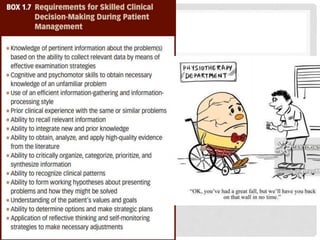
  • #4 To make effective decisions, merging clarification and understanding with critical and creative thinking is necessary.