Cardiac pathologies
Heartachokes!
Cardiac patho
• CAD- CORONARY ARTERY DISEASE
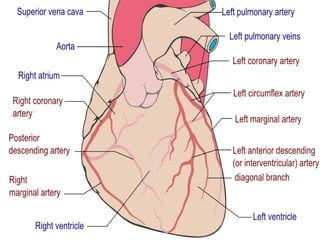
• Coronary arteries supply O2 blood to the
myocardium-heart muscle.
• Coronary arteries can easily become clogged
and a blood clot forms.
• This is called coronary thrombosis- narrowing
of the lumen of the artery- lumen is the
opening in a tube
CAD
• If the lumen is narrowed because of fat
deposits it is called plaque
• This is called atherosclerosis
• If the blockage is big enough it can block the
whole artery and cause ischemia- this is a
deficiency of blood and O2 to the heart
muscle which causes a heart attack!
CAD
• CAD is the leading cause of death in the US!
if a lumen slowly narrows, some of the heart
cells die and are replaced by scar tissue. Dead
muscle tissue is called an infarct.
This is a true heart attack or myocardial
infarction.
CAD
•
•
•
•
•

Signs and symptoms of a heart attack may be:
“feels like an elephant sitting on my chest.”
“feels like someone squeezing my chest.”
Referred pain to the neck or the left arm
Clammy, tired, nausea,sweating
CAD
• What should I do if someone is having a
myocardial infarction?
• If conscious- give aspirin, if they have a script
of nitroglycerin(causes vasodilation), put it
under their tongue- you can give up to 3 every
5 minutes
• Call 911
• If not conscious start CPR
CAD
•
•
•
•
•
•
•

Why do people have CAD?
Obesity
Smoking
High blood pressure
Diet high in fat and salt- high in cholesterol
Sedentary
*One or more of these factors may put a
person at risk*
CAD
• How is this treated?
• Thrombolytic drugs- clot busters like:
• TPA (tissue plasminogen activator) and
streptokinase busts a clot once it has
happened. hospital wants thrombolytics
within 3 hours.
• Anticoagulants- aspirin thins the blood to
keep one from forming
CAD
• Oxygen and pain relievers- O2 to help get
oxygen to the dying portions of the heart
and pain meds to reduce stress on the heart
and use less O2.
Surgery- coronary artery bypass graft (CABG)
They take a vein from somewhere in the bodylike the saphenous from the leg, or mammary
vein from the chest and bypass the artery with
the clot.
CAD
• Angina pectoris- this is temporary O2
insufficiency. They may have severe pain in
the chest. This is not a heart attack, but can
feel like one. These usually follow a big meal,
trying to exercise, exposure to cold or stress.
• Again nitroglycerin under the tongue can help
with pain because it dilates the arteries to let
blood through more easily
Hypertensive heart disease
• People who have had high blood pressure for
a long time overwork the heart because it has
to pump against resistance- like putting your
finger over the hose.
• The heart enlarges and the left ventricle has
to do most of the work to meet the demands
of the body.
• Finally the ventricle becomes exhausted and is
unable to pump and fails. Heart failure.
CAD
• Cor pulmonale- right side heart failure from
chronic lung disease. The lung blood vessels
are diseased and impairs the blood flow to the
lungs. This works the right side ventricle and
it becomes enlarged and eventually fails. right
ventricle pumps to lungs.
CAD
• Congestive heart failure- CHF
• Means the heart is pumping inadequately to
meet the needs of the body. This allows fluid
buildup in lungs and extremities.
• It can be right or left sided each have different
signs and symptoms
CHF
• Right side failure looks like:
• Edema in the ankles, distention of neck veins,
enlarged liver and spleen.
• Left side looks like:
• Shortness of breath due to fluid build up in
the lungs- pulmonary edema, wheezing
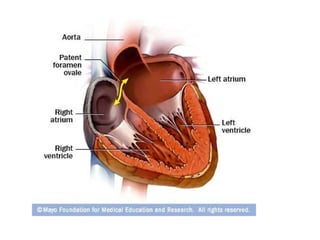
Congenital heart disease
• The foramen ovale is a small opening that babies
have before they are born and it is located in the
septum, or the middle wall that divides the right
and left side of the heart.
• Before the baby is breathing on it’s own, this
little hole allows the blood from the right side of
the heart to go directly to the left side without
having to go to the lungs.
• If it does not close after the baby is born, it can
cause some heart failure because the heart is
pumping too hard to get the blood into the aorta.
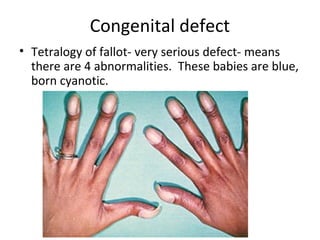
Congenital defect
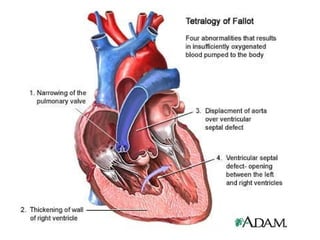
• Tetralogy of fallot- very serious defect- means
there are 4 abnormalities. These babies are blue,
born cyanotic.
Congenital heart disease
•
•
•
•
•

Tetrology of fallot- signs and symptoms
Child will be blue
Clubbed fingers and nails
Short of breath with any exertion- even crying
Child will squat after exercise for relief from
breathlessness
Congenital defects
• What can they do for tetrology of fallot?
• Surgery on the narrow opening of blood flow
to the lungs.
• Sometimes these children do not live long
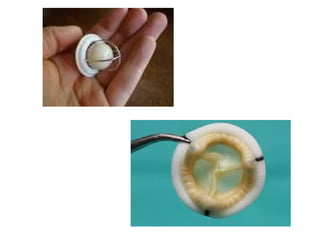
Valve diseases
• There are 2 ways valves can fail:
• 1st: valve may be too small for blood flow
called stenosis
• 2nd: valve can be too large and floppy and
allows the back-flow of blood into the atria
called valvular insufficiency.
• Heart murmur is the sound that indicates the
defect- whoosh whoosh sound not lub dub
Valve disease
• Mitral stenosis- valve is too small and cusps
form on the valve flaps that are normally
flexible. Now they become rigid and fuse
together and it takes much pressure to get the
blood forced through the narrow opening.
• Sometimes a clot can form because the blood
pools for too long and can travel to the brain
vessels of the brain ect.
Mitral stenosis
•
•
•
•
•

Signs and symptoms: neck veins distended
Cyanosis
Edema in ankles
Wet cough
More common in women than men
Aortic stenosis
• The valve stenosis that leads to the aorta,
happens more in men than women.
• Again the cusps become rigid and fuse
together look like warts on the valve because
calcified material are deposited on the valve.
The left ventricle has to work too hard to
pump the blood to the body
Aortic stenosis
•
•
•
•
•

Signs and symptoms can be:
Fainting
Chest pain
Short of breath
cyanosis
Rheumatic heart disease
• Heart disease that occurs from a strep
infection.
• When a person has an infection with
hemolytic strep, they have sore throat, or ear
infection, inflamed and painful joints, and
sometimes a rash.
• Usually this is an infection of children or
young adults
Rheumatic heart disease
• A few weeks after the infection, the body
develops a reaction between the strep
antigen and the body’s own antibodies against
them. This makes scarring on the mitral valve
and sometimes the semilunar valve.
• Rheumatic heart disease can be the
underlying cause for valve disease.
Heart infections
• Infectious endocarditis- the endocardium is
the inner lining of the chambers of the heart
and covers the valves. Endocarditis is an
inflammation of this lining caused by a strain
of strep. Organisms enter the blood stream
from an infected tooth, UTI, skin infection ect.
• If the person already has rheumatic fever
lesion on the heart, the infection will spread
to the heart.
endocarditis
•
•
•
•
•
•
•

Signs and symptoms:
Fever
Chills
Pain
Joint pain
Swelling in ankles
New heart murmur sounds like whooshwhoosh to even scrapping
endocarditis
• Treatment- antibiotics, surgery on the valves if
it is necessary.
anemia
• Anemia is an inadequate number of red blood
cells, hemoglobin or both.
• There are different kinds of anemia from
different sources:
• Chronic blood loss anemia- too few RBCs
needs a transfusion- caused by slow bleeding
or inability to clot
anemia
• Iron deficiency anemia- not enough iron to
form hemoglobin. Diet is poor in green leafy
veggies, and may need an iron supplement
• Aplastic anemia- injury or destruction of red
bone marrow. This leads to poor formation of
red blood cells. Usually caused by
chemotherapy, radiation, or viruses.- this is
frequently fatal
anemia
• Pernicious anemia- abnormally large erythrocytes(RBCs) and
not enough of them.
Patients do not absorb vitamin b12 in the digestion tract, and
need b12 injections
Signs and symptom of anemia:
Fatigue
Chest pain
Pale
Weakness short of breath
Brittle nails
Irregular heartbeat
Restless leg syndrome
Increased susceptibility to infections
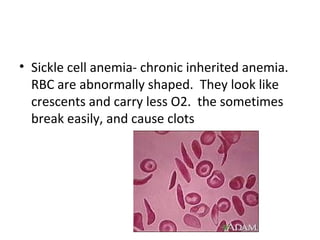
• Sickle cell anemia- chronic inherited anemia.
RBC are abnormally shaped. They look like
crescents and carry less O2. the sometimes
break easily, and cause clots
anemia
• Signs and symptoms of sickle cell:
• In babies you might see swollen hands and
feet
• In a “crisis” the sickle cells can clog vessels in
joints chest, legs, and cause moderate to
severe pain.
• Some people only have a few crisis’ ever, and
some people can have dozens per year.

Cardiacpathologies

  • 1.
  • 2.
    Cardiac patho • CAD-CORONARY ARTERY DISEASE • Coronary arteries supply O2 blood to the myocardium-heart muscle. • Coronary arteries can easily become clogged and a blood clot forms. • This is called coronary thrombosis- narrowing of the lumen of the artery- lumen is the opening in a tube
  • 4.
    CAD • If thelumen is narrowed because of fat deposits it is called plaque • This is called atherosclerosis • If the blockage is big enough it can block the whole artery and cause ischemia- this is a deficiency of blood and O2 to the heart muscle which causes a heart attack!
  • 6.
    CAD • CAD isthe leading cause of death in the US! if a lumen slowly narrows, some of the heart cells die and are replaced by scar tissue. Dead muscle tissue is called an infarct. This is a true heart attack or myocardial infarction.
  • 7.
    CAD • • • • • Signs and symptomsof a heart attack may be: “feels like an elephant sitting on my chest.” “feels like someone squeezing my chest.” Referred pain to the neck or the left arm Clammy, tired, nausea,sweating
  • 8.
    CAD • What shouldI do if someone is having a myocardial infarction? • If conscious- give aspirin, if they have a script of nitroglycerin(causes vasodilation), put it under their tongue- you can give up to 3 every 5 minutes • Call 911 • If not conscious start CPR
  • 9.
    CAD • • • • • • • Why do peoplehave CAD? Obesity Smoking High blood pressure Diet high in fat and salt- high in cholesterol Sedentary *One or more of these factors may put a person at risk*
  • 10.
    CAD • How isthis treated? • Thrombolytic drugs- clot busters like: • TPA (tissue plasminogen activator) and streptokinase busts a clot once it has happened. hospital wants thrombolytics within 3 hours. • Anticoagulants- aspirin thins the blood to keep one from forming
  • 11.
    CAD • Oxygen andpain relievers- O2 to help get oxygen to the dying portions of the heart and pain meds to reduce stress on the heart and use less O2. Surgery- coronary artery bypass graft (CABG) They take a vein from somewhere in the bodylike the saphenous from the leg, or mammary vein from the chest and bypass the artery with the clot.
  • 12.
    CAD • Angina pectoris-this is temporary O2 insufficiency. They may have severe pain in the chest. This is not a heart attack, but can feel like one. These usually follow a big meal, trying to exercise, exposure to cold or stress. • Again nitroglycerin under the tongue can help with pain because it dilates the arteries to let blood through more easily
  • 13.
    Hypertensive heart disease •People who have had high blood pressure for a long time overwork the heart because it has to pump against resistance- like putting your finger over the hose. • The heart enlarges and the left ventricle has to do most of the work to meet the demands of the body. • Finally the ventricle becomes exhausted and is unable to pump and fails. Heart failure.
  • 14.
    CAD • Cor pulmonale-right side heart failure from chronic lung disease. The lung blood vessels are diseased and impairs the blood flow to the lungs. This works the right side ventricle and it becomes enlarged and eventually fails. right ventricle pumps to lungs.
  • 15.
    CAD • Congestive heartfailure- CHF • Means the heart is pumping inadequately to meet the needs of the body. This allows fluid buildup in lungs and extremities. • It can be right or left sided each have different signs and symptoms
  • 16.
    CHF • Right sidefailure looks like: • Edema in the ankles, distention of neck veins, enlarged liver and spleen. • Left side looks like: • Shortness of breath due to fluid build up in the lungs- pulmonary edema, wheezing
  • 17.
    Congenital heart disease •The foramen ovale is a small opening that babies have before they are born and it is located in the septum, or the middle wall that divides the right and left side of the heart. • Before the baby is breathing on it’s own, this little hole allows the blood from the right side of the heart to go directly to the left side without having to go to the lungs. • If it does not close after the baby is born, it can cause some heart failure because the heart is pumping too hard to get the blood into the aorta.
  • 19.
    Congenital defect • Tetralogyof fallot- very serious defect- means there are 4 abnormalities. These babies are blue, born cyanotic.
  • 21.
    Congenital heart disease • • • • • Tetrologyof fallot- signs and symptoms Child will be blue Clubbed fingers and nails Short of breath with any exertion- even crying Child will squat after exercise for relief from breathlessness
  • 22.
    Congenital defects • Whatcan they do for tetrology of fallot? • Surgery on the narrow opening of blood flow to the lungs. • Sometimes these children do not live long
  • 23.
    Valve diseases • Thereare 2 ways valves can fail: • 1st: valve may be too small for blood flow called stenosis • 2nd: valve can be too large and floppy and allows the back-flow of blood into the atria called valvular insufficiency. • Heart murmur is the sound that indicates the defect- whoosh whoosh sound not lub dub
  • 25.
    Valve disease • Mitralstenosis- valve is too small and cusps form on the valve flaps that are normally flexible. Now they become rigid and fuse together and it takes much pressure to get the blood forced through the narrow opening. • Sometimes a clot can form because the blood pools for too long and can travel to the brain vessels of the brain ect.
  • 26.
    Mitral stenosis • • • • • Signs andsymptoms: neck veins distended Cyanosis Edema in ankles Wet cough More common in women than men
  • 27.
    Aortic stenosis • Thevalve stenosis that leads to the aorta, happens more in men than women. • Again the cusps become rigid and fuse together look like warts on the valve because calcified material are deposited on the valve. The left ventricle has to work too hard to pump the blood to the body
  • 28.
    Aortic stenosis • • • • • Signs andsymptoms can be: Fainting Chest pain Short of breath cyanosis
  • 29.
    Rheumatic heart disease •Heart disease that occurs from a strep infection. • When a person has an infection with hemolytic strep, they have sore throat, or ear infection, inflamed and painful joints, and sometimes a rash. • Usually this is an infection of children or young adults
  • 30.
    Rheumatic heart disease •A few weeks after the infection, the body develops a reaction between the strep antigen and the body’s own antibodies against them. This makes scarring on the mitral valve and sometimes the semilunar valve. • Rheumatic heart disease can be the underlying cause for valve disease.
  • 31.
    Heart infections • Infectiousendocarditis- the endocardium is the inner lining of the chambers of the heart and covers the valves. Endocarditis is an inflammation of this lining caused by a strain of strep. Organisms enter the blood stream from an infected tooth, UTI, skin infection ect. • If the person already has rheumatic fever lesion on the heart, the infection will spread to the heart.
  • 32.
    endocarditis • • • • • • • Signs and symptoms: Fever Chills Pain Jointpain Swelling in ankles New heart murmur sounds like whooshwhoosh to even scrapping
  • 33.
    endocarditis • Treatment- antibiotics,surgery on the valves if it is necessary.
  • 34.
    anemia • Anemia isan inadequate number of red blood cells, hemoglobin or both. • There are different kinds of anemia from different sources: • Chronic blood loss anemia- too few RBCs needs a transfusion- caused by slow bleeding or inability to clot
  • 35.
    anemia • Iron deficiencyanemia- not enough iron to form hemoglobin. Diet is poor in green leafy veggies, and may need an iron supplement • Aplastic anemia- injury or destruction of red bone marrow. This leads to poor formation of red blood cells. Usually caused by chemotherapy, radiation, or viruses.- this is frequently fatal
  • 36.
    anemia • Pernicious anemia-abnormally large erythrocytes(RBCs) and not enough of them. Patients do not absorb vitamin b12 in the digestion tract, and need b12 injections Signs and symptom of anemia: Fatigue Chest pain Pale Weakness short of breath Brittle nails Irregular heartbeat Restless leg syndrome Increased susceptibility to infections
  • 37.
    • Sickle cellanemia- chronic inherited anemia. RBC are abnormally shaped. They look like crescents and carry less O2. the sometimes break easily, and cause clots
  • 38.
    anemia • Signs andsymptoms of sickle cell: • In babies you might see swollen hands and feet • In a “crisis” the sickle cells can clog vessels in joints chest, legs, and cause moderate to severe pain. • Some people only have a few crisis’ ever, and some people can have dozens per year.