Creating Interdisciplinary Units
                 with Cooperative Learning Centers

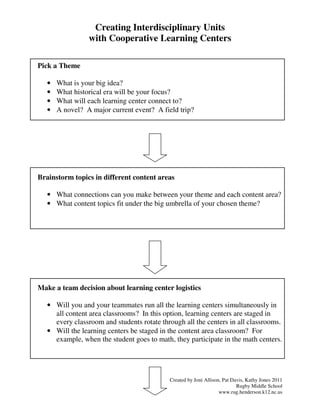
Pick a Theme

   •   What is your big idea?
   •   What historical era will be your focus?
   •   What will each learning center connect to?
   •   A novel? A major current event? A field trip?


Brainstorm topics in different content areas

   • What connections can you make between your theme and each content area?
   • What content topics fit under the big umbrella of your chosen theme?


Make a team decision about learning center logistics

   • Will you and your teammates run all the learning centers simultaneously in
     all content area classrooms? In this option, learning centers are staged in
     every classroom and students rotate through all the centers in all classrooms.
   • Will the learning centers be staged in the content area classroom? For
     example, when the student goes to math, they participate in the math centers.


                                            Created by Joni Allison, Pat Davis, Kathy Jones 2011
                                                                           Rugby Middle School
                                                                   www.rug.henderson.k12.nc.us
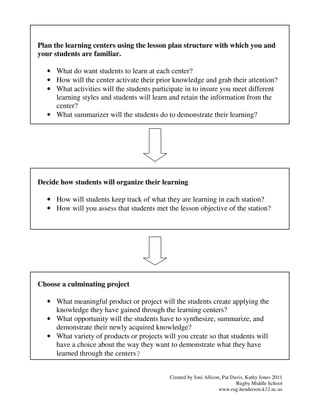
Plan the learning centers using the lesson plan structure with which you and
your students are familiar.

   • What do want students to learn at each center?
   • How will the center activate their prior knowledge and grab their attention?
   • What activities will the students participate in to insure you meet different
     learning styles and students will learn and retain the information from the
     center?
   • What summarizer will the students do to demonstrate their learning?


Decide how students will organize their learning

   • How will students keep track of what they are learning in each station?
   • How will you assess that students met the lesson objective of the station?


Choose a culminating project

   • What meaningful product or project will the students create applying the
     knowledge they have gained through the learning centers?
   • What opportunity will the students have to synthesize, summarize, and
     demonstrate their newly acquired knowledge?
   • What variety of products or projects will you create so that students will
     have a choice about the way they want to demonstrate what they have
     learned through the centers?


                                             Created by Joni Allison, Pat Davis, Kathy Jones 2011
                                                                            Rugby Middle School
                                                                    www.rug.henderson.k12.nc.us
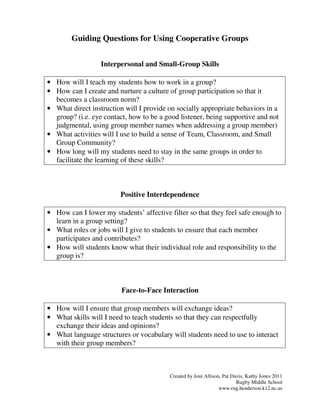
Guiding Questions for Using Cooperative Groups


                  Interpersonal and Small-Group Skills

• How will I teach my students how to work in a group?
• How can I create and nurture a culture of group participation so that it
  becomes a classroom norm?
• What direct instruction will I provide on socially appropriate behaviors in a
  group? (i.e. eye contact, how to be a good listener, being supportive and not
  judgmental, using group member names when addressing a group member)
• What activities will I use to build a sense of Team, Classroom, and Small
  Group Community?
• How long will my students need to stay in the same groups in order to
  facilitate the learning of these skills?


                         Positive Interdependence

• How can I lower my students’ affective filter so that they feel safe enough to
  learn in a group setting?
• What roles or jobs will I give to students to ensure that each member
  participates and contributes?
• How will students know what their individual role and responsibility to the
  group is?


                         Face-to-Face Interaction

• How will I ensure that group members will exchange ideas?
• What skills will I need to teach students so that they can respectfully
  exchange their ideas and opinions?
• What language structures or vocabulary will students need to use to interact
  with their group members?


                                         Created by Joni Allison, Pat Davis, Kathy Jones 2011
                                                                        Rugby Middle School
                                                                www.rug.henderson.k12.nc.us
Individual and Group Accountability

•   How will I know if each person in the group is learning the content?
•   How will I give feedback to individual students?
•   How will I give feedback to the group?
•   How will I grade the individual students and the group?


                             Group Processing

• How will groups reflect on their group performance?
• How will the groups identify their strengths?
• How will the groups identify their weaknesses and what steps will they take
  in the future to improve upon their weaknesses?


                            Active Engagement

• Will the group task challenge my students?
• Will my students learn and grow after participating in the group activities?
• Will the group tasks engage my students?


                                Teacher Role

• How will I facilitate group conflict-resolution?
• How will I monitor student learning and participation?
• What groups will need more individual support from me?


                                          Created by Joni Allison, Pat Davis, Kathy Jones 2011
                                                                         Rugby Middle School
                                                                 www.rug.henderson.k12.nc.us
Benefits of cooperative groups

•   Increases achievement at all ability levels.
•   Empowers students to take responsibility for their own learning.
•   Enhances a sense of community among students.
•   Promotes interpersonal communication skills.


                         Recommended Resources

• Drumming to the Beat of Different Marchers by Debbie Silvers

• Productive Group Work: How to Engage Students, Build Teamwork, and
  Promote Understanding by Nancy Frey, Douglas Fisher, Sandi Evelove

• The New Circles of Learning: Cooperation in the Classroom and School by
  David Johnson

• Cooperative Learning: Theory, Research, and Practice by Robert Slavin

• Mini-Lessons for Literature Circles by Harvey Daniels &Nancy Steineke


                                          Created by Joni Allison, Pat Davis, Kathy Jones 2011
                                                                         Rugby Middle School
                                                                 www.rug.henderson.k12.nc.us

Cooperative Learning Centers: Meeting the Needs of Diverse Learners

  • 1.
    Creating Interdisciplinary Units with Cooperative Learning Centers Pick a Theme • What is your big idea? • What historical era will be your focus? • What will each learning center connect to? • A novel? A major current event? A field trip? Brainstorm topics in different content areas • What connections can you make between your theme and each content area? • What content topics fit under the big umbrella of your chosen theme? Make a team decision about learning center logistics • Will you and your teammates run all the learning centers simultaneously in all content area classrooms? In this option, learning centers are staged in every classroom and students rotate through all the centers in all classrooms. • Will the learning centers be staged in the content area classroom? For example, when the student goes to math, they participate in the math centers. Created by Joni Allison, Pat Davis, Kathy Jones 2011 Rugby Middle School www.rug.henderson.k12.nc.us
  • 2.
    Plan the learningcenters using the lesson plan structure with which you and your students are familiar. • What do want students to learn at each center? • How will the center activate their prior knowledge and grab their attention? • What activities will the students participate in to insure you meet different learning styles and students will learn and retain the information from the center? • What summarizer will the students do to demonstrate their learning? Decide how students will organize their learning • How will students keep track of what they are learning in each station? • How will you assess that students met the lesson objective of the station? Choose a culminating project • What meaningful product or project will the students create applying the knowledge they have gained through the learning centers? • What opportunity will the students have to synthesize, summarize, and demonstrate their newly acquired knowledge? • What variety of products or projects will you create so that students will have a choice about the way they want to demonstrate what they have learned through the centers? Created by Joni Allison, Pat Davis, Kathy Jones 2011 Rugby Middle School www.rug.henderson.k12.nc.us
  • 3.
    Guiding Questions forUsing Cooperative Groups Interpersonal and Small-Group Skills • How will I teach my students how to work in a group? • How can I create and nurture a culture of group participation so that it becomes a classroom norm? • What direct instruction will I provide on socially appropriate behaviors in a group? (i.e. eye contact, how to be a good listener, being supportive and not judgmental, using group member names when addressing a group member) • What activities will I use to build a sense of Team, Classroom, and Small Group Community? • How long will my students need to stay in the same groups in order to facilitate the learning of these skills? Positive Interdependence • How can I lower my students’ affective filter so that they feel safe enough to learn in a group setting? • What roles or jobs will I give to students to ensure that each member participates and contributes? • How will students know what their individual role and responsibility to the group is? Face-to-Face Interaction • How will I ensure that group members will exchange ideas? • What skills will I need to teach students so that they can respectfully exchange their ideas and opinions? • What language structures or vocabulary will students need to use to interact with their group members? Created by Joni Allison, Pat Davis, Kathy Jones 2011 Rugby Middle School www.rug.henderson.k12.nc.us
  • 4.
    Individual and GroupAccountability • How will I know if each person in the group is learning the content? • How will I give feedback to individual students? • How will I give feedback to the group? • How will I grade the individual students and the group? Group Processing • How will groups reflect on their group performance? • How will the groups identify their strengths? • How will the groups identify their weaknesses and what steps will they take in the future to improve upon their weaknesses? Active Engagement • Will the group task challenge my students? • Will my students learn and grow after participating in the group activities? • Will the group tasks engage my students? Teacher Role • How will I facilitate group conflict-resolution? • How will I monitor student learning and participation? • What groups will need more individual support from me? Created by Joni Allison, Pat Davis, Kathy Jones 2011 Rugby Middle School www.rug.henderson.k12.nc.us
  • 5.
    Benefits of cooperativegroups • Increases achievement at all ability levels. • Empowers students to take responsibility for their own learning. • Enhances a sense of community among students. • Promotes interpersonal communication skills. Recommended Resources • Drumming to the Beat of Different Marchers by Debbie Silvers • Productive Group Work: How to Engage Students, Build Teamwork, and Promote Understanding by Nancy Frey, Douglas Fisher, Sandi Evelove • The New Circles of Learning: Cooperation in the Classroom and School by David Johnson • Cooperative Learning: Theory, Research, and Practice by Robert Slavin • Mini-Lessons for Literature Circles by Harvey Daniels &Nancy Steineke Created by Joni Allison, Pat Davis, Kathy Jones 2011 Rugby Middle School www.rug.henderson.k12.nc.us