Present Continuous
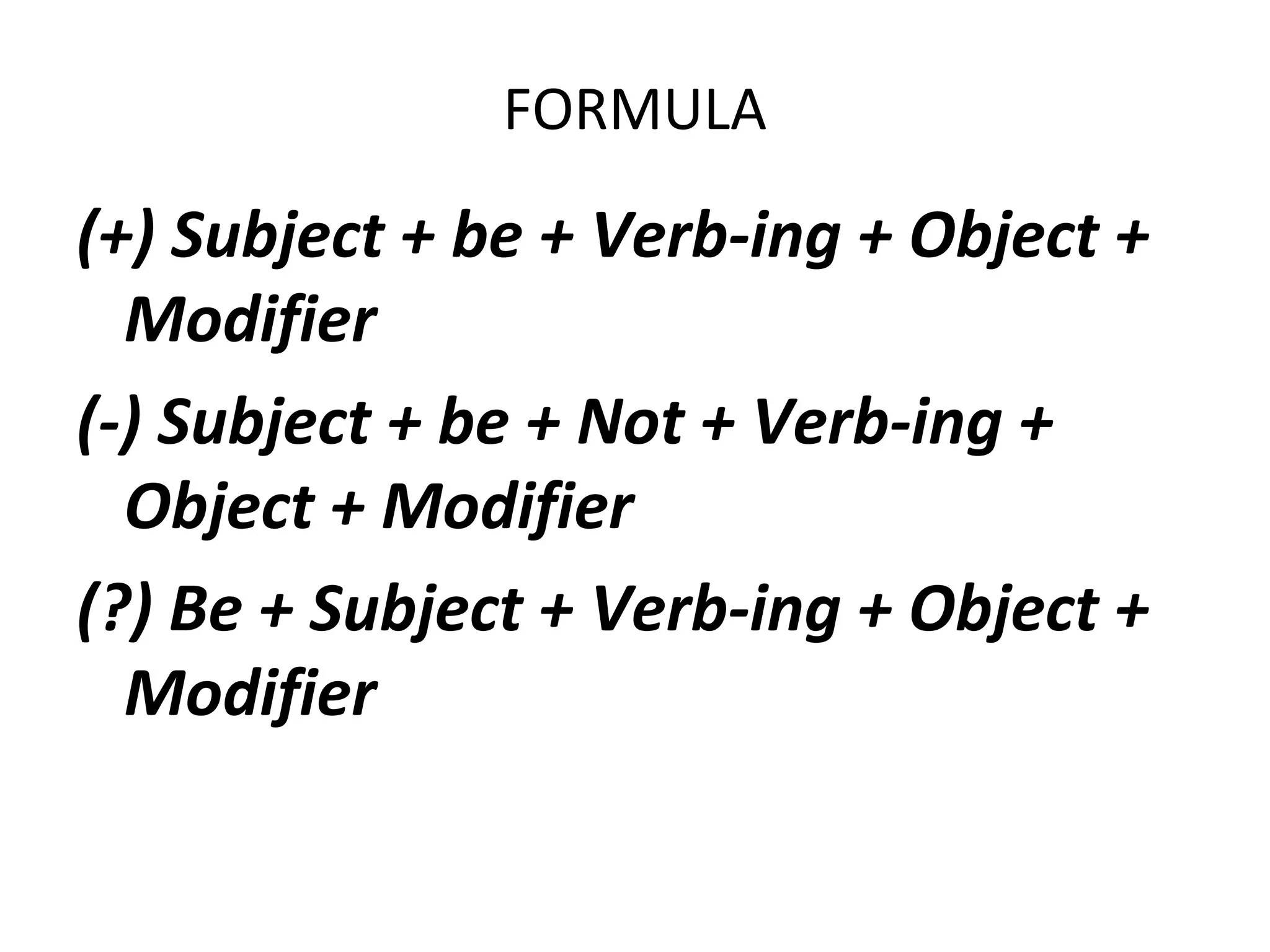
FORMULA

(+) Subject + be + Verb-ing + Object +
Modifier
(-) Subject + be + Not + Verb-ing +
Object + Modifier
(?) Be + Subject + Verb-ing + Object +
Modifier
POSITIVE FORM
NEGATIVE & QUESTION FORM
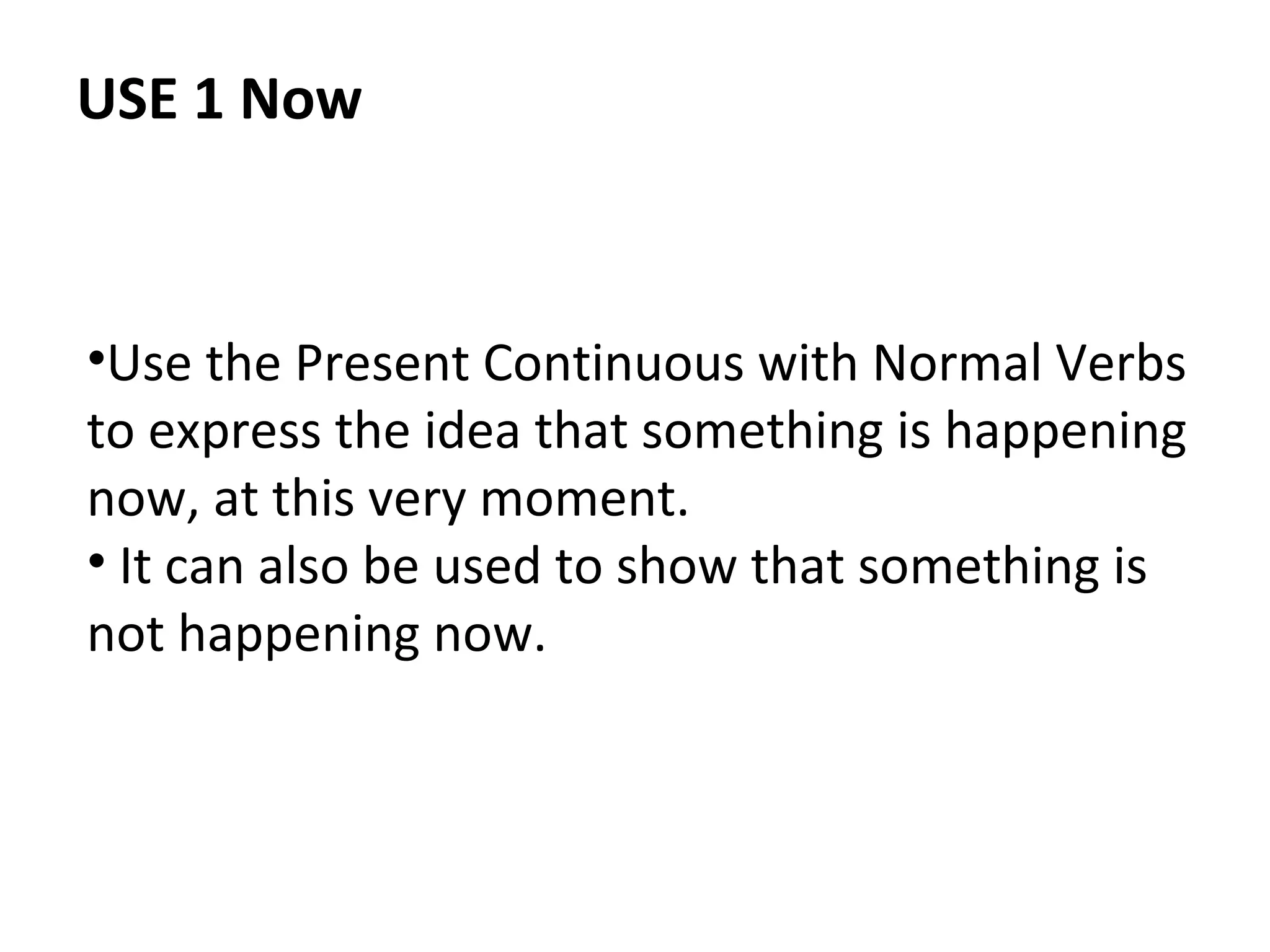
USE 1 Now

•Use the Present Continuous with Normal Verbs
to express the idea that something is happening
now, at this very moment.
• It can also be used to show that something is
not happening now.
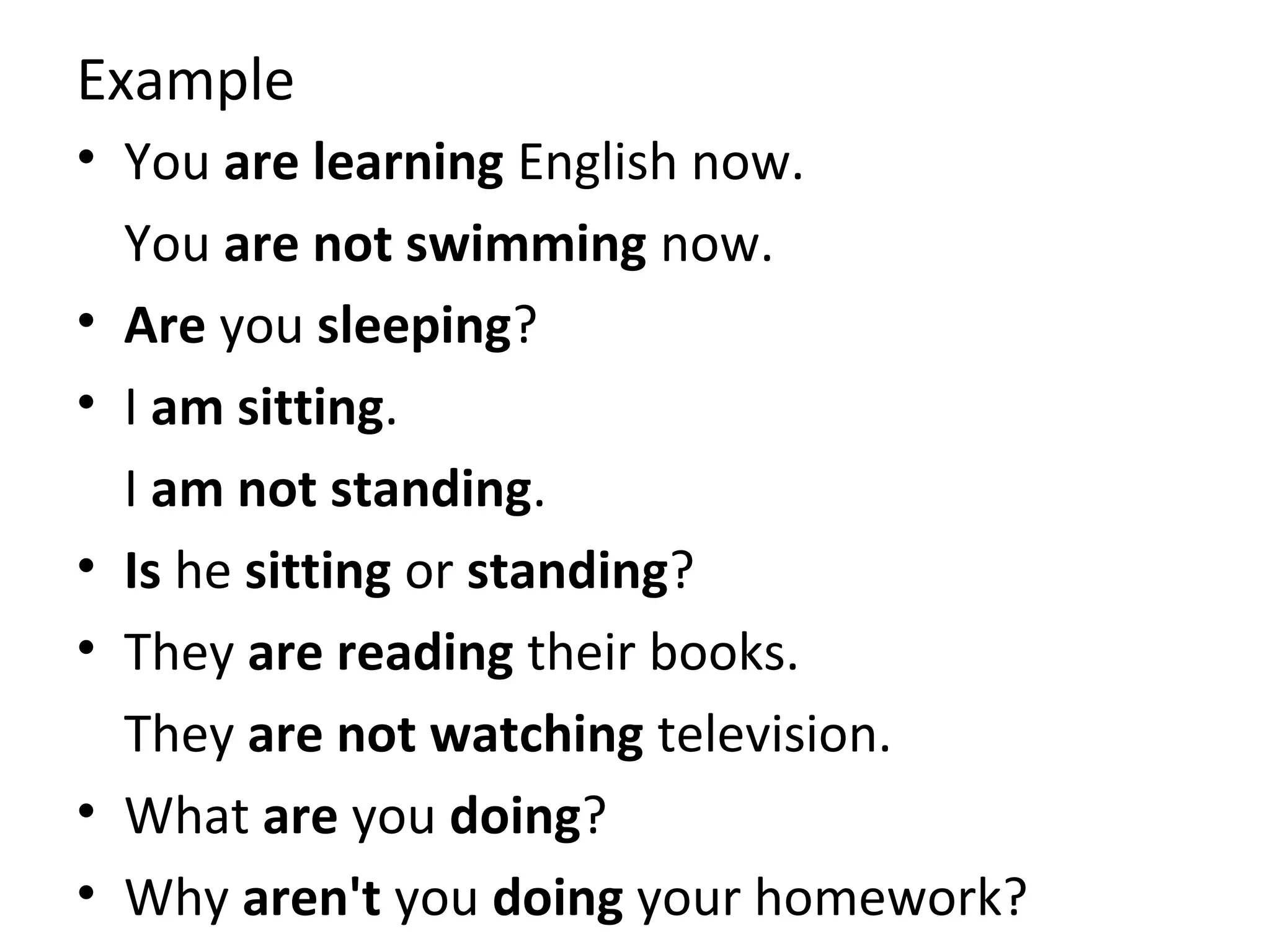
Example
• You are learning English now.
You are not swimming now.
• Are you sleeping?
• I am sitting.
I am not standing.
• Is he sitting or standing?
• They are reading their books.
They are not watching television.
• What are you doing?
• Why aren't you doing your homework?
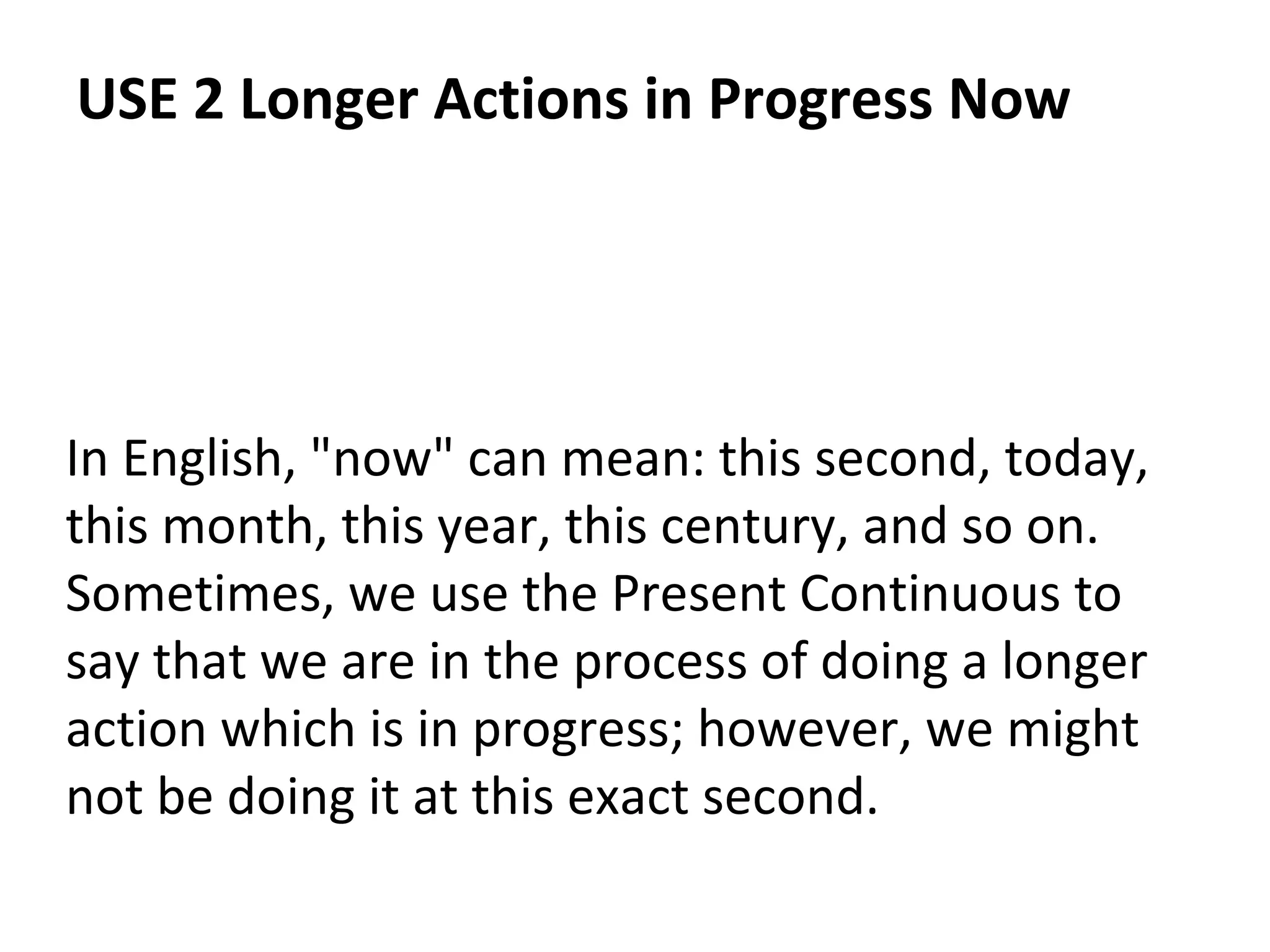
USE 2 Longer Actions in Progress Now

In English, "now" can mean: this second, today,
this month, this year, this century, and so on.
Sometimes, we use the Present Continuous to
say that we are in the process of doing a longer
action which is in progress; however, we might
not be doing it at this exact second.
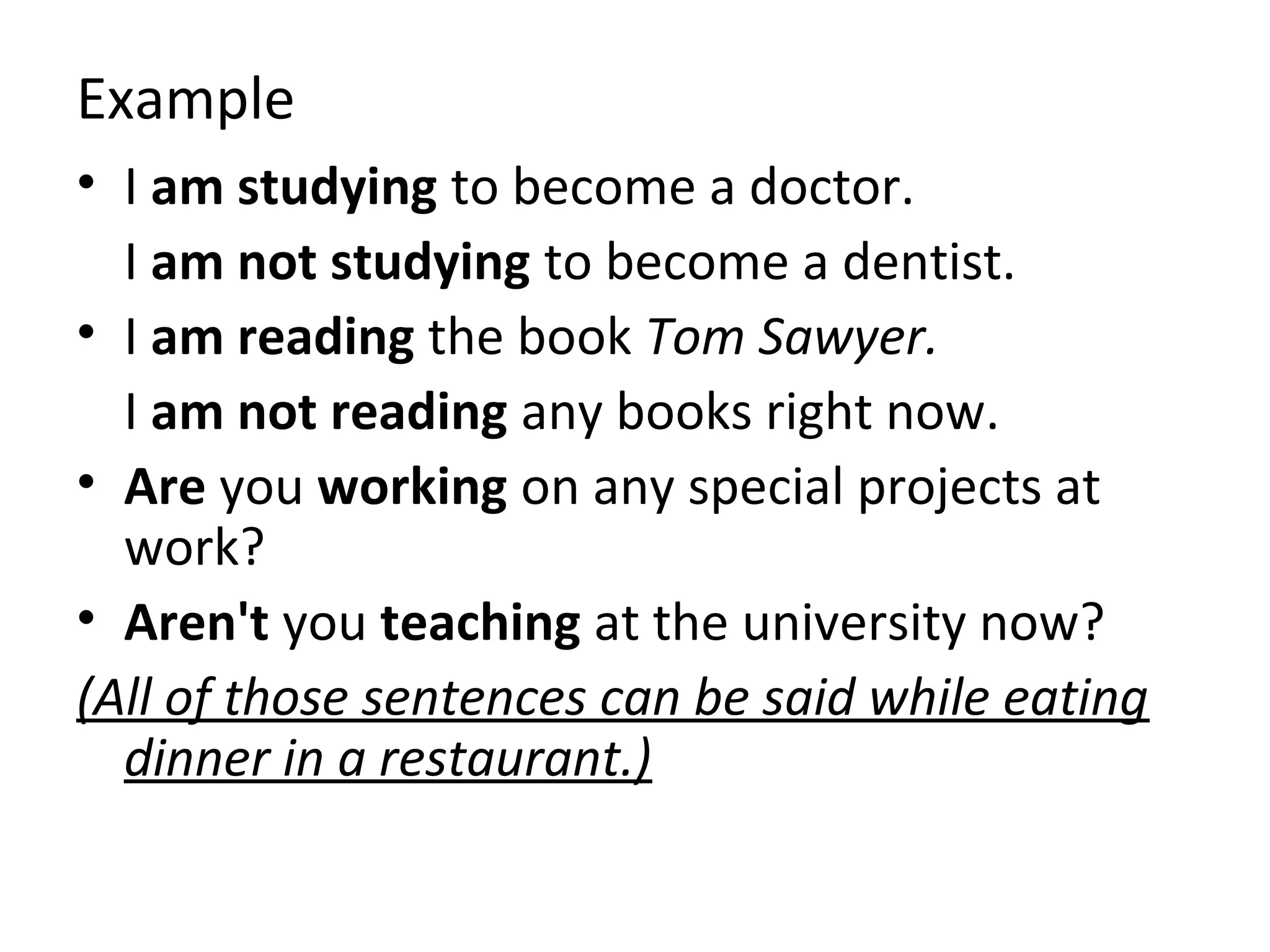
Example
• I am studying to become a doctor.
I am not studying to become a dentist.
• I am reading the book Tom Sawyer.
I am not reading any books right now.
• Are you working on any special projects at
work?
• Aren't you teaching at the university now?
(All of those sentences can be said while eating
dinner in a restaurant.)
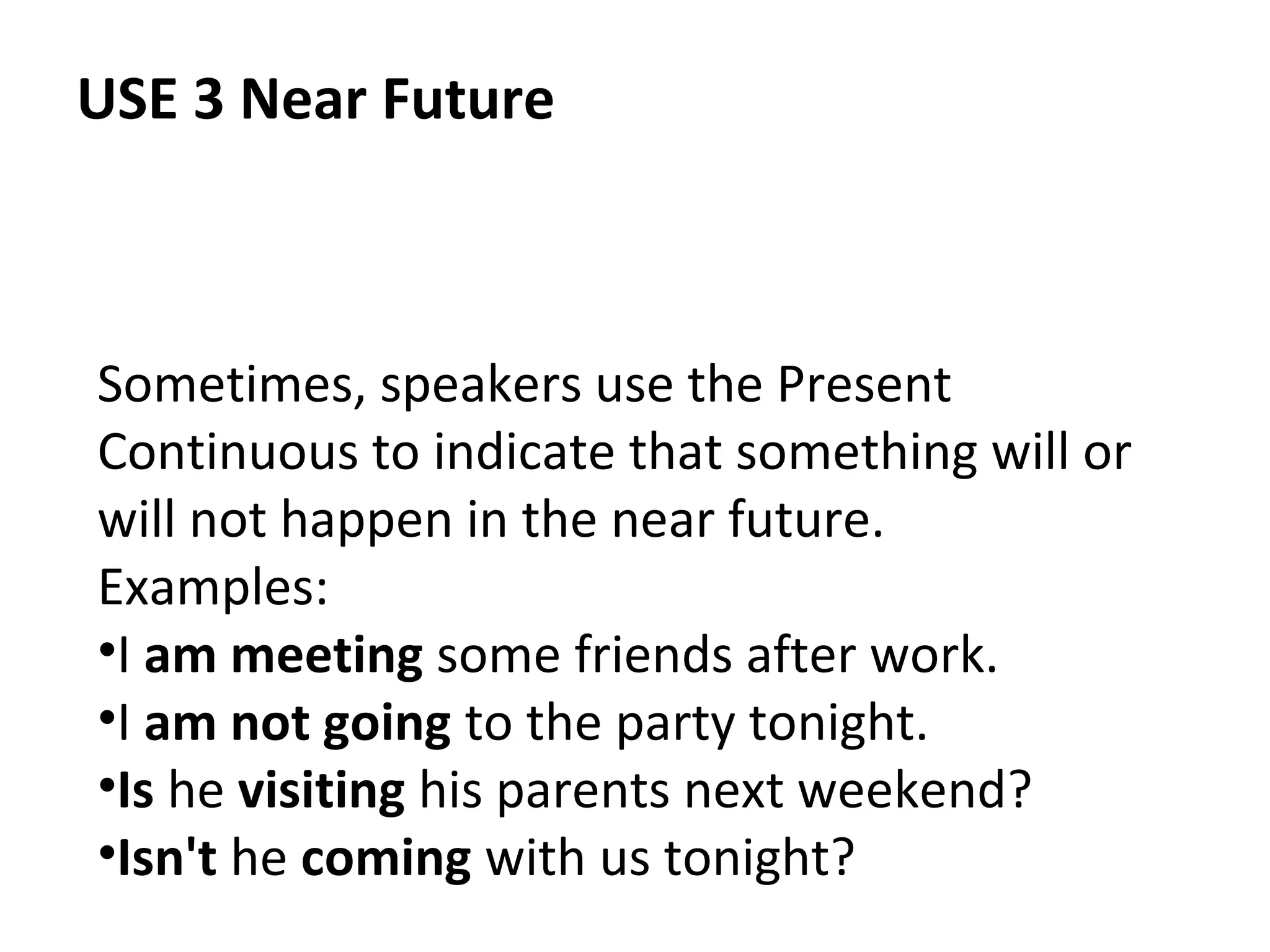
USE 3 Near Future

Sometimes, speakers use the Present
Continuous to indicate that something will or
will not happen in the near future.
Examples:
•I am meeting some friends after work.
•I am not going to the party tonight.
•Is he visiting his parents next weekend?
•Isn't he coming with us tonight?
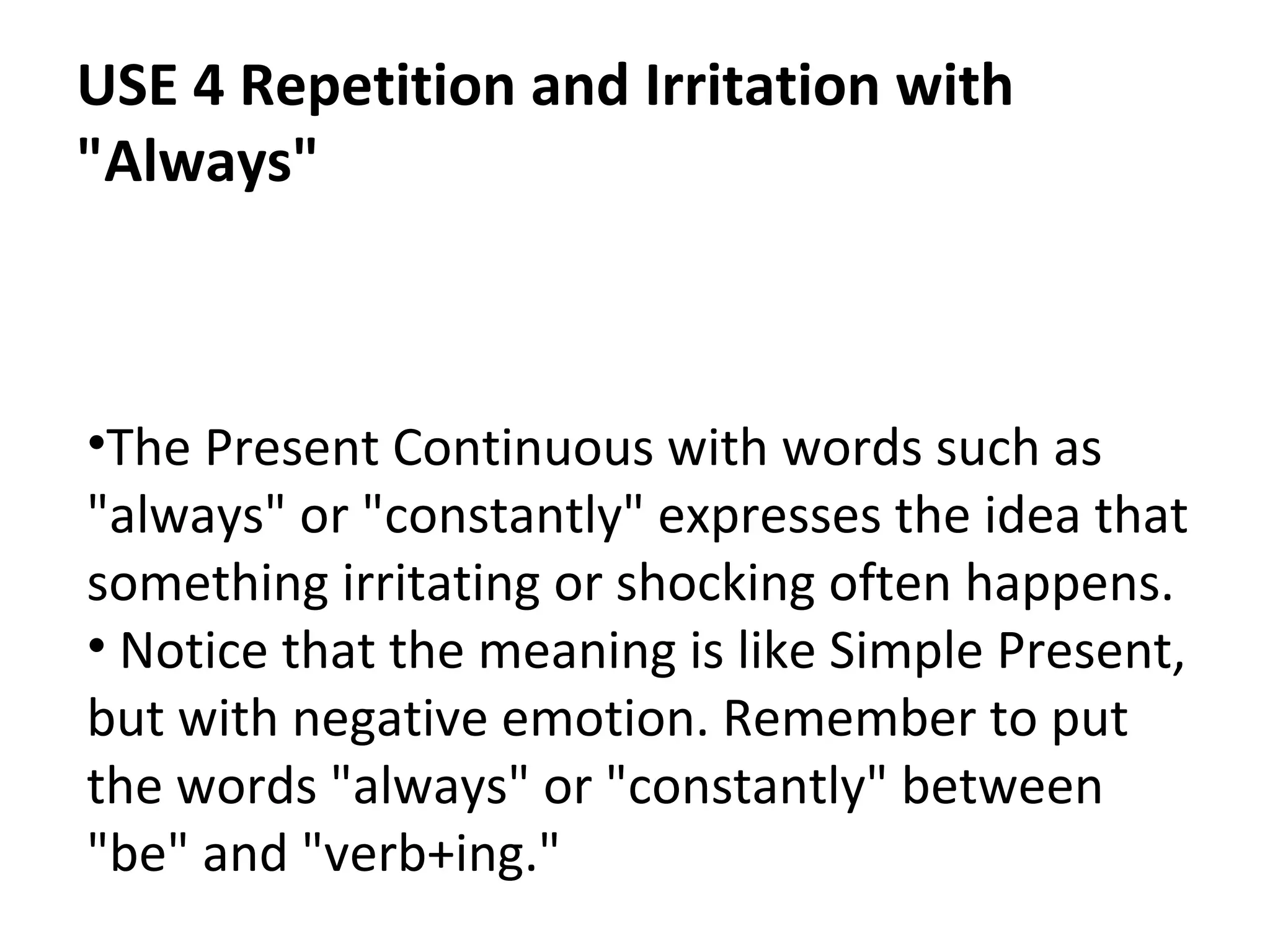
USE 4 Repetition and Irritation with
"Always"

•The Present Continuous with words such as
"always" or "constantly" expresses the idea that
something irritating or shocking often happens.
• Notice that the meaning is like Simple Present,
but with negative emotion. Remember to put
the words "always" or "constantly" between
"be" and "verb+ing."
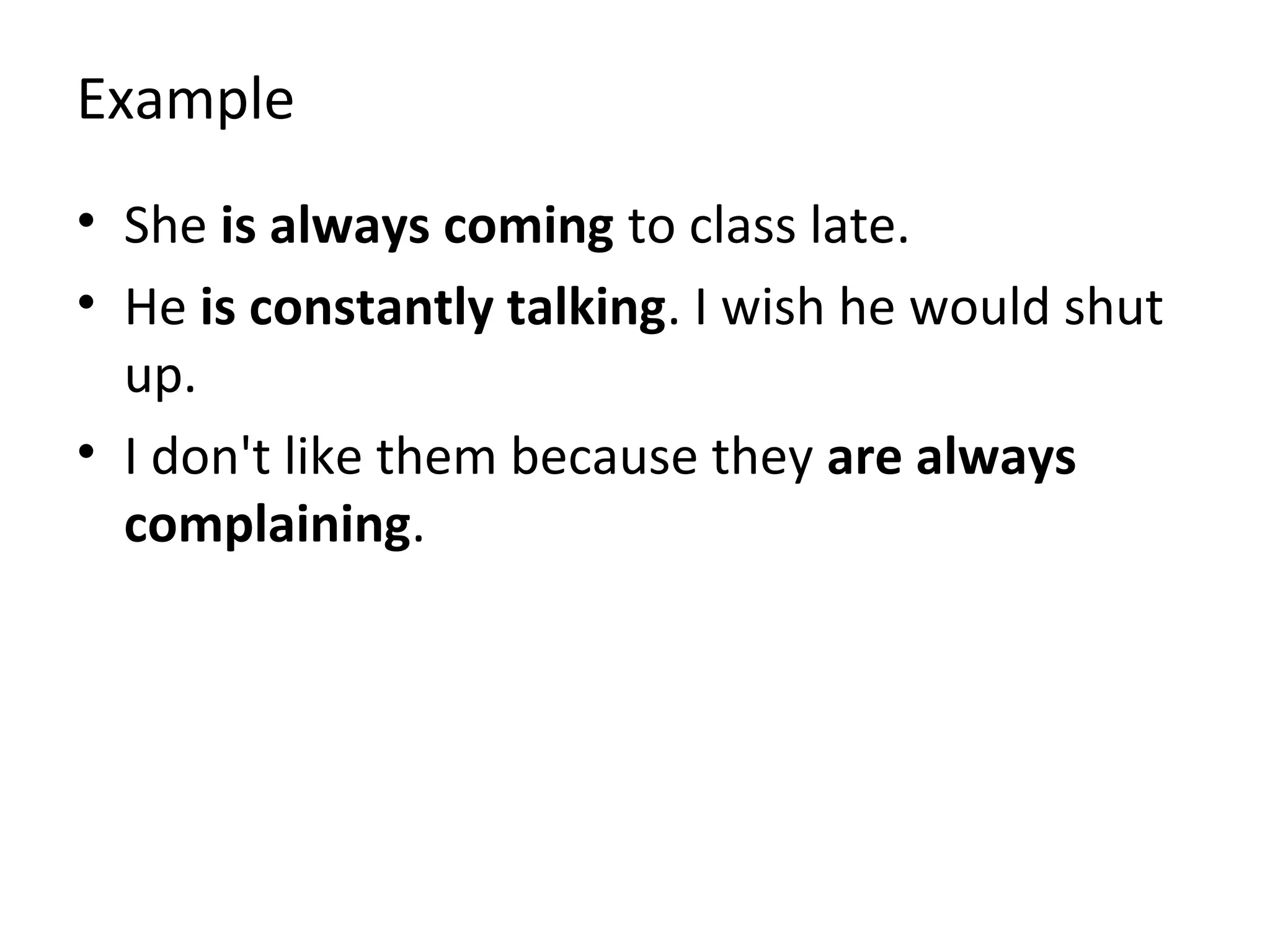
Example
• She is always coming to class late.
• He is constantly talking. I wish he would shut
up.
• I don't like them because they are always
complaining.
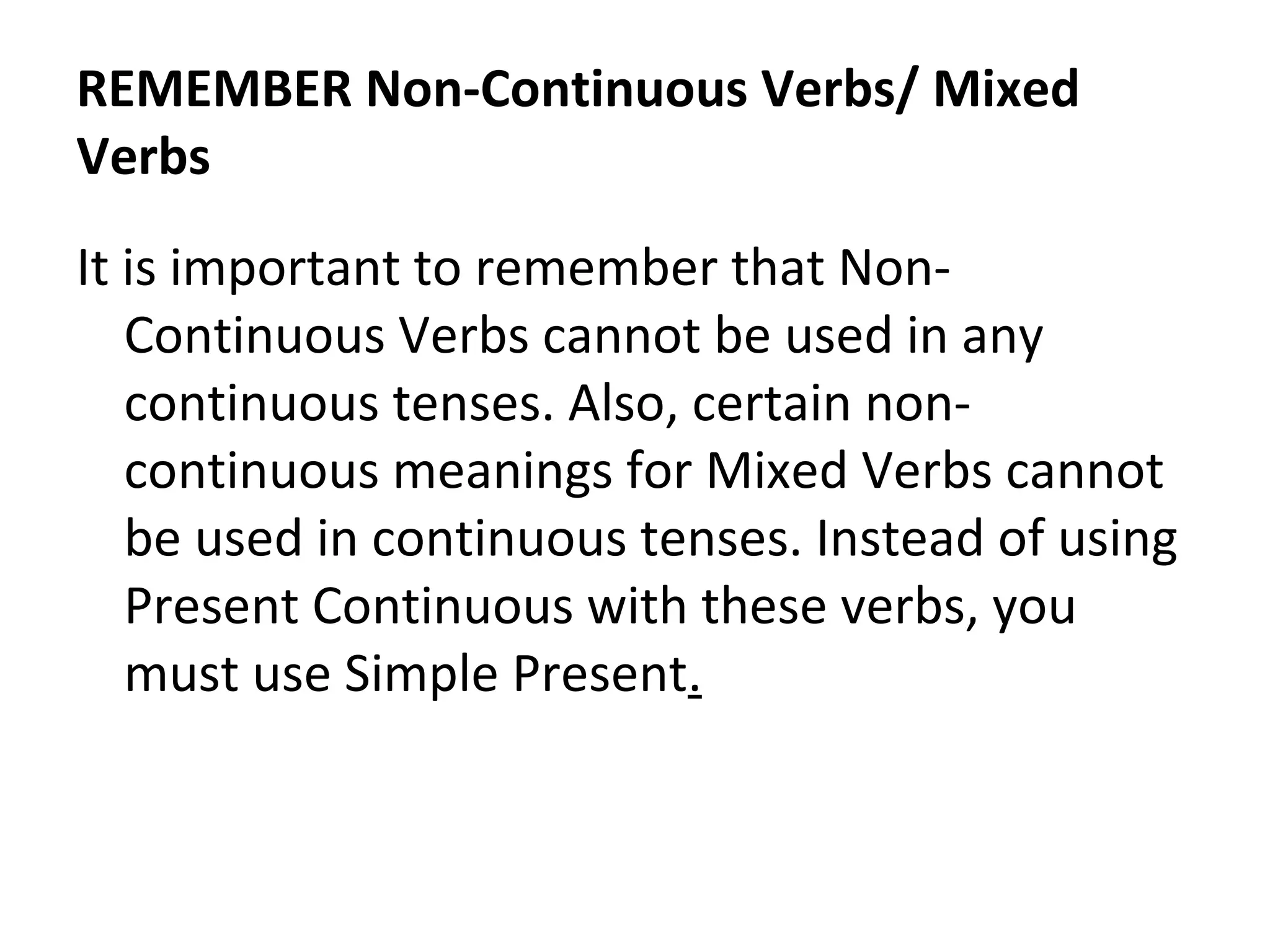
REMEMBER Non-Continuous Verbs/ Mixed
Verbs
It is important to remember that NonContinuous Verbs cannot be used in any
continuous tenses. Also, certain noncontinuous meanings for Mixed Verbs cannot
be used in continuous tenses. Instead of using
Present Continuous with these verbs, you
must use Simple Present.
Examples:
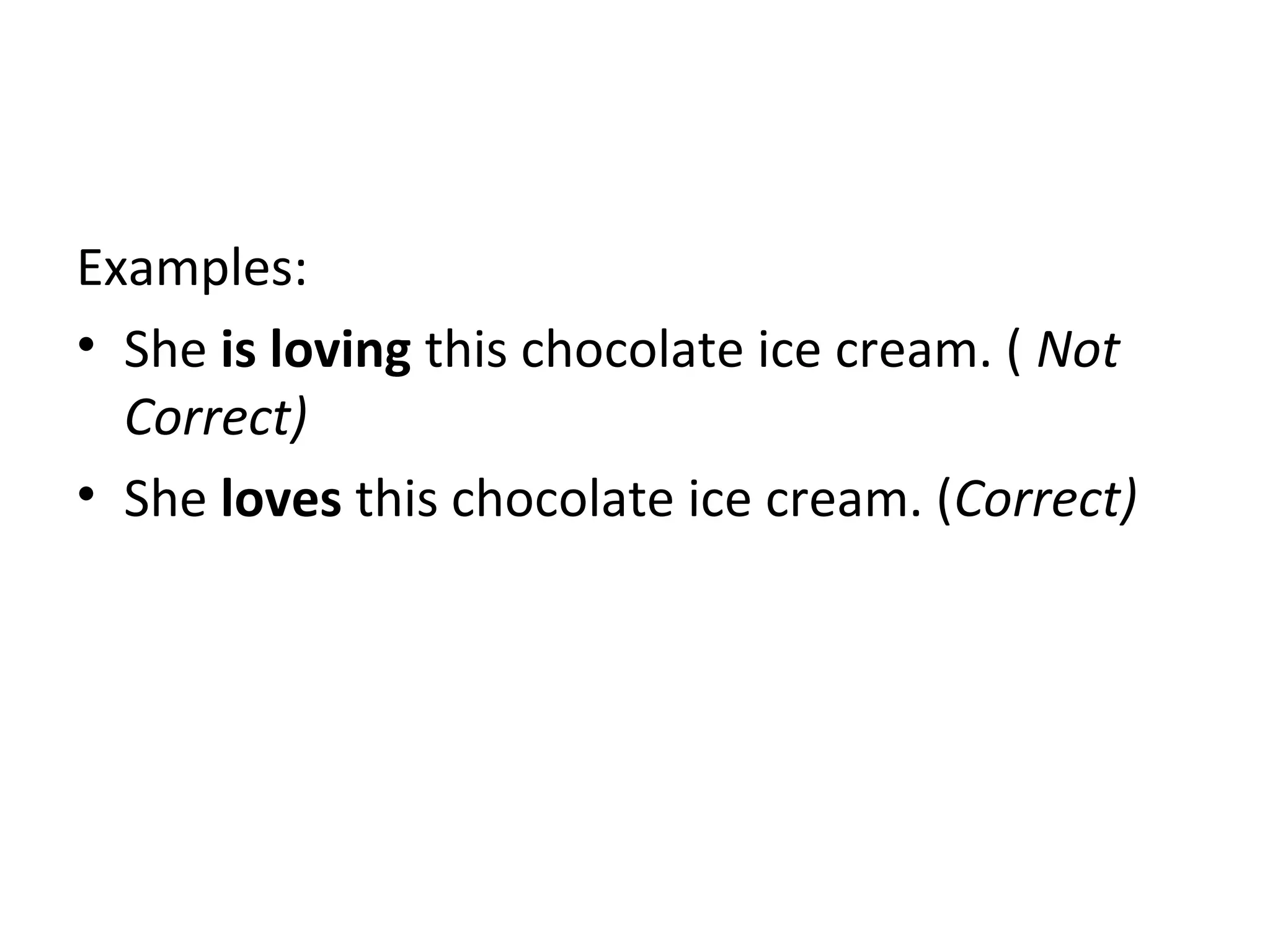
• She is loving this chocolate ice cream. ( Not
Correct)
• She loves this chocolate ice cream. (Correct)
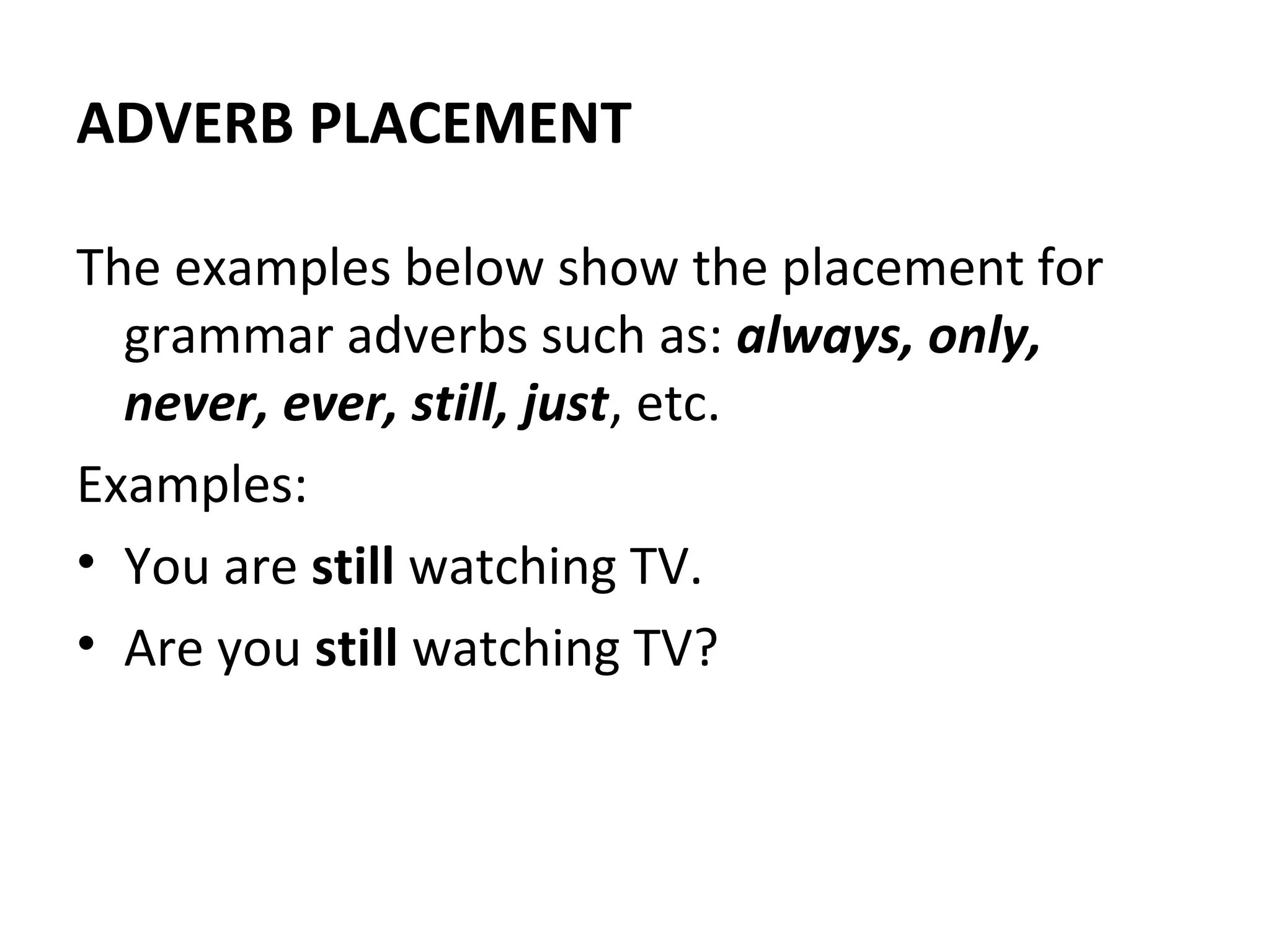
ADVERB PLACEMENT
The examples below show the placement for
grammar adverbs such as: always, only,
never, ever, still, just, etc.
Examples:
• You are still watching TV.
• Are you still watching TV?
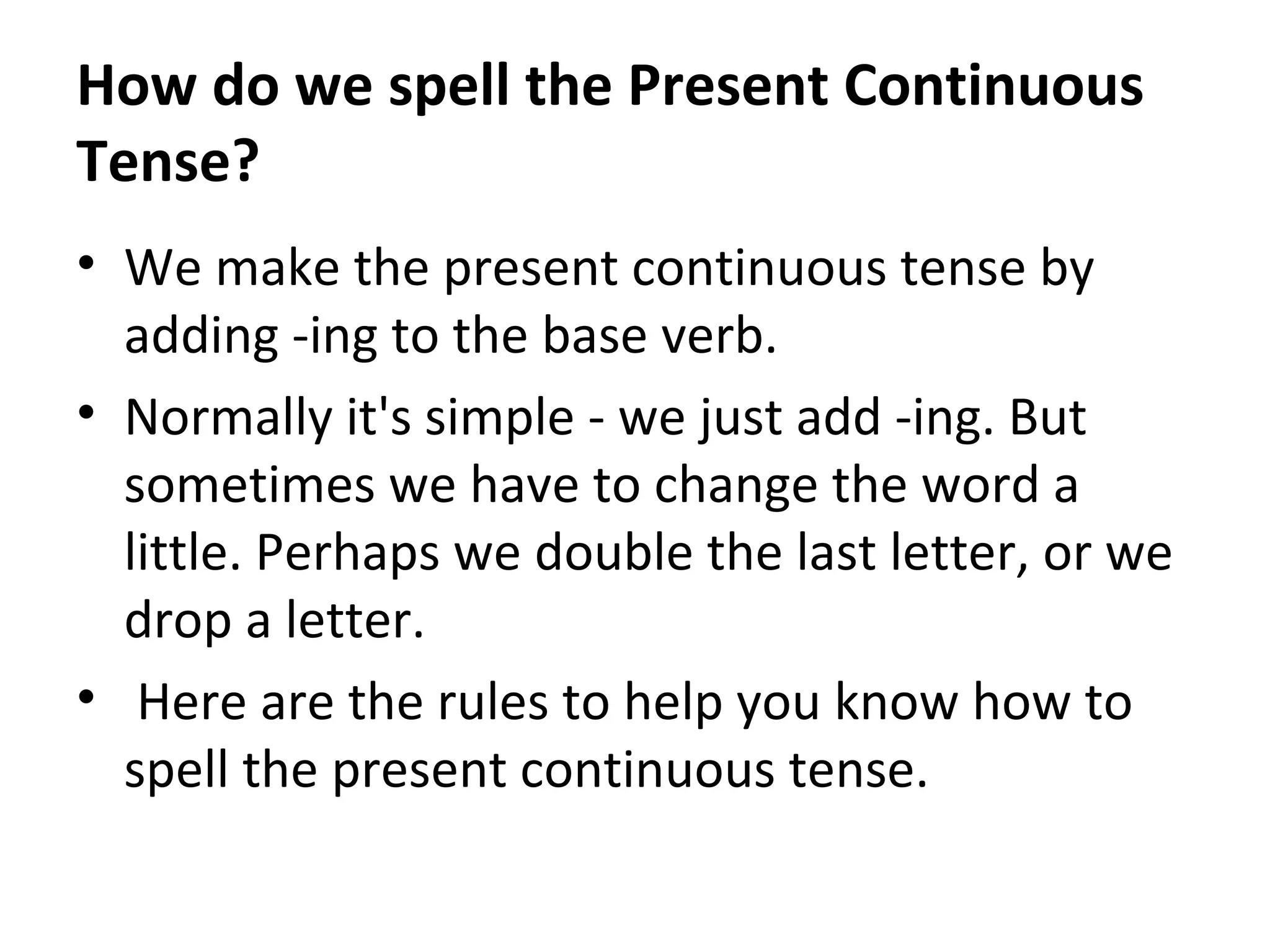
How do we spell the Present Continuous
Tense?
• We make the present continuous tense by
adding -ing to the base verb.
• Normally it's simple - we just add -ing. But
sometimes we have to change the word a
little. Perhaps we double the last letter, or we
drop a letter.
• Here are the rules to help you know how to
spell the present continuous tense.
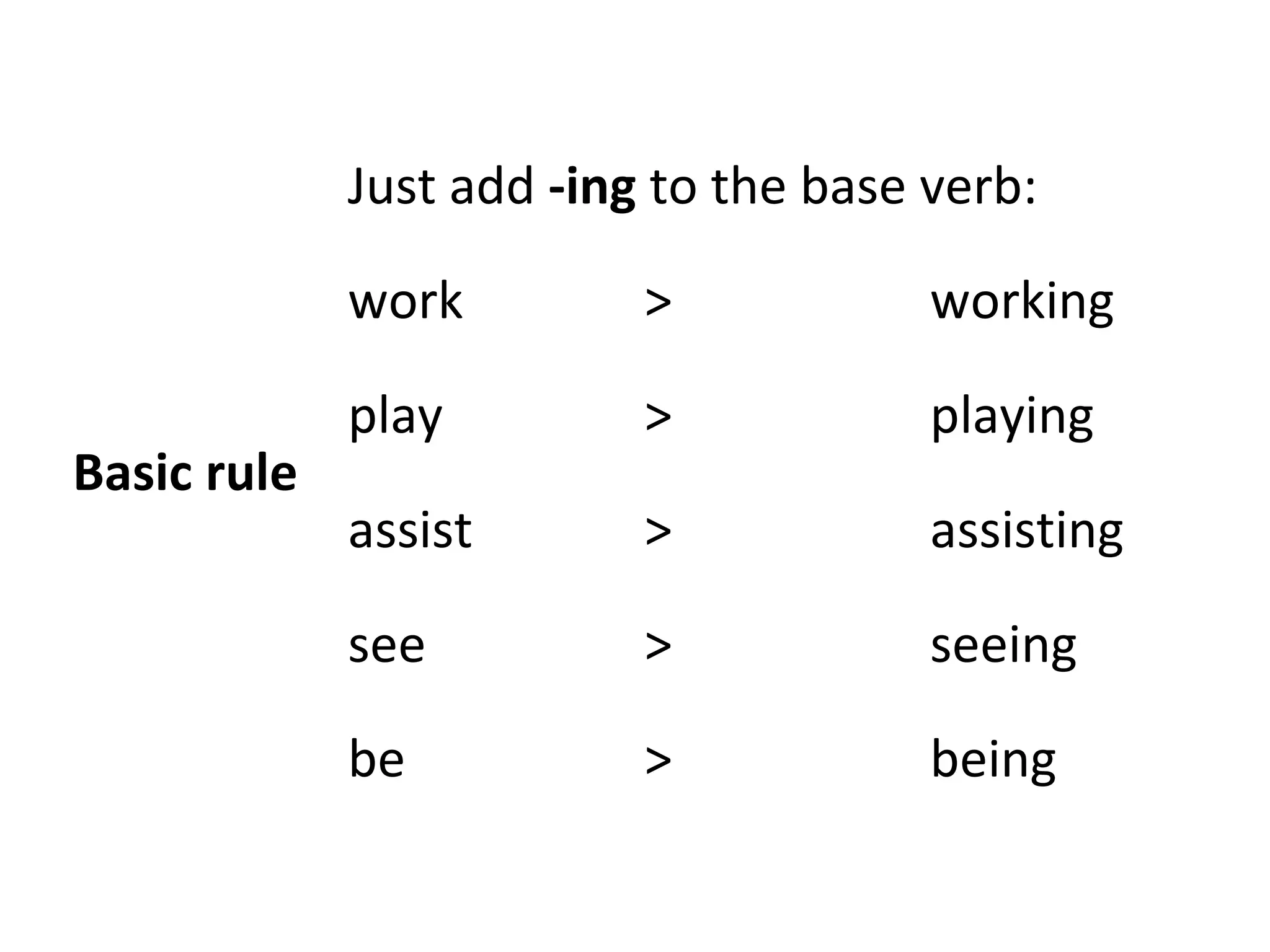
Just add -ing to the base verb:
work
Basic rule

>

working

play

>

playing

assist

>

assisting

see

>

seeing

be

>

being
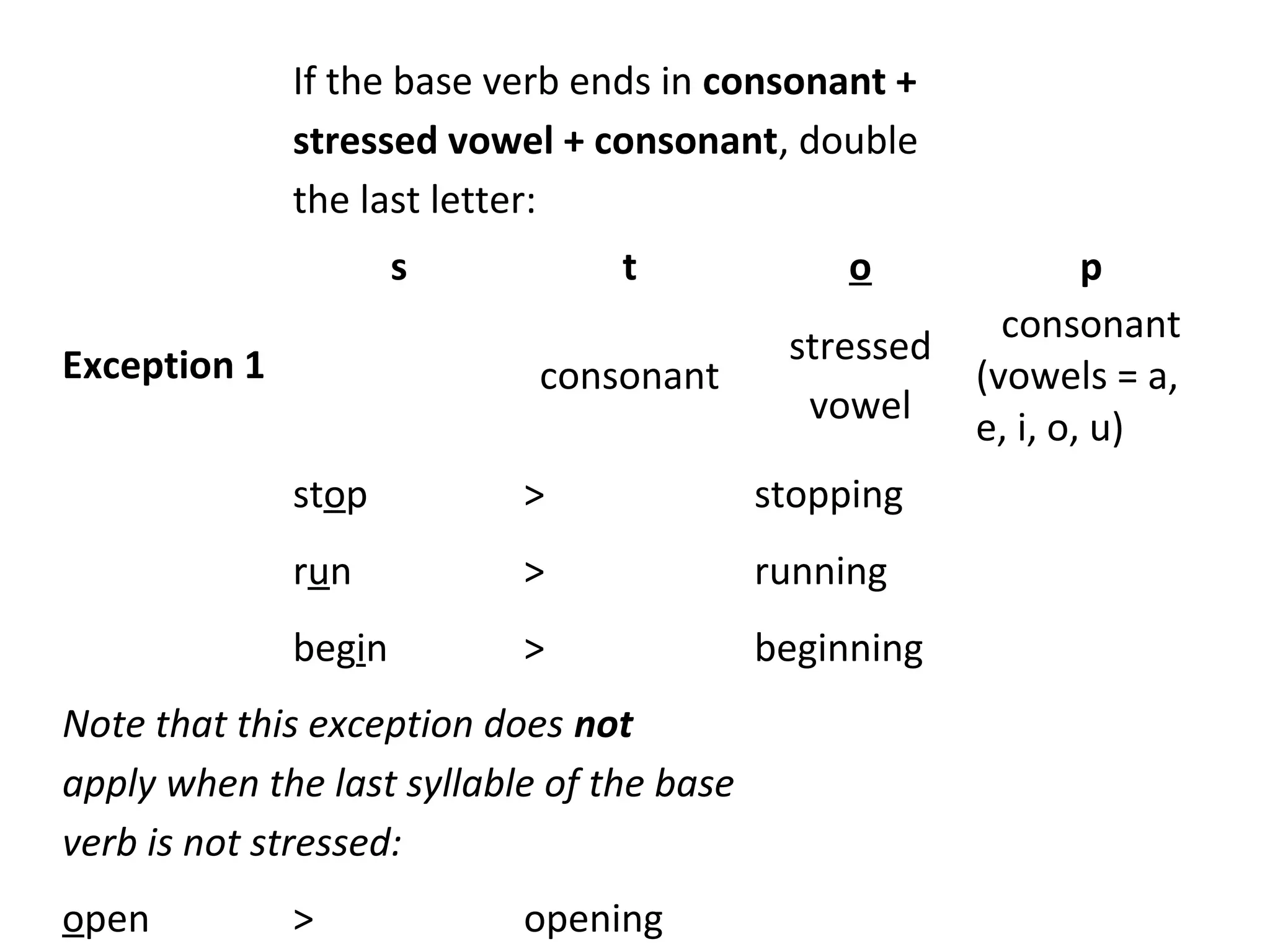
If the base verb ends in consonant +
stressed vowel + consonant, double
the last letter:
s

o

consonant

Exception 1

t

stressed
vowel

stop

>

stopping

run

>

running

begin

>

beginning

Note that this exception does not
apply when the last syllable of the base
verb is not stressed:
open

>

opening

p
consonant
(vowels = a,
e, i, o, u)
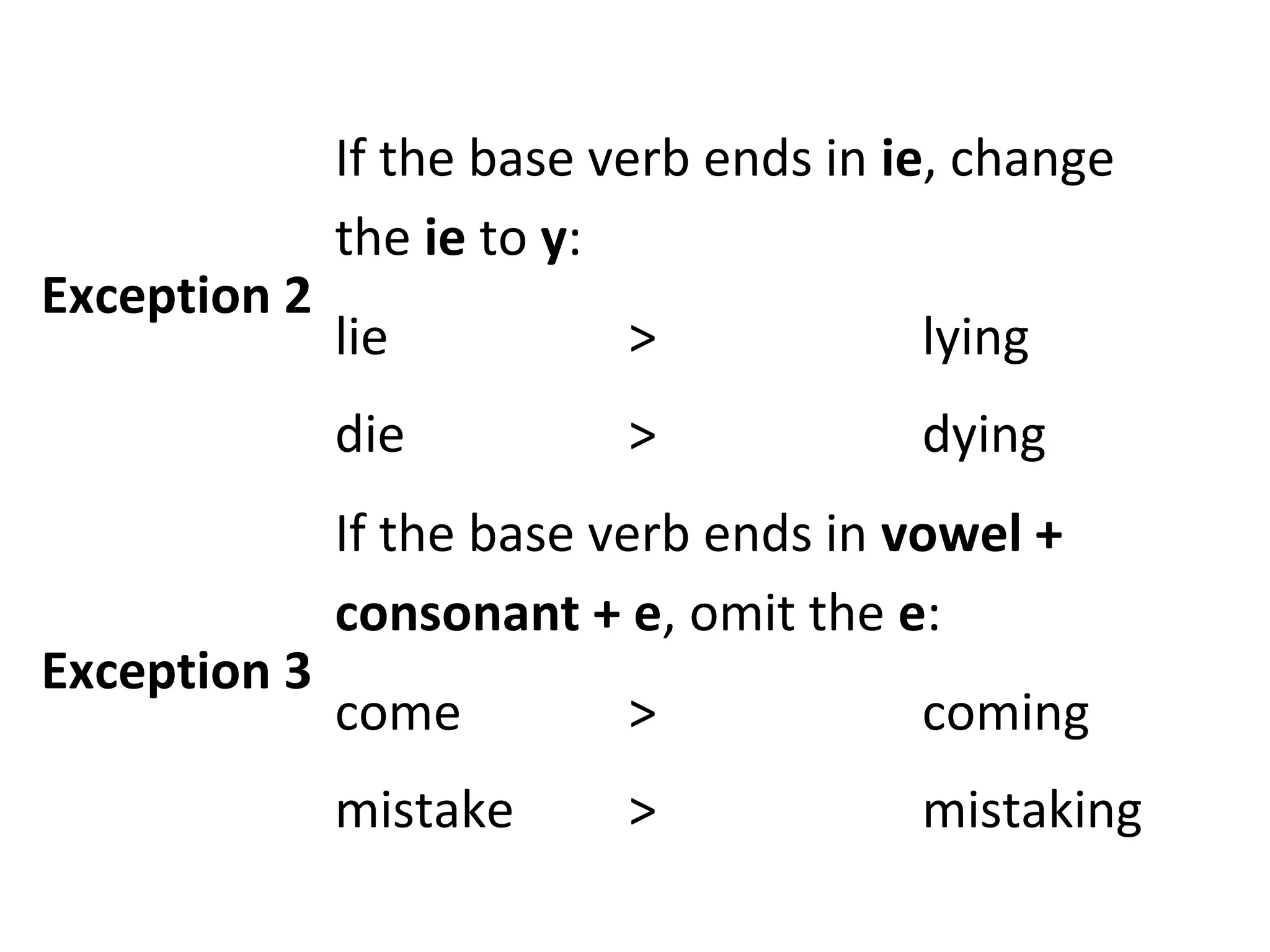
Exception 2

If the base verb ends in ie, change
the ie to y:
>

lying

die

Exception 3

lie

>

dying

If the base verb ends in vowel +
consonant + e, omit the e:
come

>

coming

mistake

>

mistaking

Present continuous

  • 1.
  • 2.
    FORMULA (+) Subject +be + Verb-ing + Object + Modifier (-) Subject + be + Not + Verb-ing + Object + Modifier (?) Be + Subject + Verb-ing + Object + Modifier
  • 3.
  • 4.
  • 5.
    USE 1 Now •Usethe Present Continuous with Normal Verbs to express the idea that something is happening now, at this very moment. • It can also be used to show that something is not happening now.
  • 6.
    Example • You arelearning English now. You are not swimming now. • Are you sleeping? • I am sitting. I am not standing. • Is he sitting or standing? • They are reading their books. They are not watching television. • What are you doing? • Why aren't you doing your homework?
  • 7.
    USE 2 LongerActions in Progress Now In English, "now" can mean: this second, today, this month, this year, this century, and so on. Sometimes, we use the Present Continuous to say that we are in the process of doing a longer action which is in progress; however, we might not be doing it at this exact second.
  • 8.
    Example • I amstudying to become a doctor. I am not studying to become a dentist. • I am reading the book Tom Sawyer. I am not reading any books right now. • Are you working on any special projects at work? • Aren't you teaching at the university now? (All of those sentences can be said while eating dinner in a restaurant.)
  • 9.
    USE 3 NearFuture Sometimes, speakers use the Present Continuous to indicate that something will or will not happen in the near future. Examples: •I am meeting some friends after work. •I am not going to the party tonight. •Is he visiting his parents next weekend? •Isn't he coming with us tonight?
  • 10.
    USE 4 Repetitionand Irritation with "Always" •The Present Continuous with words such as "always" or "constantly" expresses the idea that something irritating or shocking often happens. • Notice that the meaning is like Simple Present, but with negative emotion. Remember to put the words "always" or "constantly" between "be" and "verb+ing."
  • 11.
    Example • She isalways coming to class late. • He is constantly talking. I wish he would shut up. • I don't like them because they are always complaining.
  • 12.
    REMEMBER Non-Continuous Verbs/Mixed Verbs It is important to remember that NonContinuous Verbs cannot be used in any continuous tenses. Also, certain noncontinuous meanings for Mixed Verbs cannot be used in continuous tenses. Instead of using Present Continuous with these verbs, you must use Simple Present.
  • 13.
    Examples: • She isloving this chocolate ice cream. ( Not Correct) • She loves this chocolate ice cream. (Correct)
  • 14.
    ADVERB PLACEMENT The examplesbelow show the placement for grammar adverbs such as: always, only, never, ever, still, just, etc. Examples: • You are still watching TV. • Are you still watching TV?
  • 15.
    How do wespell the Present Continuous Tense? • We make the present continuous tense by adding -ing to the base verb. • Normally it's simple - we just add -ing. But sometimes we have to change the word a little. Perhaps we double the last letter, or we drop a letter. • Here are the rules to help you know how to spell the present continuous tense.
  • 16.
    Just add -ingto the base verb: work Basic rule > working play > playing assist > assisting see > seeing be > being
  • 17.
    If the baseverb ends in consonant + stressed vowel + consonant, double the last letter: s o consonant Exception 1 t stressed vowel stop > stopping run > running begin > beginning Note that this exception does not apply when the last syllable of the base verb is not stressed: open > opening p consonant (vowels = a, e, i, o, u)
  • 18.
    Exception 2 If thebase verb ends in ie, change the ie to y: > lying die Exception 3 lie > dying If the base verb ends in vowel + consonant + e, omit the e: come > coming mistake > mistaking