REPÚBLICA BOLIVARIANA DE VENEZUELA
MINISTERIO DEL PODER POPULAR PARA LA EDUCACIÓN
INSTITUTO UNIVERSITARIO POLITÉCNICO “SANTIAGO MARIÑO”
Extensión- Porlamar
SIMPLE PAST
made by:soriand duben
c.i:28.189.861
Escuela: 46
There are many ways to talk about the past in English, but the
simple past is the most common way. We use the past simple for
complete actions in the past. In the past simple there are regular
verbs and irregular verbs.
Simple past
Grammatical Rules
To form the past simple with regular verbs, we use the infinitive and add the ending "-ed". The
form is the same for all people (I, you, he, she, it, we, they).
want → wanted
learn → learned
stay → stayed
walk → walked
show → showed
examples
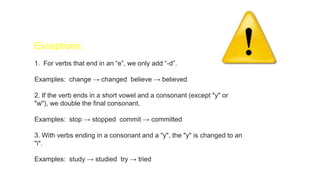
Exceptions:
1. For verbs that end in an “e”, we only add “-d”.
Examples: change → changed believe → believed
2. If the verb ends in a short vowel and a consonant (except "y" or
"w"), we double the final consonant.
Examples: stop → stopped commit → committed
3. With verbs ending in a consonant and a "y", the "y" is changed to an
"i".
Examples: study → studied try → tried
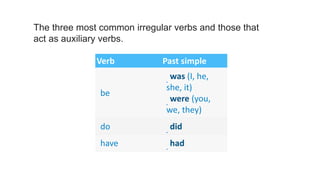
Verb Past simple
be
was (I, he,
she, it)
were (you,
we, they)
do did
have had
The three most common irregular verbs and those that
act as auxiliary verbs.
We pronounce the ending "-ed" differently depending on the letter that goes to
the end of the infinitive. In general the "e" is mute.
1. With the infinitives ending in "p", "f", "k" or "s" (deaf consonants, except "t") we
pronounce the ending "-ed" as a "t".
Examples: looked ; kissed
2. With the infinitives ending in "b", "g", "l", "m", "n", "v", "z" (sound consonants,
except "d") or a vowel, we pronounce only the D".
Examples: yelled; cleaned
3. With the infinitives ending in "d" or "t", we pronounce the "e" as an "i".
Examples: ended ; waited
Pronunciation
1. Affirmative Sentences
Subject + main verb
Examples: She was a doctor.
The keys were in the drawer.
I wanted to dance.
They learned English.
We believed him.
2. Negative Sentences
To be: Subject + "to be" + "not" ...
Examples: She wasn't a doctor.
The keys weren’t in the drawer.
All other verbs:
Subject + auxiliary verb (to do) +
“not” + main verb (in infinitive)
Examples: I didn’t want to dance.
They didn’t learn English.
We didn’t believe him.
I didn’t buy a blue car.
Structure
3. Interrogative Sentences
To be: "To be" + subject ...?
Examples: Was she a doctor?
Were the keys in the drawer?
All other verbs:
Auxiliary verb (to do) + subject + main verb (in infinitive)…?
Examples Did you want to dance?
Did they learn English?
Did you believe him?
Did you buy a blue car?
1. The simple past is used to talk about a concrete action that began and ended in the past. Generally, we
use it with adverbs of time like "last year", "yesterday", "last night" .
Examples:
Tom stayed at home last night. Kate worked last Saturday.
2. The simple past is used for a series of actions in the past.
Examples: I received the good news and immediately called my husband.
I studied for an hour in the morning, worked all afternoon and didn’t return home until 10 at night.
3. We also use it for repeated or habitual actions in the past.
Examples: We always traveled to Cancun for vacation when we were young.
I have walked 5 kilometers every day to work.
4. We use it for narratives or actions of long-term periods in the past, such as the past Spanish imperfect.
Examples: I worked for many years in a museum. She didn’t eat meat for years.
5. It is used to talk about generalities or facts of the past.
Examples: The Aztec lived in Mexico. I played the guitar when I was a child.
uses

Pasado simple soriand duben

  • 1.
    REPÚBLICA BOLIVARIANA DEVENEZUELA MINISTERIO DEL PODER POPULAR PARA LA EDUCACIÓN INSTITUTO UNIVERSITARIO POLITÉCNICO “SANTIAGO MARIÑO” Extensión- Porlamar SIMPLE PAST made by:soriand duben c.i:28.189.861 Escuela: 46
  • 2.
    There are manyways to talk about the past in English, but the simple past is the most common way. We use the past simple for complete actions in the past. In the past simple there are regular verbs and irregular verbs. Simple past
  • 3.
    Grammatical Rules To formthe past simple with regular verbs, we use the infinitive and add the ending "-ed". The form is the same for all people (I, you, he, she, it, we, they). want → wanted learn → learned stay → stayed walk → walked show → showed examples
  • 4.
    Exceptions: 1. For verbsthat end in an “e”, we only add “-d”. Examples: change → changed believe → believed 2. If the verb ends in a short vowel and a consonant (except "y" or "w"), we double the final consonant. Examples: stop → stopped commit → committed 3. With verbs ending in a consonant and a "y", the "y" is changed to an "i". Examples: study → studied try → tried
  • 5.
    Verb Past simple be was(I, he, she, it) were (you, we, they) do did have had The three most common irregular verbs and those that act as auxiliary verbs.
  • 6.
    We pronounce theending "-ed" differently depending on the letter that goes to the end of the infinitive. In general the "e" is mute. 1. With the infinitives ending in "p", "f", "k" or "s" (deaf consonants, except "t") we pronounce the ending "-ed" as a "t". Examples: looked ; kissed 2. With the infinitives ending in "b", "g", "l", "m", "n", "v", "z" (sound consonants, except "d") or a vowel, we pronounce only the D". Examples: yelled; cleaned 3. With the infinitives ending in "d" or "t", we pronounce the "e" as an "i". Examples: ended ; waited Pronunciation
  • 7.
    1. Affirmative Sentences Subject+ main verb Examples: She was a doctor. The keys were in the drawer. I wanted to dance. They learned English. We believed him. 2. Negative Sentences To be: Subject + "to be" + "not" ... Examples: She wasn't a doctor. The keys weren’t in the drawer. All other verbs: Subject + auxiliary verb (to do) + “not” + main verb (in infinitive) Examples: I didn’t want to dance. They didn’t learn English. We didn’t believe him. I didn’t buy a blue car. Structure
  • 8.
    3. Interrogative Sentences Tobe: "To be" + subject ...? Examples: Was she a doctor? Were the keys in the drawer? All other verbs: Auxiliary verb (to do) + subject + main verb (in infinitive)…? Examples Did you want to dance? Did they learn English? Did you believe him? Did you buy a blue car?
  • 9.
    1. The simplepast is used to talk about a concrete action that began and ended in the past. Generally, we use it with adverbs of time like "last year", "yesterday", "last night" . Examples: Tom stayed at home last night. Kate worked last Saturday. 2. The simple past is used for a series of actions in the past. Examples: I received the good news and immediately called my husband. I studied for an hour in the morning, worked all afternoon and didn’t return home until 10 at night. 3. We also use it for repeated or habitual actions in the past. Examples: We always traveled to Cancun for vacation when we were young. I have walked 5 kilometers every day to work. 4. We use it for narratives or actions of long-term periods in the past, such as the past Spanish imperfect. Examples: I worked for many years in a museum. She didn’t eat meat for years. 5. It is used to talk about generalities or facts of the past. Examples: The Aztec lived in Mexico. I played the guitar when I was a child. uses