
UNIVERSIDAD CENTRAL DEL
       ECUADOR
 FACULTAD DE FILOSOFIA
 LETRA Y CIENCIAS DE LA
      EDUCACION
            ESCUELA DE
              IDIOMAS

            BELEN IMBA
NOW WE ARE GOING TO
LEARN A NEW TOPIC OF ENGLISH

         LET S GO!!
   The simple present tense is one of the
    most common tenses in English.

   This slides will explain the rules for
    forming the tense with regular verbs.
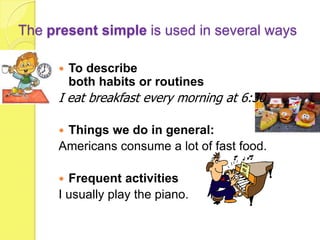
The present simple is used in several ways

         To describe
          both habits or routines
      I eat breakfast every morning at 6:30

      Things we do in general:
      Americans consume a lot of fast food.

       Frequent activities
      I usually play the piano.
Forming the simple present tense
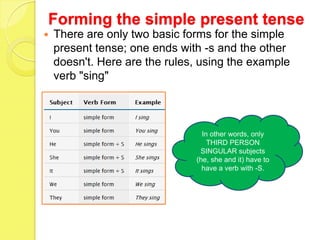
   There are only two basic forms for the simple
    present tense; one ends with -s and the other
    doesn't. Here are the rules, using the example
    verb "sing"


                                 In other words, only
                                   THIRD PERSON
                                SINGULAR subjects
                               (he, she and it) have to
                                 have a verb with -S.
-s or -es ?
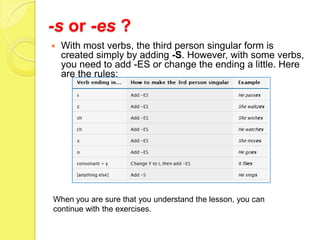
   With most verbs, the third person singular form is
    created simply by adding -S. However, with some verbs,
    you need to add -ES or change the ending a little. Here
    are the rules:


When you are sure that you understand the lesson, you can
continue with the exercises.
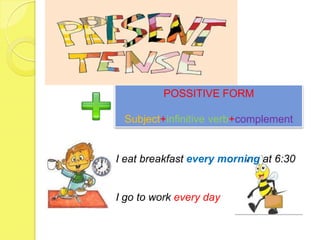
POSSITIVE FORM

 Subject+infinitive verb+complement


I eat breakfast every morning at 6:30


I go to work every day
Negative form
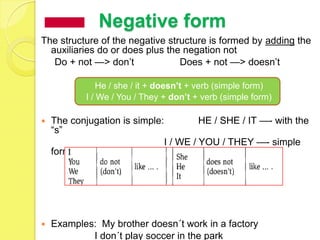
The structure of the negative structure is formed by adding the
  auxiliaries do or does plus the negation not
   Do + not —> don’t             Does + not —> doesn’t

                He / she / it + doesn’t + verb (simple form)
            I / We / You / They + don’t + verb (simple form)

   The conjugation is simple:           HE / SHE / IT —- with the
    ―s‖
                                 I / WE / YOU / THEY —- simple
    form


   Examples: My brother doesn´t work in a factory
            I don´t play soccer in the park
Question
   form
    The question structure is formed by following the following
    structure
[Do / Does + SUBJECT + Verb (simple form)] + Complement

We use the auxiliaries do and does in the question form and they have to
agree with the subject

The conjugation is the following:     Does —–> he/she/it
                                    Do —-> I/we/you/they

The verb ALWAYS stays in the simple form (not with the ―s‖ form)
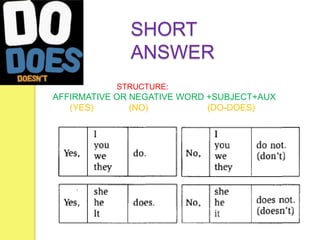
SHORT
              ANSWER
           STRUCTURE:
AFFIRMATIVE OR NEGATIVE WORD +SUBJECT+AUX
   (YES)       (NO)          (DO-DOES)
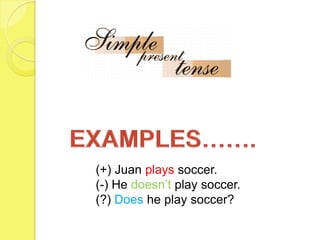
(+) Juan plays soccer.
(-) He doesn’t play soccer.
(?) Does he play soccer?
I GET UP EARLY   HE TAKES A SHOWER   JOHN TAKES
BREAKFAST
SHE DO THE   WE PLAY IN
THEY GO TO
             HOMEWORKS    THE PARK
 SCHOOL
BELEN IMBA
    UCE

ESCUELA DE IDIOMAS BELEN IMBA Simple present

  • 1.
    UNIVERSIDAD CENTRAL DEL ECUADOR FACULTAD DE FILOSOFIA LETRA Y CIENCIAS DE LA EDUCACION ESCUELA DE IDIOMAS BELEN IMBA
  • 2.
    NOW WE AREGOING TO LEARN A NEW TOPIC OF ENGLISH LET S GO!!
  • 3.
    The simple present tense is one of the most common tenses in English.  This slides will explain the rules for forming the tense with regular verbs.
  • 4.
    The present simpleis used in several ways  To describe both habits or routines I eat breakfast every morning at 6:30 Things we do in general: Americans consume a lot of fast food.  Frequent activities I usually play the piano.
  • 5.
    Forming the simplepresent tense  There are only two basic forms for the simple present tense; one ends with -s and the other doesn't. Here are the rules, using the example verb "sing" In other words, only THIRD PERSON SINGULAR subjects (he, she and it) have to have a verb with -S.
  • 6.
    -s or -es?  With most verbs, the third person singular form is created simply by adding -S. However, with some verbs, you need to add -ES or change the ending a little. Here are the rules: When you are sure that you understand the lesson, you can continue with the exercises.
  • 7.
    POSSITIVE FORM Subject+infinitiveverb+complement I eat breakfast every morning at 6:30 I go to work every day
  • 8.
    Negative form The structureof the negative structure is formed by adding the auxiliaries do or does plus the negation not Do + not —> don’t Does + not —> doesn’t He / she / it + doesn’t + verb (simple form) I / We / You / They + don’t + verb (simple form)  The conjugation is simple: HE / SHE / IT —- with the ―s‖ I / WE / YOU / THEY —- simple form  Examples: My brother doesn´t work in a factory I don´t play soccer in the park
  • 9.
    Question  form The question structure is formed by following the following structure [Do / Does + SUBJECT + Verb (simple form)] + Complement We use the auxiliaries do and does in the question form and they have to agree with the subject The conjugation is the following: Does —–> he/she/it Do —-> I/we/you/they The verb ALWAYS stays in the simple form (not with the ―s‖ form)
  • 10.
    SHORT ANSWER STRUCTURE: AFFIRMATIVE OR NEGATIVE WORD +SUBJECT+AUX (YES) (NO) (DO-DOES)
  • 11.
    (+) Juan playssoccer. (-) He doesn’t play soccer. (?) Does he play soccer?
  • 12.
    I GET UPEARLY HE TAKES A SHOWER JOHN TAKES BREAKFAST
  • 13.
    SHE DO THE WE PLAY IN THEY GO TO HOMEWORKS THE PARK SCHOOL
  • 14.