

ELC 120
What is Simple Past Tense?
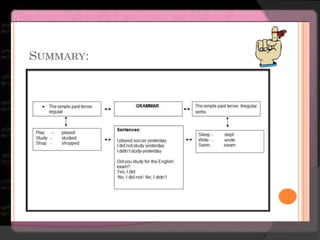
 An action that occurred in the past and
which does not extend into the present.
 The simple past tense also known as
the past simple and not accompanied by
helping verb.
The PAST TENSE indicates that an action is
in the past relative to the speaker or writer.
 when the time period has finished:
"We went to Chicago last Christmas.“
 when the time period is definite:
"We visited Mom last week."
 with for, when the action is finished:
"I worked with the FBI for two months."
How do we form the simple
past tense?
 There are two types of verbs in the
past:
-regular
-irregular
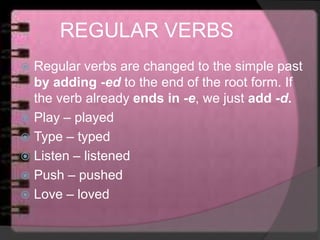
REGULAR VERBS
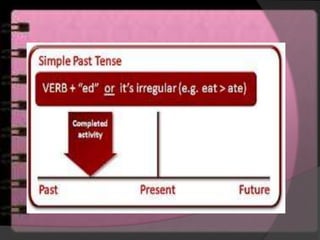
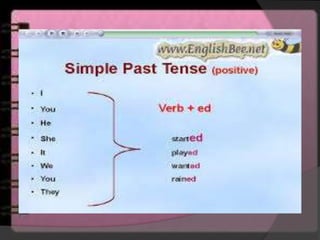
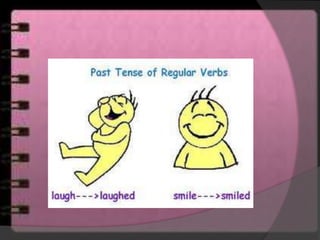
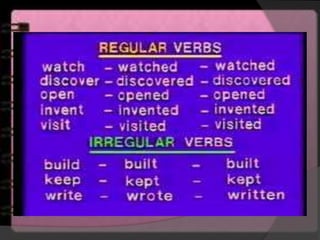
 Regular verbs are changed to the simple past
by adding -ed to the end of the root form. If
the verb already ends in -e, we just add -d.
 Play – played
 Type – typed
 Listen – listened
 Push – pushed
 Love – loved
IRREGULAR VERBS
 Irregular verbs are verbs that don’t end
in –ed.
 Sometimes with irregular past tense
verbs you have to change the vowel to
make the verb past tense
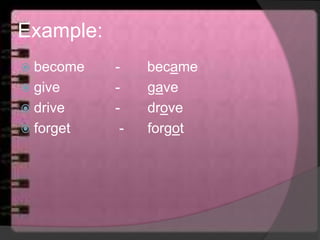
Example:
 become - became
 give - gave
 drive - drove
 forget - forgot
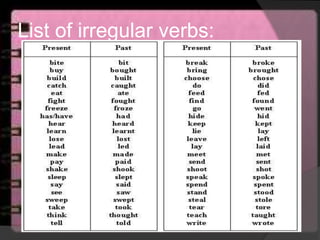
List of irregular verbs:
USES IN SIMPLE
PAST TENSE
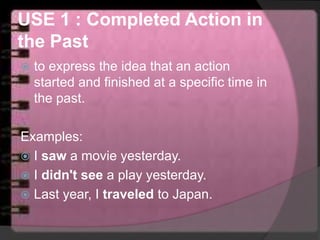
USE 1 : Completed Action in
the Past
 to express the idea that an action
started and finished at a specific time in
the past.
Examples:
 I saw a movie yesterday.
 I didn't see a play yesterday.
 Last year, I traveled to Japan.
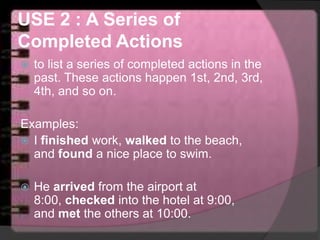
USE 2 : A Series of
Completed Actions
 to list a series of completed actions in the
past. These actions happen 1st, 2nd, 3rd,
4th, and so on.
Examples:
 I finished work, walked to the beach,
and found a nice place to swim.
 He arrived from the airport at
8:00, checked into the hotel at 9:00,
and met the others at 10:00.
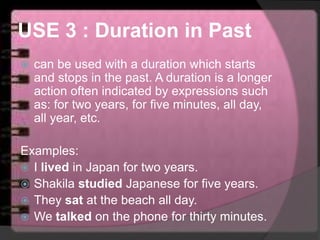
USE 3 : Duration in Past
 can be used with a duration which starts
and stops in the past. A duration is a longer
action often indicated by expressions such
as: for two years, for five minutes, all day,
all year, etc.
Examples:
 I lived in Japan for two years.
 Shakila studied Japanese for five years.
 They sat at the beach all day.
 We talked on the phone for thirty minutes.
USE 4 : Habits in the Past
 to describe a habit which stopped in the past.
It can have the same meaning as "used to." To
make it clear that we are talking about a habit,
we often add expressions such as: always,
often, usually, never, when I was a child, when
I was younger, etc.
Examples:
 I studied French when I was a child.
 He didn't play the piano.
 Did you play a musical instrument when you
were a kid?
USE 5 : Past Facts or
Generalizations
 The Simple Past can also be used to describe
past facts or generalizations which are no
longer true. As in USE 4 above, this use of the
Simple Past is quite similar to the expression
"used to."
Examples:
 She was shy as a child, but now she is very
outgoing.
 He didn't like tomatoes before.
 Did you live in Texas when you were a kid?
 People paid much more to make cell phone
calls in the past.
IMPORTANT !!
When Clauses Happen First ;
 Clauses are groups of words which have meaning
but are often not complete sentences. Some
clauses begin with the word "when" such as "when
I dropped my pen..." or "when class began..."
These clauses are called when-clauses, and they
are very important. The examples below contain
when-clauses.
Examples:
 When I paid her one dollar, she answered my
question.
 She answered my question when I paid her one
dollar.
 I paid her one dollar when she answered my
question.
ADVERB PLACEMENT
The examples below show the placement
for grammar adverbs such as: always,
only, never, ever, still, just, etc.
Examples:
 You just called Debbie.
 Did you just call Debbie?
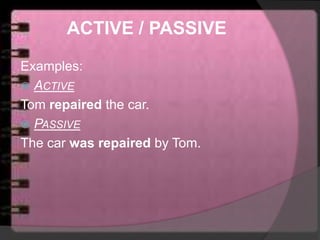
ACTIVE / PASSIVE
Examples:
 ACTIVE
Tom repaired the car.
 PASSIVE
The car was repaired by Tom.
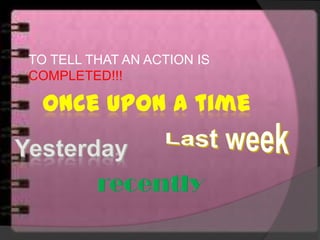
Why do we use
past tense verbs?
TO TELL THAT AN ACTION IS
COMPLETED!!!
Once upon a time
EXERCISE…
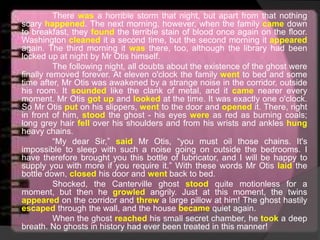
There was a horrible storm that night, but apart from that nothing
scary happened. The next morning, however, when the family came down
to breakfast, they found the terrible stain of blood once again on the floor.
Washington cleaned it a second time, but the second morning it appeared
again. The third morning it was there, too, although the library had been
locked up at night by Mr Otis himself.
The following night, all doubts about the existence of the ghost
were finally removed forever. At eleven o'clock the family went to bed and
some time after, Mr Otis was awakened by a strange noise in the corridor,
outside his room. It sounded like the clank of metal, and it came nearer
every moment. Mr Otis got up and looked at the time. It was exactly one
o'clock. So Mr Otis put on his slippers, went to the door and opened it.
There, right in front of him, stood the ghost - his eyes were as red as
burning coals; long grey hair fell over his shoulders and from his wrists and
ankles hung heavy chains.
“My dear Sir,” said Mr Otis, “you must oil those chains. It's
impossible to sleep with such a noise going on outside the bedrooms. I
have therefore brought you this bottle of lubricator, and I will be happy to
supply you with more if you require it.” With these words Mr Otis laid the
bottle down, closed his door and went back to bed.
Shocked, the Canterville ghost stood quite motionless for a
moment, but then he growled angrily. Just at this moment, the twins
appeared on the corridor and threw a large pillow at him! The ghost hastily
escaped through the wall, and the house became quiet again.
When the ghost reached his small secret chamber, he took a deep
breath. No ghosts in history had ever been treated in this manner!
There was a horrible storm that night, but apart from that nothing
scary happened. The next morning, however, when the family came down
to breakfast, they found the terrible stain of blood once again on the floor.
Washington cleaned it a second time, but the second morning it appeared
again. The third morning it was there, too, although the library had been
locked up at night by Mr Otis himself.
The following night, all doubts about the existence of the ghost were
finally removed forever. At eleven o'clock the family went to bed and some
time after, Mr Otis was awakened by a strange noise in the corridor, outside
his room. It sounded like the clank of metal, and it came nearer every
moment. Mr Otis got up and looked at the time. It was exactly one o'clock.
So Mr Otis put on his slippers, went to the door and opened it. There, right
in front of him, stood the ghost - his eyes were as red as burning coals;
long grey hair fell over his shoulders and from his wrists and ankles hung
heavy chains.
“My dear Sir,” said Mr Otis, “you must oil those chains. It's
impossible to sleep with such a noise going on outside the bedrooms. I
have therefore brought you this bottle of lubricator, and I will be happy to
supply you with more if you require it.” With these words Mr Otis laid the
bottle down, closed his door and went back to bed.
Shocked, the Canterville ghost stood quite motionless for a
moment, but then he growled angrily. Just at this moment, the twins
appeared on the corridor and threw a large pillow at him! The ghost hastily
escaped through the wall, and the house became quiet again.
When the ghost reached his small secret chamber, he took a deep
breath. No ghosts in history had ever been treated in this manner!
Simple past tense

Simple past tense

  • 1.
  • 2.
    What is SimplePast Tense?  An action that occurred in the past and which does not extend into the present.  The simple past tense also known as the past simple and not accompanied by helping verb.
  • 5.
    The PAST TENSEindicates that an action is in the past relative to the speaker or writer.  when the time period has finished: "We went to Chicago last Christmas.“  when the time period is definite: "We visited Mom last week."  with for, when the action is finished: "I worked with the FBI for two months."
  • 6.
    How do weform the simple past tense?  There are two types of verbs in the past: -regular -irregular
  • 7.
    REGULAR VERBS  Regularverbs are changed to the simple past by adding -ed to the end of the root form. If the verb already ends in -e, we just add -d.  Play – played  Type – typed  Listen – listened  Push – pushed  Love – loved
  • 9.
    IRREGULAR VERBS  Irregularverbs are verbs that don’t end in –ed.  Sometimes with irregular past tense verbs you have to change the vowel to make the verb past tense
  • 10.
    Example:  become -became  give - gave  drive - drove  forget - forgot
  • 11.
  • 14.
  • 15.
    USE 1 :Completed Action in the Past  to express the idea that an action started and finished at a specific time in the past. Examples:  I saw a movie yesterday.  I didn't see a play yesterday.  Last year, I traveled to Japan.
  • 16.
    USE 2 :A Series of Completed Actions  to list a series of completed actions in the past. These actions happen 1st, 2nd, 3rd, 4th, and so on. Examples:  I finished work, walked to the beach, and found a nice place to swim.  He arrived from the airport at 8:00, checked into the hotel at 9:00, and met the others at 10:00.
  • 17.
    USE 3 :Duration in Past  can be used with a duration which starts and stops in the past. A duration is a longer action often indicated by expressions such as: for two years, for five minutes, all day, all year, etc. Examples:  I lived in Japan for two years.  Shakila studied Japanese for five years.  They sat at the beach all day.  We talked on the phone for thirty minutes.
  • 18.
    USE 4 :Habits in the Past  to describe a habit which stopped in the past. It can have the same meaning as "used to." To make it clear that we are talking about a habit, we often add expressions such as: always, often, usually, never, when I was a child, when I was younger, etc. Examples:  I studied French when I was a child.  He didn't play the piano.  Did you play a musical instrument when you were a kid?
  • 19.
    USE 5 :Past Facts or Generalizations  The Simple Past can also be used to describe past facts or generalizations which are no longer true. As in USE 4 above, this use of the Simple Past is quite similar to the expression "used to." Examples:  She was shy as a child, but now she is very outgoing.  He didn't like tomatoes before.  Did you live in Texas when you were a kid?  People paid much more to make cell phone calls in the past.
  • 20.
    IMPORTANT !! When ClausesHappen First ;  Clauses are groups of words which have meaning but are often not complete sentences. Some clauses begin with the word "when" such as "when I dropped my pen..." or "when class began..." These clauses are called when-clauses, and they are very important. The examples below contain when-clauses. Examples:  When I paid her one dollar, she answered my question.  She answered my question when I paid her one dollar.  I paid her one dollar when she answered my question.
  • 21.
    ADVERB PLACEMENT The examplesbelow show the placement for grammar adverbs such as: always, only, never, ever, still, just, etc. Examples:  You just called Debbie.  Did you just call Debbie?
  • 22.
    ACTIVE / PASSIVE Examples: ACTIVE Tom repaired the car.  PASSIVE The car was repaired by Tom.
  • 23.
    Why do weuse past tense verbs?
  • 24.
    TO TELL THATAN ACTION IS COMPLETED!!! Once upon a time
  • 25.
  • 26.
    There was ahorrible storm that night, but apart from that nothing scary happened. The next morning, however, when the family came down to breakfast, they found the terrible stain of blood once again on the floor. Washington cleaned it a second time, but the second morning it appeared again. The third morning it was there, too, although the library had been locked up at night by Mr Otis himself. The following night, all doubts about the existence of the ghost were finally removed forever. At eleven o'clock the family went to bed and some time after, Mr Otis was awakened by a strange noise in the corridor, outside his room. It sounded like the clank of metal, and it came nearer every moment. Mr Otis got up and looked at the time. It was exactly one o'clock. So Mr Otis put on his slippers, went to the door and opened it. There, right in front of him, stood the ghost - his eyes were as red as burning coals; long grey hair fell over his shoulders and from his wrists and ankles hung heavy chains. “My dear Sir,” said Mr Otis, “you must oil those chains. It's impossible to sleep with such a noise going on outside the bedrooms. I have therefore brought you this bottle of lubricator, and I will be happy to supply you with more if you require it.” With these words Mr Otis laid the bottle down, closed his door and went back to bed. Shocked, the Canterville ghost stood quite motionless for a moment, but then he growled angrily. Just at this moment, the twins appeared on the corridor and threw a large pillow at him! The ghost hastily escaped through the wall, and the house became quiet again. When the ghost reached his small secret chamber, he took a deep breath. No ghosts in history had ever been treated in this manner!
  • 27.
    There was ahorrible storm that night, but apart from that nothing scary happened. The next morning, however, when the family came down to breakfast, they found the terrible stain of blood once again on the floor. Washington cleaned it a second time, but the second morning it appeared again. The third morning it was there, too, although the library had been locked up at night by Mr Otis himself. The following night, all doubts about the existence of the ghost were finally removed forever. At eleven o'clock the family went to bed and some time after, Mr Otis was awakened by a strange noise in the corridor, outside his room. It sounded like the clank of metal, and it came nearer every moment. Mr Otis got up and looked at the time. It was exactly one o'clock. So Mr Otis put on his slippers, went to the door and opened it. There, right in front of him, stood the ghost - his eyes were as red as burning coals; long grey hair fell over his shoulders and from his wrists and ankles hung heavy chains. “My dear Sir,” said Mr Otis, “you must oil those chains. It's impossible to sleep with such a noise going on outside the bedrooms. I have therefore brought you this bottle of lubricator, and I will be happy to supply you with more if you require it.” With these words Mr Otis laid the bottle down, closed his door and went back to bed. Shocked, the Canterville ghost stood quite motionless for a moment, but then he growled angrily. Just at this moment, the twins appeared on the corridor and threw a large pillow at him! The ghost hastily escaped through the wall, and the house became quiet again. When the ghost reached his small secret chamber, he took a deep breath. No ghosts in history had ever been treated in this manner!