



Things You Need
Things you need to know before
formulating passive sentences
• What is voice in grammar?
• What is an Agent in English Grammar?
• Subject And Agent
• What is patient in grammar?
• What is active voice in grammar?
• What is passive voice in grammar?
• When To Use Passive Voice?
• Sentences which cannot be changed into passive voice.
• Check, Whether a sentence is active or passive.
• Rules for changing Voice.
What is voice in grammar?
• Voice is the term used to describe whether
a verb is active or passive.
• In a passive sentence, the verb is said to be in
the passive voice. Similarly, the verb in
an active sentence is said to be in the active
voice. 
• The voice of a verb tells us whether
the subject of the verb is acted upon or is
acting.
What is an Agent in English Grammar?
• In English grammar, the agent is the noun
phrase or pronoun that identifies the person or
thing which performs an action in a sentence.
• In active voice sentence, the agent is usually
the subject .
• Omar selected the winners.
• In passive voice sentence, the agent if identified
at all is usually the object of the preposition by.
• The winners were selected by Omar.
Subject and Agents
• Sentences in which the grammatical subject is
not the agent are common. 
• in the following examples the subjects are not
agents because the verbs do not describe an
action: 
• My son has a very good memory for songs.
• This lecture was a bit special.
• It belongs to her mum and dad."
What is patient in grammar?
• In grammar, the person or thing that is affected or
acted upon by the action expressed by a verb. OR
• The person or thing that receives an action in a
sentence is called the recipient or patient (roughly
equivalent to the traditional concept of object).  
• Often in English (but not always), the patient fills
the role of direct object in a clause in the active
voice.
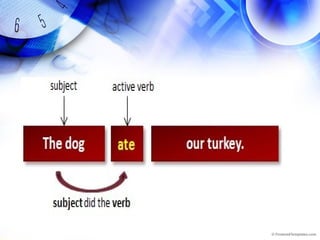
What Is the Active Voice?
• When the subject is the agent or doer of the action,
the verb is in the active voice.
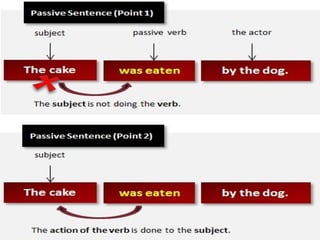
What Is the Passive Voice?
• When the subject is the patient, target or undergoer
of the action, the verb is said to be in the passive
voice.
When To Use Passive Voice?
• When the doer of the action is general or obvious or
understood
• Cookies are backed here.
• Nuts are grown in Iran.
• English and German are spoken in many
countries.
• Every year thousands of people are killed on
our roads.
When To Use Passive Voice?
• When the doer of the action is unknown
• My car has been stolen.
• He was kidnapped yesterday.
• The cave paintings of Lascaux were made in the
Upper Old Stone Age.
When To Use Passive Voice?
• When You are talking about a general truth:
• Rules are made to be broken.
• Mistakes are made by humen.
When To Use Passive Voice?
• When you don't want to reveal who was
responsible 
• The document had been released into the
public domain.
(passive sentence – no blame)
• Look at the active version:Jackie released the
document into the public domain.
(Jaaaaackiiieeeeeeeeeeeeee!)
When To Use Passive Voice?
• When official statements are given:
• It was reported today that the federal funds
have been allocated for the power plant.
When To Use Passive Voice?
• Passive voice is used when the focus is on the
action. It is not important or not known,
however, who or what is performing the
action.
• The house was built in 1654.
• The road is being repaired.
• we are interested in the house and road, not in
the people who are doing these actions.
Sentences which cannot be changed into
passive voice
• Future Continuous tense
• Perfect Continuous tense(all).
• Sentences, having intransitive verb, cannot
be changed into passive.
• Sentences, having no action verbs.
Transitive and Intransitive Verbs
• Transitive verbs are verbs that have subjects or
objects that receive the action. They are
either active voice or passive voice.
• The boy kicked the ball. 
• The ball was kicked by the boy.
• A verb that does not need a direct object to complete its
meaning. 
• Run, sleep, laugh, walk, sit travel, wonder, and die. etc
Passive voice should not be
confused with verb tense.
• Verb tense is action + time. What happened and
when.
• Passive/active voice is the subject in relation to
the action. Is the subject the doer or the
recipient of the action
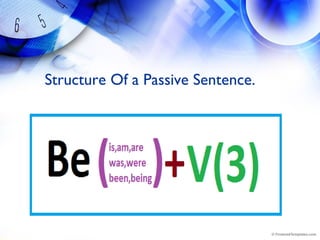
Structure Of a Passive Sentence.
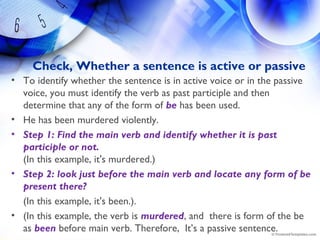
Check, Whether a sentence is active or passive
• To identify whether the sentence is in active voice or in the passive
voice, you must identify the verb as past participle and then
determine that any of the form of be has been used.
• He has been murdered violently.
• Step 1: Find the main verb and identify whether it is past
participle or not.
(In this example, it's murdered.)
• Step 2: look just before the main verb and locate any form of be
present there? 
(In this example, it's been.).
• (In this example, the verb is murdered, and  there is form of the be
as been before main verb. Therefore,  It’s a passive sentence.
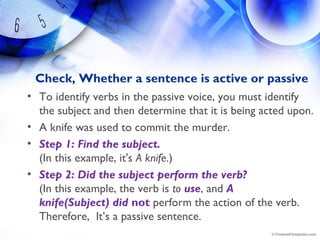
Check, Whether a sentence is active or passive
• To identify verbs in the passive voice, you must identify
the subject and then determine that it is being acted upon.
• A knife was used to commit the murder.
• Step 1: Find the subject.
(In this example, it's A knife.)
• Step 2: Did the subject perform the verb? 
(In this example, the verb is to use, and A
knife(Subject) did not perform the action of the verb.
Therefore,  It’s a passive sentence.
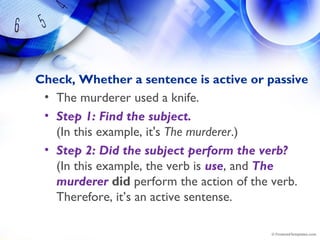
Check, Whether a sentence is active or passive
• The murderer used a knife.
• Step 1: Find the subject.
(In this example, it's The murderer.)
• Step 2: Did the subject perform the verb? 
(In this example, the verb is use, and The
murderer did perform the action of the verb.
Therefore, it’s an active sentense.
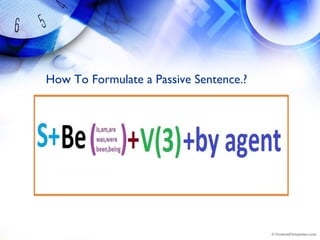
How To Formulate a Passive Sentence.?
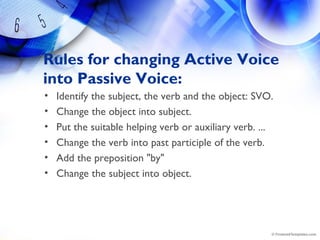
Rules for changing Active Voice
into Passive Voice:
• Identify the subject, the verb and the object: SVO.
• Change the object into subject.
• Put the suitable helping verb or auxiliary verb. ...
• Change the verb into past participle of the verb.
• Add the preposition "by"
• Change the subject into object.
BY, The Preposition
• Is it necessary to use by-agnet in every passive
sentence?
• ……
Sentences with two objects
• If a sentence contains two objects namely Indirect
Object and Direct Object in the Active Voice, two forms
of Passive Voice can be formed except some cases.
• The teacher teaches us grammar. (AV)
We are taught grammar by the teacher. (PV) (or)
Grammar is taught [to] us by the teacher. (PV)
• Exception:
• They made him king. (AV)
He was made king by them. (PV)
• king was made to him by them.(wrong)
Passive voice

Passive voice

  • 2.
  • 3.
    Things you needto know before formulating passive sentences • What is voice in grammar? • What is an Agent in English Grammar? • Subject And Agent • What is patient in grammar? • What is active voice in grammar? • What is passive voice in grammar? • When To Use Passive Voice? • Sentences which cannot be changed into passive voice. • Check, Whether a sentence is active or passive. • Rules for changing Voice.
  • 4.
    What is voicein grammar? • Voice is the term used to describe whether a verb is active or passive. • In a passive sentence, the verb is said to be in the passive voice. Similarly, the verb in an active sentence is said to be in the active voice.  • The voice of a verb tells us whether the subject of the verb is acted upon or is acting.
  • 5.
    What is anAgent in English Grammar? • In English grammar, the agent is the noun phrase or pronoun that identifies the person or thing which performs an action in a sentence. • In active voice sentence, the agent is usually the subject . • Omar selected the winners. • In passive voice sentence, the agent if identified at all is usually the object of the preposition by. • The winners were selected by Omar.
  • 6.
    Subject and Agents •Sentences in which the grammatical subject is not the agent are common.  • in the following examples the subjects are not agents because the verbs do not describe an action:  • My son has a very good memory for songs. • This lecture was a bit special. • It belongs to her mum and dad."
  • 7.
    What is patientin grammar? • In grammar, the person or thing that is affected or acted upon by the action expressed by a verb. OR • The person or thing that receives an action in a sentence is called the recipient or patient (roughly equivalent to the traditional concept of object).   • Often in English (but not always), the patient fills the role of direct object in a clause in the active voice.
  • 8.
    What Is theActive Voice? • When the subject is the agent or doer of the action, the verb is in the active voice.
  • 10.
    What Is thePassive Voice? • When the subject is the patient, target or undergoer of the action, the verb is said to be in the passive voice.
  • 12.
    When To UsePassive Voice? • When the doer of the action is general or obvious or understood • Cookies are backed here. • Nuts are grown in Iran. • English and German are spoken in many countries. • Every year thousands of people are killed on our roads.
  • 13.
    When To UsePassive Voice? • When the doer of the action is unknown • My car has been stolen. • He was kidnapped yesterday. • The cave paintings of Lascaux were made in the Upper Old Stone Age.
  • 14.
    When To UsePassive Voice? • When You are talking about a general truth: • Rules are made to be broken. • Mistakes are made by humen.
  • 15.
    When To UsePassive Voice? • When you don't want to reveal who was responsible  • The document had been released into the public domain. (passive sentence – no blame) • Look at the active version:Jackie released the document into the public domain. (Jaaaaackiiieeeeeeeeeeeeee!)
  • 16.
    When To UsePassive Voice? • When official statements are given: • It was reported today that the federal funds have been allocated for the power plant.
  • 17.
    When To UsePassive Voice? • Passive voice is used when the focus is on the action. It is not important or not known, however, who or what is performing the action. • The house was built in 1654. • The road is being repaired. • we are interested in the house and road, not in the people who are doing these actions.
  • 18.
    Sentences which cannotbe changed into passive voice • Future Continuous tense • Perfect Continuous tense(all). • Sentences, having intransitive verb, cannot be changed into passive. • Sentences, having no action verbs.
  • 19.
    Transitive and IntransitiveVerbs • Transitive verbs are verbs that have subjects or objects that receive the action. They are either active voice or passive voice. • The boy kicked the ball.  • The ball was kicked by the boy. • A verb that does not need a direct object to complete its meaning.  • Run, sleep, laugh, walk, sit travel, wonder, and die. etc
  • 20.
    Passive voice shouldnot be confused with verb tense. • Verb tense is action + time. What happened and when. • Passive/active voice is the subject in relation to the action. Is the subject the doer or the recipient of the action
  • 21.
    Structure Of aPassive Sentence.
  • 22.
    Check, Whether asentence is active or passive • To identify whether the sentence is in active voice or in the passive voice, you must identify the verb as past participle and then determine that any of the form of be has been used. • He has been murdered violently. • Step 1: Find the main verb and identify whether it is past participle or not. (In this example, it's murdered.) • Step 2: look just before the main verb and locate any form of be present there?  (In this example, it's been.). • (In this example, the verb is murdered, and  there is form of the be as been before main verb. Therefore,  It’s a passive sentence.
  • 23.
    Check, Whether asentence is active or passive • To identify verbs in the passive voice, you must identify the subject and then determine that it is being acted upon. • A knife was used to commit the murder. • Step 1: Find the subject. (In this example, it's A knife.) • Step 2: Did the subject perform the verb?  (In this example, the verb is to use, and A knife(Subject) did not perform the action of the verb. Therefore,  It’s a passive sentence.
  • 24.
    Check, Whether asentence is active or passive • The murderer used a knife. • Step 1: Find the subject. (In this example, it's The murderer.) • Step 2: Did the subject perform the verb?  (In this example, the verb is use, and The murderer did perform the action of the verb. Therefore, it’s an active sentense.
  • 25.
    How To Formulatea Passive Sentence.?
  • 26.
    Rules for changingActive Voice into Passive Voice: • Identify the subject, the verb and the object: SVO. • Change the object into subject. • Put the suitable helping verb or auxiliary verb. ... • Change the verb into past participle of the verb. • Add the preposition "by" • Change the subject into object.
  • 27.
    BY, The Preposition •Is it necessary to use by-agnet in every passive sentence? • ……
  • 28.
    Sentences with twoobjects • If a sentence contains two objects namely Indirect Object and Direct Object in the Active Voice, two forms of Passive Voice can be formed except some cases. • The teacher teaches us grammar. (AV) We are taught grammar by the teacher. (PV) (or) Grammar is taught [to] us by the teacher. (PV) • Exception: • They made him king. (AV) He was made king by them. (PV) • king was made to him by them.(wrong)