CHANGING PASSIVE
VOICE TO ACTIVE
VOICE
By: Christine Joy D. Baloncio BSED-1
VOICE- Voice is the quality of a verb which
indicates whether the subject acts or is being acted
upon.
Two types of Voice:
1. ACTIVE VOICE
- tells us what a person or thing does.
- the subject performs the action (verb) on the object.
Sentence structure: Subject (doer) + verb + object
Examples: Anna painted the house.
Subject verb object
2. PASSIVE VOICE
- tells us what is done to someone or something.
- The subject is being acted upon. It receives the action
of the verb.
- Often passive voice sentences will contain a
preposition ‘by’. A by-phrase indicates the doer of the action.
Sentence structure: subject (object slot in the active voice) +
auxiliary verb (be) + main verb (past participle) + optional
prepositional phrase (subject slot in the active voice)
Examples: The house was painted by Anna.
subject auxiliary verb main verb prepositional
phrase
(past participle)
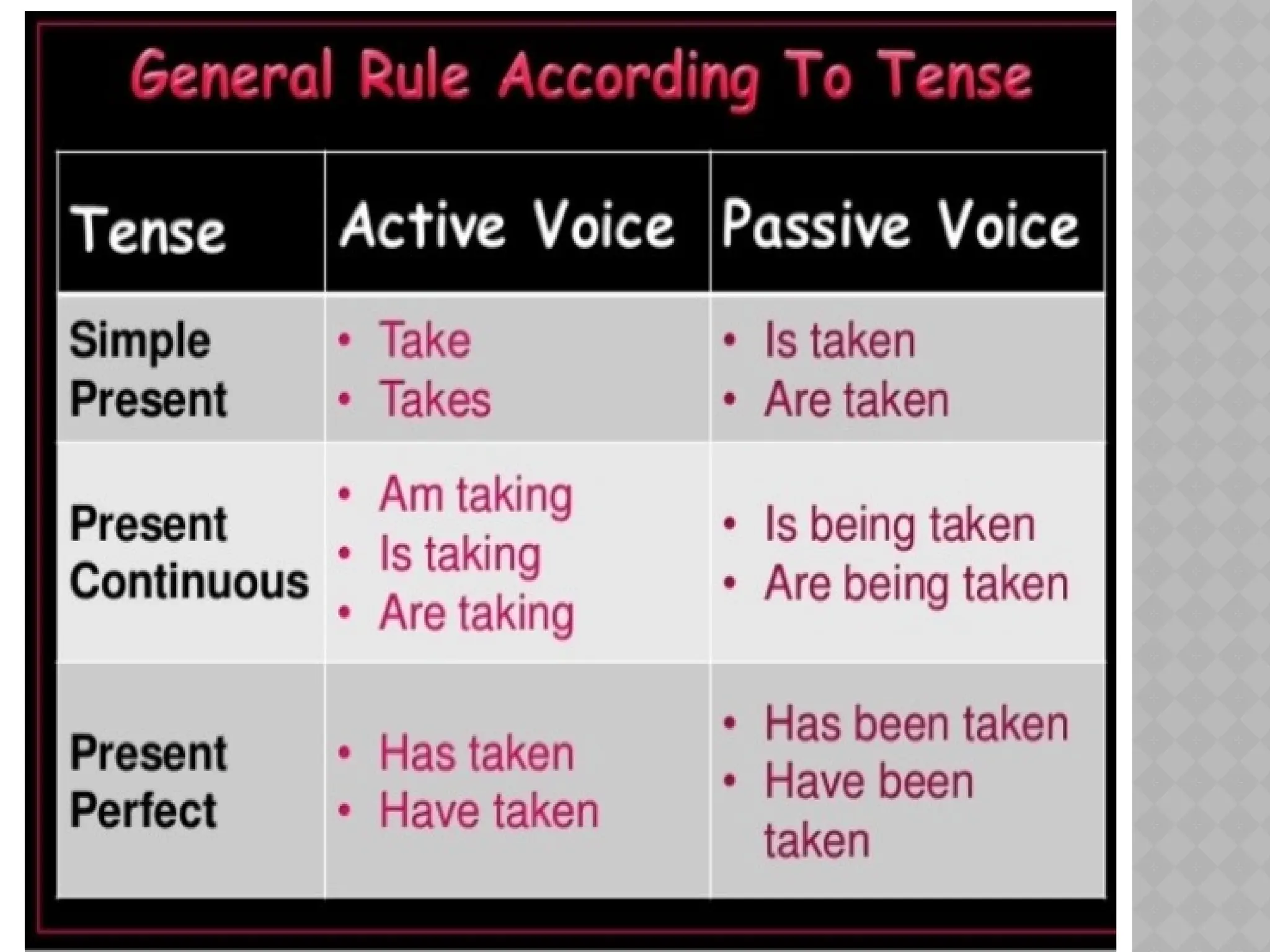
Passive- voice verbs are always preceded by the auxiliary verb be and are in
their past participle forms. While the receiver of the action comes before the
verb, the person or thing performing the action (known as agent) comes after
the verb and is preceded by the preposition by to form a prepositional phrase.
CHANGING SENTENCE FROM THE PASSIVE
VOICE TO THE ACTIVE VOICE.
You may only convert a sentence from the passive
voice into the active voice if there is an identifiable agent
or the performer of the verb. In the active voice, this agent
becomes the subject.
Step 1: Determine the verb and the performer of the
action.
Example:
Passive voice: This blanket was knitted by my grandmother.
verb
agent/performer of the
action.
2. Make the performer of the action be the subject of the
sentence in the active voice.
Passive voice: This blanket was knitted by my grandmother.
Active voice: My grandmother
3. Make the subject of the sentence the direct object in
the active voice.
Passive voice: This blanket was knitted by my grandmother.
subject (receives the action)
Active voice: My grandmother………..this blanket
direct object (receives the action
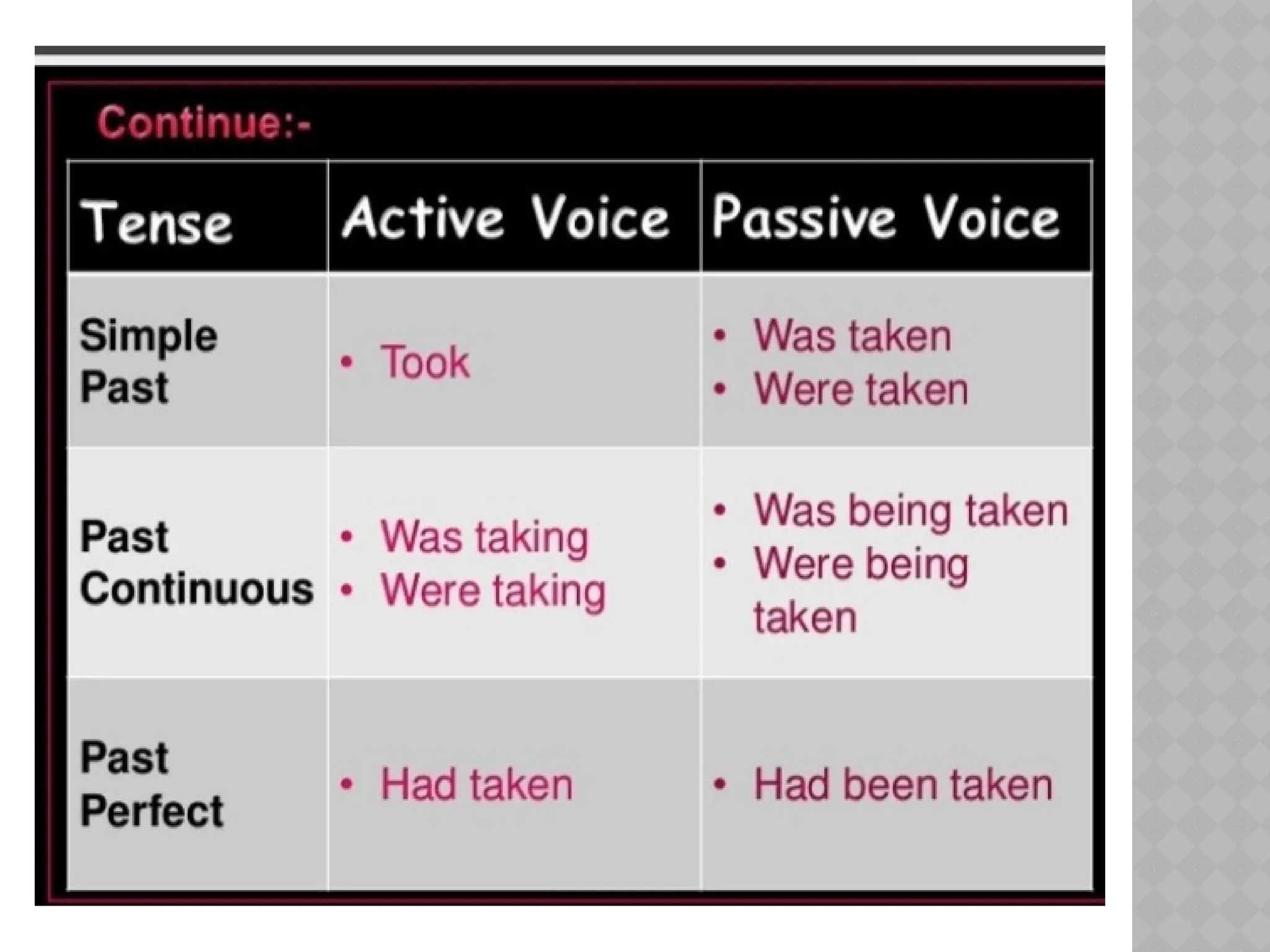
4. Change the tense form of the verb. Consider the tense
indicted in the be-verb.
Passive voice: This blanket was knitted by my grandmother.
Active voice: My grandmother knitted this blanket.
MORE EXAMPLES:
1.Passive voice: The kittens were adopted by my
neighbors.
Active Voice: My neighbors adopted the kittens.
2. Passive Voice: The deer was being chased by a
bear.
Active Voice: A bear was chasing the deer.
3. Passive Voice: Myths and legends are retold by
storytellers all over the world.
Active Voice: Storytellers all over the world retell
myths and legends.
4. Passive Voice: A creature’s feature is
changed by some writers.
Active Voice: Some writers change a
creature’s feature.
5. Passive Voice: Stories will be printed by
schools soon.
Active Voice: Schools will print stories soon.
6. Passive Voice: Myths were written by
ancient storytellers.
Active Voice: Ancient storytellers wrote
myths.
If a passive-voice sentences does not
contain an agent, it cannot be converted into
the active, as the sentence will lack coherency
without a subject.
Example:
Passive Voice: The Great Pyramid of Giza was
constructed more than 4,000 years ago.
“ Constructed the Great Pyramid of Giza more
than 4, 000 years ago.” ( Who constructed the
Great Pyramid of Giza?)
RECOGNIZING PASSIVE VOICE
You can recognize passive-voice expressions because the verb
phrase will always include a form of be, such as am, is, was, were, are,
or been. The presence of a be-verb, however, does not necessarily mean
that the sentence is in passive voice. Another way to recognize passive-
voice sentences is that they may include a “by the…” phrase after the
verb; the agent performing the action, if named is the object of
preposition in this phrase.
HELPFUL HINT
You can recognize passive voice because the verb phrase will
include a form of be ( was, am, are, been, is). Don’t assume that just
because there is a form of ‘be’ that the sentence is passive, however.
Sometimes a prepositional phrase like “by the” in the sentences above
indicates that the action is performed on the subject, and that the
sentence is passive.
THANK YOU

CHANGING PASSIVE VOICE TO ACTIVE VOICE.pptx

  • 1.
    CHANGING PASSIVE VOICE TOACTIVE VOICE By: Christine Joy D. Baloncio BSED-1
  • 2.
    VOICE- Voice isthe quality of a verb which indicates whether the subject acts or is being acted upon. Two types of Voice: 1. ACTIVE VOICE - tells us what a person or thing does. - the subject performs the action (verb) on the object. Sentence structure: Subject (doer) + verb + object Examples: Anna painted the house. Subject verb object
  • 3.
    2. PASSIVE VOICE -tells us what is done to someone or something. - The subject is being acted upon. It receives the action of the verb. - Often passive voice sentences will contain a preposition ‘by’. A by-phrase indicates the doer of the action. Sentence structure: subject (object slot in the active voice) + auxiliary verb (be) + main verb (past participle) + optional prepositional phrase (subject slot in the active voice) Examples: The house was painted by Anna. subject auxiliary verb main verb prepositional phrase (past participle) Passive- voice verbs are always preceded by the auxiliary verb be and are in their past participle forms. While the receiver of the action comes before the verb, the person or thing performing the action (known as agent) comes after the verb and is preceded by the preposition by to form a prepositional phrase.
  • 4.
    CHANGING SENTENCE FROMTHE PASSIVE VOICE TO THE ACTIVE VOICE. You may only convert a sentence from the passive voice into the active voice if there is an identifiable agent or the performer of the verb. In the active voice, this agent becomes the subject. Step 1: Determine the verb and the performer of the action. Example: Passive voice: This blanket was knitted by my grandmother. verb agent/performer of the action.
  • 5.
    2. Make theperformer of the action be the subject of the sentence in the active voice. Passive voice: This blanket was knitted by my grandmother. Active voice: My grandmother 3. Make the subject of the sentence the direct object in the active voice. Passive voice: This blanket was knitted by my grandmother. subject (receives the action) Active voice: My grandmother………..this blanket direct object (receives the action 4. Change the tense form of the verb. Consider the tense indicted in the be-verb. Passive voice: This blanket was knitted by my grandmother. Active voice: My grandmother knitted this blanket.
  • 9.
    MORE EXAMPLES: 1.Passive voice:The kittens were adopted by my neighbors. Active Voice: My neighbors adopted the kittens. 2. Passive Voice: The deer was being chased by a bear. Active Voice: A bear was chasing the deer. 3. Passive Voice: Myths and legends are retold by storytellers all over the world. Active Voice: Storytellers all over the world retell myths and legends.
  • 10.
    4. Passive Voice:A creature’s feature is changed by some writers. Active Voice: Some writers change a creature’s feature. 5. Passive Voice: Stories will be printed by schools soon. Active Voice: Schools will print stories soon. 6. Passive Voice: Myths were written by ancient storytellers. Active Voice: Ancient storytellers wrote myths.
  • 11.
    If a passive-voicesentences does not contain an agent, it cannot be converted into the active, as the sentence will lack coherency without a subject. Example: Passive Voice: The Great Pyramid of Giza was constructed more than 4,000 years ago. “ Constructed the Great Pyramid of Giza more than 4, 000 years ago.” ( Who constructed the Great Pyramid of Giza?)
  • 12.
    RECOGNIZING PASSIVE VOICE Youcan recognize passive-voice expressions because the verb phrase will always include a form of be, such as am, is, was, were, are, or been. The presence of a be-verb, however, does not necessarily mean that the sentence is in passive voice. Another way to recognize passive- voice sentences is that they may include a “by the…” phrase after the verb; the agent performing the action, if named is the object of preposition in this phrase. HELPFUL HINT You can recognize passive voice because the verb phrase will include a form of be ( was, am, are, been, is). Don’t assume that just because there is a form of ‘be’ that the sentence is passive, however. Sometimes a prepositional phrase like “by the” in the sentences above indicates that the action is performed on the subject, and that the sentence is passive.
  • 13.