Past Continuous
Tense
MR. TORRES
ENGLISH CLASS
Past Continuous Tense
 The past continuous tense is an
important tense in English.
 We use it to say what we were
doing in the middle of a
particular moment in the past.
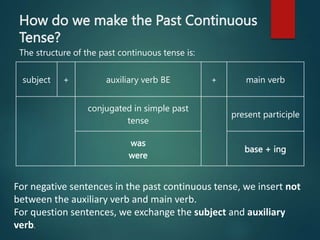
How do we make the Past Continuous
Tense?
The structure of the past continuous tense is:
subject + auxiliary verb BE + main verb
conjugated in simple past
tense
present participle
was
were
base + ing
For negative sentences in the past continuous tense, we insert not
between the auxiliary verb and main verb.
For question sentences, we exchange the subject and auxiliary
verb.
examples sentences with the past
continuous tense
subject
auxiliary
verb
main
verb
+ I was watching TV.
+ You were working hard.
- He, she, it was not helping Mary.
- We were not joking.
? Were you being silly?
? Were they playing football?
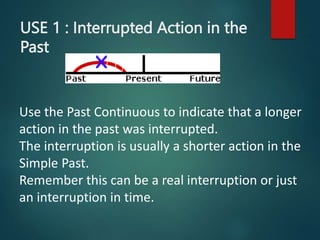
USE 1 : Interrupted Action in the
Past
Use the Past Continuous to indicate that a longer
action in the past was interrupted.
The interruption is usually a shorter action in the
Simple Past.
Remember this can be a real interruption or just
an interruption in time.
Examples:
 I was watching TV when she called.
 When the phone rang, she was writing a letter.
 While we were having the picnic, it started to rain.
 What were you doing when the earthquake started?
 I was listening to my iPod, so I didn't hear the fire
alarm.
 You were not listening to me when I told you to
turn the oven off.
 While John was sleeping last night, someone stole
his car.
 Sammy was waiting for us when we got off the
plane.
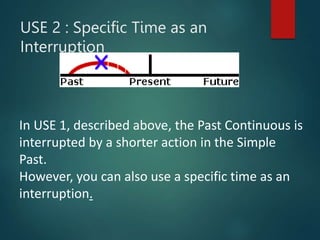
USE 2 : Specific Time as an
Interruption
In USE 1, described above, the Past Continuous is
interrupted by a shorter action in the Simple
Past.
However, you can also use a specific time as an
interruption.
Examples:
 Last night at 6 PM, I was eating dinner.
 At midnight, we were still driving
through the desert.
 Yesterday at this time, I was sitting at
my desk at work
IMPORTANT
In the Simple Past, a specific time is used to show
when an action began or finished.
In the Past Continuous, a specific time only
interrupts the action.
Examples:
 Last night at 6 PM, I ate dinner.
I started eating at 6 PM.
 Last night at 6 PM, I was eating dinner.
I started earlier; and at 6 PM, I was in the process
of eating dinner.
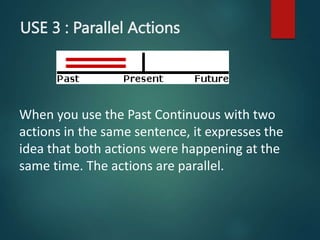
USE 3 : Parallel Actions
When you use the Past Continuous with two
actions in the same sentence, it expresses the
idea that both actions were happening at the
same time. The actions are parallel.
Examples:
 I was studying while he was making dinner.
 While Ellen was reading, Tim was watching
television.
 Were you listening while he was talking?
 I wasn't paying attention while I was writing the
letter, so I made several mistakes.
 What were you doing while you were waiting?
 Thomas wasn't working, and I wasn't working
either.
 They were eating dinner, discussing their plans,
and having a good time.
USE 4: Atmosphere
In English, we often use a series of parallel actions to describe the
atmosphere at a particular time in the past.
Example:
 When I walked into the office, several people were busily typing,
some were talking on the phones, the boss was yelling directions,
and customers were waiting to be helped. One customer was yelling
at a secretary and waving his hands. Others were complaining to
each other about the bad service.
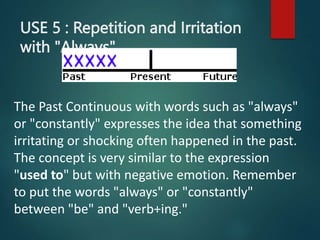
USE 5 : Repetition and Irritation
with "Always"
The Past Continuous with words such as "always"
or "constantly" expresses the idea that something
irritating or shocking often happened in the past.
The concept is very similar to the expression
"used to" but with negative emotion. Remember
to put the words "always" or "constantly"
between "be" and "verb+ing."
Examples:
 She was always coming to class
late.
 He was constantly talking. He
annoyed everyone.
 I didn't like them because they
were always complaining.
While vs. When
 Some clauses begin with the word "when" such
as "when she called" or "when it bit me."
 Other clauses begin with "while" such as "while
she was sleeping" and "while he was surfing.“
 When you talk about things in the past, "when" is
most often followed by the verb tense Simple
Past, whereas "while" is usually followed by Past
Continuous. "While" expresses the idea of
"during that time."
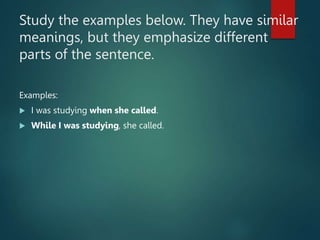
Study the examples below. They have similar
meanings, but they emphasize different
parts of the sentence.
Examples:
 I was studying when she called.
 While I was studying, she called.
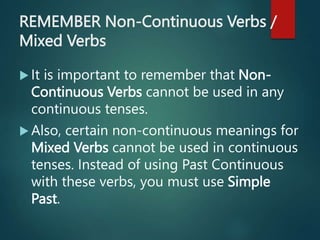
REMEMBER Non-Continuous Verbs /
Mixed Verbs
 It is important to remember that Non-
Continuous Verbs cannot be used in any
continuous tenses.
 Also, certain non-continuous meanings for
Mixed Verbs cannot be used in continuous
tenses. Instead of using Past Continuous
with these verbs, you must use Simple
Past.
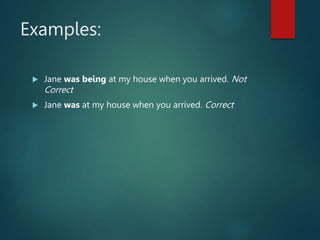
Examples:
 Jane was being at my house when you arrived. Not
Correct
 Jane was at my house when you arrived. Correct
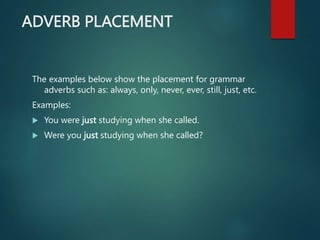
ADVERB PLACEMENT
The examples below show the placement for grammar
adverbs such as: always, only, never, ever, still, just, etc.
Examples:
 You were just studying when she called.
 Were you just studying when she called?

THE - PAST - CONTINUOUS - TENSE .ppt-.-

  • 1.
  • 2.
    Past Continuous Tense The past continuous tense is an important tense in English.  We use it to say what we were doing in the middle of a particular moment in the past.
  • 3.
    How do wemake the Past Continuous Tense? The structure of the past continuous tense is: subject + auxiliary verb BE + main verb conjugated in simple past tense present participle was were base + ing For negative sentences in the past continuous tense, we insert not between the auxiliary verb and main verb. For question sentences, we exchange the subject and auxiliary verb.
  • 4.
    examples sentences withthe past continuous tense subject auxiliary verb main verb + I was watching TV. + You were working hard. - He, she, it was not helping Mary. - We were not joking. ? Were you being silly? ? Were they playing football?
  • 5.
    USE 1 :Interrupted Action in the Past Use the Past Continuous to indicate that a longer action in the past was interrupted. The interruption is usually a shorter action in the Simple Past. Remember this can be a real interruption or just an interruption in time.
  • 6.
    Examples:  I waswatching TV when she called.  When the phone rang, she was writing a letter.  While we were having the picnic, it started to rain.  What were you doing when the earthquake started?  I was listening to my iPod, so I didn't hear the fire alarm.  You were not listening to me when I told you to turn the oven off.  While John was sleeping last night, someone stole his car.  Sammy was waiting for us when we got off the plane.
  • 7.
    USE 2 :Specific Time as an Interruption In USE 1, described above, the Past Continuous is interrupted by a shorter action in the Simple Past. However, you can also use a specific time as an interruption.
  • 8.
    Examples:  Last nightat 6 PM, I was eating dinner.  At midnight, we were still driving through the desert.  Yesterday at this time, I was sitting at my desk at work
  • 9.
    IMPORTANT In the SimplePast, a specific time is used to show when an action began or finished. In the Past Continuous, a specific time only interrupts the action. Examples:  Last night at 6 PM, I ate dinner. I started eating at 6 PM.  Last night at 6 PM, I was eating dinner. I started earlier; and at 6 PM, I was in the process of eating dinner.
  • 10.
    USE 3 :Parallel Actions When you use the Past Continuous with two actions in the same sentence, it expresses the idea that both actions were happening at the same time. The actions are parallel.
  • 11.
    Examples:  I wasstudying while he was making dinner.  While Ellen was reading, Tim was watching television.  Were you listening while he was talking?  I wasn't paying attention while I was writing the letter, so I made several mistakes.  What were you doing while you were waiting?  Thomas wasn't working, and I wasn't working either.  They were eating dinner, discussing their plans, and having a good time.
  • 12.
    USE 4: Atmosphere InEnglish, we often use a series of parallel actions to describe the atmosphere at a particular time in the past. Example:  When I walked into the office, several people were busily typing, some were talking on the phones, the boss was yelling directions, and customers were waiting to be helped. One customer was yelling at a secretary and waving his hands. Others were complaining to each other about the bad service.
  • 13.
    USE 5 :Repetition and Irritation with "Always" The Past Continuous with words such as "always" or "constantly" expresses the idea that something irritating or shocking often happened in the past. The concept is very similar to the expression "used to" but with negative emotion. Remember to put the words "always" or "constantly" between "be" and "verb+ing."
  • 14.
    Examples:  She wasalways coming to class late.  He was constantly talking. He annoyed everyone.  I didn't like them because they were always complaining.
  • 15.
    While vs. When Some clauses begin with the word "when" such as "when she called" or "when it bit me."  Other clauses begin with "while" such as "while she was sleeping" and "while he was surfing.“  When you talk about things in the past, "when" is most often followed by the verb tense Simple Past, whereas "while" is usually followed by Past Continuous. "While" expresses the idea of "during that time."
  • 16.
    Study the examplesbelow. They have similar meanings, but they emphasize different parts of the sentence. Examples:  I was studying when she called.  While I was studying, she called.
  • 17.
    REMEMBER Non-Continuous Verbs/ Mixed Verbs  It is important to remember that Non- Continuous Verbs cannot be used in any continuous tenses.  Also, certain non-continuous meanings for Mixed Verbs cannot be used in continuous tenses. Instead of using Past Continuous with these verbs, you must use Simple Past.
  • 18.
    Examples:  Jane wasbeing at my house when you arrived. Not Correct  Jane was at my house when you arrived. Correct
  • 19.
    ADVERB PLACEMENT The examplesbelow show the placement for grammar adverbs such as: always, only, never, ever, still, just, etc. Examples:  You were just studying when she called.  Were you just studying when she called?