PASSIVE
SOLAR
BUILDING
Rohit Chaurasia
71/08
WHAT IS
PASSIVE SOLAR BUILDING?
PASSIVE SOLAR BUILDING RULES OF
THUMB
• The building should be elongated on an east-west axis.
• The building’s south face should receive sunlight
between the hours of 9:00 A.M. and 3:00 P.M. (sun
time) during the heating season.
• Interior spaces requiring the most light , heating and
cooling should be along the south face of the building.
Less used spaces should be located on the north.
• An open floor plan optimizes passive system operation.
• Use shading to prevent summer sun entering the
interior. Sustainable by design has an online calculator
for Sun Angles and from that you can figure the
overhang calculations.
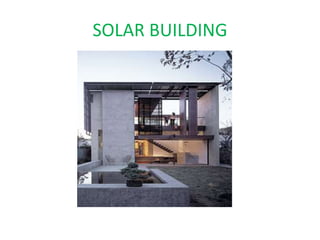
SOLAR BUILDING
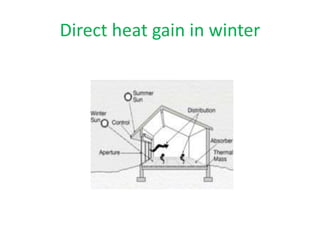
Direct heat gain in winter
PRIMARY ELEMENTS OF PASSIVE SOLAR
HEATING
DIRECT GAIN:
• SPACE IS USED AS SOLAR COLLECTOR AND
DISTRIBUTER
• SOUTHFACING GLASS
• THERMAL MASS FLOORS AND WALLS ARE THE
FUNCTIONAL PARTS
• IN DAY TIME THEY ABSORB SUNLIGHT AND
RADIATES IN NIGHT
INDIRECT GAIN
• Thermal mass located between sun and living space
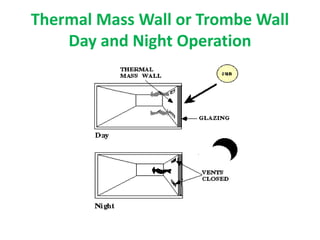
THERMAL STORAGE WALL SYSTEM:
• Thermal mass located immediately behind the glass
ROOF POND SYSTEM:
• 6 to 12 inches of water layer
• Best for low humid areas but in high humid areas it can be
modified
INTERIOR WATER WALLS:
• Water has good convective properties
• Widely fluctuating temperature is not often a problem when
interior water walls are used as heat storage
Thermal Mass Wall or Trombe Wall
Day and Night Operation
ISOLATED GAIN
• This part is seperated from living areas
• Utilize 15 to 20 % of sun light
• Isolated gain is combination of direct and indirect
gain
• Heating is done by convection process though air
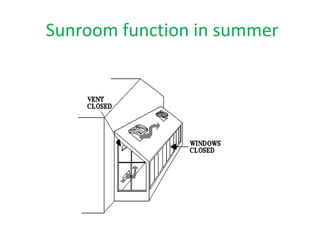
Sunroom function in summer
PASSIVE SOLAR COOLING
• uses in removing the unwanted heat from building
• Primary strategy for cooling building, without any mechanical
or electrical source
VENTILATION AND OPERABLE WINDOWS:
• Employ natural ventilation
• Place operable windows on the south exposure If a room can
have windows on only one side, use two widely spaced
windows instead of one window.
• Place operable windows on south exposure
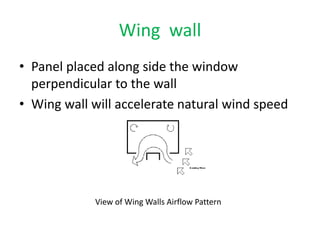
Wing wall
• Panel placed along side the window
perpendicular to the wall
• Wing wall will accelerate natural wind speed
View of Wing Walls Airflow Pattern
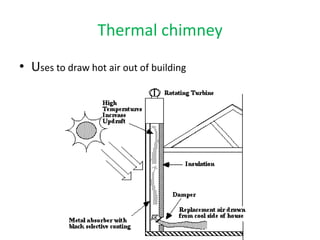
Thermal chimney
• Uses to draw hot air out of building
OTHER VENTILATION STRATEGY
• Make the outlet openings slightly larger than
the inlet openings.
• Place the inlets at low to medium heights to
provide airflow at occupant levels in the room
SHADING:
• It is done in south direction
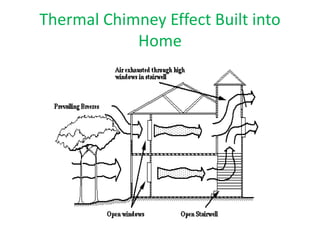
Thermal Chimney Effect Built into
Home
PASSIVE SOLAR WATER HEATING
• Heated water can be used for domestic
purpose
• It involves no pump or electrical device
• In swimming pools
COST AND ECONOMICS
• Same or slightly more than conventional
building
CONCLUSIONS
• Passive solar building is eco friendly as well as
it cost is almost same as conventional
building
• It is less costly in lighting purpose
• Beneficial for health
• So people should be encouraged for the use of
passive solar buildings.
58147877-Passive-Solar-Building.pptx

58147877-Passive-Solar-Building.pptx

  • 1.
  • 2.
  • 3.
    PASSIVE SOLAR BUILDINGRULES OF THUMB • The building should be elongated on an east-west axis. • The building’s south face should receive sunlight between the hours of 9:00 A.M. and 3:00 P.M. (sun time) during the heating season. • Interior spaces requiring the most light , heating and cooling should be along the south face of the building. Less used spaces should be located on the north. • An open floor plan optimizes passive system operation. • Use shading to prevent summer sun entering the interior. Sustainable by design has an online calculator for Sun Angles and from that you can figure the overhang calculations.
  • 4.
  • 5.
  • 6.
    PRIMARY ELEMENTS OFPASSIVE SOLAR HEATING DIRECT GAIN: • SPACE IS USED AS SOLAR COLLECTOR AND DISTRIBUTER • SOUTHFACING GLASS • THERMAL MASS FLOORS AND WALLS ARE THE FUNCTIONAL PARTS • IN DAY TIME THEY ABSORB SUNLIGHT AND RADIATES IN NIGHT
  • 7.
    INDIRECT GAIN • Thermalmass located between sun and living space THERMAL STORAGE WALL SYSTEM: • Thermal mass located immediately behind the glass ROOF POND SYSTEM: • 6 to 12 inches of water layer • Best for low humid areas but in high humid areas it can be modified INTERIOR WATER WALLS: • Water has good convective properties • Widely fluctuating temperature is not often a problem when interior water walls are used as heat storage
  • 8.
    Thermal Mass Wallor Trombe Wall Day and Night Operation
  • 9.
    ISOLATED GAIN • Thispart is seperated from living areas • Utilize 15 to 20 % of sun light • Isolated gain is combination of direct and indirect gain • Heating is done by convection process though air
  • 10.
  • 11.
    PASSIVE SOLAR COOLING •uses in removing the unwanted heat from building • Primary strategy for cooling building, without any mechanical or electrical source VENTILATION AND OPERABLE WINDOWS: • Employ natural ventilation • Place operable windows on the south exposure If a room can have windows on only one side, use two widely spaced windows instead of one window. • Place operable windows on south exposure
  • 12.
    Wing wall • Panelplaced along side the window perpendicular to the wall • Wing wall will accelerate natural wind speed View of Wing Walls Airflow Pattern
  • 13.
    Thermal chimney • Usesto draw hot air out of building
  • 14.
    OTHER VENTILATION STRATEGY •Make the outlet openings slightly larger than the inlet openings. • Place the inlets at low to medium heights to provide airflow at occupant levels in the room SHADING: • It is done in south direction
  • 15.
    Thermal Chimney EffectBuilt into Home
  • 16.
    PASSIVE SOLAR WATERHEATING • Heated water can be used for domestic purpose • It involves no pump or electrical device • In swimming pools
  • 17.
    COST AND ECONOMICS •Same or slightly more than conventional building
  • 18.
    CONCLUSIONS • Passive solarbuilding is eco friendly as well as it cost is almost same as conventional building • It is less costly in lighting purpose • Beneficial for health • So people should be encouraged for the use of passive solar buildings.