PASSIVE SOLAR BUILDINGS
BY
MUBBASHER ABBASS
76-CE/L-14
7th semester
B.Tech
Civil engineering
SCHOOL OF ENGINEERING AND TECHNOLOGY , BGSBU Rajouri ,
(J&K)
CONTENTS
 Introduction
 What are passive solar buildings
 Constructional elements for residential buildings
 Material used.
 How does passive solar design uses the sun’s power
 How does it work
 Categories of passive solar energy
 Some of the passive buildings
 Usage among countries
 Advantages
 Conclusion
INTRODUCTION
 Over the last decade, there has been a lot of pressure on
energy consumption in domestic households.
 Industrial and technological innovation, population
growth and rapid urbanization lead to an increase in
energy consumption
 Dependency on foreign sources of energy and their
negative environmental impact have made energy
efficiency and conservation critical issues
 35-40 % of our energy is consumed by buildings and
85% of that is need solely for heating
WHAT ARE PASSIVE SOLAR
BUILDINGS
“In PASSIVE SOLAR BUILDINGS ,
windows, walls, and floors are made to
collect, store and distribute ‘SOLAR
ENERGY’ in the form heat in the winter
and reject solar heat in the summer.
ELEMENTS TO BE CONSIDERED FOR
RESEDENTIAL BUILDIND CONSTRUCTION
 Placements of room-types, internal doors & walls, & equipment
in the house
 Orienting the building to face the equator
 Extending the building dimension along east/west axis
 Windows to face the midday sun in winter, and be shaded in the
summer
 Minimizing the windows on other sides, especially western
windows.
 Using thermal mass to store excess solar energy during the winter
day (which is re radiated during night)
MATERIAL USED
South Facing Glass
Thermal mass to absorb & store energy
SOUTH FACING GLASS
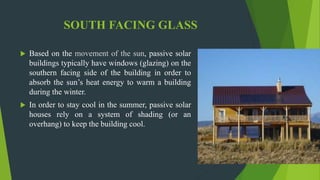
 Based on the movement of the sun, passive solar
buildings typically have windows (glazing) on the
southern facing side of the building in order to
absorb the sun’s heat energy to warm a building
during the winter.
 In order to stay cool in the summer, passive solar
houses rely on a system of shading (or an
overhang) to keep the building cool.
THERMAL MASS
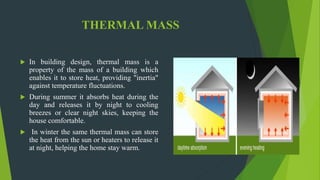
 In building design, thermal mass is a
property of the mass of a building which
enables it to store heat, providing "inertia"
against temperature fluctuations.
 During summer it absorbs heat during the
day and releases it by night to cooling
breezes or clear night skies, keeping the
house comfortable.
 In winter the same thermal mass can store
the heat from the sun or heaters to release it
at night, helping the home stay warm.
HOW DOES PASSIVE SOLAR DESIGN USE
THE SUN’S POWER?
Procedure for design of buildings to passively use solar energy for
heating building may typically involve
 Use of shading devices to reduces heating by radiant (solar)
energy in the summer and allow it in winter,
 Utilize thermal convection to maximize heating convection in
winter, and
 Utilize thermal storage to transfer excess heating capacity from
day light to night time hours
HOW DOES IT WORK
 Passive solar buildings are designed to let heat into
the buildings during the winter months and block
out the sun during hot summer days. This can be
achieved by passive solar design elements such as
shading, implementing large south facing windows ,
and building materials that absorb and slowly
release the sun’s heat.
CATEGORIES OF PASSIVE SOLAR
ENERGY
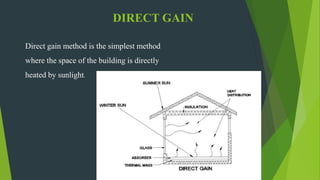
 DIRECT GAIN
 INDIRECT GAIN
 ISOLATED GAIN
DIRECT GAIN
Direct gain method is the simplest method
where the space of the building is directly
heated by sunlight.
INDIRECT GAIN
For indirect gain , sunlight is often received by a south facing
wall , and as air moves internal space the heat moves through
the living room.
ISOLATED GAIN
Isolated gain method contains solar collection, thermal storage that
are separated from actual living space.
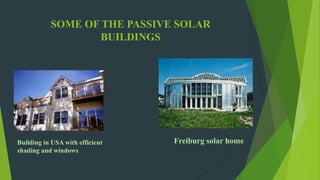
SOME OF THE PASSIVE SOLAR
BUILDINGS
Building in USA with efficient
shading and windows
Freiburg solar home
0%
10%
20%
30%
40%
50%
60%
70%
80%
USAGE
USAGE
USAGE AMONG COUNTRIES
ADVANTAGES
 Mainly it provide perfect temperature and it is renewable energy
resource.
 It’s cost of installation is lower than active solar energy resources.
 And it is eco friendly due to the eradication of green house effect.
 Less or zero usage of conventional equipments.
CONCLUSION
 They can perform effortlessly and quietly with out mechanical or
electrical assistance
 Reduction can be made to heating bills by as much as 40%
annually, and also improve the comfort of living spaces
 Simple techniques can make a huge difference in the comfort and
energy consumption through year
 The economical solution to a warmer house in the winter and
cooler house in the summer is to insulate well, while
understanding the movement of heat it is the better solution.
The best creator next to god is a civil
engineer.
THANK
YOU

Passive solar buildings

  • 1.
    PASSIVE SOLAR BUILDINGS BY MUBBASHERABBASS 76-CE/L-14 7th semester B.Tech Civil engineering SCHOOL OF ENGINEERING AND TECHNOLOGY , BGSBU Rajouri , (J&K)
  • 2.
    CONTENTS  Introduction  Whatare passive solar buildings  Constructional elements for residential buildings  Material used.  How does passive solar design uses the sun’s power  How does it work  Categories of passive solar energy  Some of the passive buildings  Usage among countries  Advantages  Conclusion
  • 3.
    INTRODUCTION  Over thelast decade, there has been a lot of pressure on energy consumption in domestic households.  Industrial and technological innovation, population growth and rapid urbanization lead to an increase in energy consumption  Dependency on foreign sources of energy and their negative environmental impact have made energy efficiency and conservation critical issues  35-40 % of our energy is consumed by buildings and 85% of that is need solely for heating
  • 4.
    WHAT ARE PASSIVESOLAR BUILDINGS “In PASSIVE SOLAR BUILDINGS , windows, walls, and floors are made to collect, store and distribute ‘SOLAR ENERGY’ in the form heat in the winter and reject solar heat in the summer.
  • 5.
    ELEMENTS TO BECONSIDERED FOR RESEDENTIAL BUILDIND CONSTRUCTION  Placements of room-types, internal doors & walls, & equipment in the house  Orienting the building to face the equator  Extending the building dimension along east/west axis  Windows to face the midday sun in winter, and be shaded in the summer  Minimizing the windows on other sides, especially western windows.  Using thermal mass to store excess solar energy during the winter day (which is re radiated during night)
  • 6.
    MATERIAL USED South FacingGlass Thermal mass to absorb & store energy
  • 7.
    SOUTH FACING GLASS Based on the movement of the sun, passive solar buildings typically have windows (glazing) on the southern facing side of the building in order to absorb the sun’s heat energy to warm a building during the winter.  In order to stay cool in the summer, passive solar houses rely on a system of shading (or an overhang) to keep the building cool.
  • 8.
    THERMAL MASS  Inbuilding design, thermal mass is a property of the mass of a building which enables it to store heat, providing "inertia" against temperature fluctuations.  During summer it absorbs heat during the day and releases it by night to cooling breezes or clear night skies, keeping the house comfortable.  In winter the same thermal mass can store the heat from the sun or heaters to release it at night, helping the home stay warm.
  • 10.
    HOW DOES PASSIVESOLAR DESIGN USE THE SUN’S POWER? Procedure for design of buildings to passively use solar energy for heating building may typically involve  Use of shading devices to reduces heating by radiant (solar) energy in the summer and allow it in winter,  Utilize thermal convection to maximize heating convection in winter, and  Utilize thermal storage to transfer excess heating capacity from day light to night time hours
  • 11.
    HOW DOES ITWORK  Passive solar buildings are designed to let heat into the buildings during the winter months and block out the sun during hot summer days. This can be achieved by passive solar design elements such as shading, implementing large south facing windows , and building materials that absorb and slowly release the sun’s heat.
  • 12.
    CATEGORIES OF PASSIVESOLAR ENERGY  DIRECT GAIN  INDIRECT GAIN  ISOLATED GAIN
  • 13.
    DIRECT GAIN Direct gainmethod is the simplest method where the space of the building is directly heated by sunlight.
  • 14.
    INDIRECT GAIN For indirectgain , sunlight is often received by a south facing wall , and as air moves internal space the heat moves through the living room.
  • 15.
    ISOLATED GAIN Isolated gainmethod contains solar collection, thermal storage that are separated from actual living space.
  • 16.
    SOME OF THEPASSIVE SOLAR BUILDINGS Building in USA with efficient shading and windows Freiburg solar home
  • 17.
  • 18.
    ADVANTAGES  Mainly itprovide perfect temperature and it is renewable energy resource.  It’s cost of installation is lower than active solar energy resources.  And it is eco friendly due to the eradication of green house effect.  Less or zero usage of conventional equipments.
  • 19.
    CONCLUSION  They canperform effortlessly and quietly with out mechanical or electrical assistance  Reduction can be made to heating bills by as much as 40% annually, and also improve the comfort of living spaces  Simple techniques can make a huge difference in the comfort and energy consumption through year  The economical solution to a warmer house in the winter and cooler house in the summer is to insulate well, while understanding the movement of heat it is the better solution.
  • 20.
    The best creatornext to god is a civil engineer. THANK YOU