Innovative Passive Solar
Design Concepts
Katrina Johnson
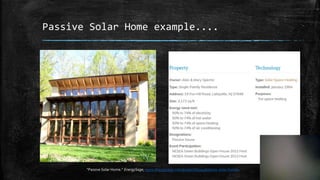
Passive Solar Home example....
“Passive Solar Home.” EnergySage, www.energysage.com/project/6244/passive-solar-home/.
What does it mean to have a sustainable
design?
▪ Sustainable building design and construction is the practice
of creating structures and using processes that are
environmentally responsible and resource efficient
throughout the life cycle of a building.
▪ Sustainable architecture seeks to renovate buildings and
homes using a combination of energy-
efficient technology, renewable materials and innovative
designs to reduce waist and minimize
environmental impact of new development.
Do not confuse Passive solar design with
active solar design!!!
In passive solar building design, windows, walls, and floors are made to
collect, store, and distribute solar energy in the form of heat in
the winter and reject solar heat in the summer.This is called passive
solar design because, unlike active solar heating systems, it does
not involve the use of mechanical and electrical devices.These
responses to solar heat leads to different material choices, placement
of openings and orientation of building.
Passive Solar is the use of the sun to cool, heat and
ventilate a building all while minimizing the adverse impacts
of climate.
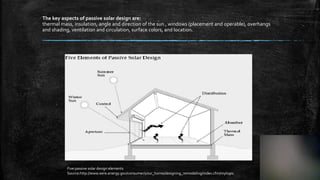
The key aspects of passive solar design are:
thermal mass, insulation, angle and direction of the sun , windows (placement and operable), overhangs
and shading, ventilation and circulation, surface colors, and location.
Five passive solar design elements
Source:http://www.eere.energy.gov/consumer/your_home/designing_remodeling/index.cfm/mytopic
Window:
Energy efficient windows are an important consideration for both new
and existing homes. Heat gain and heat loss through windows are
responsible for 25%–30% of residential heating and cooling energy use.
Vinyl, wood, fiberglass, and some composite
frame materials provide greater thermal
resistance than metal.
Coatings and technologies you may find when shopping for windows
will include :
▪ Insulated window glazing which are windows with two or more panes
of glass.
▪ Low-e coating which control heat transfer through windows with
insulated glazing (usually cost more)
▪ Gas Fills between glazing layers minimize heat transfer between the
interior and exterior of the window.
▪ Spacers are used to keep the layers of glazing the correct distance
apart.These are usually for thermal expansion and pressure
differences, while also preventing moisture and gas leaks.
Window placement
“Southern Facing Windows in Passive Solar Houses: Green Passive Solar Magazine.” Green Passive Solar Magazine | Highlighting the Sustainable, Renewable and Green Building Technologies of Passive (and Active!)
Solar Design, 31 July 2014, greenpassivesolar.com/passive-solar/building-characteristics/orientation-south-facing-windows.
Passive solar houses typically have
windows on the southern side of the
building.
*In the northern hemisphere, in order
to face the sun and obtain maximum
solar gain, the windows would face the
south. In the southern hemisphere,
however, it is opposite, with the
windows facing the north in order to
maximize solar gain.
Thermal Mass and Materials
*The best materials used for
thermalmass will have high heat
capacity and high material density.
Build Green Canada. (August 28, 2015). An explanation of thermal mass [Online].
Available: http://www.buildgreen.ca/2008/09/an-explanation-of-thermal-mass/
Thermal mass is in reference
to material inside a building that can help
reduce the temperature change throughout
the day; reducing the heating and cooling
demand of the building itself.
Materials:
Gypsum
Air
Concrete
Brick
Limestone
Basalt
Dry Sand
Soil
Granite
Wood
Building Orientation
Click to add text
“Southern Facing Windows in Passive Solar Houses: Green Passive Solar Magazine.” Green Passive Solar Magazine | Highlighting the Sustainable, Renewable and
Green Building Technologies of Passive (and Active!) Solar Design, 31 July 2014, greenpassivesolar.com/passive-solar/building-characteristics/orientation-south-
facing-windows/.
The side of the
building that is
utilized for solar
gain needs to
be facing the south
to take maximum
advantage of the
sun’s
potential energy.
In a direct gain design, sunlight enters the house through south-facing windows and
strikes masonry floors and/or walls, which absorb and store the solar heat. As the
room cools during the night, the thermal mass releases heat into the house.
Direct Gain Systems
www.eere.energy.gov/RE/solar_passive.html
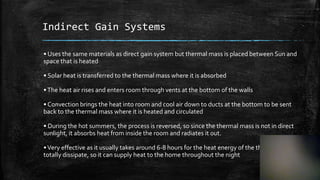
Indirect Gain Systems
• Uses the same materials as direct gain system but thermal mass is placed between Sun and
space that is heated
• Solar heat is transferred to the thermal mass where it is absorbed
•The heat air rises and enters room through vents at the bottom of the walls
• Convection brings the heat into room and cool air down to ducts at the bottom to be sent
back to the thermal mass where it is heated and circulated
• During the hot summers, the process is reversed, so since the thermal mass is not in direct
sunlight, it absorbs heat from inside the room and radiates it out.
•Very effective as it usually takes around 6-8 hours for the heat energy of the thermal to
totally dissipate, so it can supply heat to the home throughout the night
Isolated Gain Systems
• System where the space that is passively
heated by the Sun is isolated from the rest of
the building space
• South-facing sunrooms are commonly fitted
to a home to take advantage of the sun's heat
and light.
• Using sunrooms to ventilate a house is also
possible
• Lower vents from the sunroom to the interior
rooms draw air through the living space to be
expelled out the upper vents to the outside
along the top of the sunroom.
“Passive Solar Design.” Sustainable Sources LLC,
sustainablesources.com/energy/passive-solar-
design/.
Conclustion:
Passive solar design is an important aspect of building design because
people and businesses are looking to save money on energy costs and
be environmentally responsible.
Passive solar design is an easy way to provide hope for the future of
everyone on earth by reducing the effects of greenhouse gasses its
helps slow the process of climate change giving our future a healthiar
outcome.
Citation:
▪ Five passive solar design elements Source:http://www.eere.energy.gov/consumer/ your_home/designing_remodeling/index.cfm/mytopic
▪ Build Green Canada. (August 28, 2015). An explanation of thermal mass [Online]. Available: http://www.buildgreen.ca/2008/09/an-explanation-of-
thermal-mass/
▪ “Southern Facing Windows in Passive Solar Houses: Green Passive Solar Magazine.” Green Passive Solar Magazine | Highlighting the Sustainable,
Renewable and Green Building Technologies of Passive (and Active!) Solar Design, 31 July 2014, greenpassivesolar.com/passive-solar/building-
characteristics/orientation-south-facing-windows.
▪ Five Elements of Passive Solar Home Design, Your Home, Energy Savers. Last updated March 24, 2009. Energy Efficiency & Renewable Energy, US
Department of Energy. Accessed October 22, 2009. http://www.energysavers.gov/your_home/designing_remodeling/index.cfm/mytopic=10270
▪ Passive Solar Design. Choices for the Home Construction, Consumer Energy Center, California Energy Commission. Accessed October 22, 2009.
http://www.consumerenergycenter.org/home/construction/solardesign/index.html
▪ Passive Solar Design. Sustainable Sources. (Provides a great introduction to solar design, including "rules of thumb," and many diagrams that illustrate
thermal storage, ventilation and other techniques) Accessed October 22, 2009. http://www.greenbuilder.com/sourcebook/PassiveSol.html
▪ Passive Solar Design – Thermal Mass. Consumer Energy Center, California Energy Commission. Accessed October 22, 2009.
http://www.consumerenergycenter.org/home/construction/solardesign/thermal.html
▪ SolarWall – Specializing in solar heating (solar air heating and ventilation), solar agriculture. Conserval Engineering Inc. Accessed October 22, 2009.
http://www.solarwall.com
▪ “Passive Solar Design.” Sustainable Sources LLC, sustainablesources.com/energy/passive-solar-design/.

Passive Solar

  • 1.
    Innovative Passive Solar DesignConcepts Katrina Johnson
  • 2.
    Passive Solar Homeexample.... “Passive Solar Home.” EnergySage, www.energysage.com/project/6244/passive-solar-home/.
  • 3.
    What does itmean to have a sustainable design? ▪ Sustainable building design and construction is the practice of creating structures and using processes that are environmentally responsible and resource efficient throughout the life cycle of a building. ▪ Sustainable architecture seeks to renovate buildings and homes using a combination of energy- efficient technology, renewable materials and innovative designs to reduce waist and minimize environmental impact of new development.
  • 4.
    Do not confusePassive solar design with active solar design!!! In passive solar building design, windows, walls, and floors are made to collect, store, and distribute solar energy in the form of heat in the winter and reject solar heat in the summer.This is called passive solar design because, unlike active solar heating systems, it does not involve the use of mechanical and electrical devices.These responses to solar heat leads to different material choices, placement of openings and orientation of building.
  • 5.
    Passive Solar isthe use of the sun to cool, heat and ventilate a building all while minimizing the adverse impacts of climate.
  • 6.
    The key aspectsof passive solar design are: thermal mass, insulation, angle and direction of the sun , windows (placement and operable), overhangs and shading, ventilation and circulation, surface colors, and location. Five passive solar design elements Source:http://www.eere.energy.gov/consumer/your_home/designing_remodeling/index.cfm/mytopic
  • 7.
    Window: Energy efficient windowsare an important consideration for both new and existing homes. Heat gain and heat loss through windows are responsible for 25%–30% of residential heating and cooling energy use. Vinyl, wood, fiberglass, and some composite frame materials provide greater thermal resistance than metal.
  • 8.
    Coatings and technologiesyou may find when shopping for windows will include : ▪ Insulated window glazing which are windows with two or more panes of glass. ▪ Low-e coating which control heat transfer through windows with insulated glazing (usually cost more) ▪ Gas Fills between glazing layers minimize heat transfer between the interior and exterior of the window. ▪ Spacers are used to keep the layers of glazing the correct distance apart.These are usually for thermal expansion and pressure differences, while also preventing moisture and gas leaks.
  • 9.
    Window placement “Southern FacingWindows in Passive Solar Houses: Green Passive Solar Magazine.” Green Passive Solar Magazine | Highlighting the Sustainable, Renewable and Green Building Technologies of Passive (and Active!) Solar Design, 31 July 2014, greenpassivesolar.com/passive-solar/building-characteristics/orientation-south-facing-windows. Passive solar houses typically have windows on the southern side of the building. *In the northern hemisphere, in order to face the sun and obtain maximum solar gain, the windows would face the south. In the southern hemisphere, however, it is opposite, with the windows facing the north in order to maximize solar gain.
  • 10.
    Thermal Mass andMaterials *The best materials used for thermalmass will have high heat capacity and high material density. Build Green Canada. (August 28, 2015). An explanation of thermal mass [Online]. Available: http://www.buildgreen.ca/2008/09/an-explanation-of-thermal-mass/ Thermal mass is in reference to material inside a building that can help reduce the temperature change throughout the day; reducing the heating and cooling demand of the building itself. Materials: Gypsum Air Concrete Brick Limestone Basalt Dry Sand Soil Granite Wood
  • 11.
    Building Orientation Click toadd text “Southern Facing Windows in Passive Solar Houses: Green Passive Solar Magazine.” Green Passive Solar Magazine | Highlighting the Sustainable, Renewable and Green Building Technologies of Passive (and Active!) Solar Design, 31 July 2014, greenpassivesolar.com/passive-solar/building-characteristics/orientation-south- facing-windows/. The side of the building that is utilized for solar gain needs to be facing the south to take maximum advantage of the sun’s potential energy.
  • 12.
    In a directgain design, sunlight enters the house through south-facing windows and strikes masonry floors and/or walls, which absorb and store the solar heat. As the room cools during the night, the thermal mass releases heat into the house. Direct Gain Systems www.eere.energy.gov/RE/solar_passive.html
  • 13.
    Indirect Gain Systems •Uses the same materials as direct gain system but thermal mass is placed between Sun and space that is heated • Solar heat is transferred to the thermal mass where it is absorbed •The heat air rises and enters room through vents at the bottom of the walls • Convection brings the heat into room and cool air down to ducts at the bottom to be sent back to the thermal mass where it is heated and circulated • During the hot summers, the process is reversed, so since the thermal mass is not in direct sunlight, it absorbs heat from inside the room and radiates it out. •Very effective as it usually takes around 6-8 hours for the heat energy of the thermal to totally dissipate, so it can supply heat to the home throughout the night
  • 14.
    Isolated Gain Systems •System where the space that is passively heated by the Sun is isolated from the rest of the building space • South-facing sunrooms are commonly fitted to a home to take advantage of the sun's heat and light. • Using sunrooms to ventilate a house is also possible • Lower vents from the sunroom to the interior rooms draw air through the living space to be expelled out the upper vents to the outside along the top of the sunroom. “Passive Solar Design.” Sustainable Sources LLC, sustainablesources.com/energy/passive-solar- design/.
  • 15.
    Conclustion: Passive solar designis an important aspect of building design because people and businesses are looking to save money on energy costs and be environmentally responsible. Passive solar design is an easy way to provide hope for the future of everyone on earth by reducing the effects of greenhouse gasses its helps slow the process of climate change giving our future a healthiar outcome.
  • 16.
    Citation: ▪ Five passivesolar design elements Source:http://www.eere.energy.gov/consumer/ your_home/designing_remodeling/index.cfm/mytopic ▪ Build Green Canada. (August 28, 2015). An explanation of thermal mass [Online]. Available: http://www.buildgreen.ca/2008/09/an-explanation-of- thermal-mass/ ▪ “Southern Facing Windows in Passive Solar Houses: Green Passive Solar Magazine.” Green Passive Solar Magazine | Highlighting the Sustainable, Renewable and Green Building Technologies of Passive (and Active!) Solar Design, 31 July 2014, greenpassivesolar.com/passive-solar/building- characteristics/orientation-south-facing-windows. ▪ Five Elements of Passive Solar Home Design, Your Home, Energy Savers. Last updated March 24, 2009. Energy Efficiency & Renewable Energy, US Department of Energy. Accessed October 22, 2009. http://www.energysavers.gov/your_home/designing_remodeling/index.cfm/mytopic=10270 ▪ Passive Solar Design. Choices for the Home Construction, Consumer Energy Center, California Energy Commission. Accessed October 22, 2009. http://www.consumerenergycenter.org/home/construction/solardesign/index.html ▪ Passive Solar Design. Sustainable Sources. (Provides a great introduction to solar design, including "rules of thumb," and many diagrams that illustrate thermal storage, ventilation and other techniques) Accessed October 22, 2009. http://www.greenbuilder.com/sourcebook/PassiveSol.html ▪ Passive Solar Design – Thermal Mass. Consumer Energy Center, California Energy Commission. Accessed October 22, 2009. http://www.consumerenergycenter.org/home/construction/solardesign/thermal.html ▪ SolarWall – Specializing in solar heating (solar air heating and ventilation), solar agriculture. Conserval Engineering Inc. Accessed October 22, 2009. http://www.solarwall.com ▪ “Passive Solar Design.” Sustainable Sources LLC, sustainablesources.com/energy/passive-solar-design/.