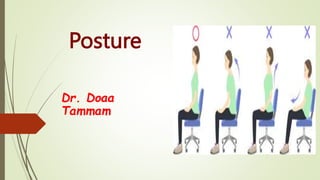
Posture
Dr. Doaa
Tammam
Definitions of Posture
Posture is a “position or attitude of the body, the
relative arrangement of body parts for a specific
activity, or a characteristic manner of bearing one’s
body.”
It is alignment of the body parts whether upright,
sitting. It is described by the positions of the joints
and body segments and also in terms of the balance
between the muscles crossing the joints.
Impairments in the joints, muscles, or connective tissues
may lead to faulty postures.
Many musculoskeletal complaints can be attributed to stresses that
occur from repetitive or sustained activities
(habitually faulty postural alignment).
Curves of the Spine
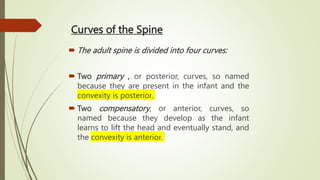
 The adult spine is divided into four curves:
 Two primary , or posterior, curves, so named
because they are present in the infant and the
convexity is posterior.
 Two compensatory, or anterior, curves, so
named because they develop as the infant
learns to lift the head and eventually stand, and
the convexity is anterior.
Postural Alignment
Gravity places stress on the structures responsible for
maintaining the body upright and therefore provides a
continual challenge to stability and efficient movement.
For a weight-bearing joint to be stable, or in
equilibrium, the gravity line of the mass must fall exactly
through the axis of rotation, or there must be a force to
counteract the moment caused by gravity.
 In the body, the counterforce is provided by either
muscle or inert structures. In addition, the standing
posture usually involves a slight anterior/posterior
swaying of the body of about 4 centimeters (cm), so
muscles are necessary to control the sway and maintain
equilibrium.
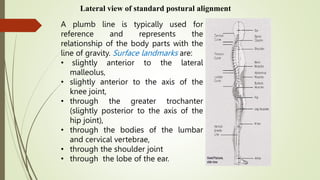
A plumb line is typically used for
reference and represents the
relationship of the body parts with the
line of gravity. Surface landmarks are:
• slightly anterior to the lateral
malleolus,
• slightly anterior to the axis of the
knee joint,
• through the greater trochanter
(slightly posterior to the axis of the
hip joint),
• through the bodies of the lumbar
and cervical vertebrae,
• through the shoulder joint
• through the lobe of the ear.
Lateral view of standard postural alignment
Types of posture:
 1-Static Posture:
• Body segments aligned and maintained in certain positions
(standing, lying, and sitting).
• No mechanical work is performed.
• Muscle tension equal external load (isometric contraction).
 2.Dynamic posture:
• Body segments are moving (walking, jumping, throwing, and
lifting).
• The bones, joints, and ligaments provide major torque needed
to counteract gravity.
Postural
Stability in
the Spine
Spinal stability is
described in terms of
three subsystems:
• Passive (inert structures/bones
and ligaments),
• Active (muscles)
• Neural control
The three subsystems are interrelated
and can be thought of as a three-legged
stool; if any one of the legs is not
providing support, it affects the stability of
the whole.
Instability of a spinal segment is often a
combination of tissue damage, insufficient
muscular strength or endurance, and poor
neuromuscular control.
A spinal segment
consists of the
following:
• Two vertebrae
• An intervertebral disc
between the two
vertebrae
• Two nerve roots that
leave the spinal cord,
one on each side
Inert Structures: Influence on Stability
 ROM of any one segment is divided into
an elastic zone neutral zone.
 When spinal segments are in the neutral zone (midrange/neutral range)
the inert joint capsules and ligaments provide minimal passive resistance to
motion and therefore minimal stability.
As a segment moves into the elastic zone,
the inert structures provide restraint as passive resistance
to the motion occurs. When a structure limits movement in a
specific direction, it provides stability in that direction.
In addition to the inert tissues, the sensory receptors in
the joint capsules and ligaments sense position and
changes in position. Stimulation of these receptors
provides feedback to the CNS, thus influencing the
neural control system.
Muscles: Influence on Stability
Role of Global and Core Muscle Activity
 The muscles of the neck and trunk act as

 Both superficial and deep muscles function to maintain the
upright posture. The global muscles, being multisegmental, are
the large guy wires that respond to external loads imposed on
the trunk that shift the center of mass.
 Their reaction is direction-specific to control spinal orientation.
they are important stabilizers of
the spine. Without the dynamic
stabilizing activity from the trunk
muscles, the spine would collapse
in the upright position.
prime movers or as
antagonists to movement
caused by gravity during
dynamic activity,
Muscles of the Spine
Lumbar spine
 Rectus abdominis (RA) Internal obliques (IO) and external obliques
(EO)
 Trunk flexion (sit-up and curl-up exercises). Bilateral contraction causes
trunk flexion;
 EO on one side with IO on contralateral side together cause diagonal
trunk rotation with flexion;
 EO and IO on same side cause side bending of trunk
 Transversus abdominis (TrA)
 Contributes to rotation
Quadratus lumborum (QL
Pelvic hiking and side bending of the spine
Multifidus Intersegmental rotators and
intertransversarii
Spinal extension and contralateral rotation
Superficial erector spinae (ES) muscles (iliocostalis,
longissimus, spinalis)
Primary trunk extensors; extend thorax on pelvis causing
spinal backward bending;
Iliopsoas (iliacus and psoas major)
Primary hip flexors and indirectly lumbar extensors
Cervical spine
 Sternocleidomastoid and scalene group
o Bilateral contraction causes cervical flexion;
o unilateral contraction causes side bending with contralateral rotation and flexion
 When the neck is stabilized, the scalenes elevate the upper ribs during inspiration,
and the sternocleidomastoids (SCM) elevate the clavicles and sternum, which assists in inspiration
 Upper trapezius and cervical erector spinae
o Bilateral contraction causes cervical extension;
o unilateral contraction causes side bending
 Levator scapulae
The levator scapulae works with the upper trapezius to elevate the scapulae
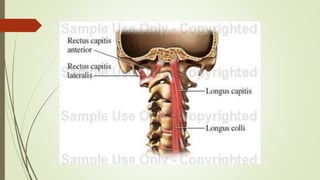
 Longus colli; rectus capitis anterior and lateralis
Craniocervical flexors; longus colli is the prime mover for cervical retraction (axial extension)
Factors affecting Posture
1-Age
Children: At birth, the whole spine is concave forward
or flexed, as the child crawls and looks up, a cervical
lordosis develops. When the child assumes an erect
posture, a lumbar lordosis also develops. Children have
similar postural alignment to an adult by 10 or 11
years
Elderly :have more flexed posture, and wider base of
support.
2- pregnancy:
increase lordotic
curve (cervical and
lumbar), protraction
of shoulder girdle,
Hyperextension of
knees.
4- Occupational changes: evaluate each
person individually, look for "overuse injuries"
(dancers, lifter), repetitive work situations for
changes in postural alignment
5- Handedness: low shoulder on the
dominant hand side.
6-Weak muscles
7-Tight muscles; decreased flexibility
9- Obesity
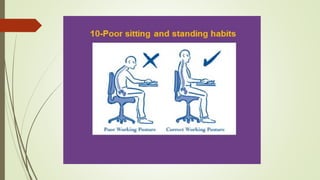
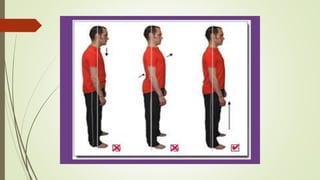
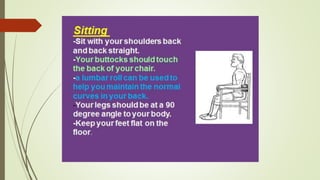
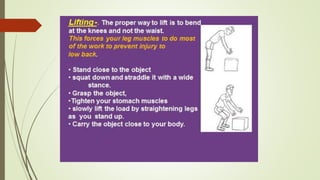
Postural Habits
 Good postural habits in the adult are necessary to
avoid postural pain syndromes and postural
dysfunction.
 Also, careful follow-up in terms of flexibility and
posture training exercises is important after trauma
or surgery to prevent impairments from
contractures and adhesions.
 In the child, good postural habits are important to
avoid abnormal stresses on growing bones and
adaptive changes in muscle and soft tissue.
posture.pptx
posture.pptx
posture.pptx

posture.pptx

  • 1.
  • 2.
    Definitions of Posture Postureis a “position or attitude of the body, the relative arrangement of body parts for a specific activity, or a characteristic manner of bearing one’s body.” It is alignment of the body parts whether upright, sitting. It is described by the positions of the joints and body segments and also in terms of the balance between the muscles crossing the joints.
  • 3.
    Impairments in thejoints, muscles, or connective tissues may lead to faulty postures. Many musculoskeletal complaints can be attributed to stresses that occur from repetitive or sustained activities (habitually faulty postural alignment).
  • 4.
    Curves of theSpine  The adult spine is divided into four curves:  Two primary , or posterior, curves, so named because they are present in the infant and the convexity is posterior.  Two compensatory, or anterior, curves, so named because they develop as the infant learns to lift the head and eventually stand, and the convexity is anterior.
  • 6.
    Postural Alignment Gravity placesstress on the structures responsible for maintaining the body upright and therefore provides a continual challenge to stability and efficient movement. For a weight-bearing joint to be stable, or in equilibrium, the gravity line of the mass must fall exactly through the axis of rotation, or there must be a force to counteract the moment caused by gravity.  In the body, the counterforce is provided by either muscle or inert structures. In addition, the standing posture usually involves a slight anterior/posterior swaying of the body of about 4 centimeters (cm), so muscles are necessary to control the sway and maintain equilibrium.
  • 7.
    A plumb lineis typically used for reference and represents the relationship of the body parts with the line of gravity. Surface landmarks are: • slightly anterior to the lateral malleolus, • slightly anterior to the axis of the knee joint, • through the greater trochanter (slightly posterior to the axis of the hip joint), • through the bodies of the lumbar and cervical vertebrae, • through the shoulder joint • through the lobe of the ear. Lateral view of standard postural alignment
  • 9.
    Types of posture: 1-Static Posture: • Body segments aligned and maintained in certain positions (standing, lying, and sitting). • No mechanical work is performed. • Muscle tension equal external load (isometric contraction).  2.Dynamic posture: • Body segments are moving (walking, jumping, throwing, and lifting). • The bones, joints, and ligaments provide major torque needed to counteract gravity.
  • 10.
    Postural Stability in the Spine Spinalstability is described in terms of three subsystems: • Passive (inert structures/bones and ligaments), • Active (muscles) • Neural control
  • 11.
    The three subsystemsare interrelated and can be thought of as a three-legged stool; if any one of the legs is not providing support, it affects the stability of the whole. Instability of a spinal segment is often a combination of tissue damage, insufficient muscular strength or endurance, and poor neuromuscular control.
  • 12.
    A spinal segment consistsof the following: • Two vertebrae • An intervertebral disc between the two vertebrae • Two nerve roots that leave the spinal cord, one on each side
  • 13.
    Inert Structures: Influenceon Stability  ROM of any one segment is divided into an elastic zone neutral zone.  When spinal segments are in the neutral zone (midrange/neutral range) the inert joint capsules and ligaments provide minimal passive resistance to motion and therefore minimal stability.
  • 14.
    As a segmentmoves into the elastic zone, the inert structures provide restraint as passive resistance to the motion occurs. When a structure limits movement in a specific direction, it provides stability in that direction. In addition to the inert tissues, the sensory receptors in the joint capsules and ligaments sense position and changes in position. Stimulation of these receptors provides feedback to the CNS, thus influencing the neural control system.
  • 15.
    Muscles: Influence onStability Role of Global and Core Muscle Activity  The muscles of the neck and trunk act as   Both superficial and deep muscles function to maintain the upright posture. The global muscles, being multisegmental, are the large guy wires that respond to external loads imposed on the trunk that shift the center of mass.  Their reaction is direction-specific to control spinal orientation. they are important stabilizers of the spine. Without the dynamic stabilizing activity from the trunk muscles, the spine would collapse in the upright position. prime movers or as antagonists to movement caused by gravity during dynamic activity,
  • 16.
    Muscles of theSpine Lumbar spine  Rectus abdominis (RA) Internal obliques (IO) and external obliques (EO)  Trunk flexion (sit-up and curl-up exercises). Bilateral contraction causes trunk flexion;  EO on one side with IO on contralateral side together cause diagonal trunk rotation with flexion;  EO and IO on same side cause side bending of trunk  Transversus abdominis (TrA)  Contributes to rotation
  • 18.
    Quadratus lumborum (QL Pelvichiking and side bending of the spine Multifidus Intersegmental rotators and intertransversarii Spinal extension and contralateral rotation Superficial erector spinae (ES) muscles (iliocostalis, longissimus, spinalis) Primary trunk extensors; extend thorax on pelvis causing spinal backward bending; Iliopsoas (iliacus and psoas major) Primary hip flexors and indirectly lumbar extensors
  • 19.
    Cervical spine  Sternocleidomastoidand scalene group o Bilateral contraction causes cervical flexion; o unilateral contraction causes side bending with contralateral rotation and flexion  When the neck is stabilized, the scalenes elevate the upper ribs during inspiration, and the sternocleidomastoids (SCM) elevate the clavicles and sternum, which assists in inspiration  Upper trapezius and cervical erector spinae o Bilateral contraction causes cervical extension; o unilateral contraction causes side bending  Levator scapulae The levator scapulae works with the upper trapezius to elevate the scapulae  Longus colli; rectus capitis anterior and lateralis Craniocervical flexors; longus colli is the prime mover for cervical retraction (axial extension)
  • 23.
    Factors affecting Posture 1-Age Children:At birth, the whole spine is concave forward or flexed, as the child crawls and looks up, a cervical lordosis develops. When the child assumes an erect posture, a lumbar lordosis also develops. Children have similar postural alignment to an adult by 10 or 11 years Elderly :have more flexed posture, and wider base of support.
  • 24.
    2- pregnancy: increase lordotic curve(cervical and lumbar), protraction of shoulder girdle, Hyperextension of knees.
  • 26.
    4- Occupational changes:evaluate each person individually, look for "overuse injuries" (dancers, lifter), repetitive work situations for changes in postural alignment 5- Handedness: low shoulder on the dominant hand side. 6-Weak muscles 7-Tight muscles; decreased flexibility
  • 27.
  • 30.
    Postural Habits  Goodpostural habits in the adult are necessary to avoid postural pain syndromes and postural dysfunction.  Also, careful follow-up in terms of flexibility and posture training exercises is important after trauma or surgery to prevent impairments from contractures and adhesions.  In the child, good postural habits are important to avoid abnormal stresses on growing bones and adaptive changes in muscle and soft tissue.