Enviromental Control
Systems
Final exam
Project Submission
PASSIVE HEATING SYSTEM
GÖRKEM DİKEN 170201005 ARC252
Introdiction
Industrial and technological innovations, population
growth, and rapid urbanization lead to an increase in
energy consumption.
Dependency on foreign sources of energy and their
negative environmental impact have made energy efficiency
and conservation critical issues.
35–40% of our energy is consumed by buildings, and
85% of that is need solely for heating.
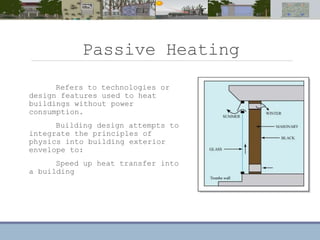
Passive Heating
Refers to technologies or
design features used to heat
buildings without power
consumption.
Building design attempts to
integrate the principles of
physics into building exterior
envelope to:
Speed up heat transfer into
a building
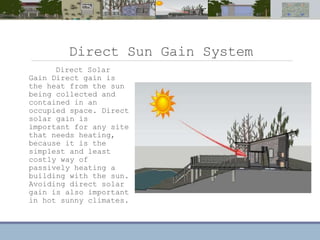
Direct Sun Gain System
Direct Solar
Gain Direct gain is
the heat from the sun
being collected and
contained in an
occupied space. Direct
solar gain is
important for any site
that needs heating,
because it is the
simplest and least
costly way of
passively heating a
building with the sun.
Avoiding direct solar
gain is also important
in hot sunny climates.
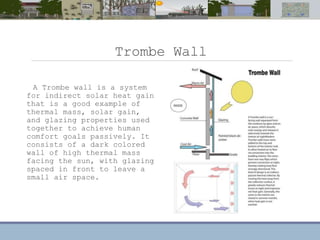
Trombe Wall
A Trombe wall is a system
for indirect solar heat gain
that is a good example of
thermal mass, solar gain,
and glazing properties used
together to achieve human
comfort goals passively. It
consists of a dark colored
wall of high thermal mass
facing the sun, with glazing
spaced in front to leave a
small air space.
Trombe Wall
In summer
•The density of the materials in the Trombe wall acts as a
method of slow heat absorption and transfer.
In winter
•In the winter, when the sun is allowed to shine on them,
they can be ‘charged’ up to help to warm the house by
transferring the sun’s heat inside.
•In the winter, when the surrounding outside air
temperature drops as the air cools after the sun has gone
down, the object with thermal mass will continue to
release its stored heat energy.
•When all the heat is discharged, it is ready to once
again ‘charge’ up or absorb heat again.
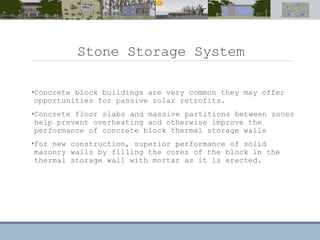
Stone Storage System
•Concrete block buildings are very common they may offer
opportunities for passive solar retrofits.
•Concrete floor slabs and massive partitions between zones
help prevent overheating and otherwise improve the
performance of concrete block thermal storage walls
•For new construction, superior performance of solid
masonry walls by filling the cores of the block in the
thermal storage wall with mortar as it is erected.
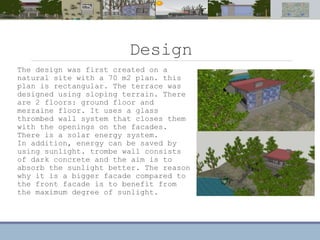
Design
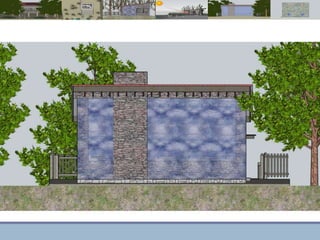
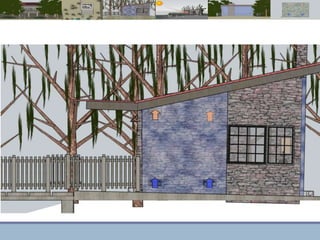
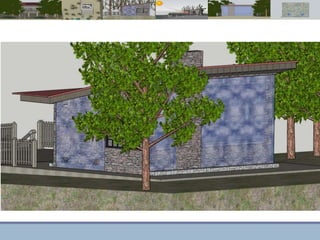
The design was first created on a
natural site with a 70 m2 plan. this
plan is rectangular. The terrace was
designed using sloping terrain. There
are 2 floors: ground floor and
mezzaine floor. It uses a glass
thrombed wall system that closes them
with the openings on the facades.
There is a solar energy system.
In addition, energy can be saved by
using sunlight. trombe wall consists
of dark concrete and the aim is to
absorb the sunlight better. The reason
why it is a bigger facade compared to
the front facade is to benefit from
the maximum degree of sunlight.
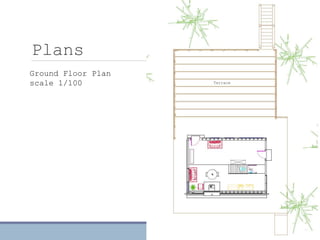
Plans
Ground Floor Plan
scale 1/100 Terrace
wc
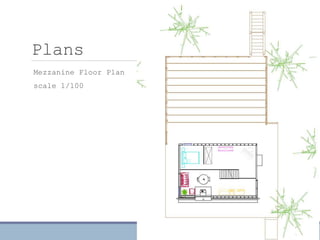
Plans
Mezzanine Floor Plan
scale 1/100
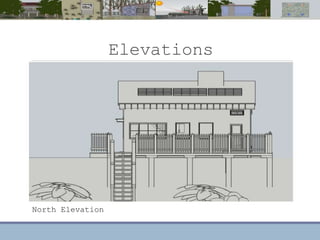
Elevations
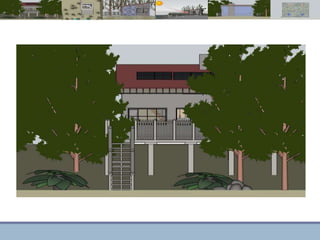
North Elevation
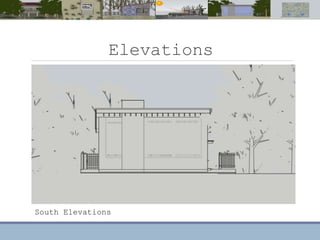
Elevations
South Elevations
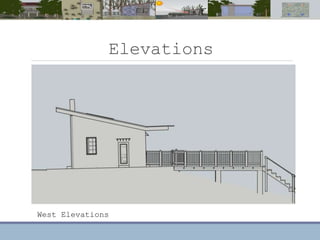
Elevations
West Elevations
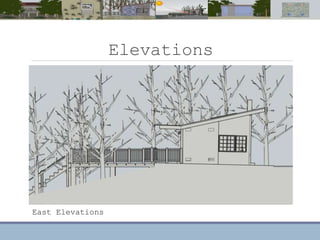
Elevations
East Elevations
Elevations
Top View ElevatiAons
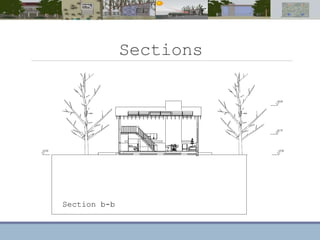
Sections
Section a-a
Sections
Section b-b
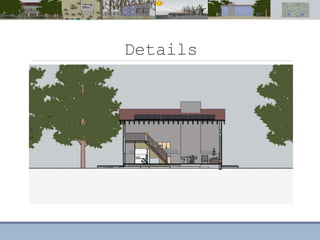
Details
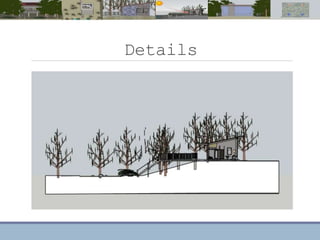
Details
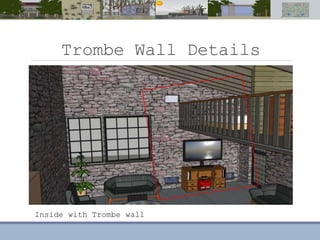
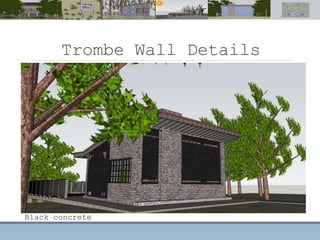
Trombe Wall Details
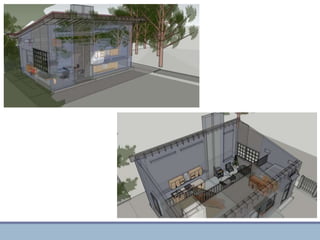
Inside with Trombe wall
Trombe Wall Details
Inside with Trombe wall
Trombe Wall Details
Black concrete
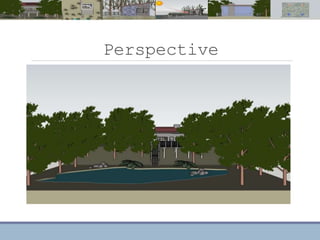
Perspective
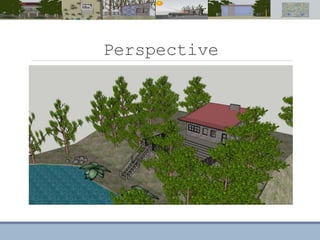
Perspective
Conclusion
•They can perform effortlessly and quietly without
mechanical or electrical assistance.
•Reductions can be made to heating bills by as much as 40%
annually, and also improve the comfort of living spaces.
•Simple techniques can make a huge difference in the
comfort and energy consumption through the years.
•The economical solution to a warmer house in the winter
and a cooler house in the summer is to insulate it well,
while understanding the movement of heat. it is the
better solution.
Passive Heating System
Trombe Wall
Enviromental Control Systems
Final exam
Project Submission
ARC252
Görkem Diken 170201005

passive heating system with trombe wall

  • 1.
    Enviromental Control Systems Final exam ProjectSubmission PASSIVE HEATING SYSTEM GÖRKEM DİKEN 170201005 ARC252
  • 2.
    Introdiction Industrial and technologicalinnovations, population growth, and rapid urbanization lead to an increase in energy consumption. Dependency on foreign sources of energy and their negative environmental impact have made energy efficiency and conservation critical issues. 35–40% of our energy is consumed by buildings, and 85% of that is need solely for heating.
  • 3.
    Passive Heating Refers totechnologies or design features used to heat buildings without power consumption. Building design attempts to integrate the principles of physics into building exterior envelope to: Speed up heat transfer into a building
  • 4.
    Direct Sun GainSystem Direct Solar Gain Direct gain is the heat from the sun being collected and contained in an occupied space. Direct solar gain is important for any site that needs heating, because it is the simplest and least costly way of passively heating a building with the sun. Avoiding direct solar gain is also important in hot sunny climates.
  • 5.
    Trombe Wall A Trombewall is a system for indirect solar heat gain that is a good example of thermal mass, solar gain, and glazing properties used together to achieve human comfort goals passively. It consists of a dark colored wall of high thermal mass facing the sun, with glazing spaced in front to leave a small air space.
  • 6.
    Trombe Wall In summer •Thedensity of the materials in the Trombe wall acts as a method of slow heat absorption and transfer. In winter •In the winter, when the sun is allowed to shine on them, they can be ‘charged’ up to help to warm the house by transferring the sun’s heat inside. •In the winter, when the surrounding outside air temperature drops as the air cools after the sun has gone down, the object with thermal mass will continue to release its stored heat energy. •When all the heat is discharged, it is ready to once again ‘charge’ up or absorb heat again.
  • 10.
    Stone Storage System •Concreteblock buildings are very common they may offer opportunities for passive solar retrofits. •Concrete floor slabs and massive partitions between zones help prevent overheating and otherwise improve the performance of concrete block thermal storage walls •For new construction, superior performance of solid masonry walls by filling the cores of the block in the thermal storage wall with mortar as it is erected.
  • 11.
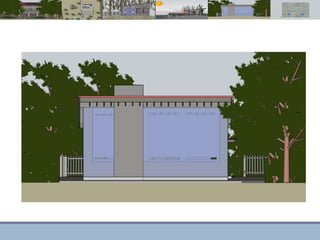
    Design The design wasfirst created on a natural site with a 70 m2 plan. this plan is rectangular. The terrace was designed using sloping terrain. There are 2 floors: ground floor and mezzaine floor. It uses a glass thrombed wall system that closes them with the openings on the facades. There is a solar energy system. In addition, energy can be saved by using sunlight. trombe wall consists of dark concrete and the aim is to absorb the sunlight better. The reason why it is a bigger facade compared to the front facade is to benefit from the maximum degree of sunlight.
  • 12.
  • 13.
  • 14.
  • 15.
  • 16.
  • 17.
  • 18.
  • 19.
  • 20.
  • 21.
  • 22.
  • 23.
  • 24.
  • 25.
  • 26.
  • 27.
  • 31.
    Conclusion •They can performeffortlessly and quietly without mechanical or electrical assistance. •Reductions can be made to heating bills by as much as 40% annually, and also improve the comfort of living spaces. •Simple techniques can make a huge difference in the comfort and energy consumption through the years. •The economical solution to a warmer house in the winter and a cooler house in the summer is to insulate it well, while understanding the movement of heat. it is the better solution.
  • 32.
    Passive Heating System TrombeWall Enviromental Control Systems Final exam Project Submission ARC252 Görkem Diken 170201005