Enviromental Control
Systems
Midterm exam
Project Submission
PASSIVE COOLING SYSTEM
GÖRKEM DİKEN 170201005 ARC252
PASSIVE COOLING
Passive cooling is
a building design
approach that focuses
on heat gain control
and heat dissipation in
a building in order to
improve the indoor
thermal comfort with
low or no energy
consumption.
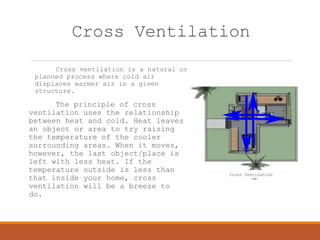
Cross Ventilation
Cross ventilation is a natural or
planned process where cold air
displaces warmer air in a given
structure.
The principle of cross
ventilation uses the relationship
between heat and cold. Heat leaves
an object or area to try raising
the temperature of the cooler
surrounding areas. When it moves,
however, the last object/place is
left with less heat. If the
temperature outside is less than
that inside your home, cross
ventilation will be a breeze to
do.
Cross Ventilation
Two ways to practice cross ventilation are:
Opening windows opposite each other in a building
Using a fan to direct the air
The importance of the tree in
passive cooling
Trees and shrubs are a very
effective means of improving the
climate on a larger scale. They
are the simplest way of shading
outdoor space and buildings.
It is important to select
the appropriate type of tree One
simple solution for regulating
shading by trees throughout the
year is the use of deciduous
trees, which provide shade during
the hot season and allow solar
radiation in winter.
Another factor that can help
in the selection of the right tree
is its "cooling factor".
Shading devices for all openings
Shutters for Windows
A window shutter is a solid
and stable window covering
usually consisting of a frame
of vertical stiles and
horizontal rails (top, centre
and bottom). Set within this
frame can be louvers .
Shutters may be employed for
a variety of reasons,
including controlling the
amount of sunlight that
enters a rooom.
Awning
An awning or overhang is a
secondary covering attached to
the exterior wall of a
building. It is typically
composed of canvas woven of
acrylic, cotton or polyester
yarn, or vinyl laminated to
polyester fabric that is
stretched tightly over a light
structure of aluminium, iron
or steel, possibly wood or
transparent material.
DESING
The design was first created with a 2
bedroom and 100 m2 plan. this plan is
rectangular. There are balconies. Windows
and other openings are placed on the cross.
There are also openings in the roof design
and it will be used for ventilation. Also,
energy savings can be made by taking
advantage of the sunlight. afforestation is
deciduous trees and provides shade in
summer. The designed wind tower is
vertical, distributes the air directly to
the house and balances the air inside, the
design of the tower can reach every part of
the house. this design is intended as a
farmhouse and can be used in an arid and
hot summer region.
PLAN
East ELevation
North Elevation
South Elevation
West Elevatıon
Section A-A
Section B-B
WIND TOWER
Wind tower is a key element
in traditional architecture of
Iran. It is seen in settlements in
hot, hot-dry and hot-humid
climates. This architectural
element shows the compatibility of
architectural design with natural
environment. It conserves energy
and functions on the basis of
sustainability principles.
A wind tower is an
architectural device used for many
centuries to create natural
ventilation in buildings.
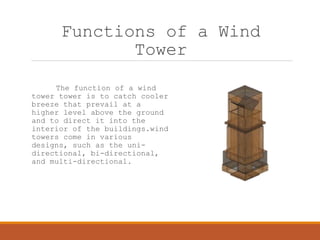
Functions of a Wind
Tower
The function of a wind
tower tower is to catch cooler
breeze that prevail at a
higher level above the ground
and to direct it into the
interior of the buildings.wind
towers come in various
designs, such as the uni-
directional, bi-directional,
and multi-directional.
Wınd Tower Drawıng
Wınd Tower Drawıng
DIRECTING AND COOLING WITH
WIND TOWER
DIRECTING AND COOLING WITH
WIND TOWER
The wind entering the tower regulates the air inside and
spreads throughout the house.
CONCLUSİON
In today’s world, the significance of energy and
energy conservation is a common knowledge. Wind towers
can save the electrical energy used to provide thermal
comfort during the warm months of the year, especially
during the peak hours. . The major advantage of wind
towers is that they are passive systems requiring no
energy for operation. Also, wind towers reduce electrical
energy consumption and environmental pollution.
PASSIVE COOLING SYSTEM
WIND TOWER DESIGN
Enviromental Control Systems
Midterm exam
Project Submission
ARC252
GÖRKEM Diken 170201005

Arc 252 enviromental control systems

  • 1.
    Enviromental Control Systems Midterm exam ProjectSubmission PASSIVE COOLING SYSTEM GÖRKEM DİKEN 170201005 ARC252
  • 2.
    PASSIVE COOLING Passive coolingis a building design approach that focuses on heat gain control and heat dissipation in a building in order to improve the indoor thermal comfort with low or no energy consumption.
  • 3.
    Cross Ventilation Cross ventilationis a natural or planned process where cold air displaces warmer air in a given structure. The principle of cross ventilation uses the relationship between heat and cold. Heat leaves an object or area to try raising the temperature of the cooler surrounding areas. When it moves, however, the last object/place is left with less heat. If the temperature outside is less than that inside your home, cross ventilation will be a breeze to do.
  • 4.
    Cross Ventilation Two waysto practice cross ventilation are: Opening windows opposite each other in a building Using a fan to direct the air
  • 5.
    The importance ofthe tree in passive cooling Trees and shrubs are a very effective means of improving the climate on a larger scale. They are the simplest way of shading outdoor space and buildings. It is important to select the appropriate type of tree One simple solution for regulating shading by trees throughout the year is the use of deciduous trees, which provide shade during the hot season and allow solar radiation in winter. Another factor that can help in the selection of the right tree is its "cooling factor".
  • 7.
    Shading devices forall openings Shutters for Windows A window shutter is a solid and stable window covering usually consisting of a frame of vertical stiles and horizontal rails (top, centre and bottom). Set within this frame can be louvers . Shutters may be employed for a variety of reasons, including controlling the amount of sunlight that enters a rooom. Awning An awning or overhang is a secondary covering attached to the exterior wall of a building. It is typically composed of canvas woven of acrylic, cotton or polyester yarn, or vinyl laminated to polyester fabric that is stretched tightly over a light structure of aluminium, iron or steel, possibly wood or transparent material.
  • 9.
    DESING The design wasfirst created with a 2 bedroom and 100 m2 plan. this plan is rectangular. There are balconies. Windows and other openings are placed on the cross. There are also openings in the roof design and it will be used for ventilation. Also, energy savings can be made by taking advantage of the sunlight. afforestation is deciduous trees and provides shade in summer. The designed wind tower is vertical, distributes the air directly to the house and balances the air inside, the design of the tower can reach every part of the house. this design is intended as a farmhouse and can be used in an arid and hot summer region.
  • 10.
  • 12.
  • 13.
  • 14.
  • 15.
  • 16.
  • 17.
  • 18.
    WIND TOWER Wind toweris a key element in traditional architecture of Iran. It is seen in settlements in hot, hot-dry and hot-humid climates. This architectural element shows the compatibility of architectural design with natural environment. It conserves energy and functions on the basis of sustainability principles. A wind tower is an architectural device used for many centuries to create natural ventilation in buildings.
  • 19.
    Functions of aWind Tower The function of a wind tower tower is to catch cooler breeze that prevail at a higher level above the ground and to direct it into the interior of the buildings.wind towers come in various designs, such as the uni- directional, bi-directional, and multi-directional.
  • 20.
  • 21.
  • 22.
    DIRECTING AND COOLINGWITH WIND TOWER
  • 23.
    DIRECTING AND COOLINGWITH WIND TOWER The wind entering the tower regulates the air inside and spreads throughout the house.
  • 29.
    CONCLUSİON In today’s world,the significance of energy and energy conservation is a common knowledge. Wind towers can save the electrical energy used to provide thermal comfort during the warm months of the year, especially during the peak hours. . The major advantage of wind towers is that they are passive systems requiring no energy for operation. Also, wind towers reduce electrical energy consumption and environmental pollution.
  • 30.
    PASSIVE COOLING SYSTEM WINDTOWER DESIGN Enviromental Control Systems Midterm exam Project Submission ARC252 GÖRKEM Diken 170201005