1 | P a g e
DELHI PUBLIC SCHOOL, BANGALORE NORTH
PHYSICS
INVESTIGATORY PROJECT
(2022-2023)
TOPIC: RAFT POWERED BY SURFACE TENSION
BOARD ROLL NO:
2 | P a g e
INDEX
S.No Pg.No
1 Certificate
2 Acknowledgement
3 Aim
4 Theory
5 Diagram
6 Apparatus
7 Procedure
8 Observations
9 Calculation
10 Conclusion
11 Bibliography
3 | P a g e
CERTIFICATE
This is to certify that the physics project “Raft
powered by Surface Tenison” submitted by
candidate, of class XI
appearing for physics practical of the Central
Board of Secondary Education 2022-2023.
Signature of :
INTERNAL EXAMINER EXTERNAL EXAMINER
PRINCIPAL TEACHER
4 | P a g e
ACKNOWLEDGEMENT
I am thankful for the help and co-operation of
the school authorities, my physics teacher,
Mrs
and the lab assistant,
Mrs for the successful
completion of the investigatory project,”
Refractive index of a liquid by using a plane
mirror and convex lens”.
I am also thankful to the school for letting me
use their resources to complete my project.
I would also like to express my gratitude to my
parents and friends for their well-meant
support and giving helping hand whenever
required.
NAME OF CANDIDATE:
5 | P a g e
AIM
To investigate how a small raft made from a clear
plastic sheet can be propelled by water surface
tension.
INTRODUCTION
Surface tension is broadly defined as the energy required to
increase the surface area by a unit amount.
SURFACE TENSION IN LIQUIDS: It is defined as the
property of liquid by virtue of which the surface of a liquid at rest
tends to have minimum area and behaves like it is covered by a
stretched membrane. The molecules of the liquid experience
intermolecular attractions, or cohesive forces, which means the
molecules are pulling and pushing away from each other, just like
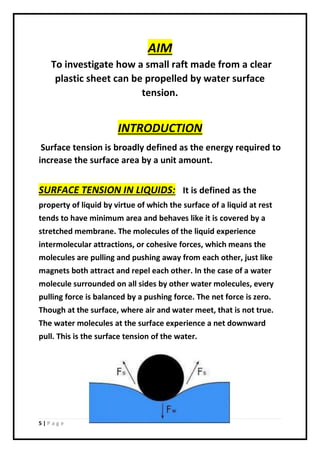
magnets both attract and repel each other. In the case of a water
molecule surrounded on all sides by other water molecules, every
pulling force is balanced by a pushing force. The net force is zero.
Though at the surface, where air and water meet, that is not true.
The water molecules at the surface experience a net downward
pull. This is the surface tension of the water.
6 | P a g e
Water molecules like to interact with each other because they are
polar molecules, meaning they have positively and negatively
charged sides. Similar to a group of magnets, the water molecules
arrange themselves so that the positive sides are away from each
other, but can interact with the negative sides. Other polar
molecules also interact with water molecules. Molecules that
interact with, and are dissolved by water are called hydrophilic
molecules. There are also molecules that do not like to interact
with water. They are hydrophobic. If a molecule that has both
hydrophilic and hydrophobic parts is added to water, the
hydrophilic end will try to get close to the water molecules while
the hydrophilic end will push away from the water. This pulling and
pushing separates the water molecules from each other and
decreases the surface tension because of this. Compounds that
lower the surface tension of water are known as surfactants.
Common effects of surface tension:
Surface tension has many effects observed in daily life. These may
include –
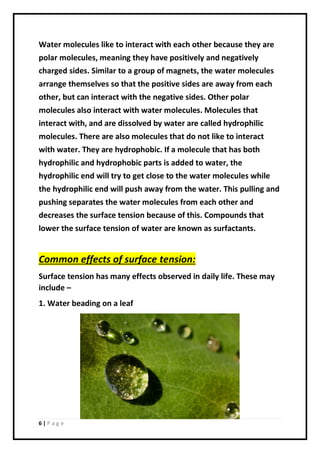
1. Water beading on a leaf
7 | P a g e
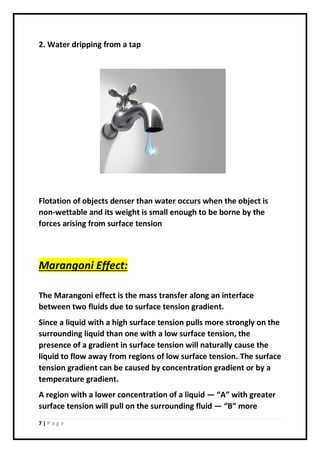
2. Water dripping from a tap
Flotation of objects denser than water occurs when the object is
non-wettable and its weight is small enough to be borne by the
forces arising from surface tension
Marangoni Effect:
The Marangoni effect is the mass transfer along an interface
between two fluids due to surface tension gradient.
Since a liquid with a high surface tension pulls more strongly on the
surrounding liquid than one with a low surface tension, the
presence of a gradient in surface tension will naturally cause the
liquid to flow away from regions of low surface tension. The surface
tension gradient can be caused by concentration gradient or by a
temperature gradient.
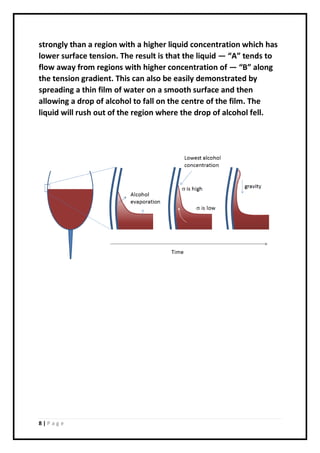
A region with a lower concentration of a liquid ― “A” with greater
surface tension will pull on the surrounding fluid ― “B” more
8 | P a g e
strongly than a region with a higher liquid concentration which has
lower surface tension. The result is that the liquid ― “A” tends to
flow away from regions with higher concentration of ― “B” along
the tension gradient. This can also be easily demonstrated by
spreading a thin film of water on a smooth surface and then
allowing a drop of alcohol to fall on the centre of the film. The
liquid will rush out of the region where the drop of alcohol fell.
9 | P a g e
Materials and Equipment
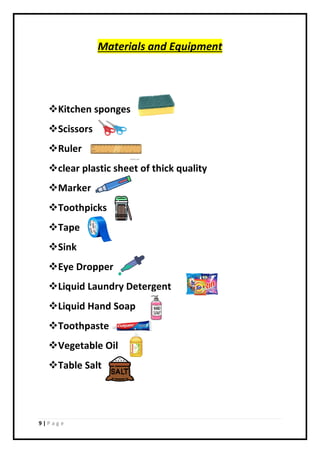
Kitchen sponges
Scissors
Ruler
clear plastic sheet of thick quality
Marker
Toothpicks
Tape
Sink
Eye Dropper
Liquid Laundry Detergent
Liquid Hand Soap
Toothpaste
Vegetable Oil
Table Salt
10 | P a g e
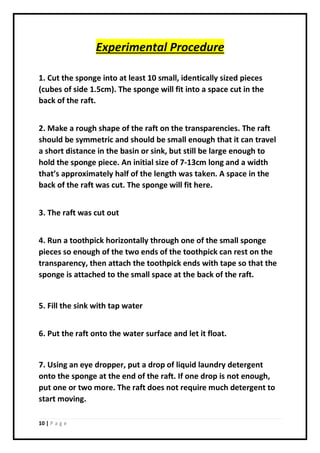
Experimental Procedure
1. Cut the sponge into at least 10 small, identically sized pieces
(cubes of side 1.5cm). The sponge will fit into a space cut in the
back of the raft.
2. Make a rough shape of the raft on the transparencies. The raft
should be symmetric and should be small enough that it can travel
a short distance in the basin or sink, but still be large enough to
hold the sponge piece. An initial size of 7-13cm long and a width
that’s approximately half of the length was taken. A space in the
back of the raft was cut. The sponge will fit here.
3. The raft was cut out
4. Run a toothpick horizontally through one of the small sponge
pieces so enough of the two ends of the toothpick can rest on the
transparency, then attach the toothpick ends with tape so that the
sponge is attached to the small space at the back of the raft.
5. Fill the sink with tap water
6. Put the raft onto the water surface and let it float.
7. Using an eye dropper, put a drop of liquid laundry detergent
onto the sponge at the end of the raft. If one drop is not enough,
put one or two more. The raft does not require much detergent to
start moving.
11 | P a g e
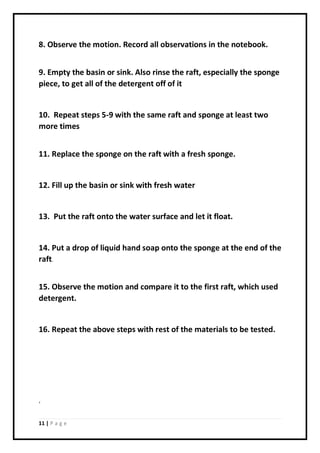
8. Observe the motion. Record all observations in the notebook.
9. Empty the basin or sink. Also rinse the raft, especially the sponge
piece, to get all of the detergent off of it
10. Repeat steps 5-9 with the same raft and sponge at least two
more times
11. Replace the sponge on the raft with a fresh sponge.
12. Fill up the basin or sink with fresh water
13. Put the raft onto the water surface and let it float.
14. Put a drop of liquid hand soap onto the sponge at the end of the
raft.
15. Observe the motion and compare it to the first raft, which used
detergent.
16. Repeat the above steps with rest of the materials to be tested.
‘
12 | P a g e
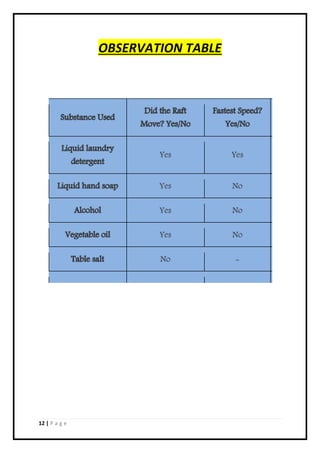
OBSERVATION TABLE
13 | P a g e
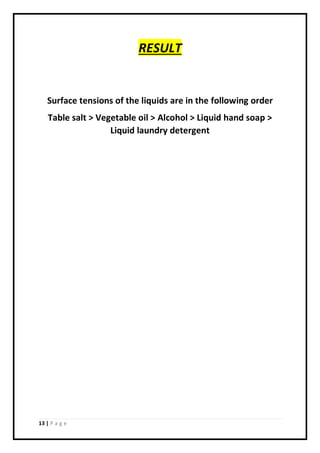
RESULT
Surface tensions of the liquids are in the following order
Table salt > Vegetable oil > Alcohol > Liquid hand soap >
Liquid laundry detergent
14 | P a g e
BIBILIOGRAPHY
 NCERT PHYSICS BOOK (CLASS 11)
 WWW.SCRIBD.COM
 WWW.WIKIPEDIA.ORG
 WWW.SCIENCEBUDDIES.ORG

Physics project class 11.pdf

  • 1.
    1 | Pa g e DELHI PUBLIC SCHOOL, BANGALORE NORTH PHYSICS INVESTIGATORY PROJECT (2022-2023) TOPIC: RAFT POWERED BY SURFACE TENSION BOARD ROLL NO:
  • 2.
    2 | Pa g e INDEX S.No Pg.No 1 Certificate 2 Acknowledgement 3 Aim 4 Theory 5 Diagram 6 Apparatus 7 Procedure 8 Observations 9 Calculation 10 Conclusion 11 Bibliography
  • 3.
    3 | Pa g e CERTIFICATE This is to certify that the physics project “Raft powered by Surface Tenison” submitted by candidate, of class XI appearing for physics practical of the Central Board of Secondary Education 2022-2023. Signature of : INTERNAL EXAMINER EXTERNAL EXAMINER PRINCIPAL TEACHER
  • 4.
    4 | Pa g e ACKNOWLEDGEMENT I am thankful for the help and co-operation of the school authorities, my physics teacher, Mrs and the lab assistant, Mrs for the successful completion of the investigatory project,” Refractive index of a liquid by using a plane mirror and convex lens”. I am also thankful to the school for letting me use their resources to complete my project. I would also like to express my gratitude to my parents and friends for their well-meant support and giving helping hand whenever required. NAME OF CANDIDATE:
  • 5.
    5 | Pa g e AIM To investigate how a small raft made from a clear plastic sheet can be propelled by water surface tension. INTRODUCTION Surface tension is broadly defined as the energy required to increase the surface area by a unit amount. SURFACE TENSION IN LIQUIDS: It is defined as the property of liquid by virtue of which the surface of a liquid at rest tends to have minimum area and behaves like it is covered by a stretched membrane. The molecules of the liquid experience intermolecular attractions, or cohesive forces, which means the molecules are pulling and pushing away from each other, just like magnets both attract and repel each other. In the case of a water molecule surrounded on all sides by other water molecules, every pulling force is balanced by a pushing force. The net force is zero. Though at the surface, where air and water meet, that is not true. The water molecules at the surface experience a net downward pull. This is the surface tension of the water.
  • 6.
    6 | Pa g e Water molecules like to interact with each other because they are polar molecules, meaning they have positively and negatively charged sides. Similar to a group of magnets, the water molecules arrange themselves so that the positive sides are away from each other, but can interact with the negative sides. Other polar molecules also interact with water molecules. Molecules that interact with, and are dissolved by water are called hydrophilic molecules. There are also molecules that do not like to interact with water. They are hydrophobic. If a molecule that has both hydrophilic and hydrophobic parts is added to water, the hydrophilic end will try to get close to the water molecules while the hydrophilic end will push away from the water. This pulling and pushing separates the water molecules from each other and decreases the surface tension because of this. Compounds that lower the surface tension of water are known as surfactants. Common effects of surface tension: Surface tension has many effects observed in daily life. These may include – 1. Water beading on a leaf
  • 7.
    7 | Pa g e 2. Water dripping from a tap Flotation of objects denser than water occurs when the object is non-wettable and its weight is small enough to be borne by the forces arising from surface tension Marangoni Effect: The Marangoni effect is the mass transfer along an interface between two fluids due to surface tension gradient. Since a liquid with a high surface tension pulls more strongly on the surrounding liquid than one with a low surface tension, the presence of a gradient in surface tension will naturally cause the liquid to flow away from regions of low surface tension. The surface tension gradient can be caused by concentration gradient or by a temperature gradient. A region with a lower concentration of a liquid ― “A” with greater surface tension will pull on the surrounding fluid ― “B” more
  • 8.
    8 | Pa g e strongly than a region with a higher liquid concentration which has lower surface tension. The result is that the liquid ― “A” tends to flow away from regions with higher concentration of ― “B” along the tension gradient. This can also be easily demonstrated by spreading a thin film of water on a smooth surface and then allowing a drop of alcohol to fall on the centre of the film. The liquid will rush out of the region where the drop of alcohol fell.
  • 9.
    9 | Pa g e Materials and Equipment Kitchen sponges Scissors Ruler clear plastic sheet of thick quality Marker Toothpicks Tape Sink Eye Dropper Liquid Laundry Detergent Liquid Hand Soap Toothpaste Vegetable Oil Table Salt
  • 10.
    10 | Pa g e Experimental Procedure 1. Cut the sponge into at least 10 small, identically sized pieces (cubes of side 1.5cm). The sponge will fit into a space cut in the back of the raft. 2. Make a rough shape of the raft on the transparencies. The raft should be symmetric and should be small enough that it can travel a short distance in the basin or sink, but still be large enough to hold the sponge piece. An initial size of 7-13cm long and a width that’s approximately half of the length was taken. A space in the back of the raft was cut. The sponge will fit here. 3. The raft was cut out 4. Run a toothpick horizontally through one of the small sponge pieces so enough of the two ends of the toothpick can rest on the transparency, then attach the toothpick ends with tape so that the sponge is attached to the small space at the back of the raft. 5. Fill the sink with tap water 6. Put the raft onto the water surface and let it float. 7. Using an eye dropper, put a drop of liquid laundry detergent onto the sponge at the end of the raft. If one drop is not enough, put one or two more. The raft does not require much detergent to start moving.
  • 11.
    11 | Pa g e 8. Observe the motion. Record all observations in the notebook. 9. Empty the basin or sink. Also rinse the raft, especially the sponge piece, to get all of the detergent off of it 10. Repeat steps 5-9 with the same raft and sponge at least two more times 11. Replace the sponge on the raft with a fresh sponge. 12. Fill up the basin or sink with fresh water 13. Put the raft onto the water surface and let it float. 14. Put a drop of liquid hand soap onto the sponge at the end of the raft. 15. Observe the motion and compare it to the first raft, which used detergent. 16. Repeat the above steps with rest of the materials to be tested. ‘
  • 12.
    12 | Pa g e OBSERVATION TABLE
  • 13.
    13 | Pa g e RESULT Surface tensions of the liquids are in the following order Table salt > Vegetable oil > Alcohol > Liquid hand soap > Liquid laundry detergent
  • 14.
    14 | Pa g e BIBILIOGRAPHY  NCERT PHYSICS BOOK (CLASS 11)  WWW.SCRIBD.COM  WWW.WIKIPEDIA.ORG  WWW.SCIENCEBUDDIES.ORG