Oxford Public School
Ranchi
Session: 2020-21
Chemistry Project
TOPIC:-
A comparative study on different
brands of tea leaves
Submitted by- Submitted to-
Name: Rema Deosi Sundi S. Pradhan
Class: XII A PGT (Chem.)
Class roll no.: 40
Board roll no.:
Certificate
This is to certify that Rema Deosi Sundi of class
XII A of Oxford Public School, Ranchi has
completed her project file under the
supervision of Mr. S. Pradhan. She has taken
care and shown sincerity in completion of this
project.
I hereby certify that this project is upto my
expectations and guidance issued by CBSE.
Internal External
Signature Signature
Acknowledgement
I would like to express my greatest
gratitude to the people who helped
and supported me throughout my
project. I am thankful to my parents
for helping me in completion of this
project. I am grateful to Mr. S. Pradhan
whose valuable guidance has been the
ones that helped me patch this project
and make it full proof success. I would
also like to express my gratitude to the
Principal Mr. Suraj Sharma for his
constant motivation during the course
of this investigation.
Name: Rema Deosi Sundi
Class: XII A
Board roll no.:
CONTENTS
S.No. Heading Page
No.
1. Objective 1
2. Introduction 2-3
3. Tea Chemistry 4-6
4. The components of tea:-
-Caffeine
-Amino acids
-Tea Fiber
-Anthocyanidins
-Carbohydrate
-Organic acids
-Lipids and fatty acids
7-10
5. Experiments carried out:-
-Experiments 1
-Experiments 2
-Experiments 3
11-16
6. Conclusion 17-18
7. Bibliography 19
Objective of this project
In this project we will study
the components of tea and its
content in different tea
brands and its flavoring effect
on it.
INTRODUCTION
Tea is the most commonly and widely used soft beverage in the
household. It acts as a stimulate for central nervous system and
skeletal muscles. That is why tea removes fatigue, tiredness and
headache. It also increases the capacity of thinking. It is also used
for lowering body temperature. The principle constituent of tea,
whichisresponsibleforalltheseproperties,isthealkaloid-caffeine.
The amount of caffeine in tea leaves varies from sample to sample.
Originally it was thought that caffeine is responsible for the taste
and flavour of tea. But pure caffeine has been found to be a
tasteless while substance. Therefore, the taste and flavour of tea is
due to some other substance present in it. There is a little doubt
that the popularity of the xanthenes beverages depends on their
stimulate action, although most people are unaware of any
stimulation. The degree to which an individual is stimulated by
given amount of caffeine varies from individual to individual.
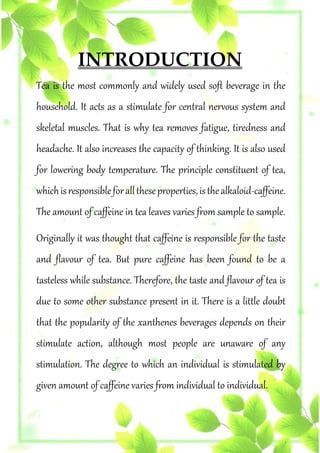
Teaismadefromtheyoungleaves
and buds of the tea plant. Besides caffeine, tea leaves contain tannic
acid and colouring matter, such as polyphenolic compounds. The
relative amounts of these substances are different in different varieties
of tea leaves, that is why, their taste and flavour are different.
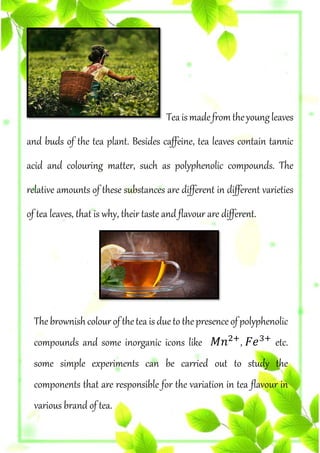
The brownishcolour ofthetea is due to thepresence ofpolyphenolic
compounds and some inorganic icons like 𝑀𝑛2+
, 𝐹𝑒3+
etc.
some simple experiments can be carried out to study the
components that are responsible for the variation in tea flavour in
various brand of tea.
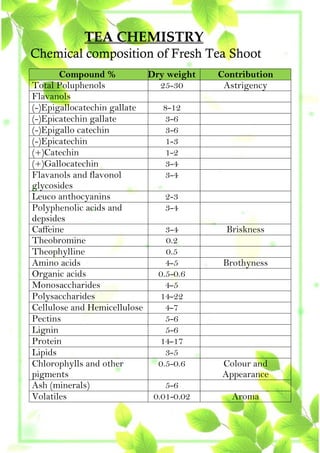
TEA CHEMISTRY
Chemical composition of Fresh Tea Shoot
Compound % Dry weight Contribution
Total Poluphenols 25-30 Astrigency
Flavanols
(-)Epigallocatechin gallate 8-12
(-)Epicatechin gallate 3-6
(-)Epigallo catechin 3-6
(-)Epicatechin 1-3
(+)Catechin 1-2
(+)Gallocatechin 3-4
Flavanols and flavonol
glycosides
3-4
Leuco anthocyanins 2-3
Polyphenolic acids and
depsides
3-4
Caffeine 3-4 Briskness
Theobromine 0.2
Theophylline 0.5
Amino acids 4-5 Brothyness
Organic acids 0.5-0.6
Monosaccharides 4-5
Polysaccharides 14-22
Cellulose and Hemicellulose 4-7
Pectins 5-6
Lignin 5-6
Protein 14-17
Lipids 3-5
Chlorophylls and other
pigments
0.5-0.6 Colour and
Appearance
Ash (minerals) 5-6
Volatiles 0.01-0.02 Aroma
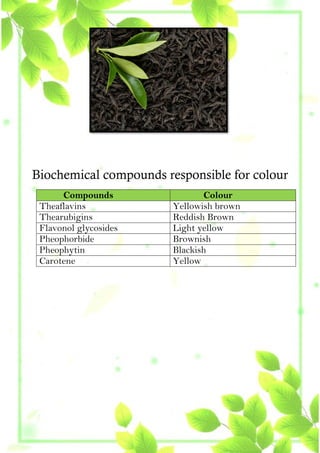
Biochemical compounds responsible for colour
Compounds Colour
Theaflavins Yellowish brown
Thearubigins Reddish Brown
Flavonol glycosides Light yellow
Pheophorbide Brownish
Pheophytin Blackish
Carotene Yellow
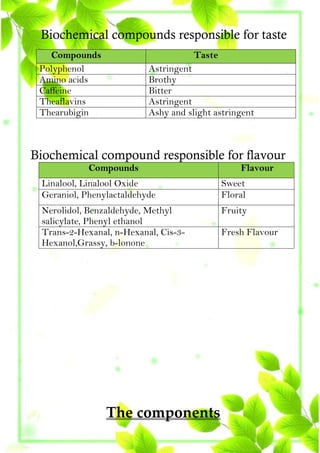
Biochemical compounds responsible for taste
Compounds Taste
Polyphenol Astringent
Amino acids Brothy
Caffeine Bitter
Theaflavins Astringent
Thearubigin Ashy and slight astringent
Biochemical compound responsible for flavour
Compounds Flavour
Linalool, Linalool Oxide Sweet
Geraniol, Phenylactaldehyde Floral
Nerolidol, Benzaldehyde, Methyl
salicylate, Phenyl ethanol
Fruity
Trans-2-Hexanal, n-Hexanal, Cis-3-
Hexanol,Grassy, b-lonone
Fresh Flavour
The components
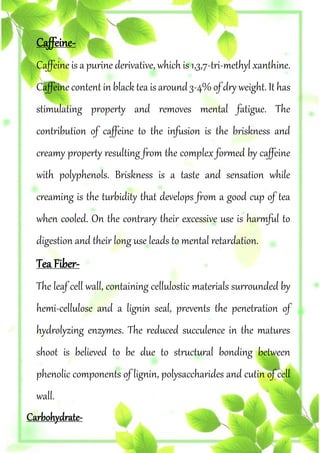
Caffeine-
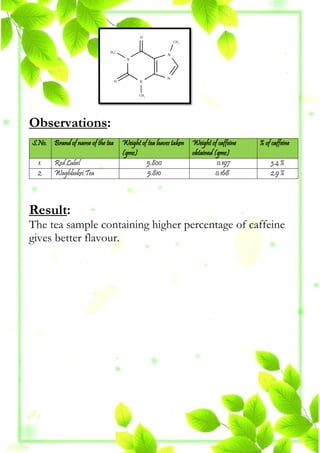
Caffeine is a purine derivative, which is 1,3,7-tri-methyl xanthine.
Caffeine content in black tea is around 3-4% of dry weight. It has
stimulating property and removes mental fatigue. The
contribution of caffeine to the infusion is the briskness and
creamy property resulting from the complex formed by caffeine
with polyphenols. Briskness is a taste and sensation while
creaming is the turbidity that develops from a good cup of tea
when cooled. On the contrary their excessive use is harmful to
digestion and their long use leads to mental retardation.
Tea Fiber-
The leaf cell wall, containing cellulostic materials surrounded by
hemi-cellulose and a lignin seal, prevents the penetration of
hydrolyzing enzymes. The reduced succulence in the matures
shoot is believed to be due to structural bonding between
phenolic components of lignin, polysaccharides and cutin of cell
wall.
Carbohydrate-
The free sugars found in tea shoot are glucose, fructose, sucrose,
raffinose and stachyose. Maltose is Assam variety and rhamnose in
China variety appeared special. Pectic substances contain galactose,
arabinose, galacturnic acid, rhamnose and ribose. Free sugars are
responsible and ribose. Free sugars are responsible for the synthesis of
catechins in tea shoot, formation of heterotypic flavour compounds
during processing of black tea and contributing towards water-soluble
solids in tea liquor. Cellulose, hemi-cellulose, pectins and lignins are
responsible for the formation of crude fiber content in black tea.
Amino acids-
Aspartic, glutamic, serine, glutamine, tyrosine, valine, phenylalanine,
leucine, isoleucine and theanine (5-N-ehtylglutamine) were found to be
the principal amino acids present in tea leaf. Theanine alone
contributed around 60% of total amino acid content. Asparagine was
formed during withering. The amino acids play an important role in
the development of tea aroma during the processing of black tea.
Lipids and fatty acids-
The neutral, glycol and phospholipid contents and their fatty
acid composition varied in Assam, China and Cambod varieties
and also during different stages of black tea manufacture. Total
lipid contents(%) and total fatty acids (µg/g) at different stages
i.e. green leaf, withered leaf, rolled leaf, fermented leaf and black
teas are about 6.5, 5.7, 4.5, 4.3 and 2.8 and 9.8, 8.4, 6.6, 4.8 and
3.7 respectively. The major fatty acids available in tea are
linolenic, linoleic, oleic and palmitic.
Anthocyanidins-
Delphenidin and cyaniding were the major anthocyanidins
present in tea leaf. Anthocyanin contents were higher in tea
shoots from pruned than those of unpruned bushes. Role of
anthocyanins on the quality of black tea however, has not been
found to be significant.
Organic acids-
Citric, tartaric, malic, oxalic, fumaric and succine acids were
detected in Assam leaf. Role of organic acids towards the
biochemical influence on the quality of black tea is not yet
reported.
Experiments carried out
Experiment-1
Aim:
Compare the water soluble polyphenol content in the
various samples of tea leaves.
Requirements:
Beakers, conical flasks, funnels, heating arrangement,
tea bags of different brands of tea.
Theory:
Tea contains up to 30% of the water soluble
polyphenols. These are largely responsible for the
flavour of the tea. To estimate the extent of these
compounds in a given sample, the tea leaves are
immersed in hot water for equal time and loss in the
weight of tea leaves is determined.
Procedure:
1.Weigh the different samples of tea and place them in
tea bags.
2.Take three or four conical flasks and put 100ml of hot
water to each of them.
3.Put tea bags of different samples of tea in different
conical flasks. After 10 minutes remove the tea bags
and dry them by placing in an over.
4.When the tea bags become dry, reweigh them.
5.Note the flavour of tea solution obtained.
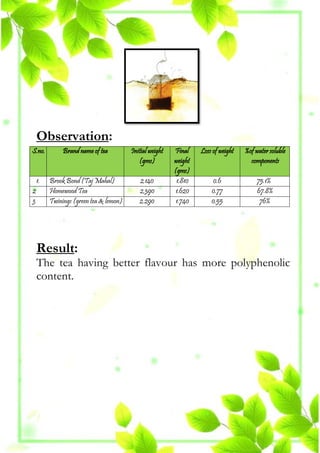
Observation:
S.no. Brand name of tea Initial weight
(gms)
Final
weight
(gms)
Loss of weight %of water soluble
components
1. Brook Bond (Taj Mahal) 2.140 1.810 0.6 75.1%
2 Homewood Tea 2.390 1.620 0.77 67.8%
3 Twinings (green tea & lemon) 2.290 1.740 0.55 76%
Result:
The tea having better flavour has more polyphenolic
content.
Experiment-2
Aim:
Compare the tannic acid content of various samples of
tea.
Requirement:
Beakers, conical flasks, funnel, heating arrangement,
various samples of tea, calcium carbonate, conc. HCl
Theory:
The tannic acid present in tea leaves is precipitated as
calcium tannate by treatment of aqueous solution of tea
with calcium carbonate, Calcium tannate is then
hydrolyzed with conc. HCl and re-crystallized from
water.
Procedure:
1.Weigh 5g of each of the given sample of tea leaves.
2. Take 100ml of distilled water in 400ml beaker and
boil it. Then add the first sample of tea leaves to it and
boil for 10 minutes. Cool and filter the solution.
3.To the filtrate add about 2g of solid calcium carbonate
and boil the contents. Tannic acid gets precipitated as
calcium tannate. Separate the precipitate of calcium
tannate by filtration.
4.Calcium tannate obtained is hydrolyzed by warming
with 4-5ml of conc. HCl. The tannic acid obtained is
crystallized from water and weighed.
5.Repeat the steps 2, 3 and 4 with the other samples of
tea and record the observations.
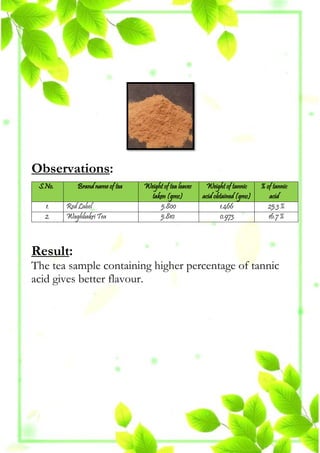
Observations:
S.No. Brand name of tea Weight of tea leaves
taken (gms)
Weight of tannic
acid obtained (gms)
% of tannic
acid
1. Red Label 5.800 1.466 25.3 %
2. Waghbakri Tea 5.810 0.973 16.7 %
Result:
The tea sample containing higher percentage of tannic
acid gives better flavour.
Experiment-3
Aim:
Compare the caffeine content of the samples of tea.
Requirement:
Beaker, conical flasks, heating arrangement, different
samples of tea, sulphuric acid, and chloroform.
Theory:
Tea contains caffeine up to 4%. It is more soluble in
chloroform than in water. Therefore, it can be extended
from the aqueous extract of the tea with chloroform.
However, tannic acid and lead interfere in the extraction
and these have to be removed first. Tannic acid is
removed as calcium tannate and lead as lead sulphate.
After the removal of tannic acid and lead, caffeine is
extracted with chloroform.
Procedure:
1.To the filtrate from Experiment 2 add about 1ml of
dilute 𝐻2𝑆𝑂4. Lead gets precipitated as lead sulphate.
2.Remove the ppt. by filtration and extract the filtrate
with chloroform 3-4 times.
3.Combine the chloroform extract and remove the
solvent by heating on a steam bath. The residue left
behind is caffeine.
4.Weigh the residue left behind.
5.Similarly, determine the amount of caffeine on other
samples of tea.
Observations:
S.No. Brand of name of the tea Weight of tea leaves taken
(gms)
Weight of caffeine
obtained (gms)
% of caffeine
1. Red Label 5.800 0.197 3.4 %
2. Waghbakri Tea 5.810 0.168 2.9 %
Result:
The tea sample containing higher percentage of caffeine
gives better flavour.
CONCLUSION
Tea is made from the young leaves and buds of the tea plant.
Besides caffeine, tea leaves contain tannic acid and colouring
matter, such as polyphenolic compounds. The relative amount of
these substances are different in different varieties of tea leaves,
which is why, their taste and flavour are different.
The brownish colour of the tea is due to the presence of
polyphenolic compounds and some inorganic icons like
Mn2+
, 𝐹𝑒3+
+ etc.
Tea contains up to 30% of the water soluble polyphenols. These
are largely responsible for the flavour of the tea. It contains
caffeineupto4%.Itismoressolubleinchloroformthaninwater.
Therefore, it can be extracted from the aqueous extract of the tea
with chloroform. However, tannic
acid and lead interfere in the extraction and these have to be
removed first.
Tea acts as a stimulant for central nervous system and skeletal
muscles and removes fatigue, tiredness and headache. The
principle constituent of tea, which is responsible for all these
properties,isthealkaloid-caffeine.Theamountofcaffeineintea
leaves varies from sample to sample
The conclusions from the three experiments are as follows:-
1. The tea having better flavour has more polyphenol content.
2. The tea sample containing higher percentage of tannic acid
gives better flavour.
3. The tea sample containing higher percentage of caffeine gives
better flavour.
BIBLIOGRAPHY
Websites:
• www.google.com
• www.wikipedia.com
• www.fmltea.com
• www.researchgate.net
• www.tocklai.net
Books:
• Comprehensive practical chemistry
• Investigatory projects on chemistry

Chemistry Project for class 12 on a comparative study on different brands of tea leaves

  • 1.
    Oxford Public School Ranchi Session:2020-21 Chemistry Project TOPIC:- A comparative study on different brands of tea leaves Submitted by- Submitted to- Name: Rema Deosi Sundi S. Pradhan Class: XII A PGT (Chem.) Class roll no.: 40 Board roll no.:
  • 2.
    Certificate This is tocertify that Rema Deosi Sundi of class XII A of Oxford Public School, Ranchi has completed her project file under the supervision of Mr. S. Pradhan. She has taken care and shown sincerity in completion of this project. I hereby certify that this project is upto my expectations and guidance issued by CBSE. Internal External Signature Signature
  • 3.
    Acknowledgement I would liketo express my greatest gratitude to the people who helped and supported me throughout my project. I am thankful to my parents for helping me in completion of this project. I am grateful to Mr. S. Pradhan whose valuable guidance has been the ones that helped me patch this project and make it full proof success. I would also like to express my gratitude to the Principal Mr. Suraj Sharma for his constant motivation during the course of this investigation. Name: Rema Deosi Sundi Class: XII A Board roll no.:
  • 4.
    CONTENTS S.No. Heading Page No. 1.Objective 1 2. Introduction 2-3 3. Tea Chemistry 4-6 4. The components of tea:- -Caffeine -Amino acids -Tea Fiber -Anthocyanidins -Carbohydrate -Organic acids -Lipids and fatty acids 7-10 5. Experiments carried out:- -Experiments 1 -Experiments 2 -Experiments 3 11-16 6. Conclusion 17-18 7. Bibliography 19
  • 5.
    Objective of thisproject In this project we will study the components of tea and its content in different tea brands and its flavoring effect on it.
  • 6.
    INTRODUCTION Tea is themost commonly and widely used soft beverage in the household. It acts as a stimulate for central nervous system and skeletal muscles. That is why tea removes fatigue, tiredness and headache. It also increases the capacity of thinking. It is also used for lowering body temperature. The principle constituent of tea, whichisresponsibleforalltheseproperties,isthealkaloid-caffeine. The amount of caffeine in tea leaves varies from sample to sample. Originally it was thought that caffeine is responsible for the taste and flavour of tea. But pure caffeine has been found to be a tasteless while substance. Therefore, the taste and flavour of tea is due to some other substance present in it. There is a little doubt that the popularity of the xanthenes beverages depends on their stimulate action, although most people are unaware of any stimulation. The degree to which an individual is stimulated by given amount of caffeine varies from individual to individual.
  • 7.
    Teaismadefromtheyoungleaves and buds ofthe tea plant. Besides caffeine, tea leaves contain tannic acid and colouring matter, such as polyphenolic compounds. The relative amounts of these substances are different in different varieties of tea leaves, that is why, their taste and flavour are different. The brownishcolour ofthetea is due to thepresence ofpolyphenolic compounds and some inorganic icons like 𝑀𝑛2+ , 𝐹𝑒3+ etc. some simple experiments can be carried out to study the components that are responsible for the variation in tea flavour in various brand of tea.
  • 8.
    TEA CHEMISTRY Chemical compositionof Fresh Tea Shoot Compound % Dry weight Contribution Total Poluphenols 25-30 Astrigency Flavanols (-)Epigallocatechin gallate 8-12 (-)Epicatechin gallate 3-6 (-)Epigallo catechin 3-6 (-)Epicatechin 1-3 (+)Catechin 1-2 (+)Gallocatechin 3-4 Flavanols and flavonol glycosides 3-4 Leuco anthocyanins 2-3 Polyphenolic acids and depsides 3-4 Caffeine 3-4 Briskness Theobromine 0.2 Theophylline 0.5 Amino acids 4-5 Brothyness Organic acids 0.5-0.6 Monosaccharides 4-5 Polysaccharides 14-22 Cellulose and Hemicellulose 4-7 Pectins 5-6 Lignin 5-6 Protein 14-17 Lipids 3-5 Chlorophylls and other pigments 0.5-0.6 Colour and Appearance Ash (minerals) 5-6 Volatiles 0.01-0.02 Aroma
  • 9.
    Biochemical compounds responsiblefor colour Compounds Colour Theaflavins Yellowish brown Thearubigins Reddish Brown Flavonol glycosides Light yellow Pheophorbide Brownish Pheophytin Blackish Carotene Yellow
  • 10.
    Biochemical compounds responsiblefor taste Compounds Taste Polyphenol Astringent Amino acids Brothy Caffeine Bitter Theaflavins Astringent Thearubigin Ashy and slight astringent Biochemical compound responsible for flavour Compounds Flavour Linalool, Linalool Oxide Sweet Geraniol, Phenylactaldehyde Floral Nerolidol, Benzaldehyde, Methyl salicylate, Phenyl ethanol Fruity Trans-2-Hexanal, n-Hexanal, Cis-3- Hexanol,Grassy, b-lonone Fresh Flavour The components
  • 11.
    Caffeine- Caffeine is apurine derivative, which is 1,3,7-tri-methyl xanthine. Caffeine content in black tea is around 3-4% of dry weight. It has stimulating property and removes mental fatigue. The contribution of caffeine to the infusion is the briskness and creamy property resulting from the complex formed by caffeine with polyphenols. Briskness is a taste and sensation while creaming is the turbidity that develops from a good cup of tea when cooled. On the contrary their excessive use is harmful to digestion and their long use leads to mental retardation. Tea Fiber- The leaf cell wall, containing cellulostic materials surrounded by hemi-cellulose and a lignin seal, prevents the penetration of hydrolyzing enzymes. The reduced succulence in the matures shoot is believed to be due to structural bonding between phenolic components of lignin, polysaccharides and cutin of cell wall. Carbohydrate-
  • 12.
    The free sugarsfound in tea shoot are glucose, fructose, sucrose, raffinose and stachyose. Maltose is Assam variety and rhamnose in China variety appeared special. Pectic substances contain galactose, arabinose, galacturnic acid, rhamnose and ribose. Free sugars are responsible and ribose. Free sugars are responsible for the synthesis of catechins in tea shoot, formation of heterotypic flavour compounds during processing of black tea and contributing towards water-soluble solids in tea liquor. Cellulose, hemi-cellulose, pectins and lignins are responsible for the formation of crude fiber content in black tea. Amino acids- Aspartic, glutamic, serine, glutamine, tyrosine, valine, phenylalanine, leucine, isoleucine and theanine (5-N-ehtylglutamine) were found to be the principal amino acids present in tea leaf. Theanine alone contributed around 60% of total amino acid content. Asparagine was formed during withering. The amino acids play an important role in the development of tea aroma during the processing of black tea. Lipids and fatty acids-
  • 13.
    The neutral, glycoland phospholipid contents and their fatty acid composition varied in Assam, China and Cambod varieties and also during different stages of black tea manufacture. Total lipid contents(%) and total fatty acids (µg/g) at different stages i.e. green leaf, withered leaf, rolled leaf, fermented leaf and black teas are about 6.5, 5.7, 4.5, 4.3 and 2.8 and 9.8, 8.4, 6.6, 4.8 and 3.7 respectively. The major fatty acids available in tea are linolenic, linoleic, oleic and palmitic. Anthocyanidins- Delphenidin and cyaniding were the major anthocyanidins present in tea leaf. Anthocyanin contents were higher in tea shoots from pruned than those of unpruned bushes. Role of anthocyanins on the quality of black tea however, has not been found to be significant.
  • 14.
    Organic acids- Citric, tartaric,malic, oxalic, fumaric and succine acids were detected in Assam leaf. Role of organic acids towards the biochemical influence on the quality of black tea is not yet reported.
  • 15.
    Experiments carried out Experiment-1 Aim: Comparethe water soluble polyphenol content in the various samples of tea leaves. Requirements: Beakers, conical flasks, funnels, heating arrangement, tea bags of different brands of tea. Theory: Tea contains up to 30% of the water soluble polyphenols. These are largely responsible for the flavour of the tea. To estimate the extent of these compounds in a given sample, the tea leaves are immersed in hot water for equal time and loss in the weight of tea leaves is determined. Procedure: 1.Weigh the different samples of tea and place them in tea bags. 2.Take three or four conical flasks and put 100ml of hot water to each of them. 3.Put tea bags of different samples of tea in different conical flasks. After 10 minutes remove the tea bags and dry them by placing in an over. 4.When the tea bags become dry, reweigh them. 5.Note the flavour of tea solution obtained.
  • 16.
    Observation: S.no. Brand nameof tea Initial weight (gms) Final weight (gms) Loss of weight %of water soluble components 1. Brook Bond (Taj Mahal) 2.140 1.810 0.6 75.1% 2 Homewood Tea 2.390 1.620 0.77 67.8% 3 Twinings (green tea & lemon) 2.290 1.740 0.55 76% Result: The tea having better flavour has more polyphenolic content.
  • 17.
    Experiment-2 Aim: Compare the tannicacid content of various samples of tea. Requirement: Beakers, conical flasks, funnel, heating arrangement, various samples of tea, calcium carbonate, conc. HCl Theory: The tannic acid present in tea leaves is precipitated as calcium tannate by treatment of aqueous solution of tea with calcium carbonate, Calcium tannate is then hydrolyzed with conc. HCl and re-crystallized from water. Procedure: 1.Weigh 5g of each of the given sample of tea leaves. 2. Take 100ml of distilled water in 400ml beaker and boil it. Then add the first sample of tea leaves to it and boil for 10 minutes. Cool and filter the solution. 3.To the filtrate add about 2g of solid calcium carbonate and boil the contents. Tannic acid gets precipitated as calcium tannate. Separate the precipitate of calcium tannate by filtration. 4.Calcium tannate obtained is hydrolyzed by warming with 4-5ml of conc. HCl. The tannic acid obtained is crystallized from water and weighed. 5.Repeat the steps 2, 3 and 4 with the other samples of tea and record the observations.
  • 18.
    Observations: S.No. Brand nameof tea Weight of tea leaves taken (gms) Weight of tannic acid obtained (gms) % of tannic acid 1. Red Label 5.800 1.466 25.3 % 2. Waghbakri Tea 5.810 0.973 16.7 % Result: The tea sample containing higher percentage of tannic acid gives better flavour.
  • 19.
    Experiment-3 Aim: Compare the caffeinecontent of the samples of tea. Requirement: Beaker, conical flasks, heating arrangement, different samples of tea, sulphuric acid, and chloroform. Theory: Tea contains caffeine up to 4%. It is more soluble in chloroform than in water. Therefore, it can be extended from the aqueous extract of the tea with chloroform. However, tannic acid and lead interfere in the extraction and these have to be removed first. Tannic acid is removed as calcium tannate and lead as lead sulphate. After the removal of tannic acid and lead, caffeine is extracted with chloroform. Procedure: 1.To the filtrate from Experiment 2 add about 1ml of dilute 𝐻2𝑆𝑂4. Lead gets precipitated as lead sulphate. 2.Remove the ppt. by filtration and extract the filtrate with chloroform 3-4 times. 3.Combine the chloroform extract and remove the solvent by heating on a steam bath. The residue left behind is caffeine. 4.Weigh the residue left behind. 5.Similarly, determine the amount of caffeine on other samples of tea.
  • 20.
    Observations: S.No. Brand ofname of the tea Weight of tea leaves taken (gms) Weight of caffeine obtained (gms) % of caffeine 1. Red Label 5.800 0.197 3.4 % 2. Waghbakri Tea 5.810 0.168 2.9 % Result: The tea sample containing higher percentage of caffeine gives better flavour.
  • 21.
    CONCLUSION Tea is madefrom the young leaves and buds of the tea plant. Besides caffeine, tea leaves contain tannic acid and colouring matter, such as polyphenolic compounds. The relative amount of these substances are different in different varieties of tea leaves, which is why, their taste and flavour are different. The brownish colour of the tea is due to the presence of polyphenolic compounds and some inorganic icons like Mn2+ , 𝐹𝑒3+ + etc. Tea contains up to 30% of the water soluble polyphenols. These are largely responsible for the flavour of the tea. It contains caffeineupto4%.Itismoressolubleinchloroformthaninwater. Therefore, it can be extracted from the aqueous extract of the tea with chloroform. However, tannic acid and lead interfere in the extraction and these have to be removed first.
  • 22.
    Tea acts asa stimulant for central nervous system and skeletal muscles and removes fatigue, tiredness and headache. The principle constituent of tea, which is responsible for all these properties,isthealkaloid-caffeine.Theamountofcaffeineintea leaves varies from sample to sample The conclusions from the three experiments are as follows:- 1. The tea having better flavour has more polyphenol content. 2. The tea sample containing higher percentage of tannic acid gives better flavour. 3. The tea sample containing higher percentage of caffeine gives better flavour.
  • 23.
    BIBLIOGRAPHY Websites: • www.google.com • www.wikipedia.com •www.fmltea.com • www.researchgate.net • www.tocklai.net Books: • Comprehensive practical chemistry • Investigatory projects on chemistry