Study on
The Effect of Acids and Bases on
the Tensile Strength of Fibres
Submitted By:-
Name-Vansh Patil
Std-11th Section-C
Roll no.-S11C36
Submitted To:-
Ms. Komal Ma’am
Chemistry Subject
Teacher
Index
• Certificate
• Acknowledgement
• Introduction
• Aim
• Requirements
• Procedure
• Observation Table
• Results
• Precautions
Certificate
It is hereby certified that original
and genuine research work is
carried out to investigate about
the subject matter and the related
data collection has been
completely solely and satisfied by
Vansh Patil
regarding the project titled
Study on THE EFFECT OF ACIDS AND
BASES ON THE TENSILE STRENGTH
OF FIBRES
Acknowledgement
I owe my thanks to our principal for providing
laboratory facilities and for her valuable guidance.
A lot of thanks to my chemistry teacher
Komal Mam/Vijayalakshmi Mam
who encouraged me in doing this project successfully
and provided the required apparatus
to perform my project work.
Name : Vansh
Introduction
Fibers differ in their chemical composition and
strength. the most important property of these fibers is
their strength. The fibre should not break while being
woven and should be durable when the cloth made
from it is used for wearing. Another important factor is
that it should not be easily affected by air, water, alkalis
and acids because these are the factors which adversely
affect the strength of fibres. The strength of fibres is
expressed in terms of tensile strength. Tensile Strength
is measured in terms of the minimum weight required
to break the fibre.
Aim
To find the effect of acids and alkalies on
Tensile strength of cotton, wool and nylon
Requirements
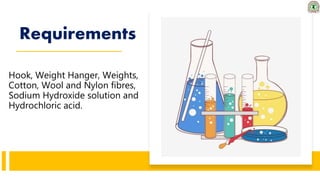
Hook, Weight Hanger, Weights,
Cotton, Wool and Nylon fibres,
Sodium Hydroxide solution and
Hydrochloric acid.
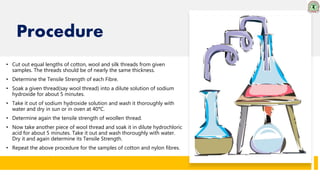
Procedure
• Cut out equal lengths of cotton, wool and silk threads from given
samples. The threads should be of nearly the same thickness.
• Determine the Tensile Strength of each Fibre.
• Soak a given thread(say wool thread) into a dilute solution of sodium
hydroxide for about 5 minutes.
• Take it out of sodium hydroxide solution and wash it thoroughly with
water and dry in sun or in oven at 40°C.
• Determine again the tensile strength of woollen thread.
• Now take another piece of wool thread and soak it in dilute hydrochloric
acid for about 5 minutes. Take it out and wash thoroughly with water.
Dry it and again determine its Tensile Strength.
• Repeat the above procedure for the samples of cotton and nylon fibres.
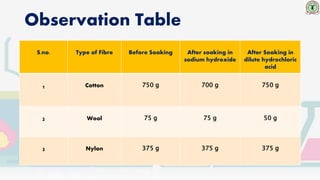
Observation Table
S.no. Type of Fibre Before Soaking After soaking in
sodium hydroxide
After Soaking in
dilute hydrochloric
acid
1 Cotton 750 g 700 g 750 g
2 Wool 75 g 75 g 50 g
3 Nylon 375 g 375 g 375 g
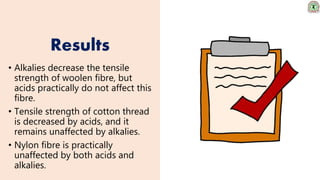
Results
• Alkalies decrease the tensile
strength of woolen fibre, but
acids practically do not affect this
fibre.
• Tensile strength of cotton thread
is decreased by acids, and it
remains unaffected by alkalies.
• Nylon fibre is practically
unaffected by both acids and
alkalies.
Precautions
• Thread must be of identical
diameters.
• Always take the same length of
the threads.
• Add the weights in small
amounts very slowly.
The Effect of Acids and Bases on the Tensile Strength of Fibres.