The document discusses the importance of recording labor progress using a partogram, which is a graphical tool to track key information about the mother, fetus, and labor progression over time. A partogram allows clinicians to monitor labor, identify issues early, make informed decisions, and defend their actions. It outlines the components recorded on a partogram, including maternal and fetal vital signs, cervical dilation, descent of the fetus, uterine contractions, and other metrics. Tracking labor accurately on a partogram can reveal normal progress or potential complications.
In this document
Powered by AI
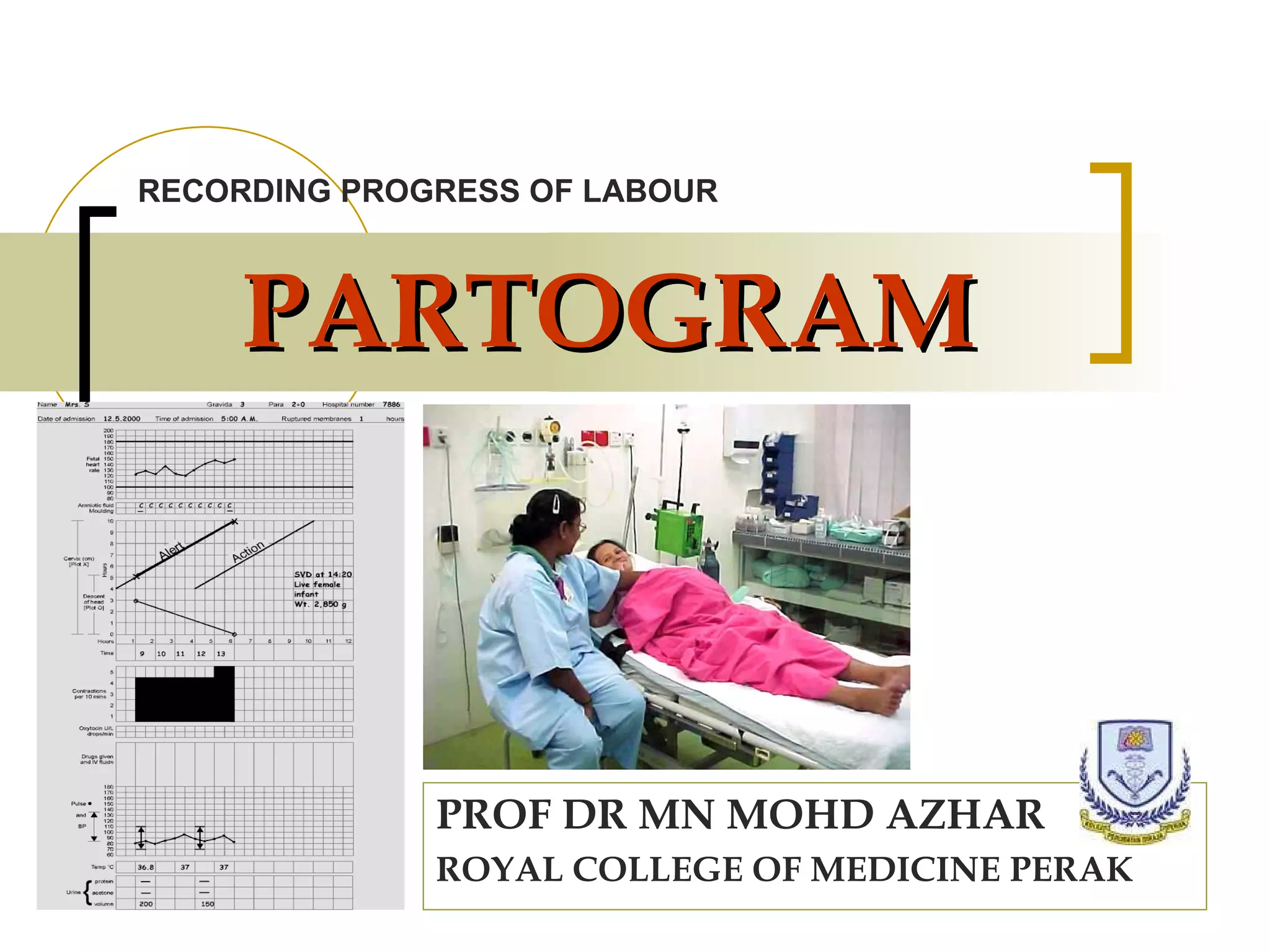
Introduces the partogram concept by Prof. Dr. MN Mohd Azhar from Royal College of Medicine Perak.
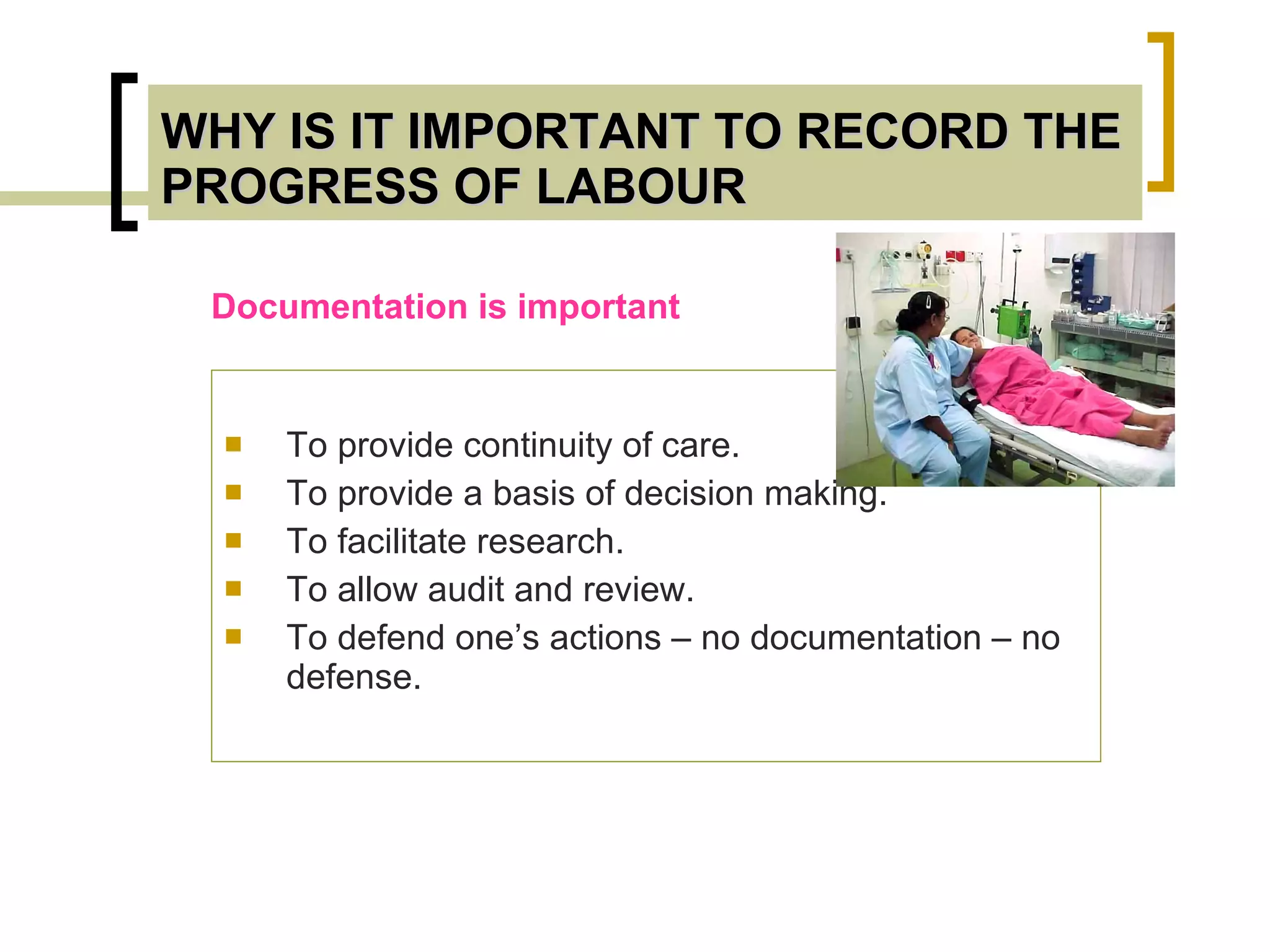
Emphasizes reasons for recording labor, including continuity of care, decision-making, and legal defense.
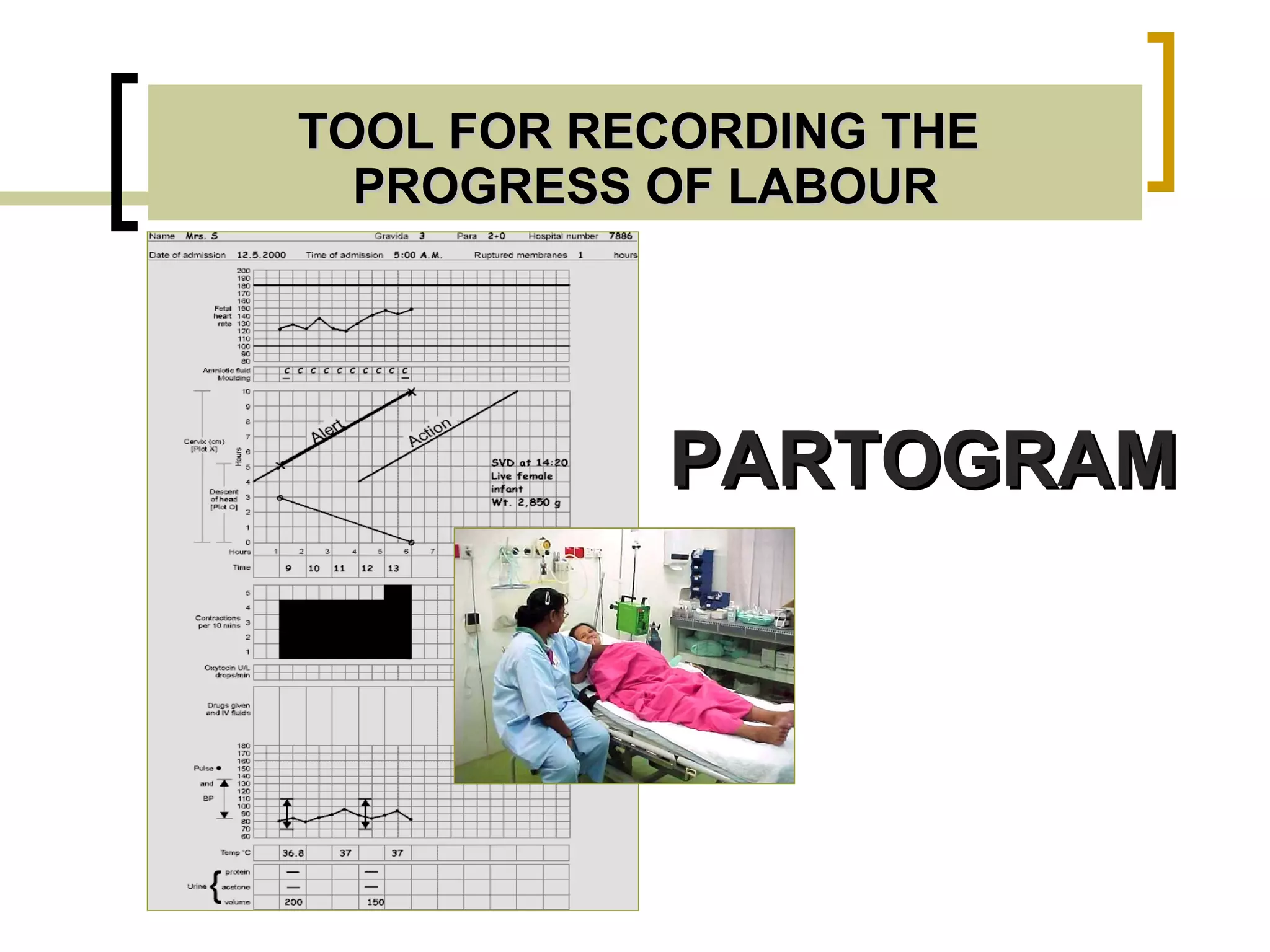
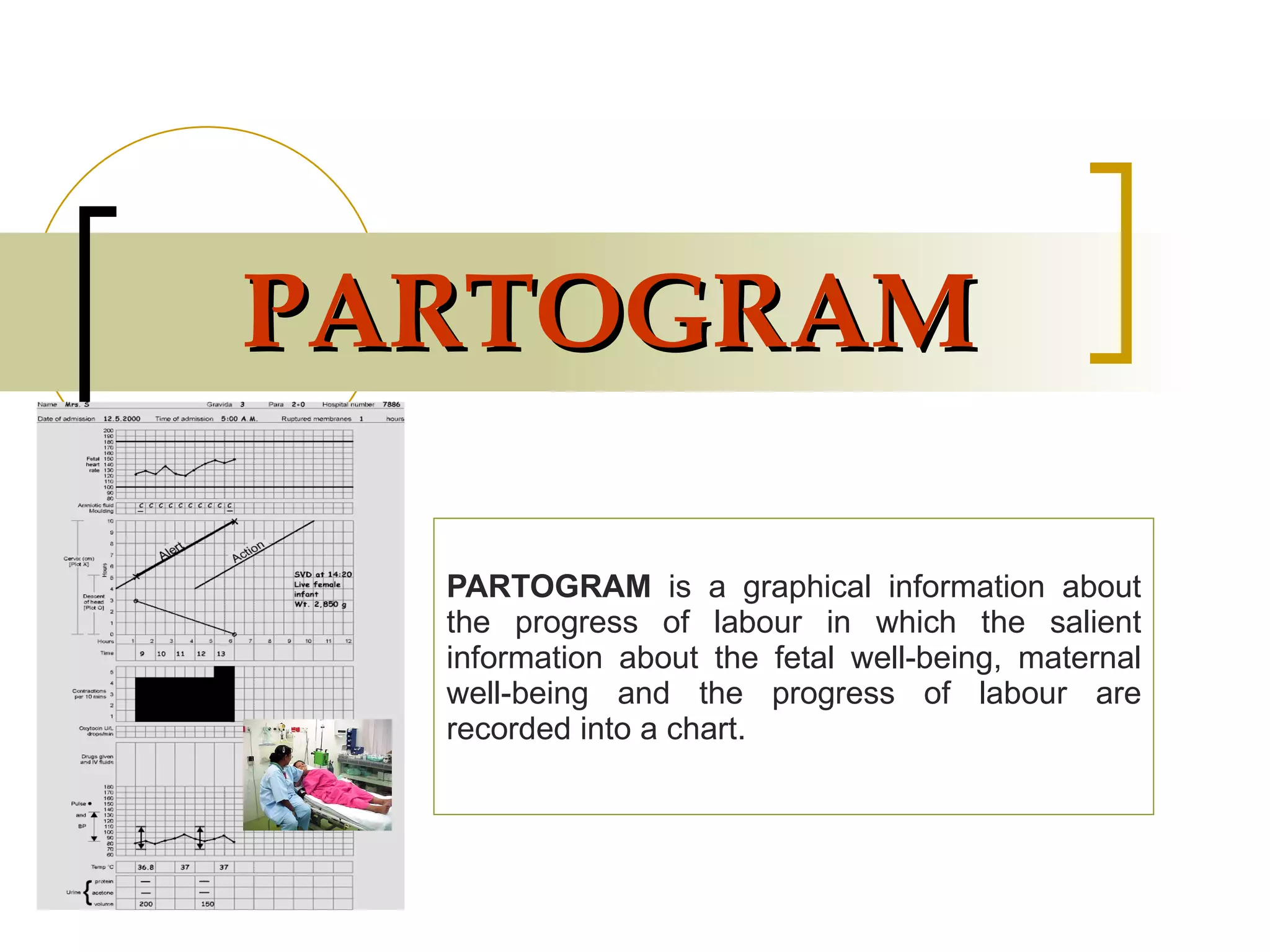
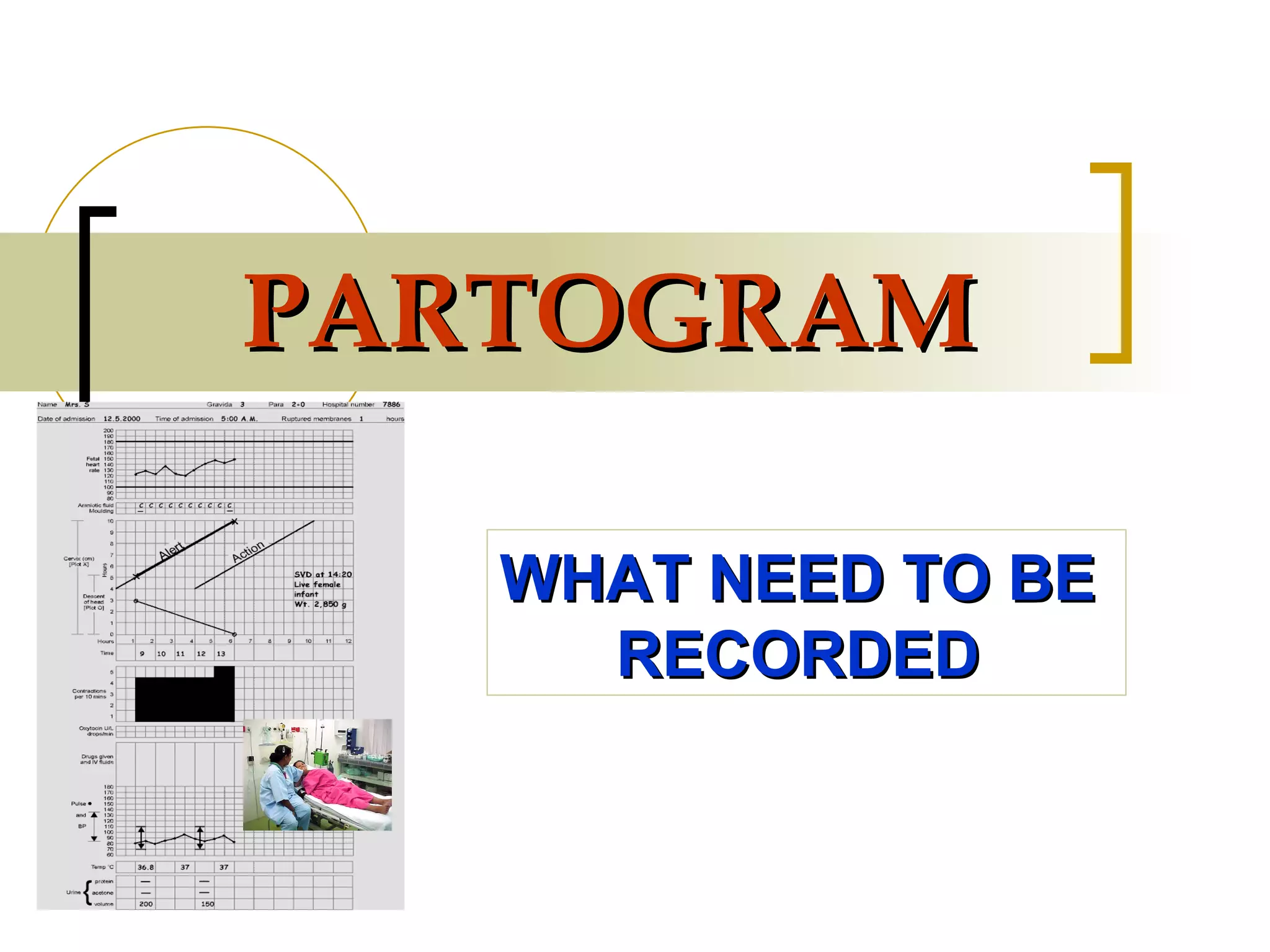
Defines the partogram as a tool for visualizing labor progress and capturing important maternal and fetal data.
Explains the partogram’s graphical representation of labor, focusing on maternal and fetal health.
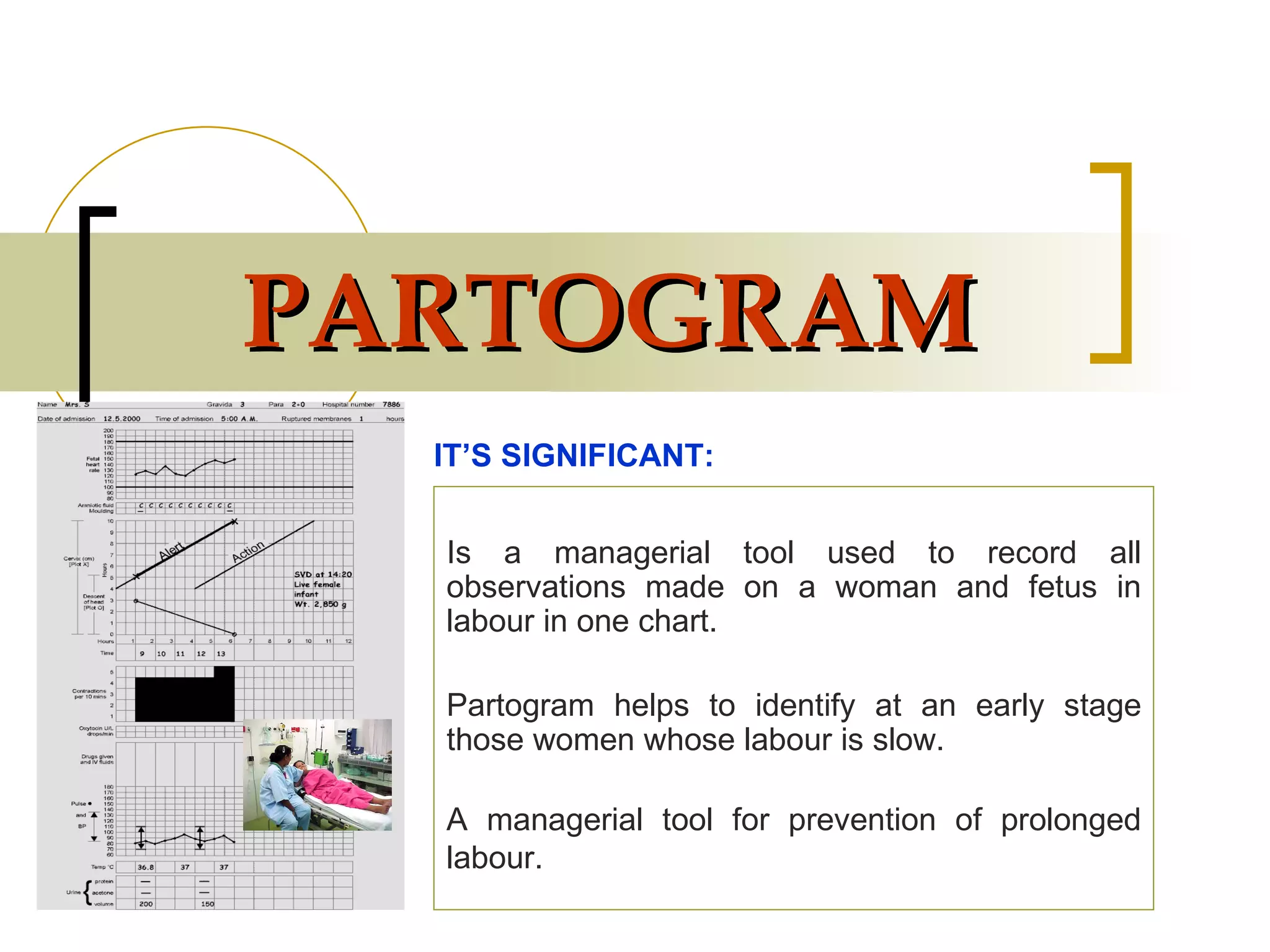
Describes partogram as a managerial tool to prevent prolonged labor and improve early identification of slow progress.
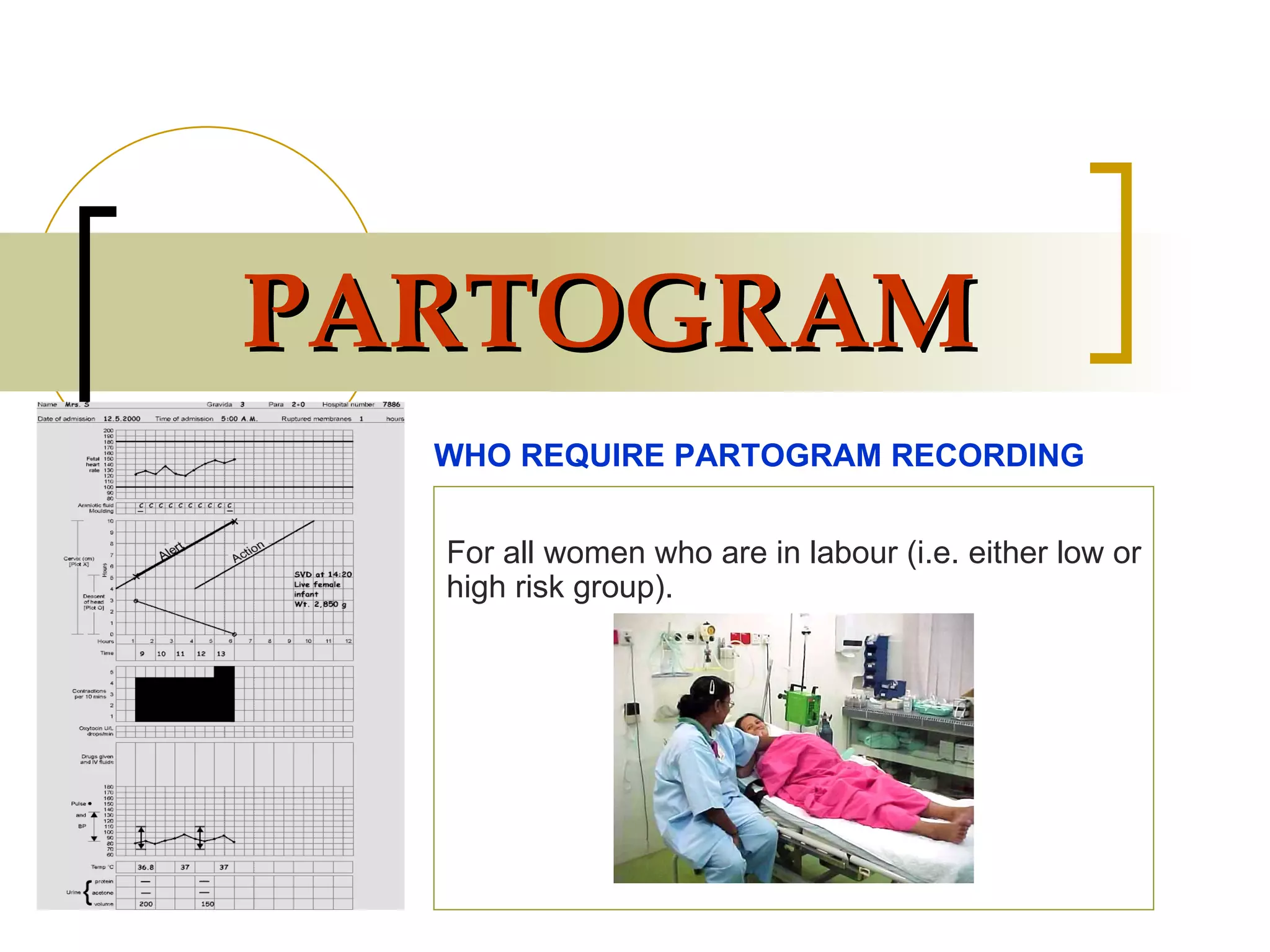
Indicates partogram is to be utilized for all women in labor, regardless of risk level.
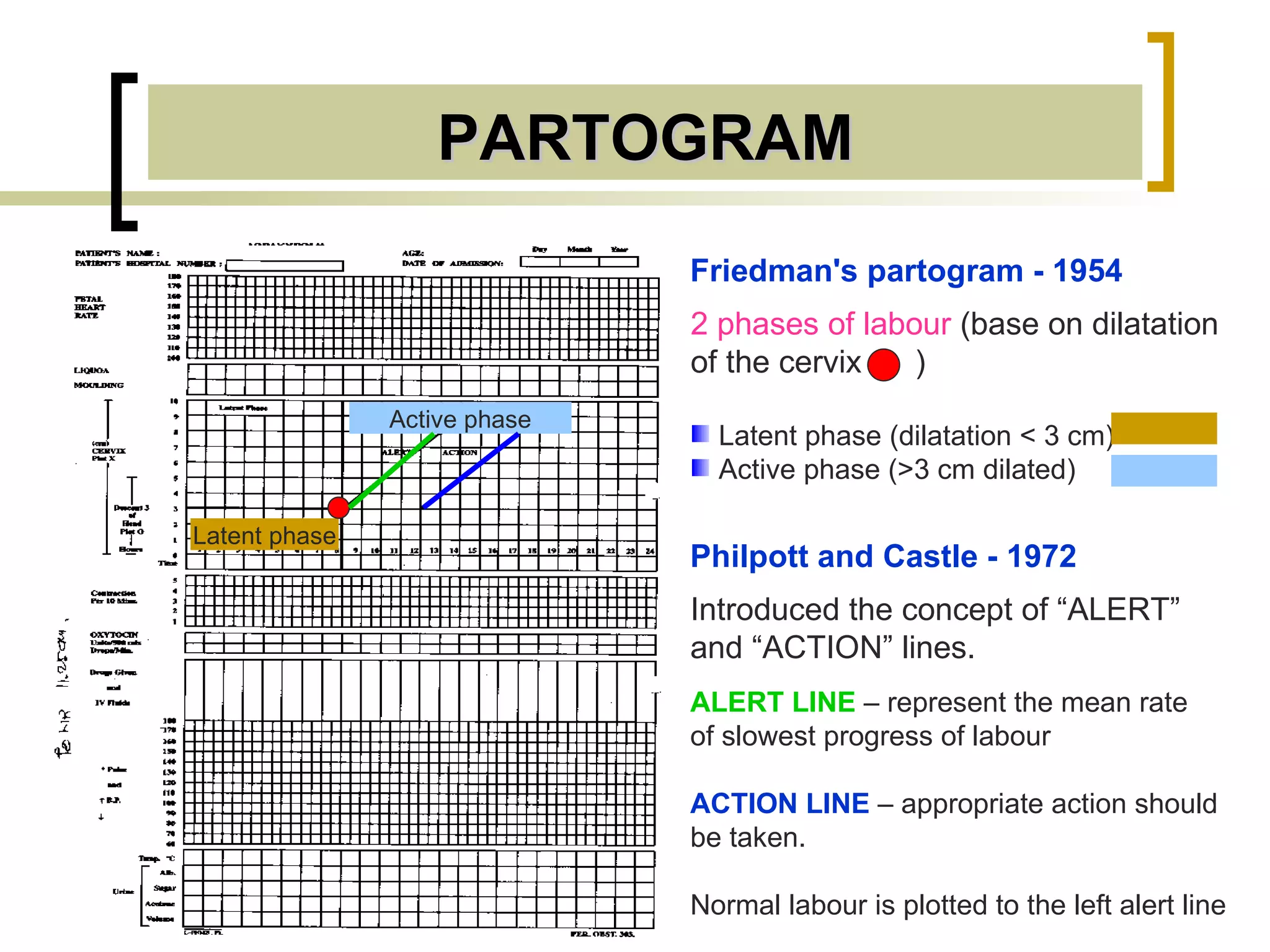
Details the evolution of the partogram, including Friedman and Philpott & Castle's contributions to labor tracking.
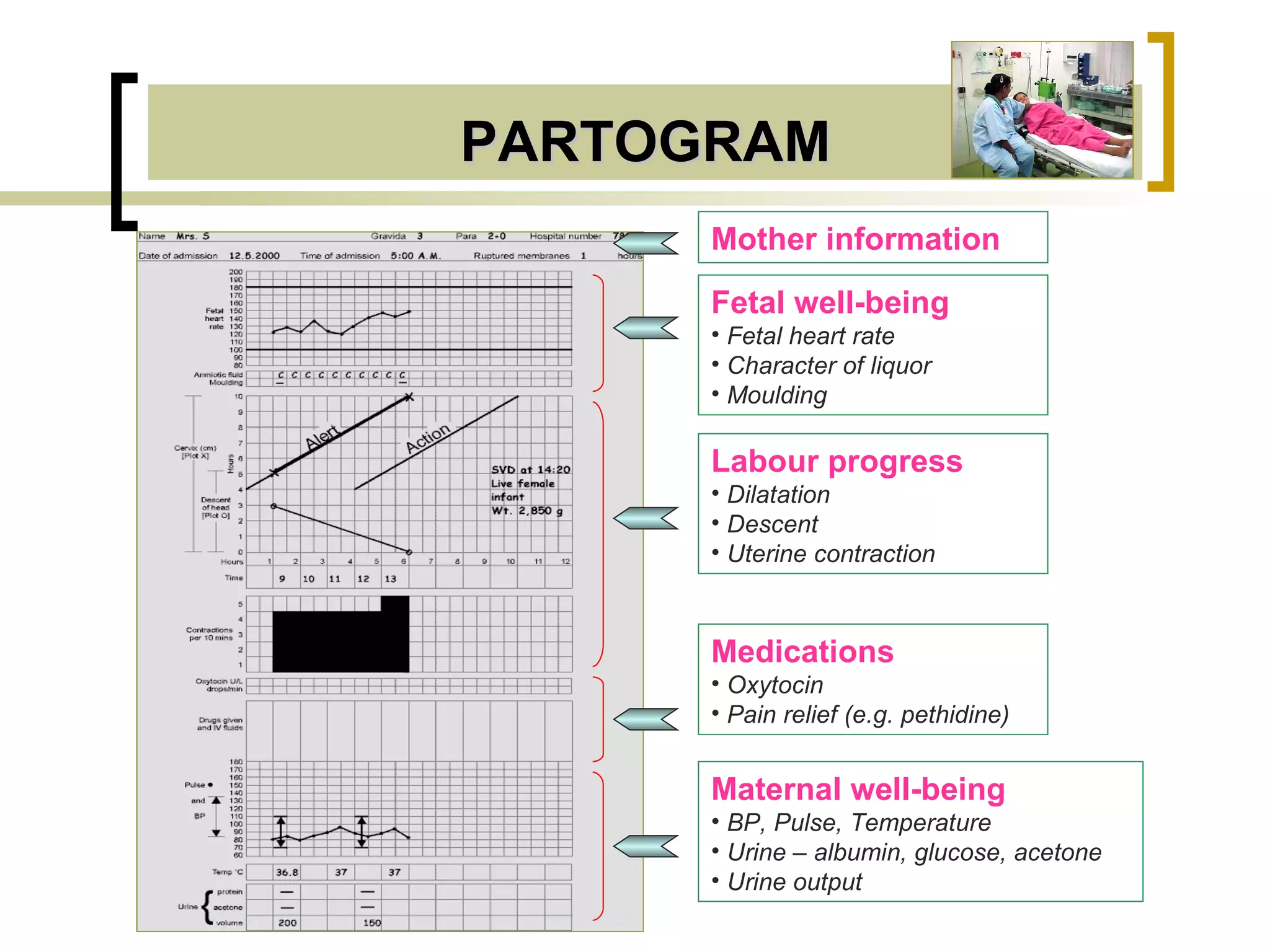
Lists key information to be documented, such as fetal heart rate, maternal vital signs, and labor progress.
Highlights various data points essential for recording in the partogram.
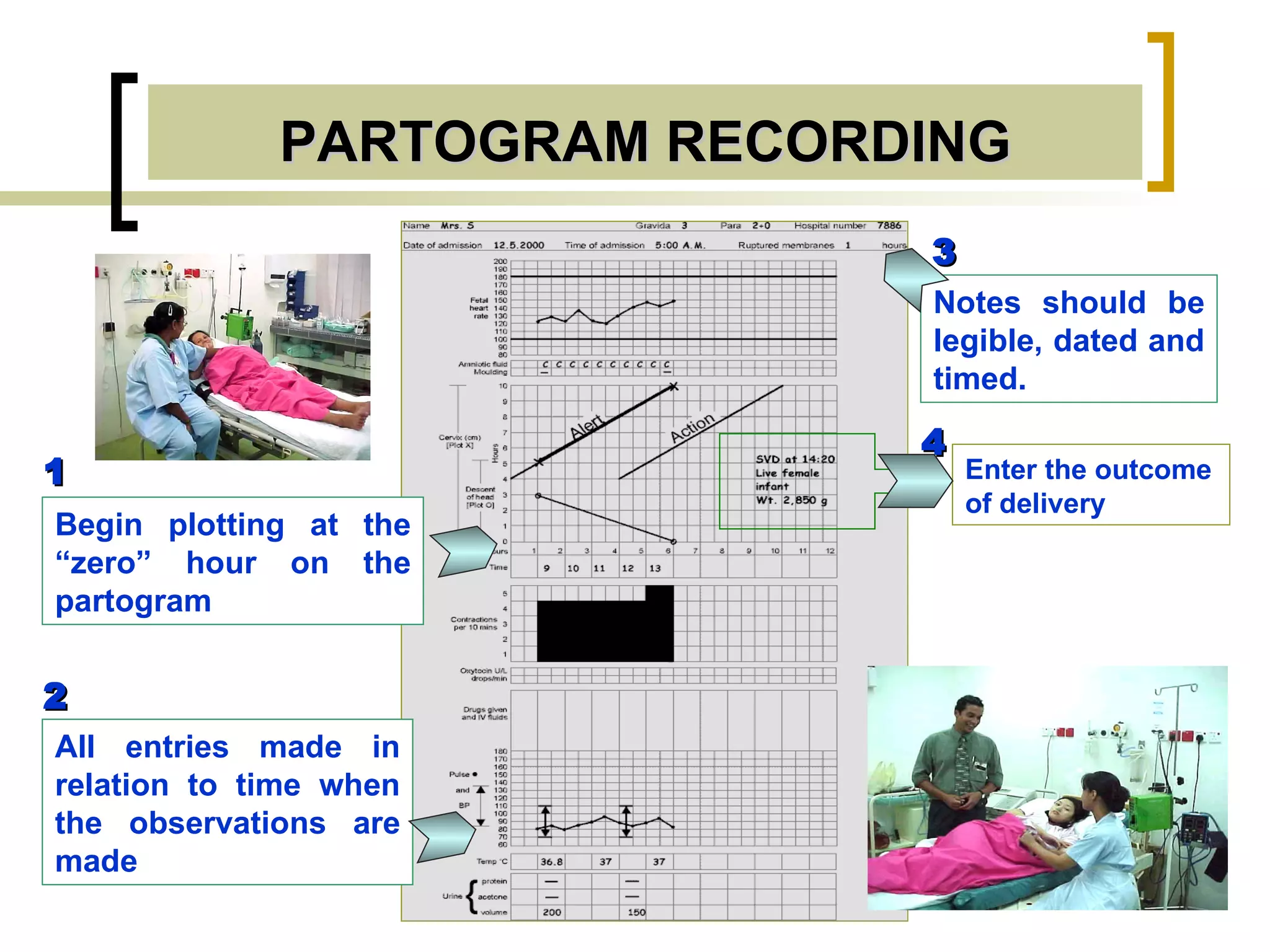
Explains how to properly initiate and document observations in the partogram format.
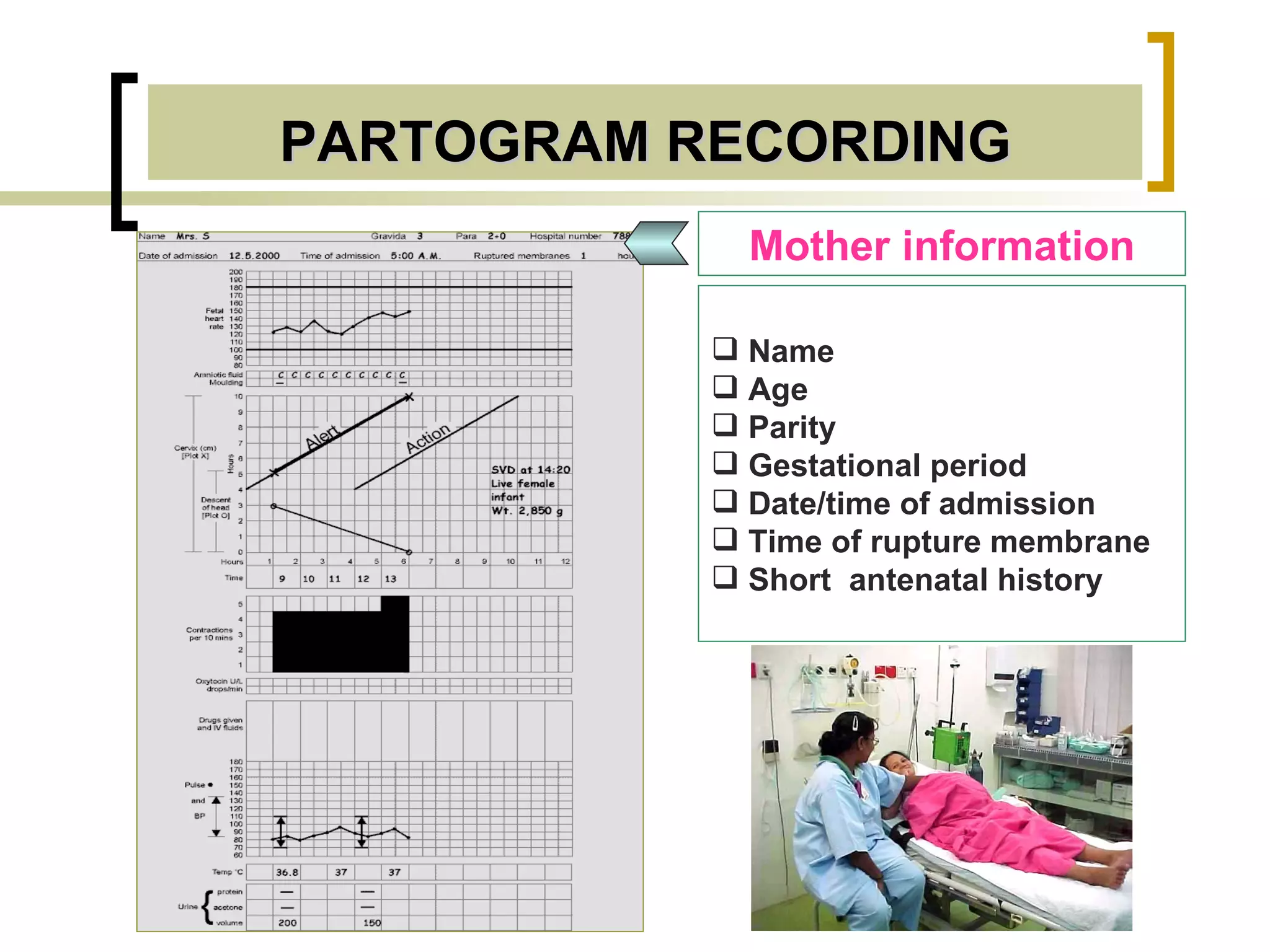
Details the maternal information to be collected and noted on the partogram upon admission.
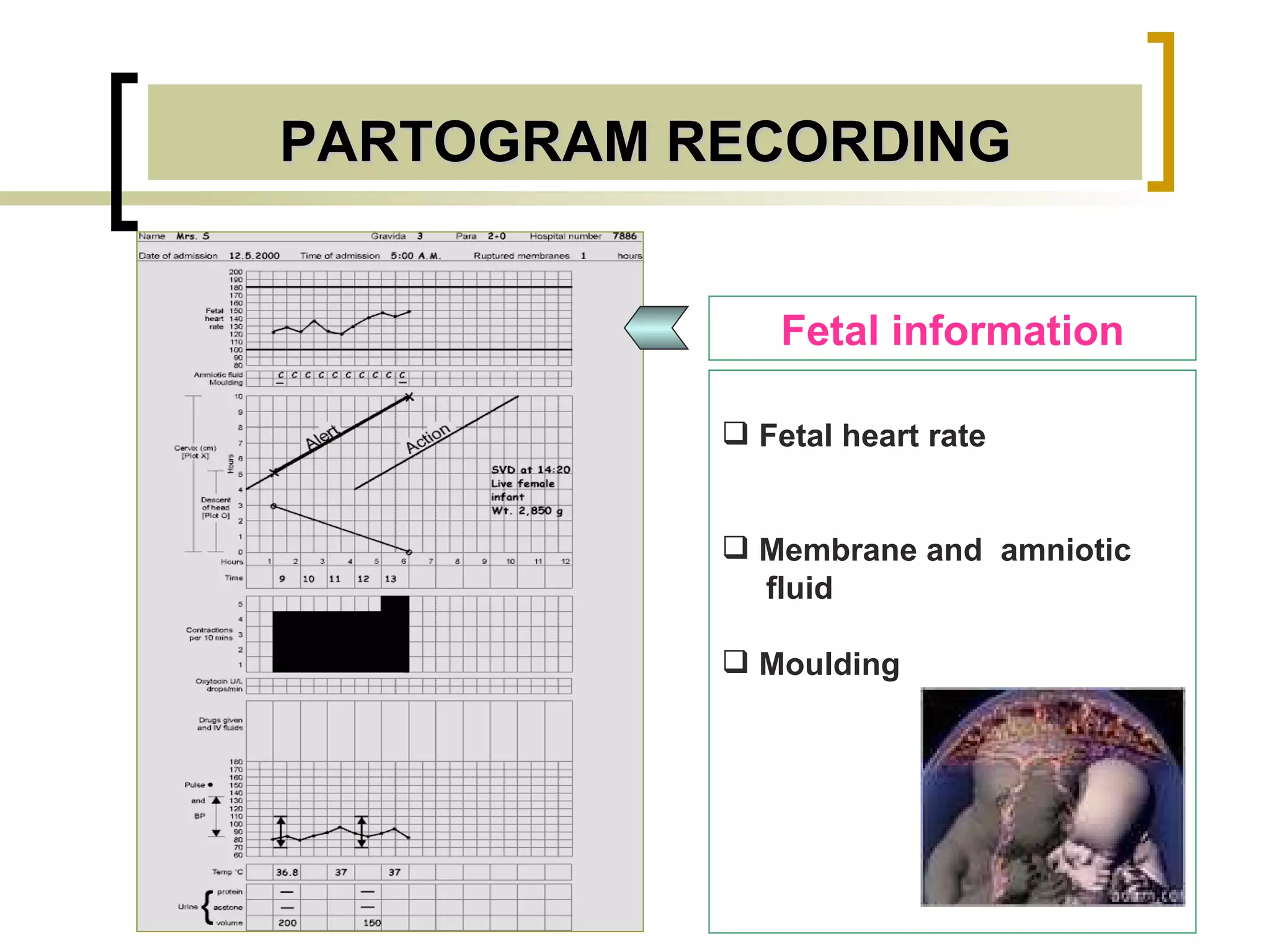
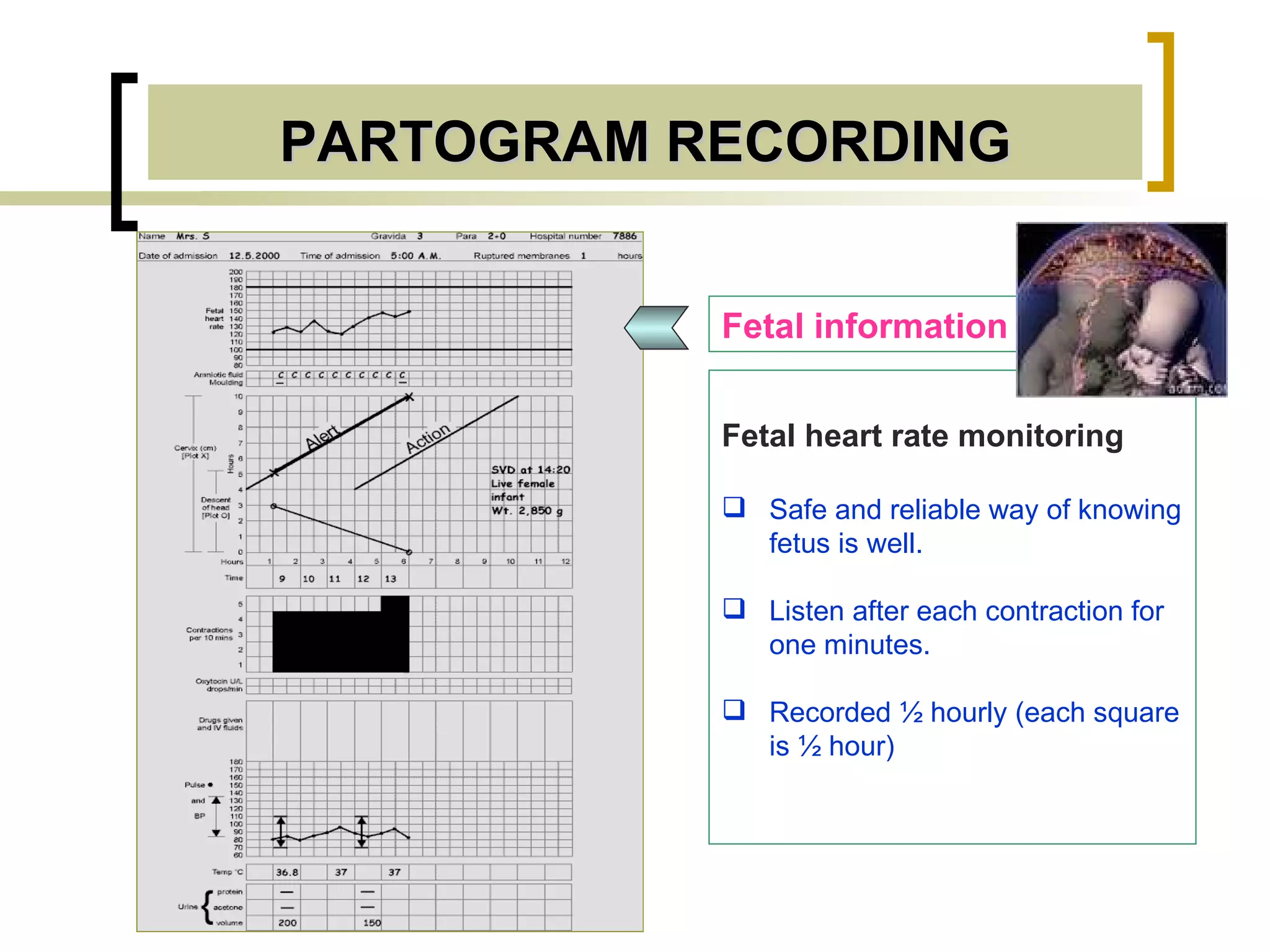
Specifies details regarding fetal monitoring to be included in the partogram.
Describes the safe monitoring of fetal heart rate post contractions and recording interval.
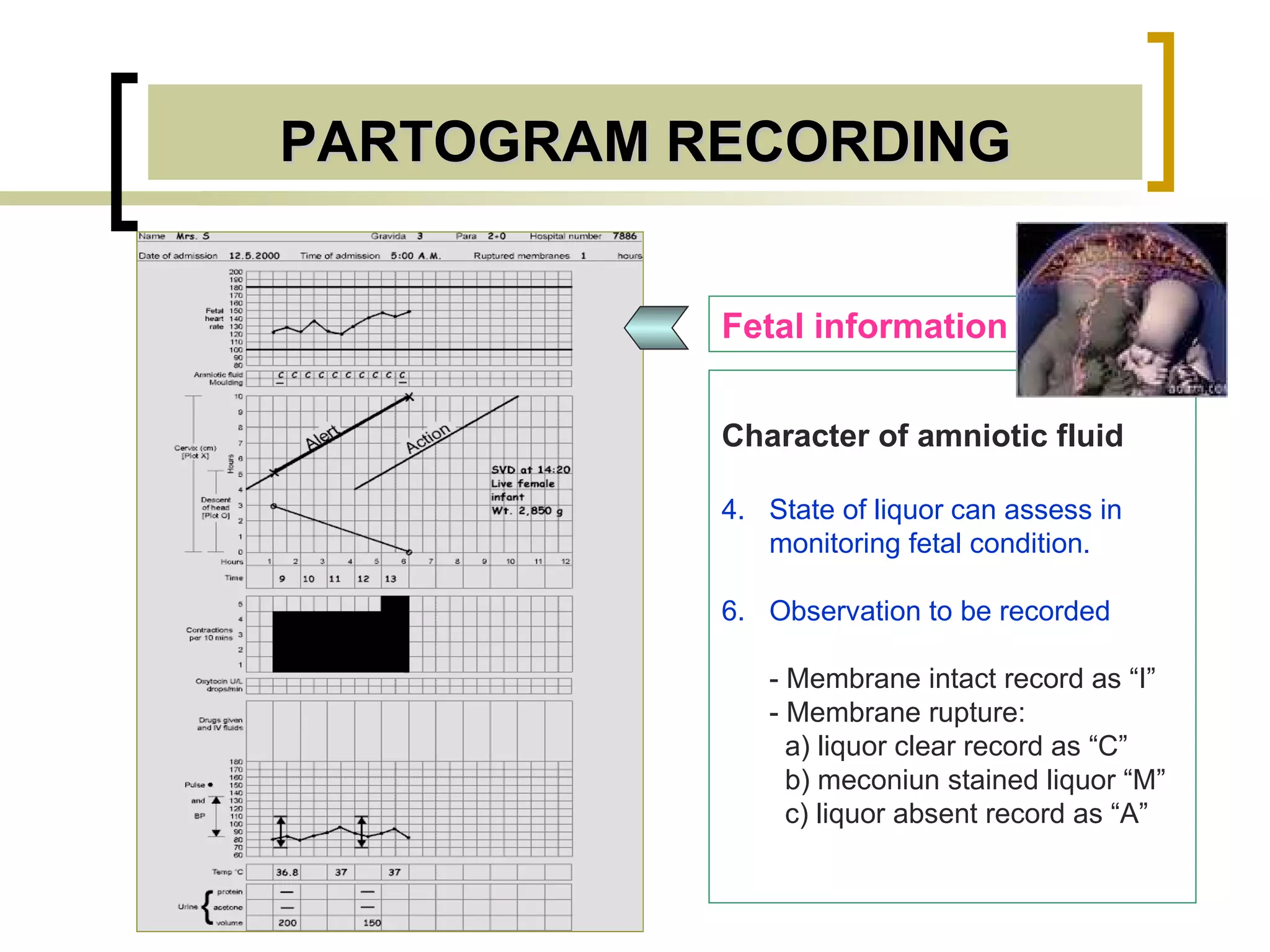
Lists observations to assess fetal condition based on the nature of the amniotic fluid.
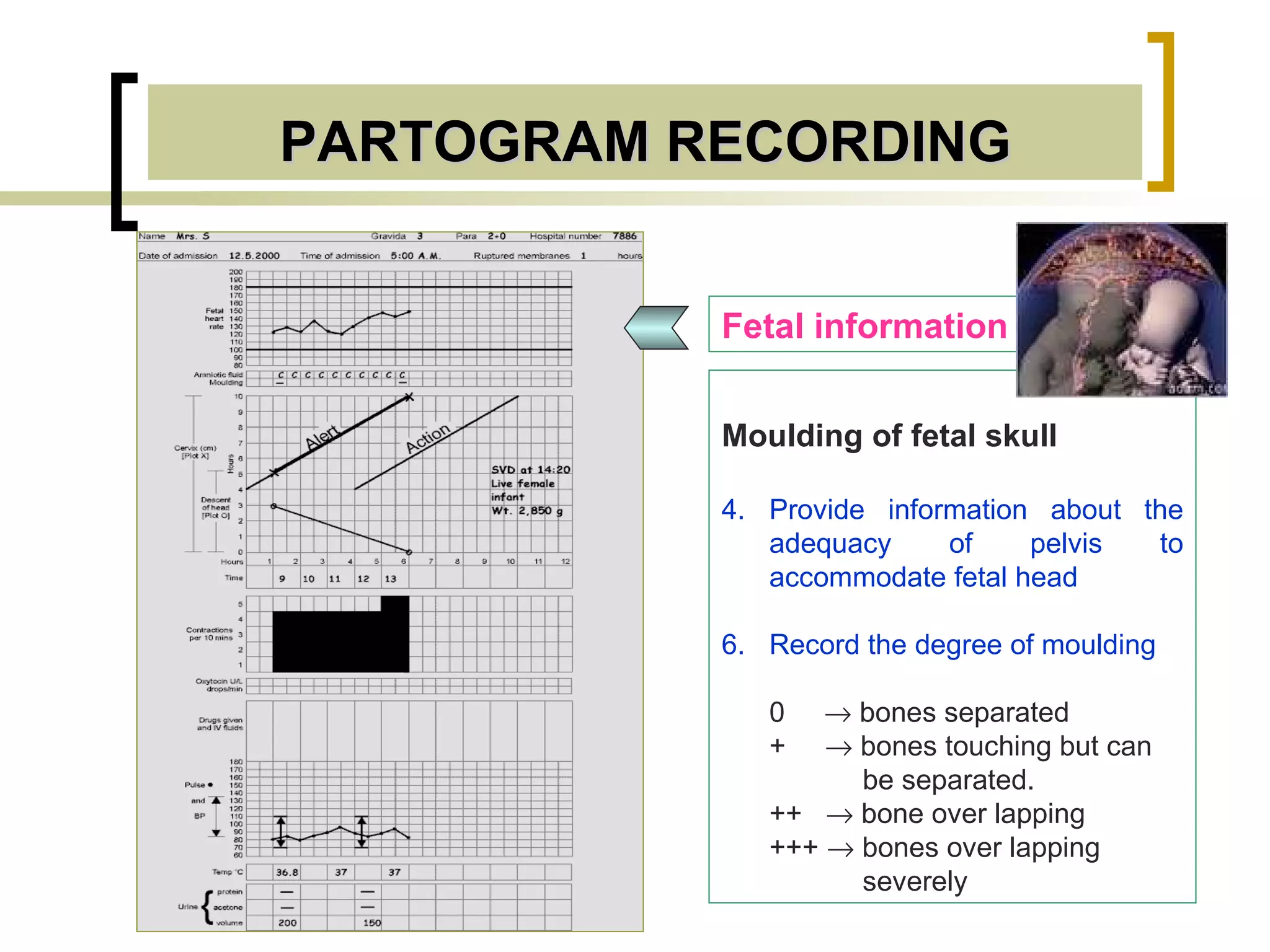
Describes the significance of observing fetal skull moulding for assessing pelvic adequacy.
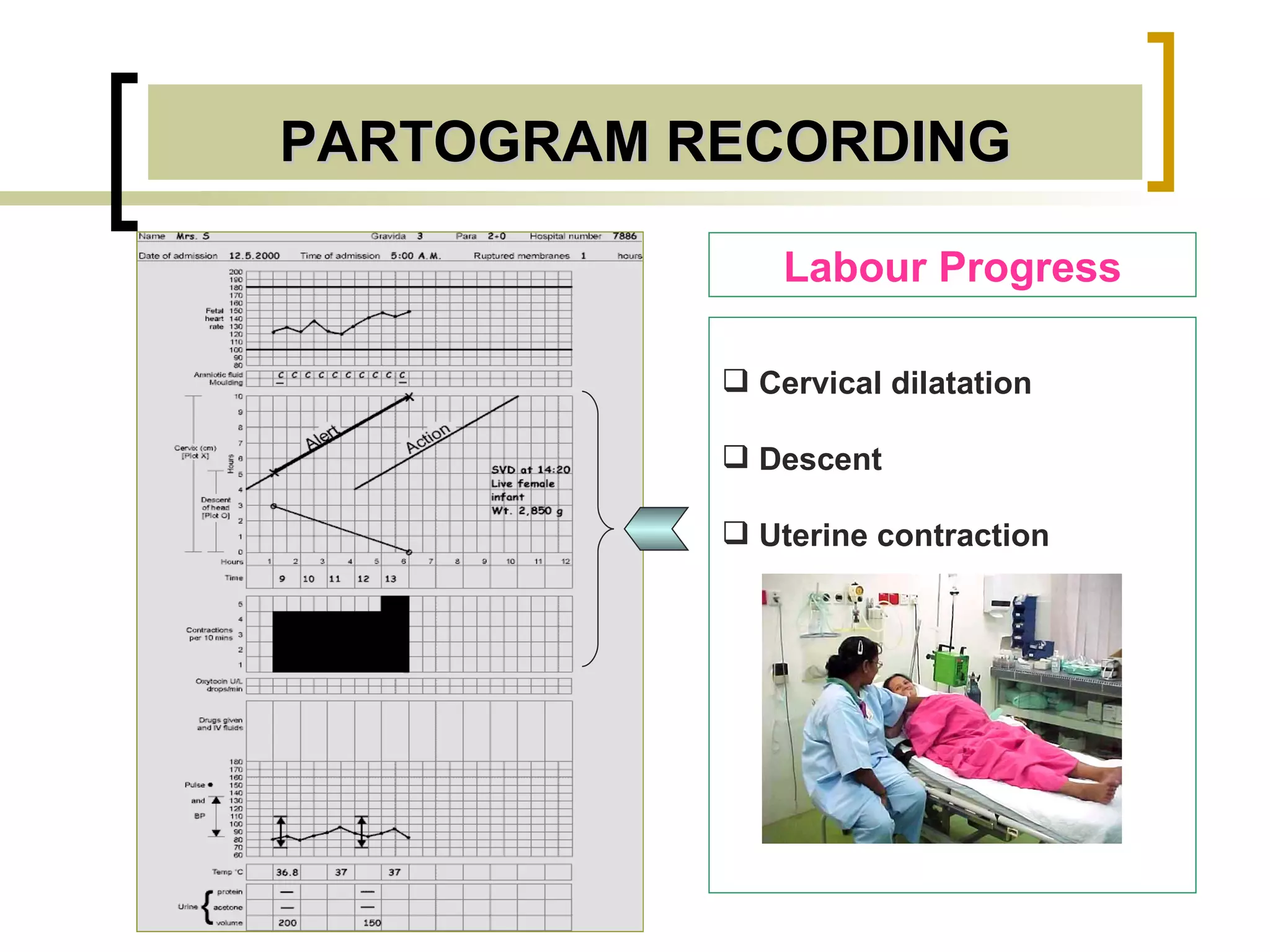
Focuses on key labor progress indicators including cervical dilation and contractions.
Explains how to record cervical dilation and descent, noting the transition between labor phases.
Details the method of documenting labor progress during the latent phase.
Illustrates how to record progress in the active phase of labor with specific measurements.
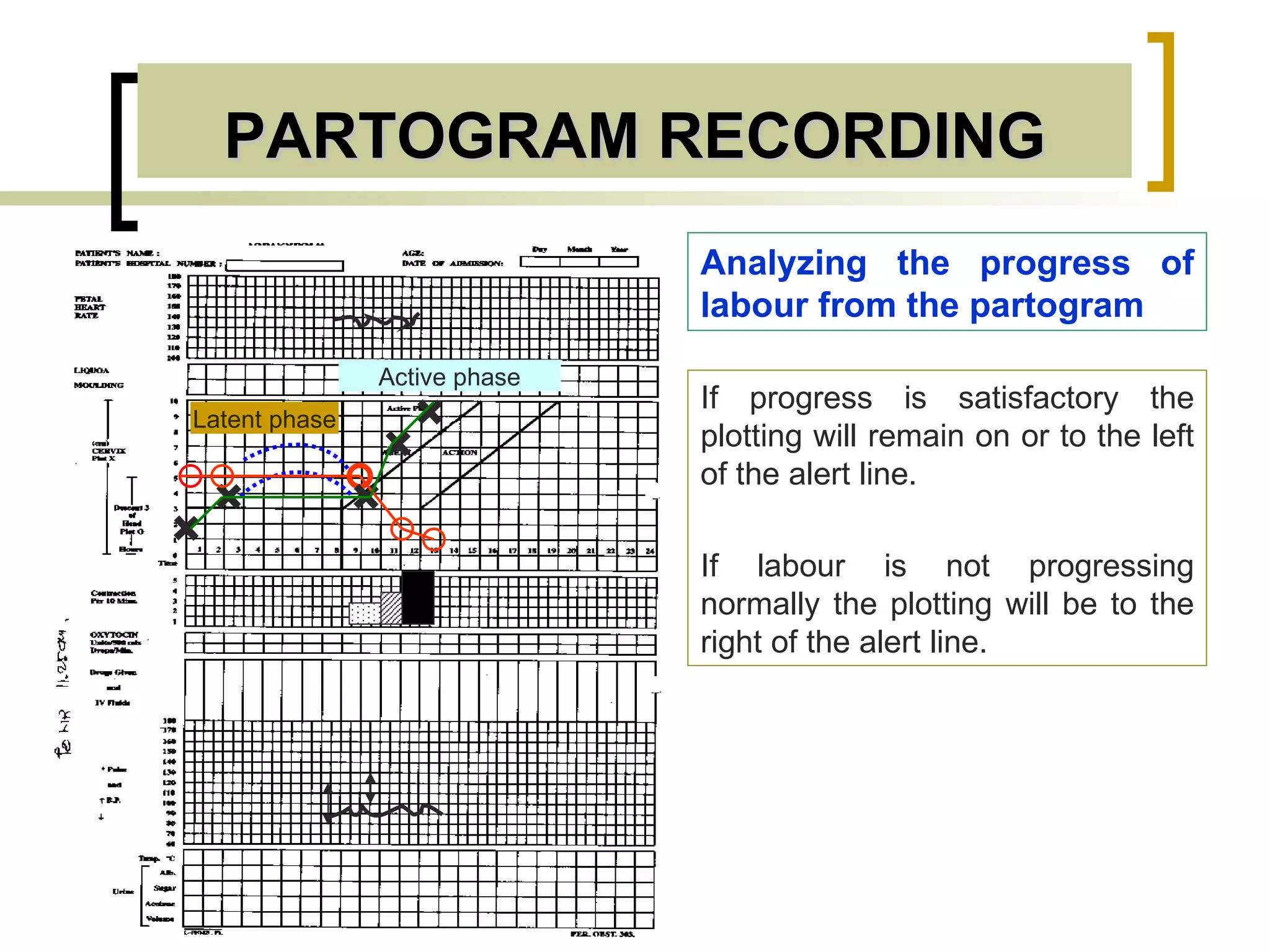
Explains the significance of graph positioning in relation to alert and action lines.
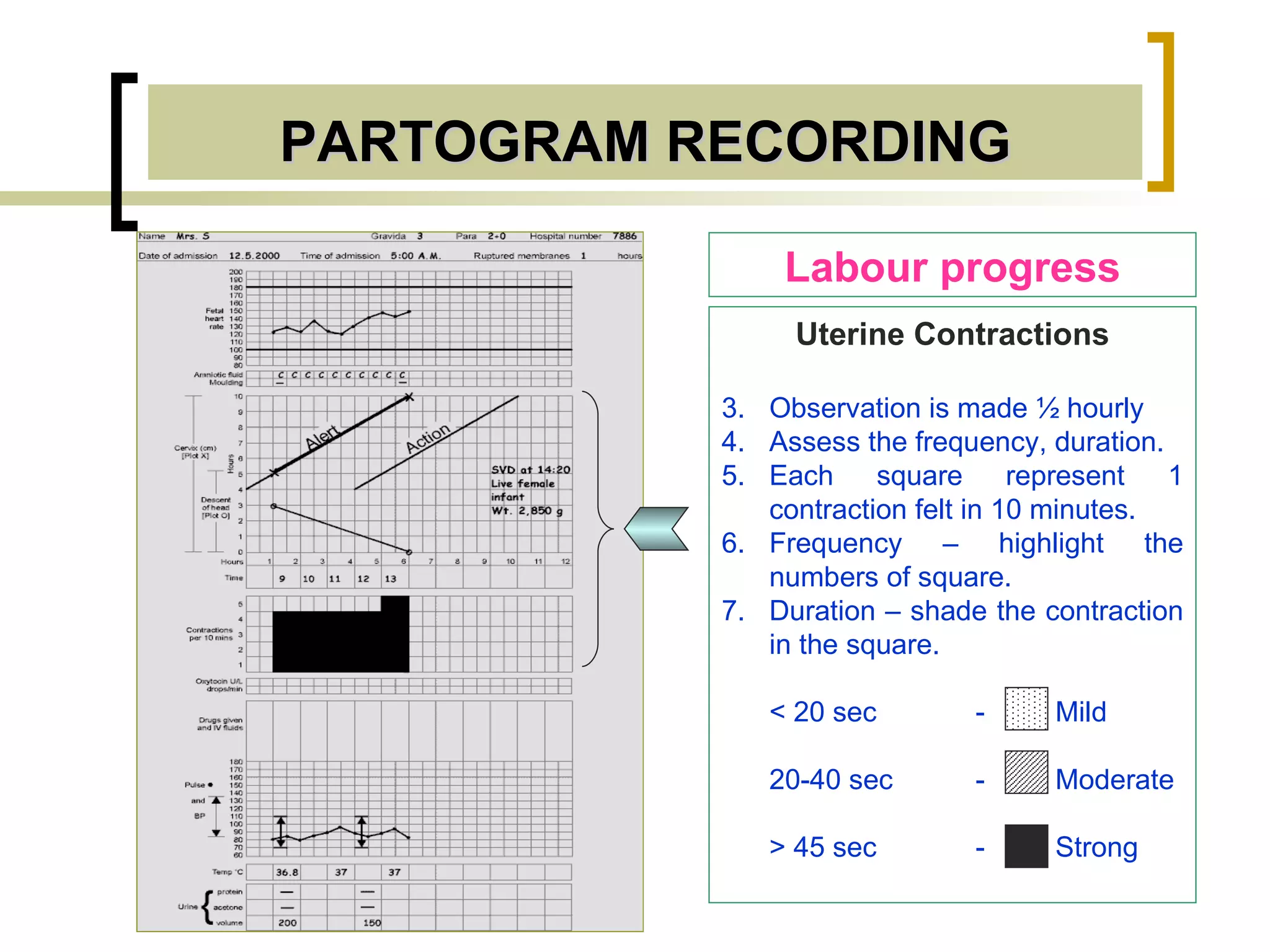
Provides method for recording the frequency and duration of uterine contractions on the partogram.
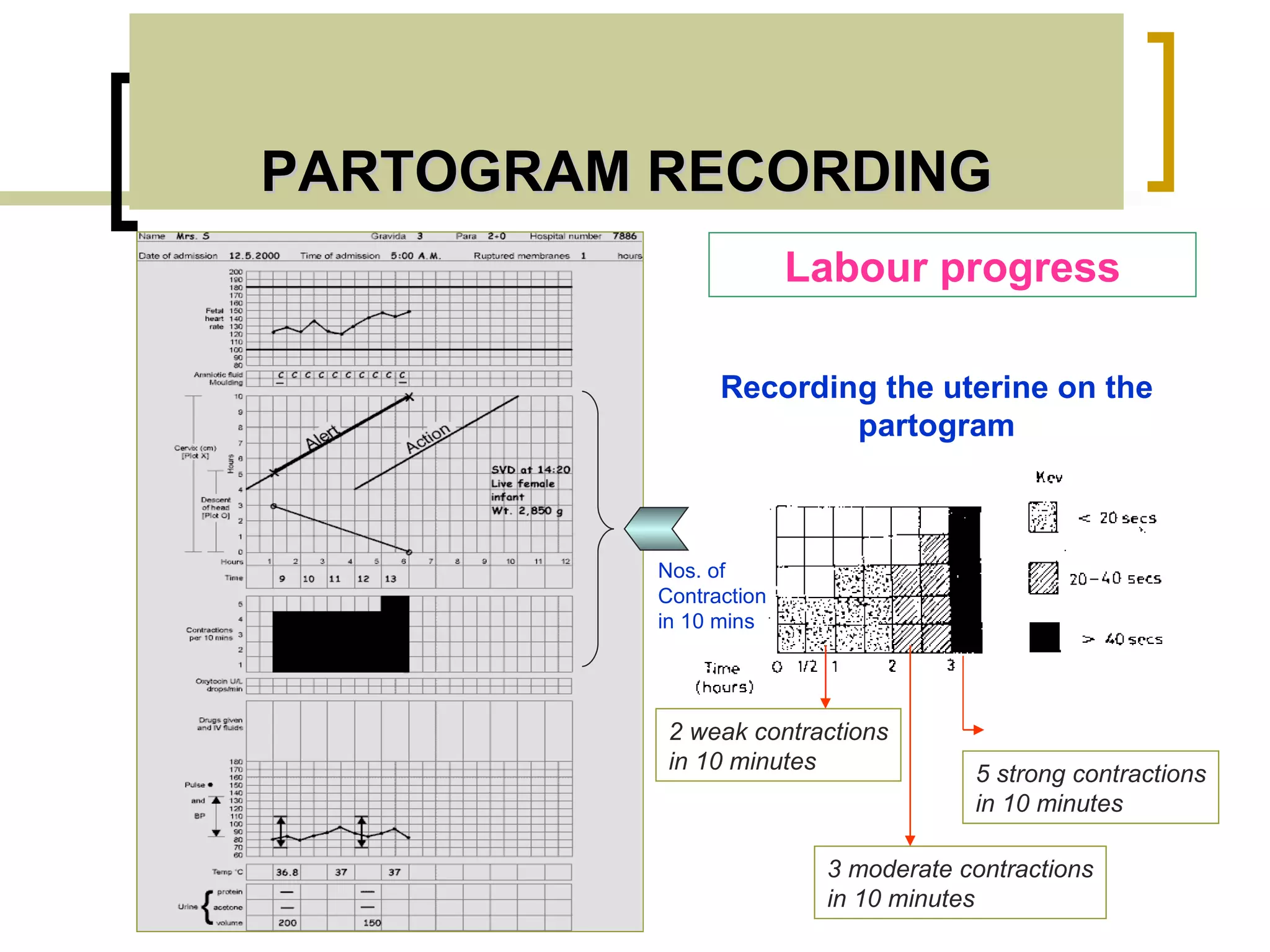
Summarizes how to log different strengths of uterine contractions occurring over 10-minute intervals.
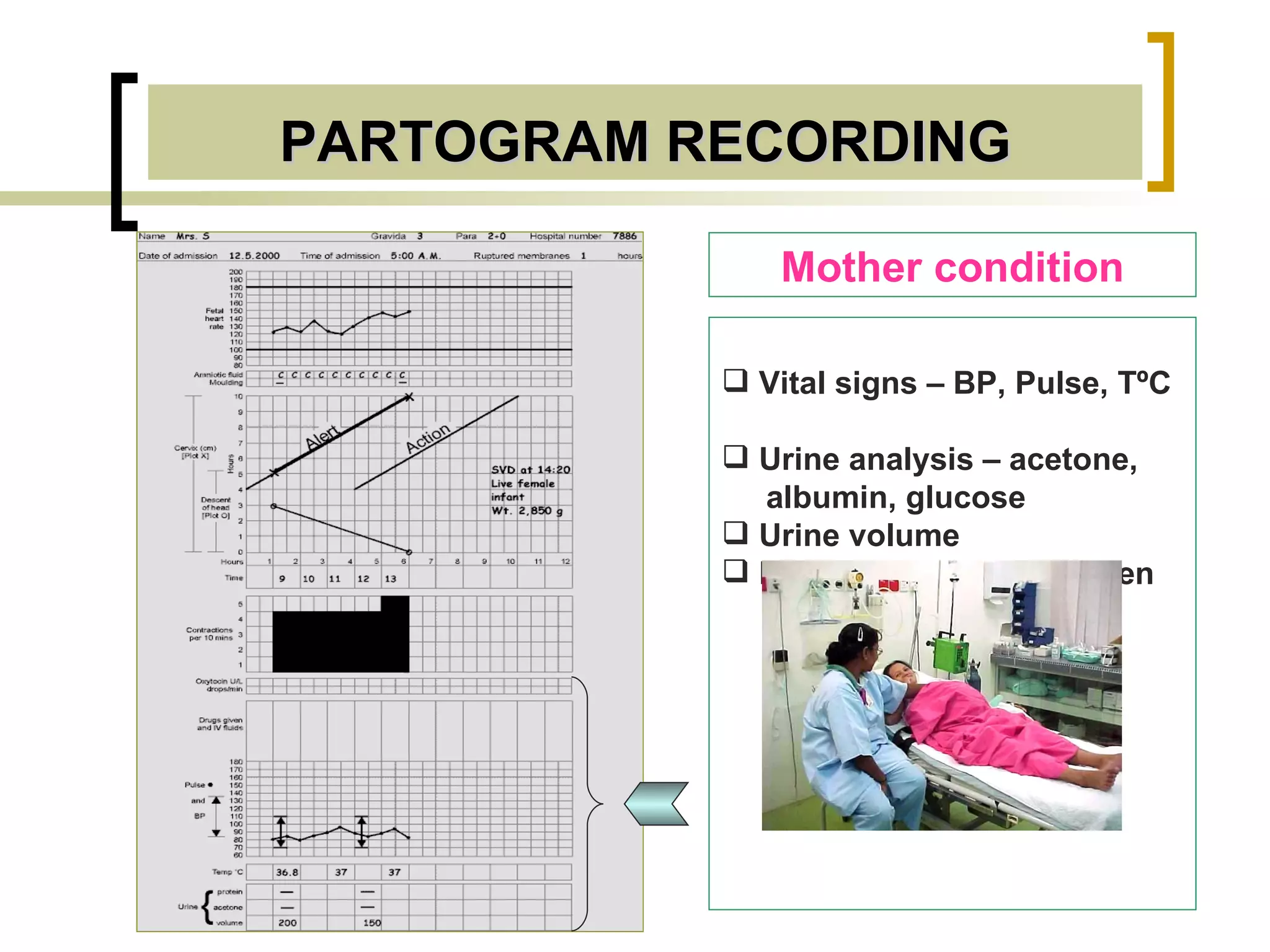
Discusses vital signs and drug administration records for monitoring maternal health during labor.
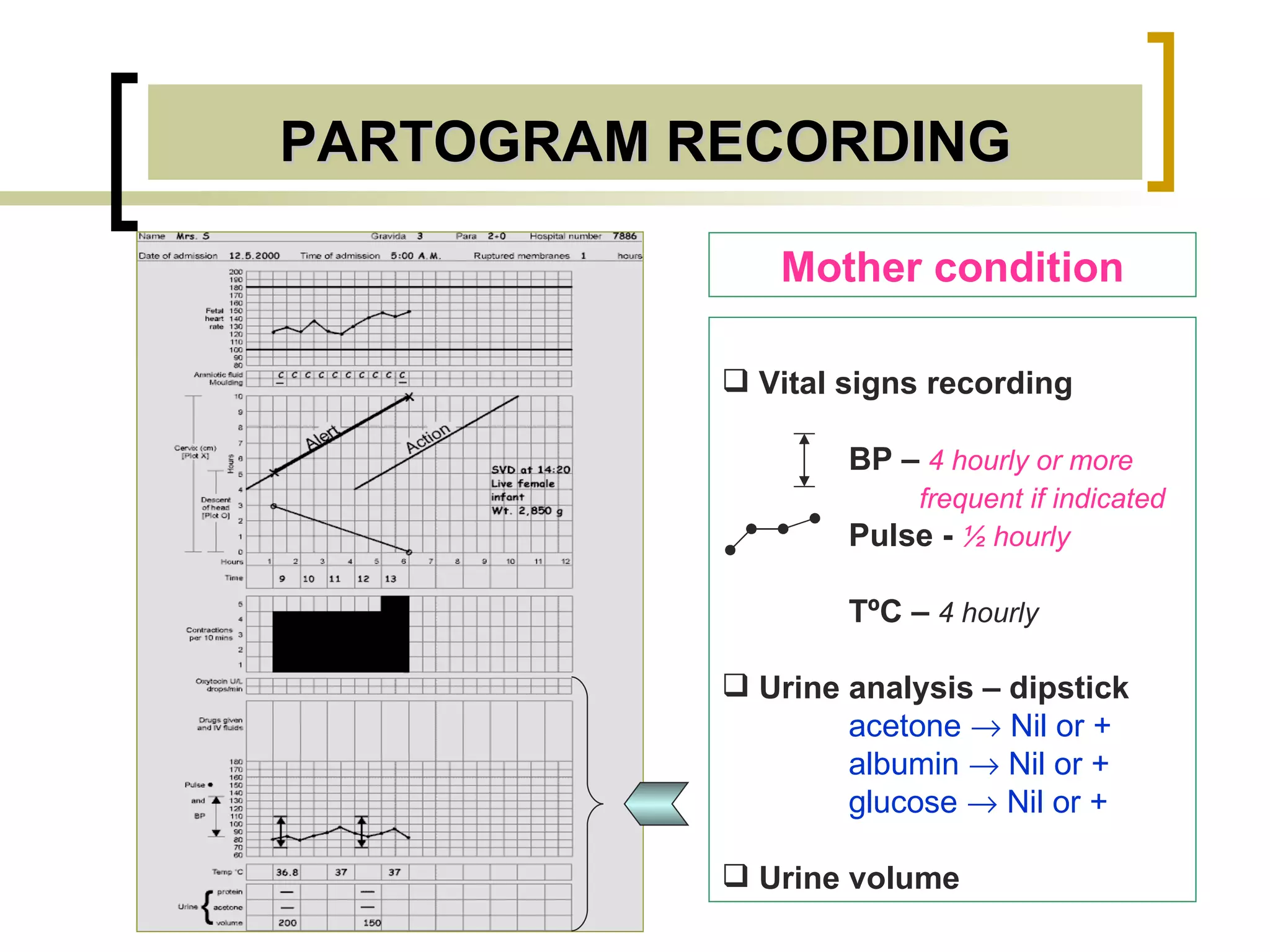
Outlines the frequency and types of vital sign and urine analysis to be recorded for maternal health.
Explains how to assess labor effectiveness by tracking graph positions relative to alert lines.
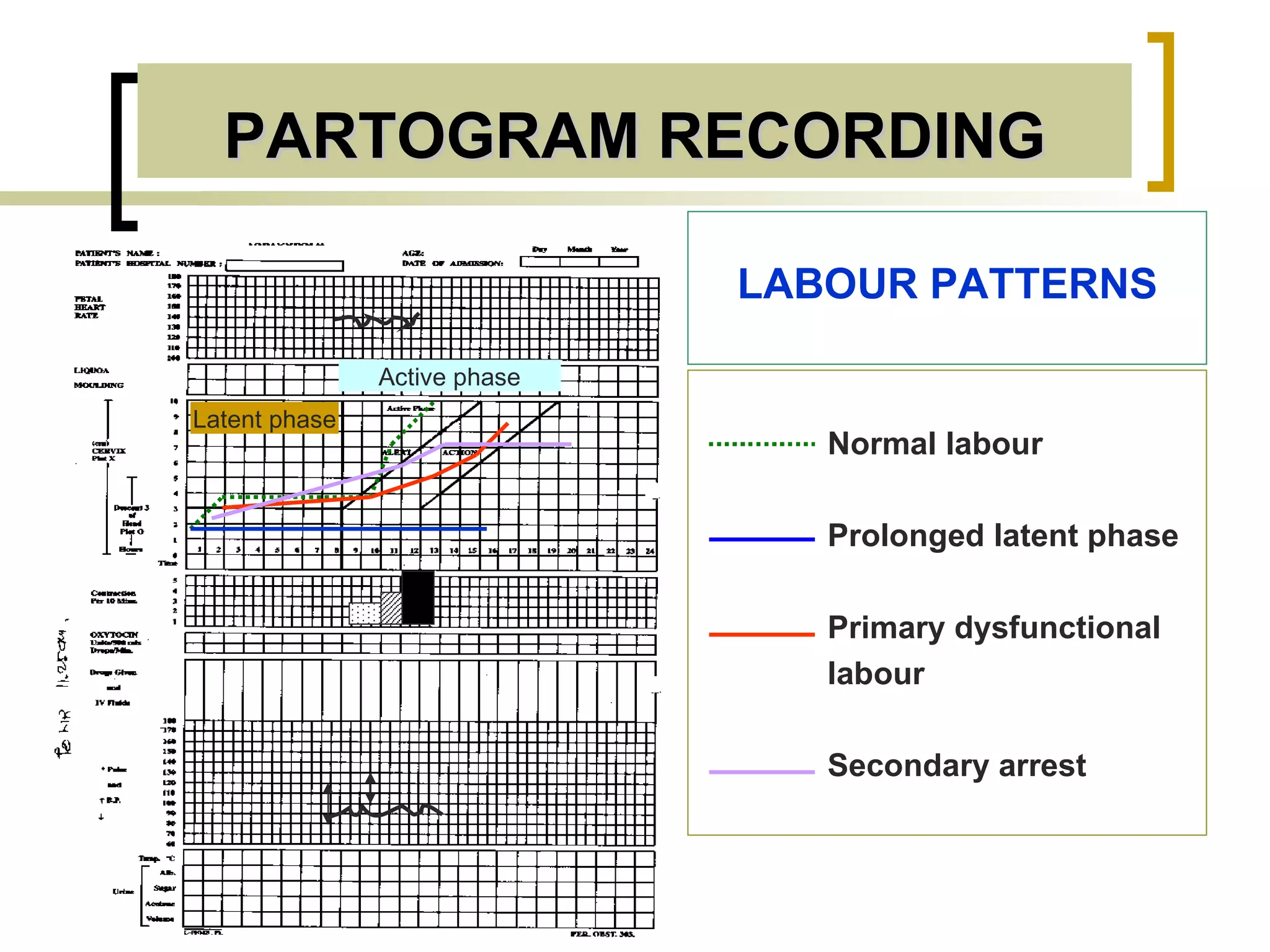
Categorizes labor patterns such as normal and dysfunctional labor types for clinical understanding.
Concludes the presentation, thanking the audience while reinforcing the importance of the partogram.
PARTOGRAM PROF DRMN MOHD AZHAR ROYAL COLLEGE OF MEDICINE PERAK RECORDING PROGRESS OF LABOUR
2.
WHY IS ITIMPORTANT TO RECORD THE PROGRESS OF LABOUR To provide continuity of care. To provide a basis of decision making. To facilitate research. To allow audit and review. To defend one’s actions – no documentation – no defense. Documentation is important
PARTOGRAM PARTOGRAM is a graphical information about the progress of labour in which the salient information about the fetal well-being, maternal well-being and the progress of labour are recorded into a chart.
5.
PARTOGRAM Is amanagerial tool used to record all observations made on a woman and fetus in labour in one chart. Partogram helps to identify at an early stage those women whose labour is slow. A managerial tool for prevention of prolonged labour. IT’S SIGNIFICANT:
6.
PARTOGRAM For allwomen who are in labour (i.e. either low or high risk group). WHO REQUIRE PARTOGRAM RECORDING
7.
PARTOGRAM Friedman's partogram- 1954 2 phases of labour (base on dilatation of the cervix ) Latent phase (dilatation < 3 cm) Active phase (>3 cm dilated) Latent phase Active phase Philpott and Castle - 1972 Introduced the concept of “ALERT” and “ACTION” lines. ALERT LINE – represent the mean rate of slowest progress of labour ACTION LINE – appropriate action should be taken. Normal labour is plotted to the left alert line
8.
PARTOGRAM Mother informationFetal well-being Fetal heart rate Character of liquor Moulding Labour progress Dilatation Descent Uterine contraction Medications Oxytocin Pain relief (e.g. pethidine) Maternal well-being BP, Pulse, Temperature Urine – albumin, glucose, acetone Urine output
PARTOGRAM RECORDING Beginplotting at the “zero” hour on the partogram Enter the outcome of delivery 1 2 All entries made in relation to time when the observations are made 3 Notes should be legible, dated and timed. 4
11.
PARTOGRAM RECORDING Motherinformation Name Age Parity Gestational period Date/time of admission Time of rupture membrane Short antenatal history
PARTOGRAM RECORDING Fetalinformation Fetal heart rate monitoring Safe and reliable way of knowing fetus is well. Listen after each contraction for one minutes. Recorded ½ hourly (each square is ½ hour)
14.
PARTOGRAM RECORDING Fetalinformation Character of amniotic fluid State of liquor can assess in monitoring fetal condition. Observation to be recorded - Membrane intact record as “I” - Membrane rupture: a) liquor clear record as “C” b) meconiun stained liquor “M” c) liquor absent record as “A”
15.
PARTOGRAM RECORDING Fetalinformation Moulding of fetal skull Provide information about the adequacy of pelvis to accommodate fetal head Record the degree of moulding 0 bones separated + bones touching but can be separated. ++ bone over lapping +++ bones over lapping severely
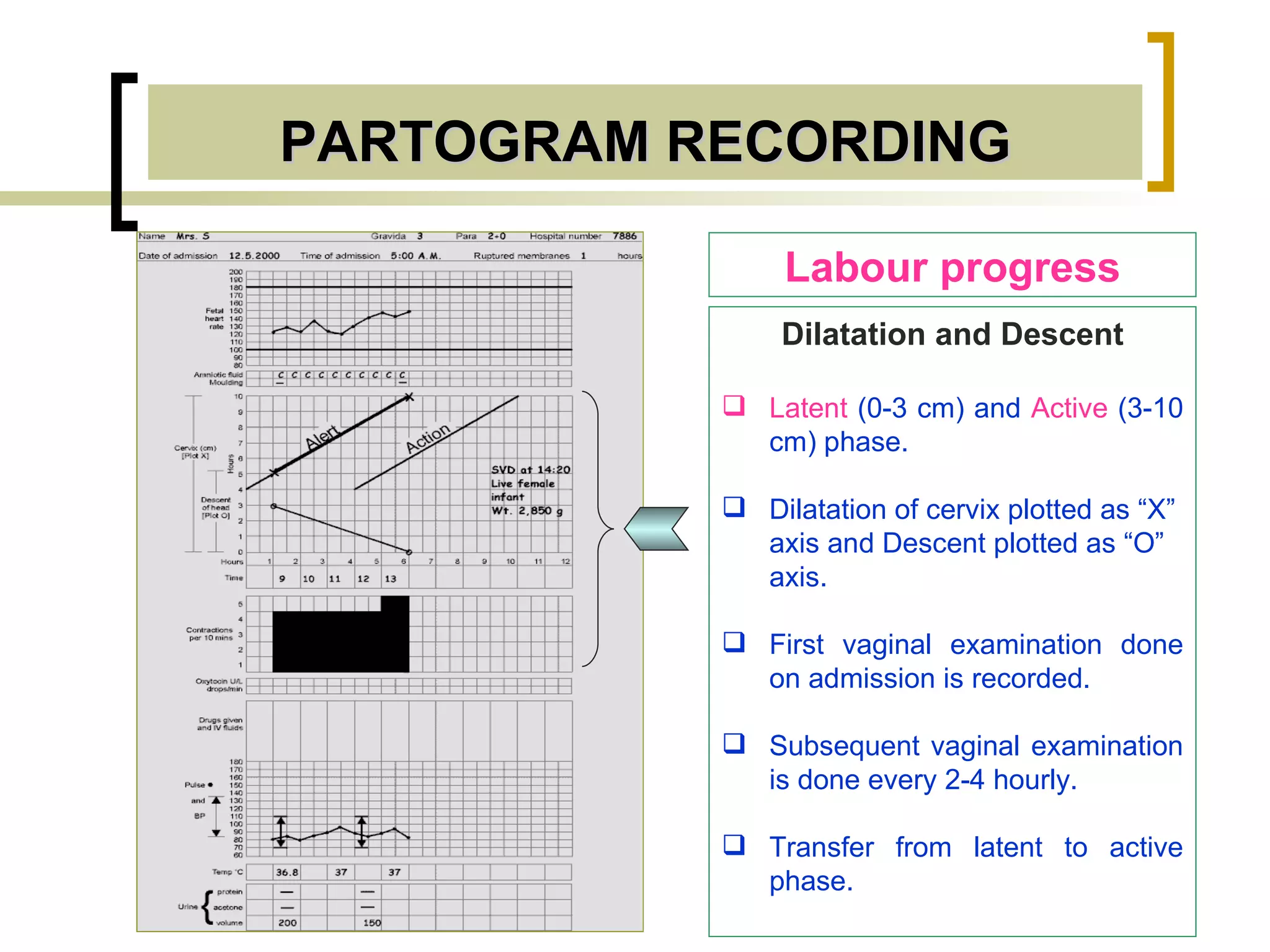
PARTOGRAM RECORDING Labourprogress Dilatation and Descent Latent (0-3 cm) and Active (3-10 cm) phase. Dilatation of cervix plotted as “X” axis and Descent plotted as “O” axis. First vaginal examination done on admission is recorded. Subsequent vaginal examination is done every 2-4 hourly. Transfer from latent to active phase.
18.
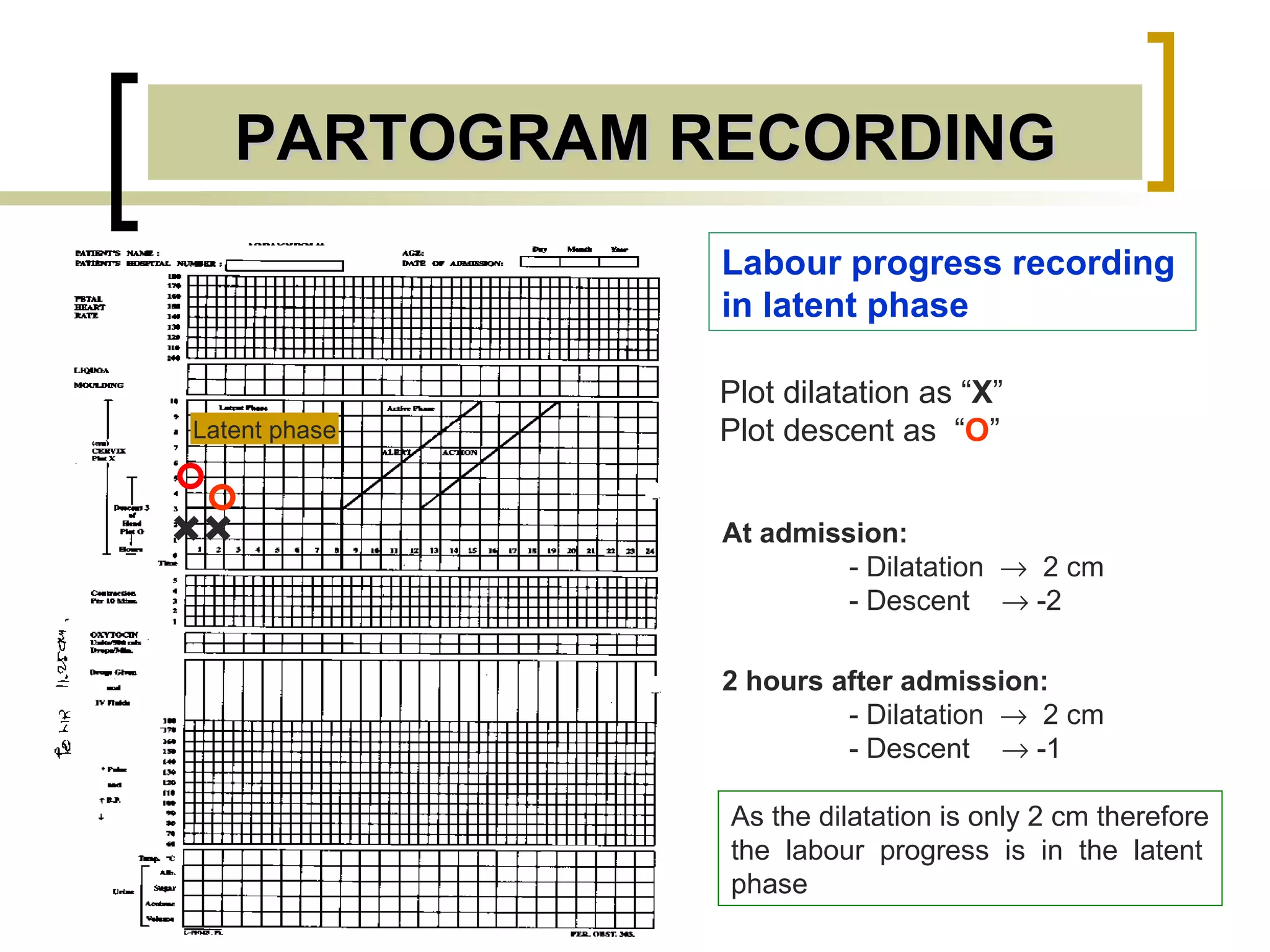
PARTOGRAM RECORDING Latentphase Labour progress recording in latent phase At admission: - Dilatation 2 cm - Descent -2 2 hours after admission: - Dilatation 2 cm - Descent -1 Plot dilatation as “ X ” Plot descent as “ O ” + + As the dilatation is only 2 cm therefore the labour progress is in the latent phase
19.
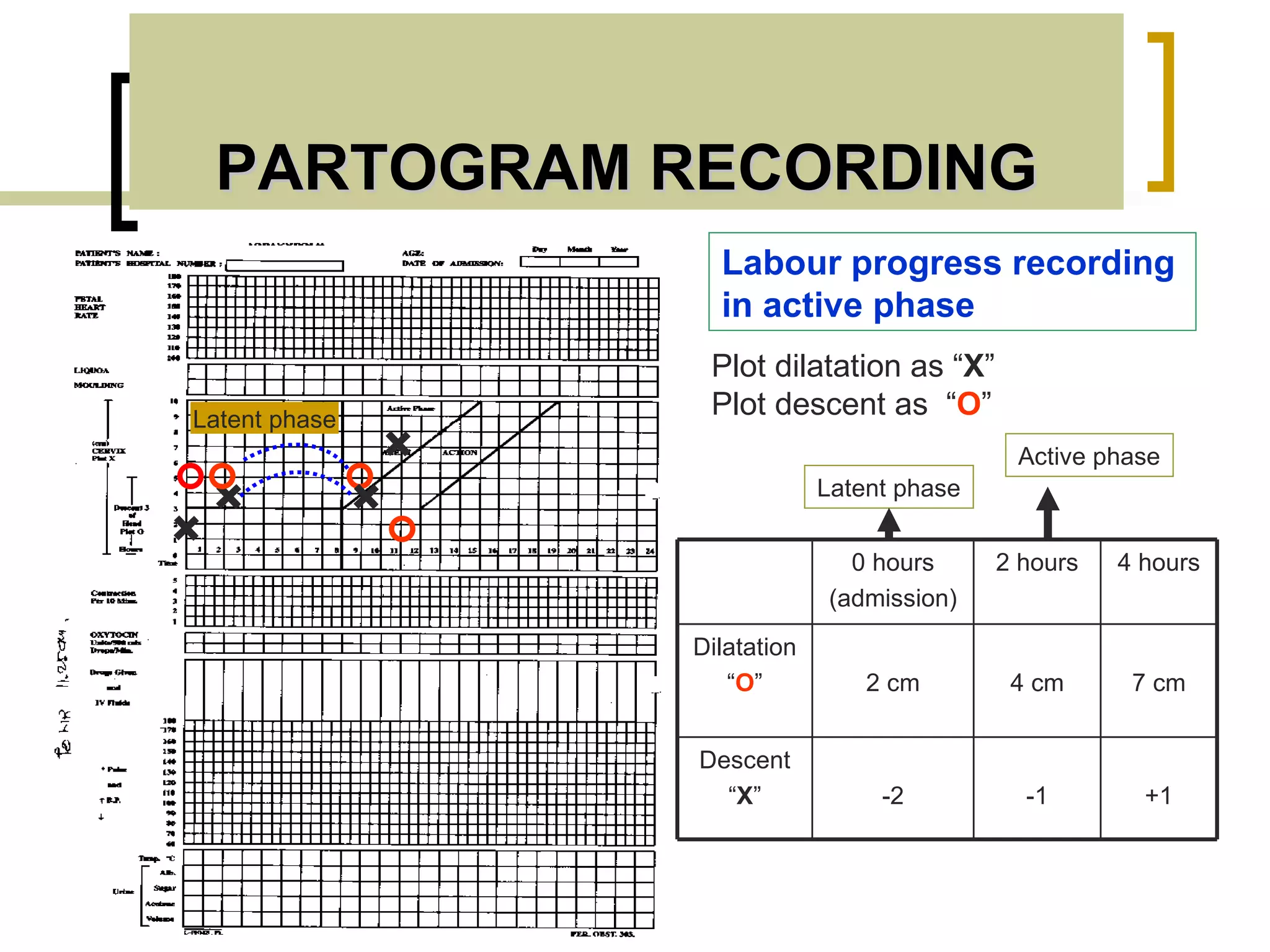
PARTOGRAM RECORDING Latentphase Labour progress recording in active phase Plot dilatation as “ X ” Plot descent as “ O ” + + + + Latent phase Active phase +1 -1 -2 Descent “ X ” 7 cm 4 cm 2 cm Dilatation “ O ” 4 hours 2 hours 0 hours (admission)
20.
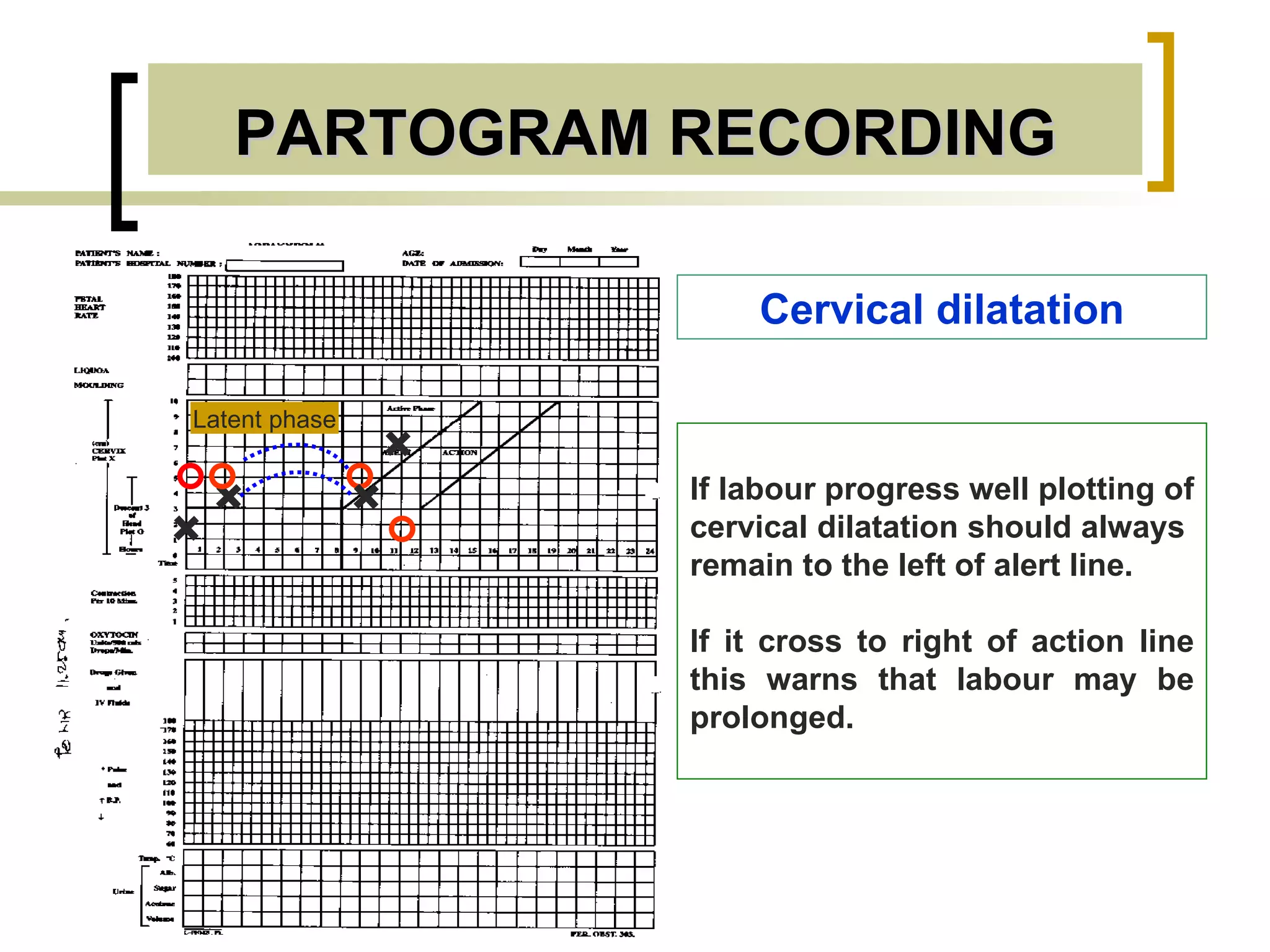
PARTOGRAM RECORDING Latentphase Cervical dilatation + + + + If labour progress well plotting of cervical dilatation should always remain to the left of alert line. If it cross to right of action line this warns that labour may be prolonged.
21.
PARTOGRAM RECORDING Labourprogress Uterine Contractions Observation is made ½ hourly Assess the frequency, duration. Each square represent 1 contraction felt in 10 minutes. Frequency – highlight the numbers of square. Duration – shade the contraction in the square. < 20 sec - Mild 20-40 sec - Moderate > 45 sec - Strong
22.
PARTOGRAM RECORDING Labourprogress Recording the uterine on the partogram 5 strong contractions in 10 minutes 2 weak contractions in 10 minutes 3 moderate contractions in 10 minutes Nos. of Contraction in 10 mins
23.
PARTOGRAM RECORDING Mothercondition Vital signs – BP, Pulse, T ºC Urine analysis – acetone, albumin, glucose Urine volume Medications or drug given
24.
PARTOGRAM RECORDING Mothercondition Vital signs recording BP – 4 hourly or more frequent if indicated Pulse - ½ hourly T ºC – 4 hourly Urine analysis – dipstick acetone Nil or + albumin Nil or + glucose Nil or + Urine volume
25.
PARTOGRAM RECORDING Latentphase Analyzing the progress of labour from the partogram + + + + + If progress is satisfactory the plotting will remain on or to the left of the alert line. If labour is not progressing normally the plotting will be to the right of the alert line. Active phase
26.
PARTOGRAM RECORDING Latentphase LABOUR PATTERNS Normal labour Prolonged latent phase Primary dysfunctional labour Secondary arrest Active phase
27.
THANK YOUPROF DR MN MOHD AZHAR ROYAL COLLEGE OF MEDICINE PERAK RECORDING PROGRESS OF LABOUR - PARTOGRAM