Target tracking using multiple auxiliary
particle filtering
Luis ´Ubeda-Medina , ´Angel F. Garc´ıa-Fern´andez†
, Jes´us Grajal
Universidad Polit´ecnica de Madrid, Spain
†Aalto University, Finland
20th International Conference on Information Fusion, 2017.
July 10-13, 2017. Xi’an, China.
1
Outline
Multiple Filtering
Multiple Particle Filter
The Multiple Auxiliary Particle Filter
Simulations and results
Conclusions
2
Outline
Multiple Filtering
Multiple Particle Filter
The Multiple Auxiliary Particle Filter
Simulations and results
Conclusions
3
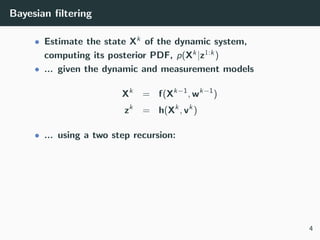
Bayesian filtering
• Estimate the state Xk of the dynamic system,
computing its posterior PDF, p(Xk|z1:k)
4
Bayesian filtering
• Estimate the state Xk of the dynamic system,
computing its posterior PDF, p(Xk|z1:k)
• ... given the dynamic and measurement models
Xk
= f(Xk−1
, wk−1
)
zk
= h(Xk
, vk
)
4
Bayesian filtering
• Estimate the state Xk of the dynamic system,
computing its posterior PDF, p(Xk|z1:k)
• ... given the dynamic and measurement models
Xk
= f(Xk−1
, wk−1
)
zk
= h(Xk
, vk
)
• ... using a two step recursion:
4
Bayesian filtering
• Estimate the state Xk of the dynamic system,
computing its posterior PDF, p(Xk|z1:k)
• ... given the dynamic and measurement models
Xk
= f(Xk−1
, wk−1
)
zk
= h(Xk
, vk
)
• ... using a two step recursion:
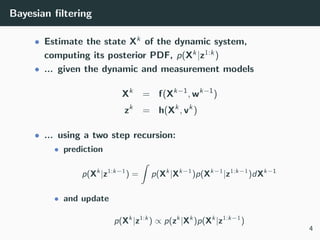
• prediction
p(Xk
|z1:k−1
) =
ˆ
p(Xk
|Xk−1
)p(Xk−1
|z1:k−1
)dXk−1
4
Bayesian filtering
• Estimate the state Xk of the dynamic system,
computing its posterior PDF, p(Xk|z1:k)
• ... given the dynamic and measurement models
Xk
= f(Xk−1
, wk−1
)
zk
= h(Xk
, vk
)
• ... using a two step recursion:
• prediction
p(Xk
|z1:k−1
) =
ˆ
p(Xk
|Xk−1
)p(Xk−1
|z1:k−1
)dXk−1
• and update
p(Xk
|z1:k
) ∝ p(zk
|Xk
)p(Xk
|z1:k−1
)
4
Multiple filtering
• Nonlinearities in the dynamic and measurement models
can make it hard to compute the posterior PDF,
specially for high-dimensional state spaces (the curse of
dimensionality)
5
Multiple filtering
• Nonlinearities in the dynamic and measurement models
can make it hard to compute the posterior PDF,
specially for high-dimensional state spaces (the curse of
dimensionality)
• Multiple filtering tries to alleviate the curse of
dimensionality, considering the state can be partitioned
into t components
Xk
= (xk
1)T
, (xk
2)T
, ..., (xk
t )T
T
5
Multiple filtering
• Nonlinearities in the dynamic and measurement models
can make it hard to compute the posterior PDF,
specially for high-dimensional state spaces (the curse of
dimensionality)
• Multiple filtering tries to alleviate the curse of
dimensionality, considering the state can be partitioned
into t components
Xk
= (xk
1)T
, (xk
2)T
, ..., (xk
t )T
T
• ... and instead computing the marginal posterior PDF of
each component (lower dimension)
p(xk
j |z1:k
) =
ˆ
p(Xk
|z1:k
)dXk
−{j}
5
Multiple filtering
• Given the following assumptions:
6
Multiple filtering
• Given the following assumptions:
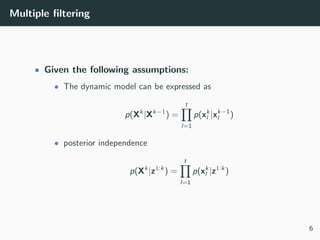
• The dynamic model can be expressed as
p(Xk
|Xk−1
) =
t
l=1
p(xk
l |xk−1
l )
6
Multiple filtering
• Given the following assumptions:
• The dynamic model can be expressed as
p(Xk
|Xk−1
) =
t
l=1
p(xk
l |xk−1
l )
• posterior independence
p(Xk
|z1:k
) =
t
l=1
p(xk
l |z1:k
)
6
Multiple filtering
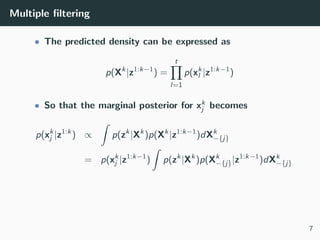
• The predicted density can be expressed as
p(Xk
|z1:k−1
) =
t
l=1
p(xk
l |z1:k−1
)
7
Multiple filtering
• The predicted density can be expressed as
p(Xk
|z1:k−1
) =
t
l=1
p(xk
l |z1:k−1
)
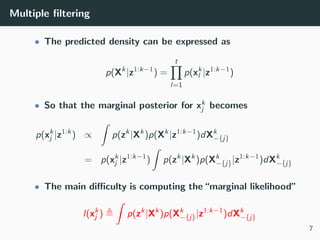
• So that the marginal posterior for xk
j becomes
p(xk
j |z1:k
) ∝
ˆ
p(zk
|Xk
)p(Xk
|z1:k−1
)dXk
−{j}
= p(xk
j |z1:k−1
)
ˆ
p(zk
|Xk
)p(Xk
−{j}|z1:k−1
)dXk
−{j}
7
Multiple filtering
• The predicted density can be expressed as
p(Xk
|z1:k−1
) =
t
l=1
p(xk
l |z1:k−1
)
• So that the marginal posterior for xk
j becomes
p(xk
j |z1:k
) ∝
ˆ
p(zk
|Xk
)p(Xk
|z1:k−1
)dXk
−{j}
= p(xk
j |z1:k−1
)
ˆ
p(zk
|Xk
)p(Xk
−{j}|z1:k−1
)dXk
−{j}
• The main difficulty is computing the“marginal likelihood”
l(xk
j )
ˆ
p(zk
|Xk
)p(Xk
−{j}|z1:k−1
)dXk
−{j}
7
Outline
Multiple Filtering
Multiple Particle Filter
The Multiple Auxiliary Particle Filter
Simulations and results
Conclusions
8
Multiple Particle Filter
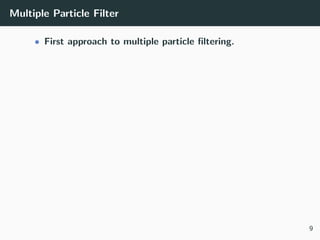
• First approach to multiple particle filtering.
9
Multiple Particle Filter
• First approach to multiple particle filtering.
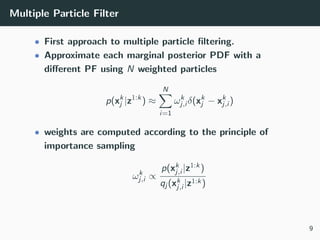
• Approximate each marginal posterior PDF with a
different PF using N weighted particles
p(xk
j |z1:k
) ≈
N
i=1
ωk
j,i δ(xk
j − xk
j,i )
9
Multiple Particle Filter
• First approach to multiple particle filtering.
• Approximate each marginal posterior PDF with a
different PF using N weighted particles
p(xk
j |z1:k
) ≈
N
i=1
ωk
j,i δ(xk
j − xk
j,i )
• weights are computed according to the principle of
importance sampling
ωk
j,i ∝
p(xk
j,i |z1:k)
qj (xk
j,i |z1:k)
9
Multiple Particle Filter
• First approach to multiple particle filtering.
• Approximate each marginal posterior PDF with a
different PF using N weighted particles
p(xk
j |z1:k
) ≈
N
i=1
ωk
j,i δ(xk
j − xk
j,i )
• weights are computed according to the principle of
importance sampling
ωk
j,i ∝
p(xk
j,i |z1:k)
qj (xk
j,i |z1:k)
• with the importance sampling function being the prior PDF
qj (xk
j |z1:k
) ∝ p(xk
j |xk−1
j ) 9
Multiple Particle Filter
• First order approximation of the “marginal likelihood”
10
Multiple Particle Filter
• First order approximation of the “marginal likelihood”
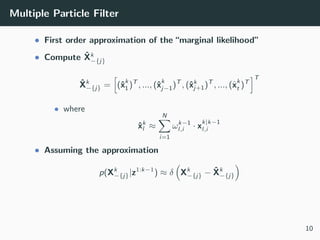
• Compute ˆXk
−{j}
ˆXk
−{j} = (ˆx
k
1)T
, ..., (ˆx
k
j−1)T
, (ˆxk
j+1)T
, ..., (ˆx
k
t )T
T
10
Multiple Particle Filter
• First order approximation of the “marginal likelihood”
• Compute ˆXk
−{j}
ˆXk
−{j} = (ˆx
k
1)T
, ..., (ˆx
k
j−1)T
, (ˆxk
j+1)T
, ..., (ˆx
k
t )T
T
• where
ˆxk
l ≈
N
i=1
ωk−1
l,i · x
k|k−1
l,i
10
Multiple Particle Filter
• First order approximation of the “marginal likelihood”
• Compute ˆXk
−{j}
ˆXk
−{j} = (ˆx
k
1)T
, ..., (ˆx
k
j−1)T
, (ˆxk
j+1)T
, ..., (ˆx
k
t )T
T
• where
ˆxk
l ≈
N
i=1
ωk−1
l,i · x
k|k−1
l,i
• Assuming the approximation
p(Xk
−{j}|z1:k−1
) ≈ δ Xk
−{j} − ˆXk
−{j}
10
Multiple Particle Filter
• First order approximation of the “marginal likelihood”
• Compute ˆXk
−{j}
ˆXk
−{j} = (ˆx
k
1)T
, ..., (ˆx
k
j−1)T
, (ˆxk
j+1)T
, ..., (ˆx
k
t )T
T
• where
ˆxk
l ≈
N
i=1
ωk−1
l,i · x
k|k−1
l,i
• Assuming the approximation
p(Xk
−{j}|z1:k−1
) ≈ δ Xk
−{j} − ˆXk
−{j}
• We approximate the “marginal likelihood” as
ˆ
p(zk
|Xk
)p(Xk
−{j}|z1:k−1
)dXk
−{j} ≈ p(zk
|xk
j , ˆXk
−{j})
10
Outline
Multiple Filtering
Multiple Particle Filter
The Multiple Auxiliary Particle Filter
Simulations and results
Conclusions
11
The Multiple Auxiliary Particle Filter
• MAPF takes advantage of auxiliary filtering. This is, use
the current measurement at time k, zk, to improve the
way samples are drawn for the importance sampling
function.
12
The Multiple Auxiliary Particle Filter
• MAPF takes advantage of auxiliary filtering. This is, use
the current measurement at time k, zk, to improve the
way samples are drawn for the importance sampling
function.
• MAPF uses an auxiliary PF to approximate the marginal
posterior PDF of each component of the partition of the
state.
12
The Multiple Auxiliary Particle Filter
• MAPF takes advantage of auxiliary filtering. This is, use
the current measurement at time k, zk, to improve the
way samples are drawn for the importance sampling
function.
• MAPF uses an auxiliary PF to approximate the marginal
posterior PDF of each component of the partition of the
state.
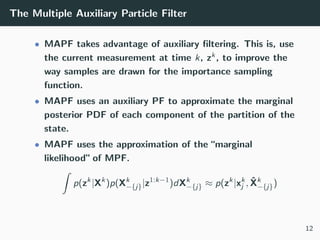
• MAPF uses the approximation of the “marginal
likelihood” of MPF.
ˆ
p(zk
|Xk
)p(Xk
−{j}|z1:k−1
)dXk
−{j} ≈ p(zk
|xk
j , ˆXk
−{j})
12
The Multiple Auxiliary Particle Filter
• MAPF indirectly obtains samples from p(xk
j |z1:k
) using an
auxiliary variable aj .
13
The Multiple Auxiliary Particle Filter
• MAPF indirectly obtains samples from p(xk
j |z1:k
) using an
auxiliary variable aj .
• Compute µk
j,i , a characterization of xk
j given xk−1
j,i , such as
µk
j,i = E[xk
j |xk−1
j,i ]
13
The Multiple Auxiliary Particle Filter
• MAPF indirectly obtains samples from p(xk
j |z1:k
) using an
auxiliary variable aj .
• Compute µk
j,i , a characterization of xk
j given xk−1
j,i , such as
µk
j,i = E[xk
j |xk−1
j,i ]
• Sample aj,i according to
λj,i ∝ p(zk
|µk
j,i , ˆXk
−{j})ωk−1
i
13
The Multiple Auxiliary Particle Filter
• MAPF indirectly obtains samples from p(xk
j |z1:k
) using an
auxiliary variable aj .
• Compute µk
j,i , a characterization of xk
j given xk−1
j,i , such as
µk
j,i = E[xk
j |xk−1
j,i ]
• Sample aj,i according to
λj,i ∝ p(zk
|µk
j,i , ˆXk
−{j})ωk−1
i
• Using the index aj thus allows to draw particles that are prone
to obtain a higher likelihood with the current measurement zk
.
13
The Multiple Auxiliary Particle Filter
• MAPF indirectly obtains samples from p(xk
j |z1:k
) using an
auxiliary variable aj .
• Compute µk
j,i , a characterization of xk
j given xk−1
j,i , such as
µk
j,i = E[xk
j |xk−1
j,i ]
• Sample aj,i according to
λj,i ∝ p(zk
|µk
j,i , ˆXk
−{j})ωk−1
i
• Using the index aj thus allows to draw particles that are prone
to obtain a higher likelihood with the current measurement zk
.
• The importance sampling function of MAPF therefore draws
samples in a higher dimension from
qj (xk
j , aj |z1:k
) ∝ p(zk
|µk
j,aj
, ˆXk
−{j})p(xk
j |xk−1
j,aj
)ωk−1
j,aj
13
Outline
Multiple Filtering
Multiple Particle Filter
The Multiple Auxiliary Particle Filter
Simulations and results
Conclusions
14
Target dynamics
• 8 target trajectories were generated according to an
independent nearly-constant velocity model.
0 20 40 60 80 100 120
x position [m]
0
20
40
60
80
100
120
yposition[m]
1
2
3
4
5
6
7
8
15
Sensor model
• A nonlinear measurement model is considered. Each sensor
receives amplitude range-dependent measurements.
zk+1
i = hi (Xk+1
) + vk+1
i
hi (Xk+1
) =
t
j=1
SNR(dk+1
j,i )
SNR(dk+1
j,i ) =



SNR0 dk+1
j,i ≤ d0
SNR0
d2
0
(dk+1
j,i )2
dk+1
j,i > d0
16
Compared filters
• Jointly Auxiliary PF (JA) [1]
[1] M. R. Morelande, “Tracking multiple targets with a sensor network,” in Proceedings of the 9th International
Conference on Information Fusion (FUSION), 2006.
[2] ´A. F. Garc´ıa-Fern´andez, J. Grajal, and M. Morelande, “Two-layer particle filter for multiple target detection and
tracking,” IEEE Transactions on Aerospace and Electronic Systems, vol. 49, no. 3, pp. 1569–1588, 2013.
[3] L. ´Ubeda-Medina, ´A. F. Garc´ıa-Fernandez, and J. Grajal, “Generalizations of the auxiliary particle filter for
multiple target tracking,” in Proceedings of the 17th International Conference on Information Fusion (FUSION),
2014.
[4] M. F. Bugallo, T. Lu, and P. M. Djuri´c, “Target Tracking by Multiple Particle Filtering,” IEEE Aerospace
Conference, pp. 1–7, 2007.
17
Compared filters
• Jointly Auxiliary PF (JA) [1]
• Parallel Partition PF (PP) [2]
[1] M. R. Morelande, “Tracking multiple targets with a sensor network,” in Proceedings of the 9th International
Conference on Information Fusion (FUSION), 2006.
[2] ´A. F. Garc´ıa-Fern´andez, J. Grajal, and M. Morelande, “Two-layer particle filter for multiple target detection and
tracking,” IEEE Transactions on Aerospace and Electronic Systems, vol. 49, no. 3, pp. 1569–1588, 2013.
[3] L. ´Ubeda-Medina, ´A. F. Garc´ıa-Fernandez, and J. Grajal, “Generalizations of the auxiliary particle filter for
multiple target tracking,” in Proceedings of the 17th International Conference on Information Fusion (FUSION),
2014.
[4] M. F. Bugallo, T. Lu, and P. M. Djuri´c, “Target Tracking by Multiple Particle Filtering,” IEEE Aerospace
Conference, pp. 1–7, 2007.
17
Compared filters
• Jointly Auxiliary PF (JA) [1]
• Parallel Partition PF (PP) [2]
• Auxiliary PP PF (APP) [3]
[1] M. R. Morelande, “Tracking multiple targets with a sensor network,” in Proceedings of the 9th International
Conference on Information Fusion (FUSION), 2006.
[2] ´A. F. Garc´ıa-Fern´andez, J. Grajal, and M. Morelande, “Two-layer particle filter for multiple target detection and
tracking,” IEEE Transactions on Aerospace and Electronic Systems, vol. 49, no. 3, pp. 1569–1588, 2013.
[3] L. ´Ubeda-Medina, ´A. F. Garc´ıa-Fernandez, and J. Grajal, “Generalizations of the auxiliary particle filter for
multiple target tracking,” in Proceedings of the 17th International Conference on Information Fusion (FUSION),
2014.
[4] M. F. Bugallo, T. Lu, and P. M. Djuri´c, “Target Tracking by Multiple Particle Filtering,” IEEE Aerospace
Conference, pp. 1–7, 2007.
17
Compared filters
• Jointly Auxiliary PF (JA) [1]
• Parallel Partition PF (PP) [2]
• Auxiliary PP PF (APP) [3]
• Multiple PF (MPF) [4]
[1] M. R. Morelande, “Tracking multiple targets with a sensor network,” in Proceedings of the 9th International
Conference on Information Fusion (FUSION), 2006.
[2] ´A. F. Garc´ıa-Fern´andez, J. Grajal, and M. Morelande, “Two-layer particle filter for multiple target detection and
tracking,” IEEE Transactions on Aerospace and Electronic Systems, vol. 49, no. 3, pp. 1569–1588, 2013.
[3] L. ´Ubeda-Medina, ´A. F. Garc´ıa-Fernandez, and J. Grajal, “Generalizations of the auxiliary particle filter for
multiple target tracking,” in Proceedings of the 17th International Conference on Information Fusion (FUSION),
2014.
[4] M. F. Bugallo, T. Lu, and P. M. Djuri´c, “Target Tracking by Multiple Particle Filtering,” IEEE Aerospace
Conference, pp. 1–7, 2007.
17
Compared filters
• Jointly Auxiliary PF (JA) [1]
• Parallel Partition PF (PP) [2]
• Auxiliary PP PF (APP) [3]
• Multiple PF (MPF) [4]
• Multiple Auxiliary PF (MAPF)
[1] M. R. Morelande, “Tracking multiple targets with a sensor network,” in Proceedings of the 9th International
Conference on Information Fusion (FUSION), 2006.
[2] ´A. F. Garc´ıa-Fern´andez, J. Grajal, and M. Morelande, “Two-layer particle filter for multiple target detection and
tracking,” IEEE Transactions on Aerospace and Electronic Systems, vol. 49, no. 3, pp. 1569–1588, 2013.
[3] L. ´Ubeda-Medina, ´A. F. Garc´ıa-Fernandez, and J. Grajal, “Generalizations of the auxiliary particle filter for
multiple target tracking,” in Proceedings of the 17th International Conference on Information Fusion (FUSION),
2014.
[4] M. F. Bugallo, T. Lu, and P. M. Djuri´c, “Target Tracking by Multiple Particle Filtering,” IEEE Aerospace
Conference, pp. 1–7, 2007.
17
Tracking 2 targets
50 100 150 200 250 300 350 400 450 500
Number of particles
0
1
2
3
4
5
OSPApositionerror[m]
JA
PP
APP
MPF
MAPF
• MAPF is the best filter, closely followed by APP
18
Tracking 2 targets
50 100 150 200 250 300 350 400 450 500
Number of particles
0
1
2
3
4
5
OSPApositionerror[m]
JA
PP
APP
MPF
MAPF
• MAPF is the best filter, closely followed by APP
• A remarkably small number of particles is needed for MAPF
to obtain good tracking results 18
Tracking 6 targets
50 100 150 200 250 300 350 400 450 500
number of particles
1
2
3
4
5
6
7
OSPApositionerror[m] JA
PP
APP
MPF
MAPF
• The performance improvement of MAPF is bigger in this
higher-dimensional scenario.
19
Tracking 6 targets
50 100 150 200 250 300 350 400 450 500
number of particles
1
2
3
4
5
6
7
OSPApositionerror[m] JA
PP
APP
MPF
MAPF
• The performance improvement of MAPF is bigger in this
higher-dimensional scenario.
• JA acutely suffers the curse of dimensionality, as it considers
the whole state in the sampling procedure. 19
Tracking 8 targets
50 100 150 200 250 300 350 400 450 500
number of particles
2
3
4
5
6
7
OSPApositionerror[m]
JA
PP
APP
MPF
MAPF
• MAPF outperforms the rest of the filters, this time followed
by MPF.
20
Tracking 1 to 8 targets, 100 particles
1 2 3 4 5 6 7 8
number of targets
0
1
2
3
4
5
6
7
OSPApositionerror[m]
JA
PP
APP
MPF
MAPF
• Multiple filters such as MAPF and MPF remarkably deal to
increases in dimensionality.
21
Tracking 1 to 8 targets, 100 particles
1 2 3 4 5 6 7 8
number of targets
0
1
2
3
4
5
6
7
OSPApositionerror[m]
JA
PP
APP
MPF
MAPF
• Multiple filters such as MAPF and MPF remarkably deal to
increases in dimensionality.
• Overall, for 100 particles, MAPF is the best performing filter,
followed by APP and MPF. 21
Tracking 8 targets (zoom). Eq. execution time (I)
50 100 150 200 250 300 350 400 450 500
number of particles
0
0.5
1
1.5
2
2.5
3
3.5
meanexecutiontime[s]
PP
APP
MPF
MAPF
50 100 150 200 250 300 350 400 450 500
number of particles
2
2.5
3
3.5
4
OSPApositionerror[m]
PP
APP
MPF
MAPF
• MAPF and APP have a higher computational cost.
22
Tracking 8 targets (zoom). Eq. execution time (I)
50 100 150 200 250 300 350 400 450 500
number of particles
0
0.5
1
1.5
2
2.5
3
3.5
meanexecutiontime[s]
PP
APP
MPF
MAPF
50 100 150 200 250 300 350 400 450 500
number of particles
2
2.5
3
3.5
4
OSPApositionerror[m]
PP
APP
MPF
MAPF
• MAPF and APP have a higher computational cost.
• Considering a different number of particles for each filter such
that they all have similar computational cost, MAPF is still
the best performing filter. 22
Tracking 8 targets (zoom). Eq. execution time (II)
50 100 150 200 250 300 350 400 450 500
number of particles
0
0.5
1
1.5
2
2.5
3
3.5
meanexecutiontime[s]
PP
APP
MPF
MAPF
50 100 150 200 250 300 350 400 450 500
number of particles
2
2.5
3
3.5
4
OSPApositionerror[m]
PP
APP
MPF
MAPF
• This behavior also holds for different computational costs.
23
Tracking 8 targets (zoom). Eq. execution time (III)
50 100 150 200 250 300 350 400 450 500
number of particles
0
0.5
1
1.5
2
2.5
3
3.5
meanexecutiontime[s]
PP
APP
MPF
MAPF
50 100 150 200 250 300 350 400 450 500
number of particles
2
2.5
3
3.5
4
OSPApositionerror[m]
PP
APP
MPF
MAPF
• This behavior also holds for different computational costs.
24
Outline
Multiple Filtering
Multiple Particle Filter
The Multiple Auxiliary Particle Filter
Simulations and results
Conclusions
25
Conclusions
• Multiple particle filtering shows a remarkable
performance in high-dimensional nonlinear systems.
26
Conclusions
• Multiple particle filtering shows a remarkable
performance in high-dimensional nonlinear systems.
• In this paper, we have formalized the use of auxiliary
filtering within the multiple particle filtering framework.
26
Conclusions
• Multiple particle filtering shows a remarkable
performance in high-dimensional nonlinear systems.
• In this paper, we have formalized the use of auxiliary
filtering within the multiple particle filtering framework.
• We have demonstrated through simulations in an MTT
scenario with nonlinear measurements that the MAPF
can outperform the MPF as well as other MTT
algorithms.
26
Thank you
Further questions:
luis.ubeda@upm.es
27

Target tracking suing multiple auxiliary particle filtering

  • 1.
    Target tracking usingmultiple auxiliary particle filtering Luis ´Ubeda-Medina , ´Angel F. Garc´ıa-Fern´andez† , Jes´us Grajal Universidad Polit´ecnica de Madrid, Spain †Aalto University, Finland 20th International Conference on Information Fusion, 2017. July 10-13, 2017. Xi’an, China. 1
  • 2.
    Outline Multiple Filtering Multiple ParticleFilter The Multiple Auxiliary Particle Filter Simulations and results Conclusions 2
  • 3.
    Outline Multiple Filtering Multiple ParticleFilter The Multiple Auxiliary Particle Filter Simulations and results Conclusions 3
  • 4.
    Bayesian filtering • Estimatethe state Xk of the dynamic system, computing its posterior PDF, p(Xk|z1:k) 4
  • 5.
    Bayesian filtering • Estimatethe state Xk of the dynamic system, computing its posterior PDF, p(Xk|z1:k) • ... given the dynamic and measurement models Xk = f(Xk−1 , wk−1 ) zk = h(Xk , vk ) 4
  • 6.
    Bayesian filtering • Estimatethe state Xk of the dynamic system, computing its posterior PDF, p(Xk|z1:k) • ... given the dynamic and measurement models Xk = f(Xk−1 , wk−1 ) zk = h(Xk , vk ) • ... using a two step recursion: 4
  • 7.
    Bayesian filtering • Estimatethe state Xk of the dynamic system, computing its posterior PDF, p(Xk|z1:k) • ... given the dynamic and measurement models Xk = f(Xk−1 , wk−1 ) zk = h(Xk , vk ) • ... using a two step recursion: • prediction p(Xk |z1:k−1 ) = ˆ p(Xk |Xk−1 )p(Xk−1 |z1:k−1 )dXk−1 4
  • 8.
    Bayesian filtering • Estimatethe state Xk of the dynamic system, computing its posterior PDF, p(Xk|z1:k) • ... given the dynamic and measurement models Xk = f(Xk−1 , wk−1 ) zk = h(Xk , vk ) • ... using a two step recursion: • prediction p(Xk |z1:k−1 ) = ˆ p(Xk |Xk−1 )p(Xk−1 |z1:k−1 )dXk−1 • and update p(Xk |z1:k ) ∝ p(zk |Xk )p(Xk |z1:k−1 ) 4
  • 9.
    Multiple filtering • Nonlinearitiesin the dynamic and measurement models can make it hard to compute the posterior PDF, specially for high-dimensional state spaces (the curse of dimensionality) 5
  • 10.
    Multiple filtering • Nonlinearitiesin the dynamic and measurement models can make it hard to compute the posterior PDF, specially for high-dimensional state spaces (the curse of dimensionality) • Multiple filtering tries to alleviate the curse of dimensionality, considering the state can be partitioned into t components Xk = (xk 1)T , (xk 2)T , ..., (xk t )T T 5
  • 11.
    Multiple filtering • Nonlinearitiesin the dynamic and measurement models can make it hard to compute the posterior PDF, specially for high-dimensional state spaces (the curse of dimensionality) • Multiple filtering tries to alleviate the curse of dimensionality, considering the state can be partitioned into t components Xk = (xk 1)T , (xk 2)T , ..., (xk t )T T • ... and instead computing the marginal posterior PDF of each component (lower dimension) p(xk j |z1:k ) = ˆ p(Xk |z1:k )dXk −{j} 5
  • 12.
    Multiple filtering • Giventhe following assumptions: 6
  • 13.
    Multiple filtering • Giventhe following assumptions: • The dynamic model can be expressed as p(Xk |Xk−1 ) = t l=1 p(xk l |xk−1 l ) 6
  • 14.
    Multiple filtering • Giventhe following assumptions: • The dynamic model can be expressed as p(Xk |Xk−1 ) = t l=1 p(xk l |xk−1 l ) • posterior independence p(Xk |z1:k ) = t l=1 p(xk l |z1:k ) 6
  • 15.
    Multiple filtering • Thepredicted density can be expressed as p(Xk |z1:k−1 ) = t l=1 p(xk l |z1:k−1 ) 7
  • 16.
    Multiple filtering • Thepredicted density can be expressed as p(Xk |z1:k−1 ) = t l=1 p(xk l |z1:k−1 ) • So that the marginal posterior for xk j becomes p(xk j |z1:k ) ∝ ˆ p(zk |Xk )p(Xk |z1:k−1 )dXk −{j} = p(xk j |z1:k−1 ) ˆ p(zk |Xk )p(Xk −{j}|z1:k−1 )dXk −{j} 7
  • 17.
    Multiple filtering • Thepredicted density can be expressed as p(Xk |z1:k−1 ) = t l=1 p(xk l |z1:k−1 ) • So that the marginal posterior for xk j becomes p(xk j |z1:k ) ∝ ˆ p(zk |Xk )p(Xk |z1:k−1 )dXk −{j} = p(xk j |z1:k−1 ) ˆ p(zk |Xk )p(Xk −{j}|z1:k−1 )dXk −{j} • The main difficulty is computing the“marginal likelihood” l(xk j ) ˆ p(zk |Xk )p(Xk −{j}|z1:k−1 )dXk −{j} 7
  • 18.
    Outline Multiple Filtering Multiple ParticleFilter The Multiple Auxiliary Particle Filter Simulations and results Conclusions 8
  • 19.
    Multiple Particle Filter •First approach to multiple particle filtering. 9
  • 20.
    Multiple Particle Filter •First approach to multiple particle filtering. • Approximate each marginal posterior PDF with a different PF using N weighted particles p(xk j |z1:k ) ≈ N i=1 ωk j,i δ(xk j − xk j,i ) 9
  • 21.
    Multiple Particle Filter •First approach to multiple particle filtering. • Approximate each marginal posterior PDF with a different PF using N weighted particles p(xk j |z1:k ) ≈ N i=1 ωk j,i δ(xk j − xk j,i ) • weights are computed according to the principle of importance sampling ωk j,i ∝ p(xk j,i |z1:k) qj (xk j,i |z1:k) 9
  • 22.
    Multiple Particle Filter •First approach to multiple particle filtering. • Approximate each marginal posterior PDF with a different PF using N weighted particles p(xk j |z1:k ) ≈ N i=1 ωk j,i δ(xk j − xk j,i ) • weights are computed according to the principle of importance sampling ωk j,i ∝ p(xk j,i |z1:k) qj (xk j,i |z1:k) • with the importance sampling function being the prior PDF qj (xk j |z1:k ) ∝ p(xk j |xk−1 j ) 9
  • 23.
    Multiple Particle Filter •First order approximation of the “marginal likelihood” 10
  • 24.
    Multiple Particle Filter •First order approximation of the “marginal likelihood” • Compute ˆXk −{j} ˆXk −{j} = (ˆx k 1)T , ..., (ˆx k j−1)T , (ˆxk j+1)T , ..., (ˆx k t )T T 10
  • 25.
    Multiple Particle Filter •First order approximation of the “marginal likelihood” • Compute ˆXk −{j} ˆXk −{j} = (ˆx k 1)T , ..., (ˆx k j−1)T , (ˆxk j+1)T , ..., (ˆx k t )T T • where ˆxk l ≈ N i=1 ωk−1 l,i · x k|k−1 l,i 10
  • 26.
    Multiple Particle Filter •First order approximation of the “marginal likelihood” • Compute ˆXk −{j} ˆXk −{j} = (ˆx k 1)T , ..., (ˆx k j−1)T , (ˆxk j+1)T , ..., (ˆx k t )T T • where ˆxk l ≈ N i=1 ωk−1 l,i · x k|k−1 l,i • Assuming the approximation p(Xk −{j}|z1:k−1 ) ≈ δ Xk −{j} − ˆXk −{j} 10
  • 27.
    Multiple Particle Filter •First order approximation of the “marginal likelihood” • Compute ˆXk −{j} ˆXk −{j} = (ˆx k 1)T , ..., (ˆx k j−1)T , (ˆxk j+1)T , ..., (ˆx k t )T T • where ˆxk l ≈ N i=1 ωk−1 l,i · x k|k−1 l,i • Assuming the approximation p(Xk −{j}|z1:k−1 ) ≈ δ Xk −{j} − ˆXk −{j} • We approximate the “marginal likelihood” as ˆ p(zk |Xk )p(Xk −{j}|z1:k−1 )dXk −{j} ≈ p(zk |xk j , ˆXk −{j}) 10
  • 28.
    Outline Multiple Filtering Multiple ParticleFilter The Multiple Auxiliary Particle Filter Simulations and results Conclusions 11
  • 29.
    The Multiple AuxiliaryParticle Filter • MAPF takes advantage of auxiliary filtering. This is, use the current measurement at time k, zk, to improve the way samples are drawn for the importance sampling function. 12
  • 30.
    The Multiple AuxiliaryParticle Filter • MAPF takes advantage of auxiliary filtering. This is, use the current measurement at time k, zk, to improve the way samples are drawn for the importance sampling function. • MAPF uses an auxiliary PF to approximate the marginal posterior PDF of each component of the partition of the state. 12
  • 31.
    The Multiple AuxiliaryParticle Filter • MAPF takes advantage of auxiliary filtering. This is, use the current measurement at time k, zk, to improve the way samples are drawn for the importance sampling function. • MAPF uses an auxiliary PF to approximate the marginal posterior PDF of each component of the partition of the state. • MAPF uses the approximation of the “marginal likelihood” of MPF. ˆ p(zk |Xk )p(Xk −{j}|z1:k−1 )dXk −{j} ≈ p(zk |xk j , ˆXk −{j}) 12
  • 32.
    The Multiple AuxiliaryParticle Filter • MAPF indirectly obtains samples from p(xk j |z1:k ) using an auxiliary variable aj . 13
  • 33.
    The Multiple AuxiliaryParticle Filter • MAPF indirectly obtains samples from p(xk j |z1:k ) using an auxiliary variable aj . • Compute µk j,i , a characterization of xk j given xk−1 j,i , such as µk j,i = E[xk j |xk−1 j,i ] 13
  • 34.
    The Multiple AuxiliaryParticle Filter • MAPF indirectly obtains samples from p(xk j |z1:k ) using an auxiliary variable aj . • Compute µk j,i , a characterization of xk j given xk−1 j,i , such as µk j,i = E[xk j |xk−1 j,i ] • Sample aj,i according to λj,i ∝ p(zk |µk j,i , ˆXk −{j})ωk−1 i 13
  • 35.
    The Multiple AuxiliaryParticle Filter • MAPF indirectly obtains samples from p(xk j |z1:k ) using an auxiliary variable aj . • Compute µk j,i , a characterization of xk j given xk−1 j,i , such as µk j,i = E[xk j |xk−1 j,i ] • Sample aj,i according to λj,i ∝ p(zk |µk j,i , ˆXk −{j})ωk−1 i • Using the index aj thus allows to draw particles that are prone to obtain a higher likelihood with the current measurement zk . 13
  • 36.
    The Multiple AuxiliaryParticle Filter • MAPF indirectly obtains samples from p(xk j |z1:k ) using an auxiliary variable aj . • Compute µk j,i , a characterization of xk j given xk−1 j,i , such as µk j,i = E[xk j |xk−1 j,i ] • Sample aj,i according to λj,i ∝ p(zk |µk j,i , ˆXk −{j})ωk−1 i • Using the index aj thus allows to draw particles that are prone to obtain a higher likelihood with the current measurement zk . • The importance sampling function of MAPF therefore draws samples in a higher dimension from qj (xk j , aj |z1:k ) ∝ p(zk |µk j,aj , ˆXk −{j})p(xk j |xk−1 j,aj )ωk−1 j,aj 13
  • 37.
    Outline Multiple Filtering Multiple ParticleFilter The Multiple Auxiliary Particle Filter Simulations and results Conclusions 14
  • 38.
    Target dynamics • 8target trajectories were generated according to an independent nearly-constant velocity model. 0 20 40 60 80 100 120 x position [m] 0 20 40 60 80 100 120 yposition[m] 1 2 3 4 5 6 7 8 15
  • 39.
    Sensor model • Anonlinear measurement model is considered. Each sensor receives amplitude range-dependent measurements. zk+1 i = hi (Xk+1 ) + vk+1 i hi (Xk+1 ) = t j=1 SNR(dk+1 j,i ) SNR(dk+1 j,i ) =    SNR0 dk+1 j,i ≤ d0 SNR0 d2 0 (dk+1 j,i )2 dk+1 j,i > d0 16
  • 40.
    Compared filters • JointlyAuxiliary PF (JA) [1] [1] M. R. Morelande, “Tracking multiple targets with a sensor network,” in Proceedings of the 9th International Conference on Information Fusion (FUSION), 2006. [2] ´A. F. Garc´ıa-Fern´andez, J. Grajal, and M. Morelande, “Two-layer particle filter for multiple target detection and tracking,” IEEE Transactions on Aerospace and Electronic Systems, vol. 49, no. 3, pp. 1569–1588, 2013. [3] L. ´Ubeda-Medina, ´A. F. Garc´ıa-Fernandez, and J. Grajal, “Generalizations of the auxiliary particle filter for multiple target tracking,” in Proceedings of the 17th International Conference on Information Fusion (FUSION), 2014. [4] M. F. Bugallo, T. Lu, and P. M. Djuri´c, “Target Tracking by Multiple Particle Filtering,” IEEE Aerospace Conference, pp. 1–7, 2007. 17
  • 41.
    Compared filters • JointlyAuxiliary PF (JA) [1] • Parallel Partition PF (PP) [2] [1] M. R. Morelande, “Tracking multiple targets with a sensor network,” in Proceedings of the 9th International Conference on Information Fusion (FUSION), 2006. [2] ´A. F. Garc´ıa-Fern´andez, J. Grajal, and M. Morelande, “Two-layer particle filter for multiple target detection and tracking,” IEEE Transactions on Aerospace and Electronic Systems, vol. 49, no. 3, pp. 1569–1588, 2013. [3] L. ´Ubeda-Medina, ´A. F. Garc´ıa-Fernandez, and J. Grajal, “Generalizations of the auxiliary particle filter for multiple target tracking,” in Proceedings of the 17th International Conference on Information Fusion (FUSION), 2014. [4] M. F. Bugallo, T. Lu, and P. M. Djuri´c, “Target Tracking by Multiple Particle Filtering,” IEEE Aerospace Conference, pp. 1–7, 2007. 17
  • 42.
    Compared filters • JointlyAuxiliary PF (JA) [1] • Parallel Partition PF (PP) [2] • Auxiliary PP PF (APP) [3] [1] M. R. Morelande, “Tracking multiple targets with a sensor network,” in Proceedings of the 9th International Conference on Information Fusion (FUSION), 2006. [2] ´A. F. Garc´ıa-Fern´andez, J. Grajal, and M. Morelande, “Two-layer particle filter for multiple target detection and tracking,” IEEE Transactions on Aerospace and Electronic Systems, vol. 49, no. 3, pp. 1569–1588, 2013. [3] L. ´Ubeda-Medina, ´A. F. Garc´ıa-Fernandez, and J. Grajal, “Generalizations of the auxiliary particle filter for multiple target tracking,” in Proceedings of the 17th International Conference on Information Fusion (FUSION), 2014. [4] M. F. Bugallo, T. Lu, and P. M. Djuri´c, “Target Tracking by Multiple Particle Filtering,” IEEE Aerospace Conference, pp. 1–7, 2007. 17
  • 43.
    Compared filters • JointlyAuxiliary PF (JA) [1] • Parallel Partition PF (PP) [2] • Auxiliary PP PF (APP) [3] • Multiple PF (MPF) [4] [1] M. R. Morelande, “Tracking multiple targets with a sensor network,” in Proceedings of the 9th International Conference on Information Fusion (FUSION), 2006. [2] ´A. F. Garc´ıa-Fern´andez, J. Grajal, and M. Morelande, “Two-layer particle filter for multiple target detection and tracking,” IEEE Transactions on Aerospace and Electronic Systems, vol. 49, no. 3, pp. 1569–1588, 2013. [3] L. ´Ubeda-Medina, ´A. F. Garc´ıa-Fernandez, and J. Grajal, “Generalizations of the auxiliary particle filter for multiple target tracking,” in Proceedings of the 17th International Conference on Information Fusion (FUSION), 2014. [4] M. F. Bugallo, T. Lu, and P. M. Djuri´c, “Target Tracking by Multiple Particle Filtering,” IEEE Aerospace Conference, pp. 1–7, 2007. 17
  • 44.
    Compared filters • JointlyAuxiliary PF (JA) [1] • Parallel Partition PF (PP) [2] • Auxiliary PP PF (APP) [3] • Multiple PF (MPF) [4] • Multiple Auxiliary PF (MAPF) [1] M. R. Morelande, “Tracking multiple targets with a sensor network,” in Proceedings of the 9th International Conference on Information Fusion (FUSION), 2006. [2] ´A. F. Garc´ıa-Fern´andez, J. Grajal, and M. Morelande, “Two-layer particle filter for multiple target detection and tracking,” IEEE Transactions on Aerospace and Electronic Systems, vol. 49, no. 3, pp. 1569–1588, 2013. [3] L. ´Ubeda-Medina, ´A. F. Garc´ıa-Fernandez, and J. Grajal, “Generalizations of the auxiliary particle filter for multiple target tracking,” in Proceedings of the 17th International Conference on Information Fusion (FUSION), 2014. [4] M. F. Bugallo, T. Lu, and P. M. Djuri´c, “Target Tracking by Multiple Particle Filtering,” IEEE Aerospace Conference, pp. 1–7, 2007. 17
  • 45.
    Tracking 2 targets 50100 150 200 250 300 350 400 450 500 Number of particles 0 1 2 3 4 5 OSPApositionerror[m] JA PP APP MPF MAPF • MAPF is the best filter, closely followed by APP 18
  • 46.
    Tracking 2 targets 50100 150 200 250 300 350 400 450 500 Number of particles 0 1 2 3 4 5 OSPApositionerror[m] JA PP APP MPF MAPF • MAPF is the best filter, closely followed by APP • A remarkably small number of particles is needed for MAPF to obtain good tracking results 18
  • 47.
    Tracking 6 targets 50100 150 200 250 300 350 400 450 500 number of particles 1 2 3 4 5 6 7 OSPApositionerror[m] JA PP APP MPF MAPF • The performance improvement of MAPF is bigger in this higher-dimensional scenario. 19
  • 48.
    Tracking 6 targets 50100 150 200 250 300 350 400 450 500 number of particles 1 2 3 4 5 6 7 OSPApositionerror[m] JA PP APP MPF MAPF • The performance improvement of MAPF is bigger in this higher-dimensional scenario. • JA acutely suffers the curse of dimensionality, as it considers the whole state in the sampling procedure. 19
  • 49.
    Tracking 8 targets 50100 150 200 250 300 350 400 450 500 number of particles 2 3 4 5 6 7 OSPApositionerror[m] JA PP APP MPF MAPF • MAPF outperforms the rest of the filters, this time followed by MPF. 20
  • 50.
    Tracking 1 to8 targets, 100 particles 1 2 3 4 5 6 7 8 number of targets 0 1 2 3 4 5 6 7 OSPApositionerror[m] JA PP APP MPF MAPF • Multiple filters such as MAPF and MPF remarkably deal to increases in dimensionality. 21
  • 51.
    Tracking 1 to8 targets, 100 particles 1 2 3 4 5 6 7 8 number of targets 0 1 2 3 4 5 6 7 OSPApositionerror[m] JA PP APP MPF MAPF • Multiple filters such as MAPF and MPF remarkably deal to increases in dimensionality. • Overall, for 100 particles, MAPF is the best performing filter, followed by APP and MPF. 21
  • 52.
    Tracking 8 targets(zoom). Eq. execution time (I) 50 100 150 200 250 300 350 400 450 500 number of particles 0 0.5 1 1.5 2 2.5 3 3.5 meanexecutiontime[s] PP APP MPF MAPF 50 100 150 200 250 300 350 400 450 500 number of particles 2 2.5 3 3.5 4 OSPApositionerror[m] PP APP MPF MAPF • MAPF and APP have a higher computational cost. 22
  • 53.
    Tracking 8 targets(zoom). Eq. execution time (I) 50 100 150 200 250 300 350 400 450 500 number of particles 0 0.5 1 1.5 2 2.5 3 3.5 meanexecutiontime[s] PP APP MPF MAPF 50 100 150 200 250 300 350 400 450 500 number of particles 2 2.5 3 3.5 4 OSPApositionerror[m] PP APP MPF MAPF • MAPF and APP have a higher computational cost. • Considering a different number of particles for each filter such that they all have similar computational cost, MAPF is still the best performing filter. 22
  • 54.
    Tracking 8 targets(zoom). Eq. execution time (II) 50 100 150 200 250 300 350 400 450 500 number of particles 0 0.5 1 1.5 2 2.5 3 3.5 meanexecutiontime[s] PP APP MPF MAPF 50 100 150 200 250 300 350 400 450 500 number of particles 2 2.5 3 3.5 4 OSPApositionerror[m] PP APP MPF MAPF • This behavior also holds for different computational costs. 23
  • 55.
    Tracking 8 targets(zoom). Eq. execution time (III) 50 100 150 200 250 300 350 400 450 500 number of particles 0 0.5 1 1.5 2 2.5 3 3.5 meanexecutiontime[s] PP APP MPF MAPF 50 100 150 200 250 300 350 400 450 500 number of particles 2 2.5 3 3.5 4 OSPApositionerror[m] PP APP MPF MAPF • This behavior also holds for different computational costs. 24
  • 56.
    Outline Multiple Filtering Multiple ParticleFilter The Multiple Auxiliary Particle Filter Simulations and results Conclusions 25
  • 57.
    Conclusions • Multiple particlefiltering shows a remarkable performance in high-dimensional nonlinear systems. 26
  • 58.
    Conclusions • Multiple particlefiltering shows a remarkable performance in high-dimensional nonlinear systems. • In this paper, we have formalized the use of auxiliary filtering within the multiple particle filtering framework. 26
  • 59.
    Conclusions • Multiple particlefiltering shows a remarkable performance in high-dimensional nonlinear systems. • In this paper, we have formalized the use of auxiliary filtering within the multiple particle filtering framework. • We have demonstrated through simulations in an MTT scenario with nonlinear measurements that the MAPF can outperform the MPF as well as other MTT algorithms. 26
  • 60.