Participial AdjectivesParticipial Adjectives
• This book bores (verb) me.
The book is boring (adjective).
I am bored (adjective).
• This movie interests (verb) me.
The movie is interesting (adjective).
I am interested (adjective).
​​Adjectives that Describe
Feelings: ~ing Adjectives
Adjectives like boring/interesting describe something
that causes a feeling. For example:
• It was a boring movie. The movie was boring.
• This book is boring.
<– The book is the cause of the feeling. It creates the
feeling.
Adjectives that Describe Feelings:
~ed Adjectives
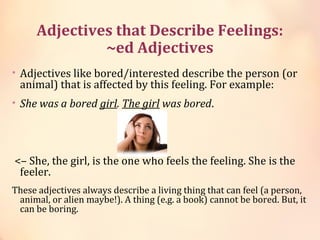
• Adjectives like bored/interested describe the person (or
animal) that is affected by this feeling. For example:
• She was a bored girl. The girl was bored.
<– She, the girl, is the one who feels the feeling. She is the
feeler.
These adjectives always describe a living thing that can feel (a person,
animal, or alien maybe!). A thing (e.g. a book) cannot be bored. But, it
can be boring.
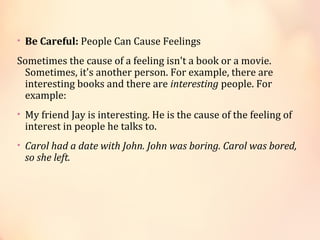
• Be Careful: People Can Cause Feelings
Sometimes the cause of a feeling isn't a book or a movie.
Sometimes, it's another person. For example, there are
interesting books and there are interesting people. For
example:
• My friend Jay is interesting. He is the cause of the feeling of
interest in people he talks to.
• Carol had a date with John. John was boring. Carol was bored,
so she left.
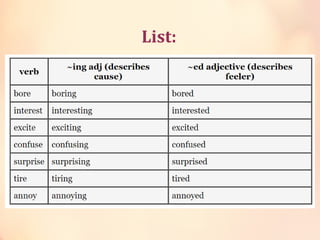
List:
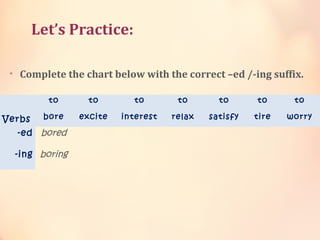
Let’s Practice:
• Complete the chart below with the correct –ed /-ing suffix.
  
Verbs
to
bore
to
excite
to
interest
to
relax
to
satisfy
to
tire
to
worry
-ed bored
-ing boring
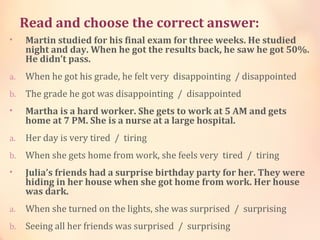
Read and choose the correct answer:
• Martin studied for his final exam for three weeks. He studied
night and day. When he got the results back, he saw he got 50%.
He didn’t pass.
a. When he got his grade, he felt very  disappointing  / disappointed
b. The grade he got was disappointing  /  disappointed
• Martha is a hard worker. She gets to work at 5 AM and gets
home at 7 PM. She is a nurse at a large hospital.
a. Her day is very tired  /  tiring
b. When she gets home from work, she feels very  tired  /  tiring
• Julia’s friends had a surprise birthday party for her. They were
hiding in her house when she got home from work. Her house
was dark.
a. When she turned on the lights, she was surprised  /  surprising
b. Seeing all her friends was surprised  /  surprising
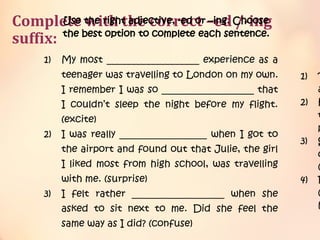
Complete with the correct –ed /-ing
suffix:
Use the right adjective, -ed or –ing. Choose
the best option to complete each sentence.
1) My most ___________________ experience as a
teenager was travelling to London on my own.
I remember I was so ___________________ that
I couldn’t sleep the night before my flight.
(excite)
2) I was really __________________ when I got to
the airport and found out that Julie, the girl
I liked most from high school, was travelling
with me. (surprise)
3) I felt rather ___________________ when she
asked to sit next to me. Did she feel the
same way as I did? (confuse)
1) T
a
2) H
t
p
3) S
d
(
4) F
(
h
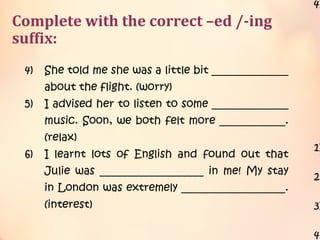
Complete with the correct –ed /-ing
suffix:
with me. (surprise)
3) I felt rather ___________________ when she
asked to sit next to me. Did she feel the
same way as I did? (confuse)
4) She told me she was a little bit ______________
about the flight. (worry)
5) I advised her to listen to some ______________
music. Soon, we both felt more ____________.
(relax)
6) I learnt lots of English and found out that
Julie was ___________________ in me! My stay
in London was extremely ___________________.
(interest)
4)
1)
2)
3)
4)

Participial Adjectives

  • 1.
  • 2.
    • This bookbores (verb) me. The book is boring (adjective). I am bored (adjective). • This movie interests (verb) me. The movie is interesting (adjective). I am interested (adjective).
  • 3.
    ​​Adjectives that Describe Feelings:~ing Adjectives Adjectives like boring/interesting describe something that causes a feeling. For example: • It was a boring movie. The movie was boring. • This book is boring. <– The book is the cause of the feeling. It creates the feeling.
  • 4.
    Adjectives that DescribeFeelings: ~ed Adjectives • Adjectives like bored/interested describe the person (or animal) that is affected by this feeling. For example: • She was a bored girl. The girl was bored. <– She, the girl, is the one who feels the feeling. She is the feeler. These adjectives always describe a living thing that can feel (a person, animal, or alien maybe!). A thing (e.g. a book) cannot be bored. But, it can be boring.
  • 5.
    • Be Careful:People Can Cause Feelings Sometimes the cause of a feeling isn't a book or a movie. Sometimes, it's another person. For example, there are interesting books and there are interesting people. For example: • My friend Jay is interesting. He is the cause of the feeling of interest in people he talks to. • Carol had a date with John. John was boring. Carol was bored, so she left.
  • 6.
  • 7.
    Let’s Practice: • Completethe chart below with the correct –ed /-ing suffix.    Verbs to bore to excite to interest to relax to satisfy to tire to worry -ed bored -ing boring
  • 8.
    Read and choosethe correct answer: • Martin studied for his final exam for three weeks. He studied night and day. When he got the results back, he saw he got 50%. He didn’t pass. a. When he got his grade, he felt very  disappointing  / disappointed b. The grade he got was disappointing  /  disappointed • Martha is a hard worker. She gets to work at 5 AM and gets home at 7 PM. She is a nurse at a large hospital. a. Her day is very tired  /  tiring b. When she gets home from work, she feels very  tired  /  tiring • Julia’s friends had a surprise birthday party for her. They were hiding in her house when she got home from work. Her house was dark. a. When she turned on the lights, she was surprised  /  surprising b. Seeing all her friends was surprised  /  surprising
  • 9.
    Complete with thecorrect –ed /-ing suffix: Use the right adjective, -ed or –ing. Choose the best option to complete each sentence. 1) My most ___________________ experience as a teenager was travelling to London on my own. I remember I was so ___________________ that I couldn’t sleep the night before my flight. (excite) 2) I was really __________________ when I got to the airport and found out that Julie, the girl I liked most from high school, was travelling with me. (surprise) 3) I felt rather ___________________ when she asked to sit next to me. Did she feel the same way as I did? (confuse) 1) T a 2) H t p 3) S d ( 4) F ( h
  • 10.
    Complete with thecorrect –ed /-ing suffix: with me. (surprise) 3) I felt rather ___________________ when she asked to sit next to me. Did she feel the same way as I did? (confuse) 4) She told me she was a little bit ______________ about the flight. (worry) 5) I advised her to listen to some ______________ music. Soon, we both felt more ____________. (relax) 6) I learnt lots of English and found out that Julie was ___________________ in me! My stay in London was extremely ___________________. (interest) 4) 1) 2) 3) 4)