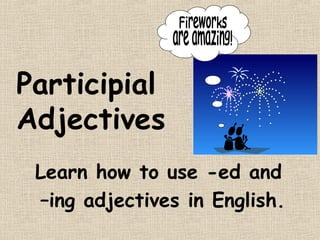
Participial
Adjectives
 Learn how to use -ed and
 –ing adjectives in English.
Participial Adjectives look like verbs,
but they are really adjectives. Their
function is to describe nouns.
 English uses many pairs of –ed and
 –ing adjectives. You probably know
 some of these adjectives already.

    Let’s think about some Examples
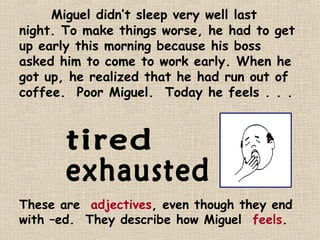
Miguel didn’t sleep very well last
night. To make things worse, he had to get
up early this morning because his boss
asked him to come to work early. When he
got up, he realized that he had run out of
coffee. Poor Miguel. Today he feels . . .


These are adjectives, even though they end
with –ed. They describe how Miguel feels.
School is difficult, but Melissa enjoys it
because she loves to learn. She especially
loves her Science class because the teacher
is very good. The teacher’s class is never
boring; on the contrary it’s . . .


 These are adjectives, even though they
 end with –ing. They describe the class.
More examples of

–ed and –ing adjectives:
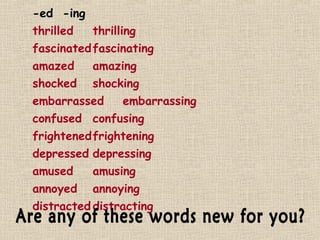
-ed -ing
thrilled   thrilling
fascinated fascinating
amazed     amazing
shocked    shocking
embarrassed   embarrassing
confused confusing
frightenedfrightening
depressed depressing
amused    amusing
annoyed annoying
distracted distracting
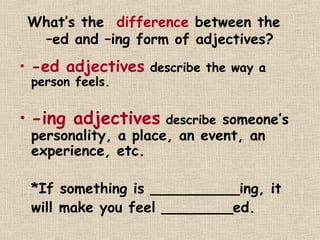
What’s the difference between the
  –ed and –ing form of adjectives?
• -ed adjectives   describe the way a
 person feels.


• -ing adjectives    describe someone’s
 personality, a place, an event, an
 experience, etc.

 *If something is __________ing, it
 will make you feel ________ed.
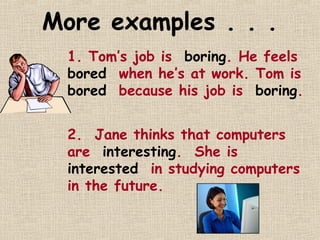
More examples . . .
  1. Tom’s job is boring. He feels
  bored when he’s at work. Tom is
  bored because his job is boring.


  2. Jane thinks that computers
  are interesting. She is
  interested in studying computers
  in the future.
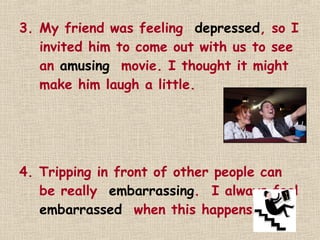
3. My friend was feeling depressed, so I
   invited him to come out with us to see
   an amusing movie. I thought it might
   make him laugh a little.


4. Tripping in front of other people can
   be really embarrassing. I always feel
   embarrassed when this happens!
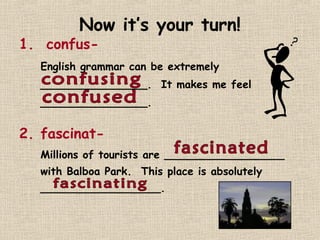
Now it’s your turn!
1. confus-
  English grammar can be extremely
  ________________. It makes me feel
  ________________.


2. fascinat-
  Millions of tourists are __________________
  with Balboa Park. This place is absolutely
  __________________.
Practice …
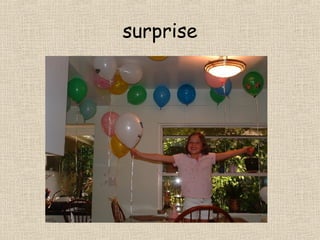
surprise
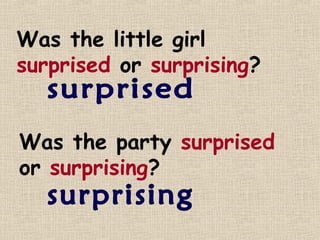
Was the little girl
surprised or surprising?


Was the party surprised
or surprising?
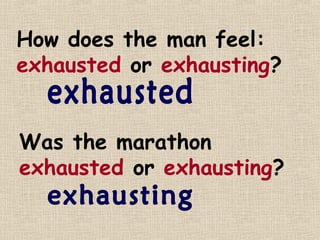
exhaust
How does the man feel:
exhausted or exhausting?


Was the marathon
exhausted or exhausting?
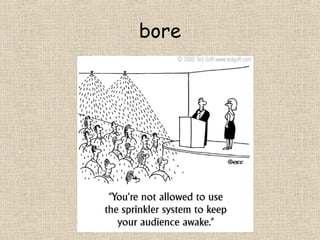
bore
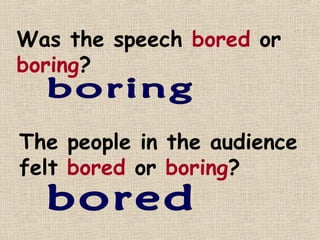
Was the speech bored or
boring?


The people in the audience
felt bored or boring?
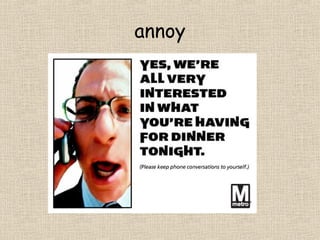
annoy
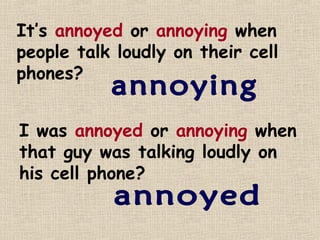
It’s annoyed or annoying when
people talk loudly on their cell
phones?


I was annoyed or annoying when
that guy was talking loudly on
his cell phone?
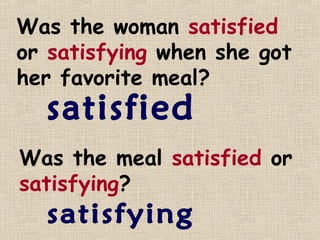
satisfy
Was the woman satisfied
or satisfying when she got
her favorite meal?


Was the meal satisfied or
satisfying?
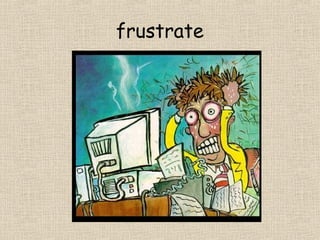
frustrate
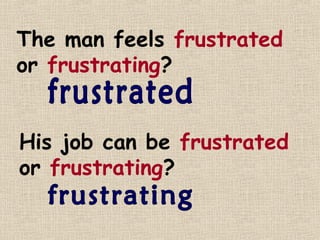
The man feels frustrated
or frustrating?


His job can be frustrated
or frustrating?
shock
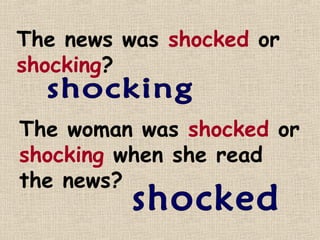
The news was shocked or
shocking?


The woman was shocked or
shocking when she read
the news?
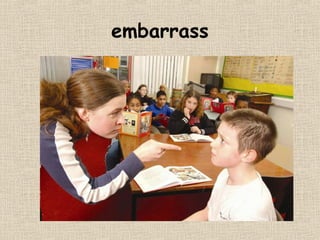
embarrass
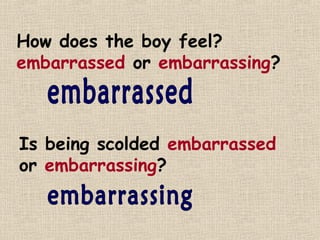
How does the boy feel?
embarrassed or embarrassing?


Is being scolded embarrassed
or embarrassing?
interest
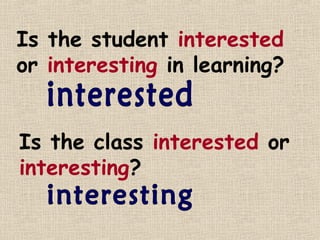
Is the student interested
or interesting in learning?


Is the class interested or
interesting?
excite
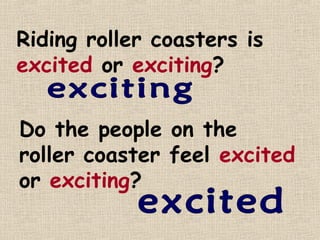
Riding roller coasters is
excited or exciting?


Do the people on the
roller coaster feel excited
or exciting?
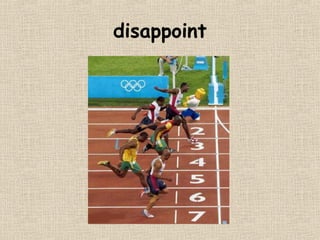
disappoint
It’s disappointed or
disappointing to lose a
race?

The runners who didn’t win
felt disappointed or
disappointing?

Ed and -ing

  • 1.
    Participial Adjectives Learn howto use -ed and –ing adjectives in English.
  • 2.
    Participial Adjectives looklike verbs, but they are really adjectives. Their function is to describe nouns. English uses many pairs of –ed and –ing adjectives. You probably know some of these adjectives already. Let’s think about some Examples
  • 3.
    Miguel didn’t sleepvery well last night. To make things worse, he had to get up early this morning because his boss asked him to come to work early. When he got up, he realized that he had run out of coffee. Poor Miguel. Today he feels . . . These are adjectives, even though they end with –ed. They describe how Miguel feels.
  • 4.
    School is difficult,but Melissa enjoys it because she loves to learn. She especially loves her Science class because the teacher is very good. The teacher’s class is never boring; on the contrary it’s . . . These are adjectives, even though they end with –ing. They describe the class.
  • 5.
    More examples of –edand –ing adjectives:
  • 6.
    -ed -ing thrilled thrilling fascinated fascinating amazed amazing shocked shocking embarrassed embarrassing confused confusing frightenedfrightening depressed depressing amused amusing annoyed annoying distracted distracting
  • 7.
    What’s the differencebetween the –ed and –ing form of adjectives? • -ed adjectives describe the way a person feels. • -ing adjectives describe someone’s personality, a place, an event, an experience, etc. *If something is __________ing, it will make you feel ________ed.
  • 8.
    More examples .. . 1. Tom’s job is boring. He feels bored when he’s at work. Tom is bored because his job is boring. 2. Jane thinks that computers are interesting. She is interested in studying computers in the future.
  • 9.
    3. My friendwas feeling depressed, so I invited him to come out with us to see an amusing movie. I thought it might make him laugh a little. 4. Tripping in front of other people can be really embarrassing. I always feel embarrassed when this happens!
  • 10.
    Now it’s yourturn! 1. confus- English grammar can be extremely ________________. It makes me feel ________________. 2. fascinat- Millions of tourists are __________________ with Balboa Park. This place is absolutely __________________.
  • 11.
  • 12.
  • 13.
    Was the littlegirl surprised or surprising? Was the party surprised or surprising?
  • 14.
  • 15.
    How does theman feel: exhausted or exhausting? Was the marathon exhausted or exhausting?
  • 16.
  • 17.
    Was the speechbored or boring? The people in the audience felt bored or boring?
  • 18.
  • 19.
    It’s annoyed orannoying when people talk loudly on their cell phones? I was annoyed or annoying when that guy was talking loudly on his cell phone?
  • 20.
  • 21.
    Was the womansatisfied or satisfying when she got her favorite meal? Was the meal satisfied or satisfying?
  • 22.
  • 23.
    The man feelsfrustrated or frustrating? His job can be frustrated or frustrating?
  • 24.
  • 25.
    The news wasshocked or shocking? The woman was shocked or shocking when she read the news?
  • 26.
  • 27.
    How does theboy feel? embarrassed or embarrassing? Is being scolded embarrassed or embarrassing?
  • 28.
  • 29.
    Is the studentinterested or interesting in learning? Is the class interested or interesting?
  • 30.
  • 31.
    Riding roller coastersis excited or exciting? Do the people on the roller coaster feel excited or exciting?
  • 32.
  • 33.
    It’s disappointed or disappointingto lose a race? The runners who didn’t win felt disappointed or disappointing?