Adjectives ending in ‘-ing’
or ‘-ed’
Adjectives ending in ‘-ing’ or
‘-ed’
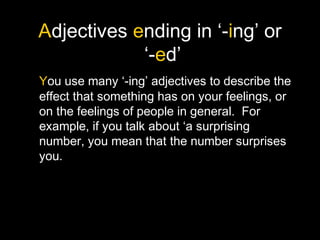
You use many ‘-ing’ adjectives to describe the
effect that something has on your feelings, or
on the feelings of people in general. For
example, if you talk about ‘a surprising
number, you mean that the number surprises
you.
Adjectives ending in ‘-ing’ or
‘-ed’
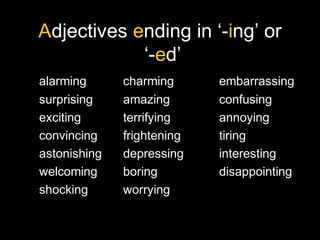
alarming charming embarrassing
surprising amazing confusing
exciting terrifying annoying
convincing frightening tiring
astonishing depressing interesting
welcoming boring disappointing
shocking worrying
Adjectives ending in ‘-ing’ or
‘-ed’
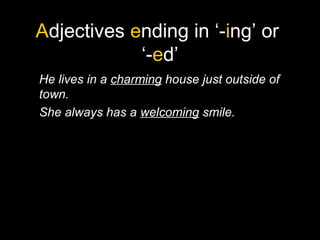
He lives in a charming house just outside of
town.
She always has a welcoming smile.
Adjectives ending in ‘-ing’ or
‘-ed’
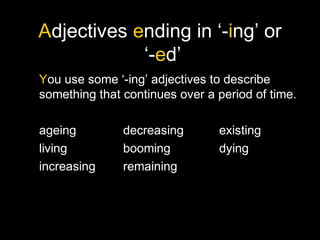
You use some ‘-ing’ adjectives to describe
something that continues over a period of time.
ageing decreasing existing
living booming dying
increasing remaining
Adjectives ending in ‘-ing’ or
‘-ed’
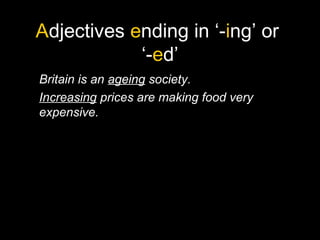
Britain is an ageing society.
Increasing prices are making food very
expensive.
Adjectives ending in ‘-ing’ or
‘-ed’
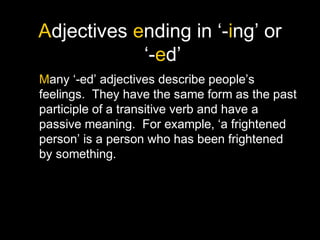
Many ‘-ed’ adjectives describe people’s
feelings. They have the same form as the past
participle of a transitive verb and have a
passive meaning. For example, ‘a frightened
person’ is a person who has been frightened
by something.
Adjectives ending in ‘-ing’ or
‘-ed’
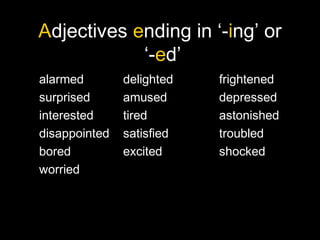
alarmed delighted frightened
surprised amused depressed
interested tired astonished
disappointed satisfied troubled
bored excited shocked
worried
Adjectives ending in ‘-ing’ or
‘-ed’
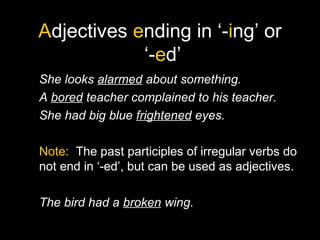
She looks alarmed about something.
A bored teacher complained to his teacher.
She had big blue frightened eyes.
Note: The past participles of irregular verbs do
not end in ‘-ed’, but can be used as adjectives.
The bird had a broken wing.
Adjectives ending in ‘-ing’ or
‘-ed’
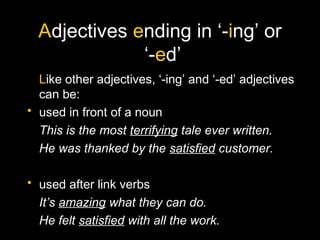
Like other adjectives, ‘-ing’ and ‘-ed’ adjectives
can be:
• used in front of a noun
This is the most terrifying tale ever written.
He was thanked by the satisfied customer.
• used after link verbs
It’s amazing what they can do.
He felt satisfied with all the work.
Adjectives ending in ‘-ing’ or
‘-ed’
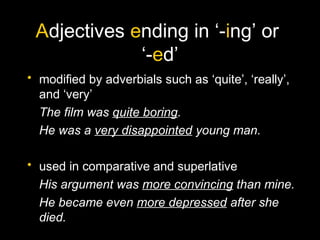
• modified by adverbials such as ‘quite’, ‘really’,
and ‘very’
The film was quite boring.
He was a very disappointed young man.
• used in comparative and superlative
His argument was more convincing than mine.
He became even more depressed after she
died.
Adjectives ending in ‘-ing’ or
‘-ed’
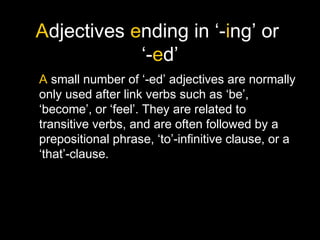
A small number of ‘-ed’ adjectives are normally
only used after link verbs such as ‘be’,
‘become’, or ‘feel’. They are related to
transitive verbs, and are often followed by a
prepositional phrase, ‘to’-infinitive clause, or a
‘that’-clause.
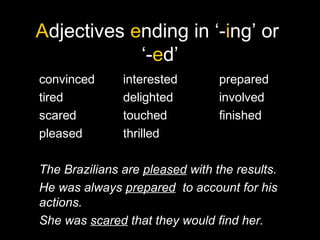
Adjectives ending in ‘-ing’ or
‘-ed’
convinced interested prepared
tired delighted involved
scared touched finished
pleased thrilled
The Brazilians are pleased with the results.
He was always prepared to account for his
actions.
She was scared that they would find her.
Questions?
For more slide presentations visit:

Adjectives ending in '-ing' or '-ed'

  • 1.
    Adjectives ending in‘-ing’ or ‘-ed’
  • 2.
    Adjectives ending in‘-ing’ or ‘-ed’ You use many ‘-ing’ adjectives to describe the effect that something has on your feelings, or on the feelings of people in general. For example, if you talk about ‘a surprising number, you mean that the number surprises you.
  • 3.
    Adjectives ending in‘-ing’ or ‘-ed’ alarming charming embarrassing surprising amazing confusing exciting terrifying annoying convincing frightening tiring astonishing depressing interesting welcoming boring disappointing shocking worrying
  • 4.
    Adjectives ending in‘-ing’ or ‘-ed’ He lives in a charming house just outside of town. She always has a welcoming smile.
  • 5.
    Adjectives ending in‘-ing’ or ‘-ed’ You use some ‘-ing’ adjectives to describe something that continues over a period of time. ageing decreasing existing living booming dying increasing remaining
  • 6.
    Adjectives ending in‘-ing’ or ‘-ed’ Britain is an ageing society. Increasing prices are making food very expensive.
  • 7.
    Adjectives ending in‘-ing’ or ‘-ed’ Many ‘-ed’ adjectives describe people’s feelings. They have the same form as the past participle of a transitive verb and have a passive meaning. For example, ‘a frightened person’ is a person who has been frightened by something.
  • 8.
    Adjectives ending in‘-ing’ or ‘-ed’ alarmed delighted frightened surprised amused depressed interested tired astonished disappointed satisfied troubled bored excited shocked worried
  • 9.
    Adjectives ending in‘-ing’ or ‘-ed’ She looks alarmed about something. A bored teacher complained to his teacher. She had big blue frightened eyes. Note: The past participles of irregular verbs do not end in ‘-ed’, but can be used as adjectives. The bird had a broken wing.
  • 10.
    Adjectives ending in‘-ing’ or ‘-ed’ Like other adjectives, ‘-ing’ and ‘-ed’ adjectives can be: • used in front of a noun This is the most terrifying tale ever written. He was thanked by the satisfied customer. • used after link verbs It’s amazing what they can do. He felt satisfied with all the work.
  • 11.
    Adjectives ending in‘-ing’ or ‘-ed’ • modified by adverbials such as ‘quite’, ‘really’, and ‘very’ The film was quite boring. He was a very disappointed young man. • used in comparative and superlative His argument was more convincing than mine. He became even more depressed after she died.
  • 12.
    Adjectives ending in‘-ing’ or ‘-ed’ A small number of ‘-ed’ adjectives are normally only used after link verbs such as ‘be’, ‘become’, or ‘feel’. They are related to transitive verbs, and are often followed by a prepositional phrase, ‘to’-infinitive clause, or a ‘that’-clause.
  • 13.
    Adjectives ending in‘-ing’ or ‘-ed’ convinced interested prepared tired delighted involved scared touched finished pleased thrilled The Brazilians are pleased with the results. He was always prepared to account for his actions. She was scared that they would find her.
  • 14.
    Questions? For more slidepresentations visit: