Business English at Work
© 2003 Glencoe/McGraw-Hill
Other Punctuation


             Use semicolons and colons correctly.
                            Objectives
             Use quotation marks and apostrophes correctly.
             Differentiate between the uses of hyphens and
             dashes.
             Use parentheses and italics (or underlines)
             correctly.

                                                    continued
Business English at Work                                 PP 17-1a
Other Punctuation


                                continued
             Identify uses for ellipses, brackets, and
             asterisks.      Objectives
             Place adjacent marks of punctuation in correct
             order.
             Use capital letters with other punctuation marks
             correctly.


Business English at Work                                   PP 17-1b
Other Punctuation

                           Independent Clauses
         Use a semicolon to separate two closely
         related independent clauses that are not joined
         by a coordinating conjunction (and, or, nor,
         but).
        Seek constructive criticism of your oral
        presentations; maintain a good attitude about
        negative comments.
Business English at Work                                PP 17-2
Other Punctuation

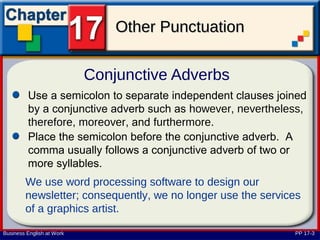
                           Conjunctive Adverbs
         Use a semicolon to separate independent clauses joined
         by a conjunctive adverb such as however, nevertheless,
         therefore, moreover, and furthermore.
         Place the semicolon before the conjunctive adverb. A
         comma usually follows a conjunctive adverb of two or
         more syllables.
        We use word processing software to design our
        newsletter; consequently, we no longer use the services
        of a graphics artist.

Business English at Work                                     PP 17-3
Other Punctuation

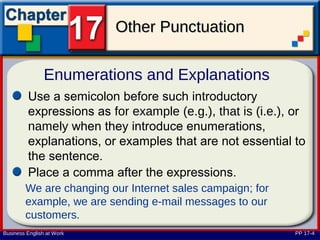
                Enumerations and Explanations
         Use a semicolon before such introductory
         expressions as for example (e.g.), that is (i.e.), or
         namely when they introduce enumerations,
         explanations, or examples that are not essential to
         the sentence.
         Place a comma after the expressions.
        We are changing our Internet sales campaign; for
        example, we are sending e-mail messages to our
        customers.
Business English at Work                                    PP 17-4
Other Punctuation

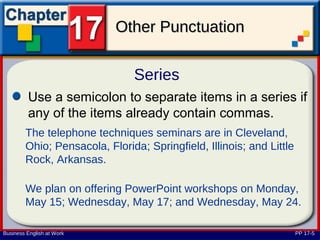
                               Series
         Use a semicolon to separate items in a series if
         any of the items already contain commas.
        The telephone techniques seminars are in Cleveland,
        Ohio; Pensacola, Florida; Springfield, Illinois; and Little
        Rock, Arkansas.

        We plan on offering PowerPoint workshops on Monday,
        May 15; Wednesday, May 17; and Wednesday, May 24.

Business English at Work                                              PP 17-5
Other Punctuation

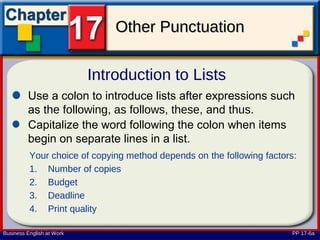
                           Introduction to Lists
         Use a colon to introduce lists after expressions such
         as the following, as follows, these, and thus.
         Capitalize the word following the colon when items
         begin on separate lines in a list.
          Your choice of copying method depends on the following factors:
          1. Number of copies
          2. Budget
          3. Deadline
          4. Print quality

Business English at Work                                                PP 17-6a
Other Punctuation

      continued
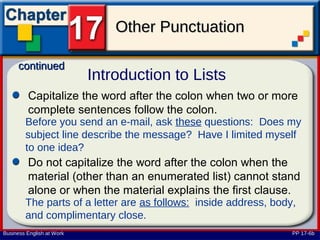
                           Introduction to Lists
         Capitalize the word after the colon when two or more
         complete sentences follow the colon.
        Before you send an e-mail, ask these questions: Does my
        subject line describe the message? Have I limited myself
        to one idea?
         Do not capitalize the word after the colon when the
         material (other than an enumerated list) cannot stand
         alone or when the material explains the first clause.
        The parts of a letter are as follows: inside address, body,
        and complimentary close.
Business English at Work                                          PP 17-6b
Other Punctuation

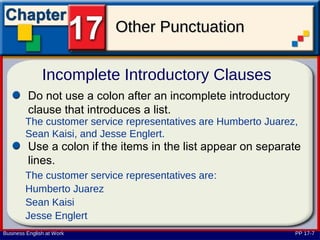
               Incomplete Introductory Clauses
         Do not use a colon after an incomplete introductory
         clause that introduces a list.
        The customer service representatives are Humberto Juarez,
        Sean Kaisi, and Jesse Englert.
         Use a colon if the items in the list appear on separate
         lines.
        The customer service representatives are:
        Humberto Juarez
        Sean Kaisi
        Jesse Englert
Business English at Work                                        PP 17-7
Other Punctuation

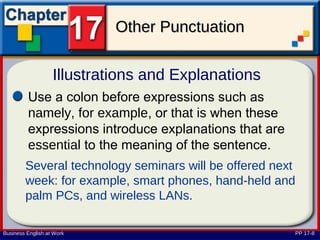
                   Illustrations and Explanations
         Use a colon before expressions such as
         namely, for example, or that is when these
         expressions introduce explanations that are
         essential to the meaning of the sentence.
        Several technology seminars will be offered next
        week: for example, smart phones, hand-held and
        palm PCs, and wireless LANs.

Business English at Work                               PP 17-8
Other Punctuation

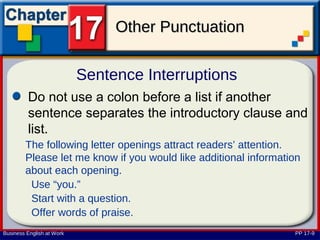
                           Sentence Interruptions
         Do not use a colon before a list if another
         sentence separates the introductory clause and
         list.
        The following letter openings attract readers’ attention.
        Please let me know if you would like additional information
        about each opening.
         Use “you.”
         Start with a question.
         Offer words of praise.
Business English at Work                                         PP 17-9
Other Punctuation

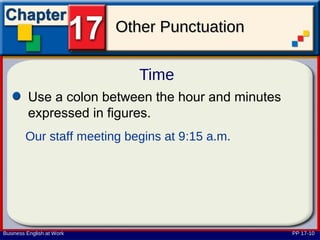
                              Time
         Use a colon between the hour and minutes
         expressed in figures.
        Our staff meeting begins at 9:15 a.m.


Business English at Work                            PP 17-10
Other Punctuation

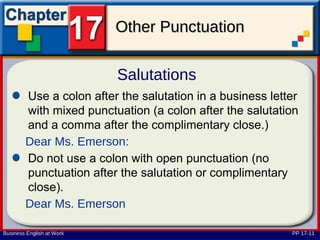
                           Salutations
        Use a colon after the salutation in a business letter
        with mixed punctuation (a colon after the salutation
        and a comma after the complimentary close.)
        Dear Ms. Emerson:
        Do not use a colon with open punctuation (no
        punctuation after the salutation or complimentary
        close).
        Dear Ms. Emerson

Business English at Work                                   PP 17-11
Other Punctuation

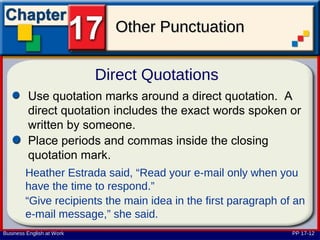
                           Direct Quotations
         Use quotation marks around a direct quotation. A
         direct quotation includes the exact words spoken or
         written by someone.
         Place periods and commas inside the closing
         quotation mark.
        Heather Estrada said, “Read your e-mail only when you
        have the time to respond.”
        “Give recipients the main idea in the first paragraph of an
        e-mail message,” she said.
Business English at Work                                        PP 17-12
Other Punctuation

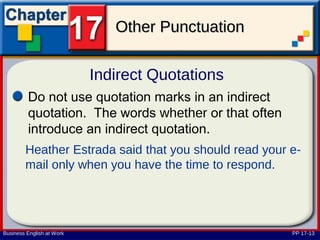
                           Indirect Quotations
         Do not use quotation marks in an indirect
         quotation. The words whether or that often
         introduce an indirect quotation.
        Heather Estrada said that you should read your e-
        mail only when you have the time to respond.


Business English at Work                               PP 17-13
Other Punctuation

                           Separated Quotations
         Use two sets of quotation marks when a
         quotation is separated by intervening
         expressions such as he said.
         Do not capitalize the first word of the second
         part of the quoted material.
        “Unlike library-based research,” she said, “the
        information found at Internet sites may have
        grammar and punctuation errors.”
Business English at Work                                  PP 17-14
Other Punctuation

                           Parts of Published Works
         Use quotation marks around the names of
         articles in newspapers and magazines.
        An article entitled “E-mail Etiquette” was in our
        latest newsletter.
         Use quotation marks around the titles of
         chapters in books.
        The title of Chapter 17 is “Business
        Communication.”
Business English at Work                                    PP 17-15
Other Punctuation

             Technical or Unusual Expressions
         Use quotation marks around technical or
         unusual expressions.
        We found a “bazillion” grammar errors on that Web
        page.
        The “downtime” for the intranet exceeded two
        hours.


Business English at Work                              PP 17-16
Other Punctuation

                           Special Effect Words
         Use quotation marks around slang words or
         special effect words and phrases.
        We offer “freebies” for ordering from our Web
        page.
        Jane needs “hand holding” whenever she learns
        new software.


Business English at Work                                PP 17-17
Other Punctuation

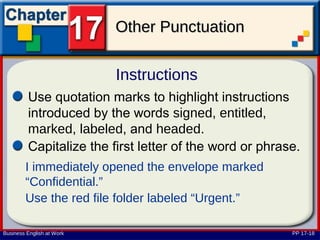
                           Instructions
         Use quotation marks to highlight instructions
         introduced by the words signed, entitled,
         marked, labeled, and headed.
         Capitalize the first letter of the word or phrase.
        I immediately opened the envelope marked
        “Confidential.”
        Use the red file folder labeled “Urgent.”

Business English at Work                                 PP 17-18
Other Punctuation

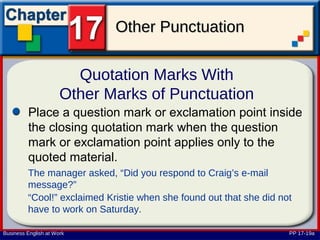
                        Quotation Marks With
                      Other Marks of Punctuation
         Place a question mark or exclamation point inside
         the closing quotation mark when the question
         mark or exclamation point applies only to the
         quoted material.
         The manager asked, “Did you respond to Craig’s e-mail
         message?”
         “Cool!” exclaimed Kristie when she found out that she did not
         have to work on Saturday.

Business English at Work                                             PP 17-19a
Other Punctuation

      continued
                        Quotation Marks With
                      Other Marks of Punctuation
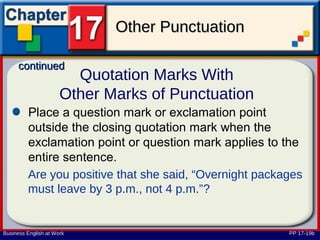
         Place a question mark or exclamation point
         outside the closing quotation mark when the
         exclamation point or question mark applies to the
         entire sentence.
         Are you positive that she said, “Overnight packages
         must leave by 3 p.m., not 4 p.m.”?


Business English at Work                                 PP 17-19b
Other Punctuation

      continued
                        Quotation Marks With
                      Other Marks of Punctuation
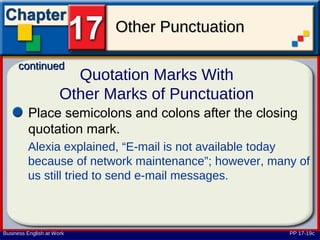
         Place semicolons and colons after the closing
         quotation mark.
         Alexia explained, “E-mail is not available today
         because of network maintenance”; however, many of
         us still tried to send e-mail messages.


Business English at Work                              PP 17-19c
Other Punctuation

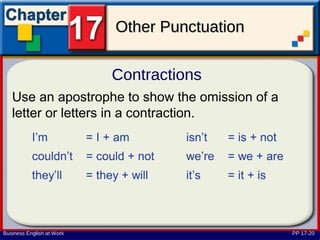
                           Contractions
   Use an apostrophe to show the omission of a
   letter or letters in a contraction.


Business English at Work                         PP 17-20
Other Punctuation

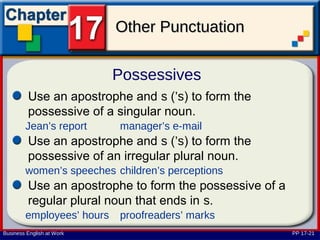
                           Possessives
         Use an apostrophe and s (’s) to form the
         possessive of a singular noun.
        Jean’s report      manager’s e-mail
         Use an apostrophe and s (’s) to form the
         possessive of an irregular plural noun.
        women’s speeches children’s perceptions
         Use an apostrophe to form the possessive of a
         regular plural noun that ends in s.
        employees’ hours   proofreaders’ marks
Business English at Work                                 PP 17-21
Other Punctuation

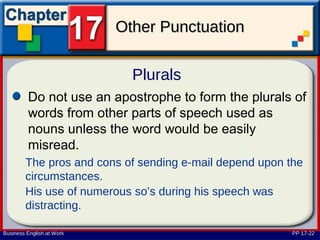
                             Plurals
         Do not use an apostrophe to form the plurals of
         words from other parts of speech used as
         nouns unless the word would be easily
         misread.
        The pros and cons of sending e-mail depend upon the
        circumstances.
        His use of numerous so’s during his speech was
        distracting.

Business English at Work                                 PP 17-22
Other Punctuation

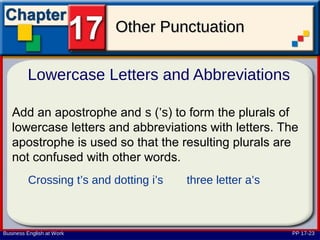
         Lowercase Letters and Abbreviations

   Add an apostrophe and s (’s) to form the plurals of
   lowercase letters and abbreviations with letters. The
   apostrophe is used so that the resulting plurals are
   not confused with other words.
         Crossing t’s and dotting i’s   three letter a’s


Business English at Work                                   PP 17-23
Other Punctuation

                            Numbers
         Add an s to form the plurals of numbers
         expressed in figures.
         Do not add an apostrophe and s (’s).
        in the 1950s
        size 12s
        several 7s
        Form 1040s

Business English at Work                           PP 17-24
Other Punctuation

              Capital Letters and Abbreviations
         Use an apostrophe and s (’s) to form the plurals of the
         capital letters A, I, M, and U to avoid misunderstandings
         in meaning.
        A’s U’s
         Do not add an apostrophe and s (’s) to form the plurals
         of other capital letters.
        four Ns        two Js
         Do not add an apostrophe with abbreviations that end
         with capital letters.
        CPAs HMOs              PCs M.A.s
Business English at Work                                       PP 17-25
Other Punctuation

            Quotations Within Quoted Material
         Use apostrophes (single quotation marks)
         around a quotation within a quotation.
         Place the period inside the closing apostrophe.
        My supervisor explained, “The newsletter design
        should have sufficient ‘white space.’”


Business English at Work                                  PP 17-26
Other Punctuation

                           Compound Numbers
         Use a hyphen with compound numbers from
         twenty-one through ninety-nine.
        Twenty-five applicants applied for the technical
        writing position.
        Three hundred thirty-five orders arrived after the
        long holiday weekend.


Business English at Work                                     PP 17-27
Other Punctuation

                            Fractions
         Use a hyphen to separate the numerator (top
         number in a fraction) from the denominator
         (bottom number) of a fraction written in words.
        Two-thirds of the report
        One-quarter of the employees


Business English at Work                              PP 17-28
Other Punctuation

                           Compound Adjectives
         Use a hyphen in a compound adjective (two or
         more words) that precedes a noun. In most
         situations, do not hyphenate a compound
         adjective that follows the noun modified.
        We hired a well-known expert on business
        communication to lead the seminar next week.
        The expert on business communication is well
        known.
Business English at Work                               PP 17-29
Other Punctuation

                           Number and Nouns
         Use a hyphen in an adjective consisting of a
         number and a noun that precedes the noun
         modified.
        one-hour presentation
        six-year study
        15-year phase


Business English at Work                                PP 17-30
Other Punctuation

                           Suspending Hyphens
   When two or more hyphenated adjectives have a
   common element and this element is shown only
   with the last term, use a suspending hyphen after
   each of the incomplete adjectives to show a
   relationship with the last term.
        knowledge- and service-oriented positions
        short- and long-term analysis
        three- or four-minute wait
Business English at Work                            PP 17-31
Other Punctuation

                           Compound Nouns
   Do not hyphenate well-known compound nouns
   acting as adjectives. If the compound noun does
   not appear as one word or as a hyphenated word
   in a dictionary, assume the word is written as two
   words.
        high school graduate
        real estate agent
        public relations expert
Business English at Work                           PP 17-32
Other Punctuation

                            Adverbs
         Do not place a hyphen after an adverb ending
         in ly that is combined with a present or past
         participle.
        a quickly written report
        a richly deserved award
        a perfectly delivered speech
        a carefully documented Web page

Business English at Work                            PP 17-33
Other Punctuation

                           Self Prefixes
         Use a hyphen after the word self when it acts
         as a prefix.
        self-assured
        self-taught
        self-centered
        self-reliant
        self-disciplined

Business English at Work                             PP 17-34
Other Punctuation

                    Range of Numbers of Letters
         Use a hyphen to indicate a range of numbers
         of letters. The hyphen takes the place of the
         word to.
        12-15 minutes
        April 23-35
        Letters J-L


Business English at Work                             PP 17-35
Other Punctuation

               One Person With Two Functions
         Use a hyphen to indicate dual functions
         performed by one person.
        manager-consultant
        secretary-treasurer
        owner-operator
        director-actor


Business English at Work                           PP 17-36
Other Punctuation

               Change of Thought/Parenthetical
                         Comment
         Use a dash to indicate a break or a change of
         thought in a sentence.
         Using e-mail—we have our own internal system—saves us
         communication time.
         Use a dash to set off a parenthetical comment or
         an afterthought from the rest of the sentence.
         If he insists on a meeting—and I hope that he will not—please
         let me know.
Business English at Work                                          PP 17-37
Other Punctuation

         Repetitions and Reminders/Summary
                        Words
         Use a dash to set off repetitious statements or to
         emphasize a reminder.
         The next meeting—Friday, January 6, at 9 a.m.—is
         mandatory for all employees.
         Use a dash before the words these, they, any, all, and
         each when these words are used as subjects to
         summarize a preceding list.
         E-mail, memos, letters, and reports—these are the most
         frequently used methods of written communication.
Business English at Work                                          PP 17-38
Other Punctuation

                           Nonessential Material
         Use parentheses to set off nonessential material that is not
         intended to be part of the main statement.
         Do not capitalize the first word of material within the
         parentheses if the material is a short complete sentence.
        These new computers (we ordered them two months ago) are for those
        employees who design Web pages.
         Capitalize the first word of material within the parentheses
         if the sentence is lengthy.
        These new computers are for those employees who design Web
        pages. (The computers are a Pentium class with 64 Megs of RAM with
        Windows NT.)
Business English at Work                                               PP 17-39
Other Punctuation

                              Lists
         Use parentheses around numbers or letters
         that identify a list of items in the text copy.
        These strategies help combat information overload: (1)
        avoid chasing Web links, (2) learn efficient ways to
        search online, and (3) restrict your computer time.


Business English at Work                                   PP 17-40
Other Punctuation

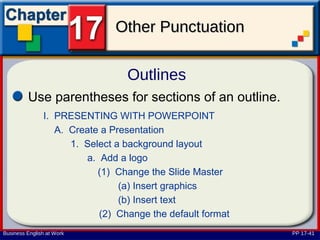
                                 Outlines
         Use parentheses for sections of an outline.
               I. PRESENTING WITH POWERPOINT
                  A. Create a Presentation
                     1. Select a background layout
                        a. Add a logo
                           (1) Change the Slide Master
                                (a) Insert graphics
                                (b) Insert text
                           (2) Change the default format
Business English at Work                                   PP 17-41
Other Punctuation

                    Nonessential References and
                      Directions/Explanations
         Use parentheses to enclose a nonessential
         reference or set of directions.
         This article discusses the research on voice mail (Figures 2,
         3, and 4).
         Use parentheses to enclose explanatory words or
         phrases.
         The Digital Millennium Copyright Act (DMCA) updates U.S.
         copyright law for the digital age.

Business English at Work                                            PP 17-42
Other Punctuation

                Numbers in Formal Documents
         Use parentheses around figures that follow
         amounts written in words in legal or formal
         business documents.
        According to our lease agreement, the price of the
        digital copy machine is five thousand five hundred
        dollars ($5,500).


Business English at Work                                PP 17-43
Other Punctuation

                Definitions and Word Emphasis
         Use italics to identify words that are being
         defined or highlighted.
        His speech contained so many you knows that I
        became distracted from his message.
        The term return on assets describes the
        comparison of net income with assets.


Business English at Work                                PP 17-44
Other Punctuation

                           Published Materials
         Use italics to identify complete published works
         such as titles of books, newspapers,
         magazines, and pamphlets.
         Use italics for titles of movies, plays, television
         and radio series, paintings, and sculptures.
        The Business Communication Quarterly provides reviews of
        business communication literature.
        I found the definition of that computer term in The
        Washington Post.
Business English at Work                                    PP 17-45
Other Punctuation

                           Omissions
         Use ellipsis marks to indicate omissions in
         quoted material.
         Use three spaced periods to designate
         omissions at the beginning or in the middle of a
         sentence.
         Use four spaced periods (or other ending
         punctuation) at the end of a sentence.
         Do not use more or fewer periods.
Business English at Work                               PP 17-46a
Other Punctuation

      continued
                           Omissions
   Examples
        Elizabeth claims, “The telephone is . . . the most
        important means of communication.”
        Elizabeth claims, “The telephone is definitely
        increasing in use and is still the most important
        means of communication . . . . In our workshop, we
        will learn valuable techniques for improving our
        telephone techniques.”

Business English at Work                                PP 17-46a
Other Punctuation

                            Displays
         Use ellipsis marks to highlight specific points.
         Advertising displays often include ellipsis marks
         to identify points that the advertisers wish to
         emphasize.
        Consider these exciting color printer projects:
        . . . Business cards
        . . . Gift tags
        . . . Custom folders
Business English at Work                                  PP 17-47
Other Punctuation

                               Errors
         Insert the word sic in brackets immediately after a
         misspelled word, grammatical error, or factual error
         made by the person quoted. Sic means “so” or “thus”
         and points out that the error was not made by the
         present writer but was present in the original version.
        We were amused when we read, “This report has been
        thoroughly proofread and contains no mispelings [sic].”
        She wrote in her e-mail, “I discovered an excellent grammer
        [sic] book.”

Business English at Work                                           PP 17-48
Other Punctuation

                           Parenthetical Expressions
                              Within Parentheses
         Use brackets to enclose a parenthetical expression
         within a statement that is already within
         parentheses.
         Place the shorter parenthetical expression in
         brackets, and place the longer parenthetical
         statement in parentheses.
         (Read Chapter 13 [writing tips] before attending the
         workshop.)
Business English at Work                                        PP 17-49
Other Punctuation

                           The Asterisk
         The main purpose of the asterisk (*) is to refer the
         reader to another location for more detailed
         explanation or reference.
         Use an asterisk to indicate that a footnote or explanation
         appears in a table or at the bottom of the page.
         Place an asterisk after a comma, semicolon, colon, or
         period.
        Over 90 percent of the executives surveyed spend more
        than an hour a day on the telephone.*
Business English at Work                                          PP 17-50
End of


Business English at Work
© 2003 Glencoe/McGraw-Hill

Other punctuation hyphen,dash,ellipses

  • 1.
    Business English atWork © 2003 Glencoe/McGraw-Hill
  • 2.
    Other Punctuation Use semicolons and colons correctly. Objectives Use quotation marks and apostrophes correctly. Differentiate between the uses of hyphens and dashes. Use parentheses and italics (or underlines) correctly. continued Business English at Work PP 17-1a
  • 3.
    Other Punctuation continued Identify uses for ellipses, brackets, and asterisks. Objectives Place adjacent marks of punctuation in correct order. Use capital letters with other punctuation marks correctly. Business English at Work PP 17-1b
  • 4.
    Other Punctuation Independent Clauses Use a semicolon to separate two closely related independent clauses that are not joined by a coordinating conjunction (and, or, nor, but). Seek constructive criticism of your oral presentations; maintain a good attitude about negative comments. Business English at Work PP 17-2
  • 5.
    Other Punctuation Conjunctive Adverbs Use a semicolon to separate independent clauses joined by a conjunctive adverb such as however, nevertheless, therefore, moreover, and furthermore. Place the semicolon before the conjunctive adverb. A comma usually follows a conjunctive adverb of two or more syllables. We use word processing software to design our newsletter; consequently, we no longer use the services of a graphics artist. Business English at Work PP 17-3
  • 6.
    Other Punctuation Enumerations and Explanations Use a semicolon before such introductory expressions as for example (e.g.), that is (i.e.), or namely when they introduce enumerations, explanations, or examples that are not essential to the sentence. Place a comma after the expressions. We are changing our Internet sales campaign; for example, we are sending e-mail messages to our customers. Business English at Work PP 17-4
  • 7.
    Other Punctuation Series Use a semicolon to separate items in a series if any of the items already contain commas. The telephone techniques seminars are in Cleveland, Ohio; Pensacola, Florida; Springfield, Illinois; and Little Rock, Arkansas. We plan on offering PowerPoint workshops on Monday, May 15; Wednesday, May 17; and Wednesday, May 24. Business English at Work PP 17-5
  • 8.
    Other Punctuation Introduction to Lists Use a colon to introduce lists after expressions such as the following, as follows, these, and thus. Capitalize the word following the colon when items begin on separate lines in a list. Your choice of copying method depends on the following factors: 1. Number of copies 2. Budget 3. Deadline 4. Print quality Business English at Work PP 17-6a
  • 9.
    Other Punctuation continued Introduction to Lists Capitalize the word after the colon when two or more complete sentences follow the colon. Before you send an e-mail, ask these questions: Does my subject line describe the message? Have I limited myself to one idea? Do not capitalize the word after the colon when the material (other than an enumerated list) cannot stand alone or when the material explains the first clause. The parts of a letter are as follows: inside address, body, and complimentary close. Business English at Work PP 17-6b
  • 10.
    Other Punctuation Incomplete Introductory Clauses Do not use a colon after an incomplete introductory clause that introduces a list. The customer service representatives are Humberto Juarez, Sean Kaisi, and Jesse Englert. Use a colon if the items in the list appear on separate lines. The customer service representatives are: Humberto Juarez Sean Kaisi Jesse Englert Business English at Work PP 17-7
  • 11.
    Other Punctuation Illustrations and Explanations Use a colon before expressions such as namely, for example, or that is when these expressions introduce explanations that are essential to the meaning of the sentence. Several technology seminars will be offered next week: for example, smart phones, hand-held and palm PCs, and wireless LANs. Business English at Work PP 17-8
  • 12.
    Other Punctuation Sentence Interruptions Do not use a colon before a list if another sentence separates the introductory clause and list. The following letter openings attract readers’ attention. Please let me know if you would like additional information about each opening. Use “you.” Start with a question. Offer words of praise. Business English at Work PP 17-9
  • 13.
    Other Punctuation Time Use a colon between the hour and minutes expressed in figures. Our staff meeting begins at 9:15 a.m. Business English at Work PP 17-10
  • 14.
    Other Punctuation Salutations Use a colon after the salutation in a business letter with mixed punctuation (a colon after the salutation and a comma after the complimentary close.) Dear Ms. Emerson: Do not use a colon with open punctuation (no punctuation after the salutation or complimentary close). Dear Ms. Emerson Business English at Work PP 17-11
  • 15.
    Other Punctuation Direct Quotations Use quotation marks around a direct quotation. A direct quotation includes the exact words spoken or written by someone. Place periods and commas inside the closing quotation mark. Heather Estrada said, “Read your e-mail only when you have the time to respond.” “Give recipients the main idea in the first paragraph of an e-mail message,” she said. Business English at Work PP 17-12
  • 16.
    Other Punctuation Indirect Quotations Do not use quotation marks in an indirect quotation. The words whether or that often introduce an indirect quotation. Heather Estrada said that you should read your e- mail only when you have the time to respond. Business English at Work PP 17-13
  • 17.
    Other Punctuation Separated Quotations Use two sets of quotation marks when a quotation is separated by intervening expressions such as he said. Do not capitalize the first word of the second part of the quoted material. “Unlike library-based research,” she said, “the information found at Internet sites may have grammar and punctuation errors.” Business English at Work PP 17-14
  • 18.
    Other Punctuation Parts of Published Works Use quotation marks around the names of articles in newspapers and magazines. An article entitled “E-mail Etiquette” was in our latest newsletter. Use quotation marks around the titles of chapters in books. The title of Chapter 17 is “Business Communication.” Business English at Work PP 17-15
  • 19.
    Other Punctuation Technical or Unusual Expressions Use quotation marks around technical or unusual expressions. We found a “bazillion” grammar errors on that Web page. The “downtime” for the intranet exceeded two hours. Business English at Work PP 17-16
  • 20.
    Other Punctuation Special Effect Words Use quotation marks around slang words or special effect words and phrases. We offer “freebies” for ordering from our Web page. Jane needs “hand holding” whenever she learns new software. Business English at Work PP 17-17
  • 21.
    Other Punctuation Instructions Use quotation marks to highlight instructions introduced by the words signed, entitled, marked, labeled, and headed. Capitalize the first letter of the word or phrase. I immediately opened the envelope marked “Confidential.” Use the red file folder labeled “Urgent.” Business English at Work PP 17-18
  • 22.
    Other Punctuation Quotation Marks With Other Marks of Punctuation Place a question mark or exclamation point inside the closing quotation mark when the question mark or exclamation point applies only to the quoted material. The manager asked, “Did you respond to Craig’s e-mail message?” “Cool!” exclaimed Kristie when she found out that she did not have to work on Saturday. Business English at Work PP 17-19a
  • 23.
    Other Punctuation continued Quotation Marks With Other Marks of Punctuation Place a question mark or exclamation point outside the closing quotation mark when the exclamation point or question mark applies to the entire sentence. Are you positive that she said, “Overnight packages must leave by 3 p.m., not 4 p.m.”? Business English at Work PP 17-19b
  • 24.
    Other Punctuation continued Quotation Marks With Other Marks of Punctuation Place semicolons and colons after the closing quotation mark. Alexia explained, “E-mail is not available today because of network maintenance”; however, many of us still tried to send e-mail messages. Business English at Work PP 17-19c
  • 25.
    Other Punctuation Contractions Use an apostrophe to show the omission of a letter or letters in a contraction. Business English at Work PP 17-20
  • 26.
    Other Punctuation Possessives Use an apostrophe and s (’s) to form the possessive of a singular noun. Jean’s report manager’s e-mail Use an apostrophe and s (’s) to form the possessive of an irregular plural noun. women’s speeches children’s perceptions Use an apostrophe to form the possessive of a regular plural noun that ends in s. employees’ hours proofreaders’ marks Business English at Work PP 17-21
  • 27.
    Other Punctuation Plurals Do not use an apostrophe to form the plurals of words from other parts of speech used as nouns unless the word would be easily misread. The pros and cons of sending e-mail depend upon the circumstances. His use of numerous so’s during his speech was distracting. Business English at Work PP 17-22
  • 28.
    Other Punctuation Lowercase Letters and Abbreviations Add an apostrophe and s (’s) to form the plurals of lowercase letters and abbreviations with letters. The apostrophe is used so that the resulting plurals are not confused with other words. Crossing t’s and dotting i’s three letter a’s Business English at Work PP 17-23
  • 29.
    Other Punctuation Numbers Add an s to form the plurals of numbers expressed in figures. Do not add an apostrophe and s (’s). in the 1950s size 12s several 7s Form 1040s Business English at Work PP 17-24
  • 30.
    Other Punctuation Capital Letters and Abbreviations Use an apostrophe and s (’s) to form the plurals of the capital letters A, I, M, and U to avoid misunderstandings in meaning. A’s U’s Do not add an apostrophe and s (’s) to form the plurals of other capital letters. four Ns two Js Do not add an apostrophe with abbreviations that end with capital letters. CPAs HMOs PCs M.A.s Business English at Work PP 17-25
  • 31.
    Other Punctuation Quotations Within Quoted Material Use apostrophes (single quotation marks) around a quotation within a quotation. Place the period inside the closing apostrophe. My supervisor explained, “The newsletter design should have sufficient ‘white space.’” Business English at Work PP 17-26
  • 32.
    Other Punctuation Compound Numbers Use a hyphen with compound numbers from twenty-one through ninety-nine. Twenty-five applicants applied for the technical writing position. Three hundred thirty-five orders arrived after the long holiday weekend. Business English at Work PP 17-27
  • 33.
    Other Punctuation Fractions Use a hyphen to separate the numerator (top number in a fraction) from the denominator (bottom number) of a fraction written in words. Two-thirds of the report One-quarter of the employees Business English at Work PP 17-28
  • 34.
    Other Punctuation Compound Adjectives Use a hyphen in a compound adjective (two or more words) that precedes a noun. In most situations, do not hyphenate a compound adjective that follows the noun modified. We hired a well-known expert on business communication to lead the seminar next week. The expert on business communication is well known. Business English at Work PP 17-29
  • 35.
    Other Punctuation Number and Nouns Use a hyphen in an adjective consisting of a number and a noun that precedes the noun modified. one-hour presentation six-year study 15-year phase Business English at Work PP 17-30
  • 36.
    Other Punctuation Suspending Hyphens When two or more hyphenated adjectives have a common element and this element is shown only with the last term, use a suspending hyphen after each of the incomplete adjectives to show a relationship with the last term. knowledge- and service-oriented positions short- and long-term analysis three- or four-minute wait Business English at Work PP 17-31
  • 37.
    Other Punctuation Compound Nouns Do not hyphenate well-known compound nouns acting as adjectives. If the compound noun does not appear as one word or as a hyphenated word in a dictionary, assume the word is written as two words. high school graduate real estate agent public relations expert Business English at Work PP 17-32
  • 38.
    Other Punctuation Adverbs Do not place a hyphen after an adverb ending in ly that is combined with a present or past participle. a quickly written report a richly deserved award a perfectly delivered speech a carefully documented Web page Business English at Work PP 17-33
  • 39.
    Other Punctuation Self Prefixes Use a hyphen after the word self when it acts as a prefix. self-assured self-taught self-centered self-reliant self-disciplined Business English at Work PP 17-34
  • 40.
    Other Punctuation Range of Numbers of Letters Use a hyphen to indicate a range of numbers of letters. The hyphen takes the place of the word to. 12-15 minutes April 23-35 Letters J-L Business English at Work PP 17-35
  • 41.
    Other Punctuation One Person With Two Functions Use a hyphen to indicate dual functions performed by one person. manager-consultant secretary-treasurer owner-operator director-actor Business English at Work PP 17-36
  • 42.
    Other Punctuation Change of Thought/Parenthetical Comment Use a dash to indicate a break or a change of thought in a sentence. Using e-mail—we have our own internal system—saves us communication time. Use a dash to set off a parenthetical comment or an afterthought from the rest of the sentence. If he insists on a meeting—and I hope that he will not—please let me know. Business English at Work PP 17-37
  • 43.
    Other Punctuation Repetitions and Reminders/Summary Words Use a dash to set off repetitious statements or to emphasize a reminder. The next meeting—Friday, January 6, at 9 a.m.—is mandatory for all employees. Use a dash before the words these, they, any, all, and each when these words are used as subjects to summarize a preceding list. E-mail, memos, letters, and reports—these are the most frequently used methods of written communication. Business English at Work PP 17-38
  • 44.
    Other Punctuation Nonessential Material Use parentheses to set off nonessential material that is not intended to be part of the main statement. Do not capitalize the first word of material within the parentheses if the material is a short complete sentence. These new computers (we ordered them two months ago) are for those employees who design Web pages. Capitalize the first word of material within the parentheses if the sentence is lengthy. These new computers are for those employees who design Web pages. (The computers are a Pentium class with 64 Megs of RAM with Windows NT.) Business English at Work PP 17-39
  • 45.
    Other Punctuation Lists Use parentheses around numbers or letters that identify a list of items in the text copy. These strategies help combat information overload: (1) avoid chasing Web links, (2) learn efficient ways to search online, and (3) restrict your computer time. Business English at Work PP 17-40
  • 46.
    Other Punctuation Outlines Use parentheses for sections of an outline. I. PRESENTING WITH POWERPOINT A. Create a Presentation 1. Select a background layout a. Add a logo (1) Change the Slide Master (a) Insert graphics (b) Insert text (2) Change the default format Business English at Work PP 17-41
  • 47.
    Other Punctuation Nonessential References and Directions/Explanations Use parentheses to enclose a nonessential reference or set of directions. This article discusses the research on voice mail (Figures 2, 3, and 4). Use parentheses to enclose explanatory words or phrases. The Digital Millennium Copyright Act (DMCA) updates U.S. copyright law for the digital age. Business English at Work PP 17-42
  • 48.
    Other Punctuation Numbers in Formal Documents Use parentheses around figures that follow amounts written in words in legal or formal business documents. According to our lease agreement, the price of the digital copy machine is five thousand five hundred dollars ($5,500). Business English at Work PP 17-43
  • 49.
    Other Punctuation Definitions and Word Emphasis Use italics to identify words that are being defined or highlighted. His speech contained so many you knows that I became distracted from his message. The term return on assets describes the comparison of net income with assets. Business English at Work PP 17-44
  • 50.
    Other Punctuation Published Materials Use italics to identify complete published works such as titles of books, newspapers, magazines, and pamphlets. Use italics for titles of movies, plays, television and radio series, paintings, and sculptures. The Business Communication Quarterly provides reviews of business communication literature. I found the definition of that computer term in The Washington Post. Business English at Work PP 17-45
  • 51.
    Other Punctuation Omissions Use ellipsis marks to indicate omissions in quoted material. Use three spaced periods to designate omissions at the beginning or in the middle of a sentence. Use four spaced periods (or other ending punctuation) at the end of a sentence. Do not use more or fewer periods. Business English at Work PP 17-46a
  • 52.
    Other Punctuation continued Omissions Examples Elizabeth claims, “The telephone is . . . the most important means of communication.” Elizabeth claims, “The telephone is definitely increasing in use and is still the most important means of communication . . . . In our workshop, we will learn valuable techniques for improving our telephone techniques.” Business English at Work PP 17-46a
  • 53.
    Other Punctuation Displays Use ellipsis marks to highlight specific points. Advertising displays often include ellipsis marks to identify points that the advertisers wish to emphasize. Consider these exciting color printer projects: . . . Business cards . . . Gift tags . . . Custom folders Business English at Work PP 17-47
  • 54.
    Other Punctuation Errors Insert the word sic in brackets immediately after a misspelled word, grammatical error, or factual error made by the person quoted. Sic means “so” or “thus” and points out that the error was not made by the present writer but was present in the original version. We were amused when we read, “This report has been thoroughly proofread and contains no mispelings [sic].” She wrote in her e-mail, “I discovered an excellent grammer [sic] book.” Business English at Work PP 17-48
  • 55.
    Other Punctuation Parenthetical Expressions Within Parentheses Use brackets to enclose a parenthetical expression within a statement that is already within parentheses. Place the shorter parenthetical expression in brackets, and place the longer parenthetical statement in parentheses. (Read Chapter 13 [writing tips] before attending the workshop.) Business English at Work PP 17-49
  • 56.
    Other Punctuation The Asterisk The main purpose of the asterisk (*) is to refer the reader to another location for more detailed explanation or reference. Use an asterisk to indicate that a footnote or explanation appears in a table or at the bottom of the page. Place an asterisk after a comma, semicolon, colon, or period. Over 90 percent of the executives surveyed spend more than an hour a day on the telephone.* Business English at Work PP 17-50
  • 57.
    End of Business Englishat Work © 2003 Glencoe/McGraw-Hill