Computer Network
Chapter 5
Quality Of Service
Alaa Gamal 2019122
Toka Mostafa 2020131
Packet scheduling
Traffic shaping Integrated services
Differentiated services
Admission control
Application requirements
Quality of service
 Mechanisms let a network with less capacity meet application requirements just as well at a lower
cost.
 The network can honor the performance guarantees that it makes even when traffic spikes, at the
cost of turning down some requests.
 Four issues must be addressed to ensure quality of service:
 Application Requirements.
 Traffic shaping.
 Packet scheduling.
 Admission control.
 Versions of quality of service for the Internet:
 Integrated Services.
 Differentiated Services.
Application Requirements
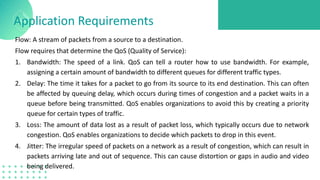
Flow: A stream of packets from a source to a destination.
Flow requires that determine the QoS (Quality of Service):
1. Bandwidth: The speed of a link. QoS can tell a router how to use bandwidth. For example,
assigning a certain amount of bandwidth to different queues for different traffic types.
2. Delay: The time it takes for a packet to go from its source to its end destination. This can often
be affected by queuing delay, which occurs during times of congestion and a packet waits in a
queue before being transmitted. QoS enables organizations to avoid this by creating a priority
queue for certain types of traffic.
3. Loss: The amount of data lost as a result of packet loss, which typically occurs due to network
congestion. QoS enables organizations to decide which packets to drop in this event.
4. Jitter: The irregular speed of packets on a network as a result of congestion, which can result in
packets arriving late and out of sequence. This can cause distortion or gaps in audio and video
being delivered.
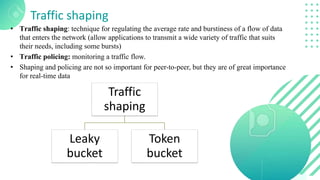
Traffic shaping
• Traffic shaping: technique for regulating the average rate and burstiness of a flow of data
that enters the network (allow applications to transmit a wide variety of traffic that suits
their needs, including some bursts)
• Traffic policing: monitoring a traffic flow.
• Shaping and policing are not so important for peer-to-peer, but they are of great importance
for real-time data
Traffic
shaping
Leaky
bucket
Token
bucket
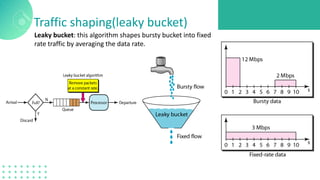
Traffic shaping(leaky bucket)
Leaky bucket: this algorithm shapes bursty bucket into fixed
rate traffic by averaging the data rate.
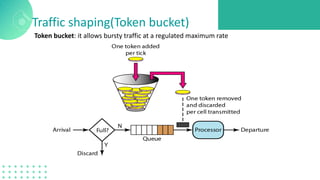
Traffic shaping(Token bucket)
Token bucket: it allows bursty traffic at a regulated maximum rate
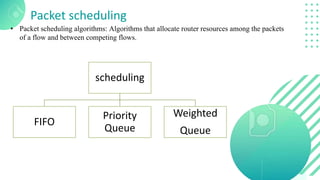
Packet scheduling
• Packet scheduling algorithms: Algorithms that allocate router resources among the packets
of a flow and between competing flows.
scheduling
FIFO
Priority
Queue
Weighted
Queue
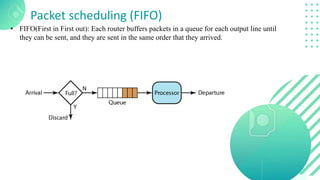
Packet scheduling (FIFO)
• FIFO(First in First out): Each router buffers packets in a queue for each output line until
they can be sent, and they are sent in the same order that they arrived.
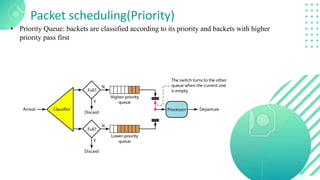
Packet scheduling(Priority)
• Priority Queue: backets are classified according to its priority and backets with higher
priority pass first
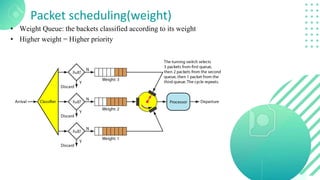
Packet scheduling(weight)
• Weight Queue: the backets classified according to its weight
• Higher weight = Higher priority
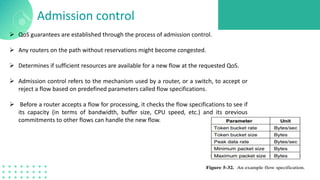
Admission control
 QoS guarantees are established through the process of admission control.
 Any routers on the path without reservations might become congested.
 Determines if sufficient resources are available for a new flow at the requested QoS.
 Admission control refers to the mechanism used by a router, or a switch, to accept or
reject a flow based on predefined parameters called flow specifications.
 Before a router accepts a flow for processing, it checks the flow specifications to see if
its capacity (in terms of bandwidth, buffer size, CPU speed, etc.) and its previous
commitments to other flows can handle the new flow.
Integrated Services
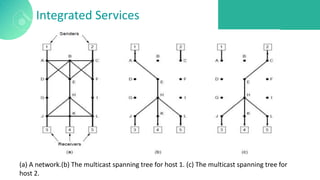
 It was aimed at both unicast and multicast applications.
 RSVP (The Resource reSerVation Protocol): The main part of the integrated services
architecture that is visible to the users of the network.
 The routing algorithm is not part of RSVP.
 The only difference from normal multicasting is a little extra information that is multicast to
the group periodically to tell the routers along the tree to maintain certain data structures in
their memories.
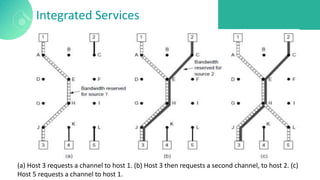
 The capacity reserved must be large enough to satisfy the greediest receiver
Integrated Services
(a) A network.(b) The multicast spanning tree for host 1. (c) The multicast spanning tree for
host 2.
Integrated Services
(a) Host 3 requests a channel to host 1. (b) Host 3 then requests a second channel, to host 2. (c)
Host 5 requests a channel to host 1.
Differentiated Services
 Flow-based algorithms have the potential to offer good quality of service to one or more
flows because they reserve whatever resources are needed along the route.
 Disadvantage: They require an advance setup to establish each flow.
 Class-based: simpler approach to quality of service, one that can be largely implemented
locally in each router without advance setup and without having the whole path involved.
 Flow-based quality of service : each telephone call gets its own resources and guarantees.
 Class-based quality of service clearer : all the telephone calls together get the resources
reserved for the class telephony.
Differentiated Services
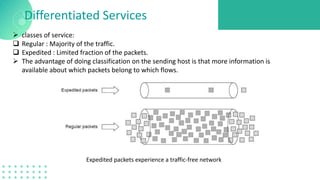
 classes of service:
 Regular : Majority of the traffic.
 Expedited : Limited fraction of the packets.
 The advantage of doing classification on the sending host is that more information is
available about which packets belong to which flows.
Expedited packets experience a traffic-free network
Differentiated Services
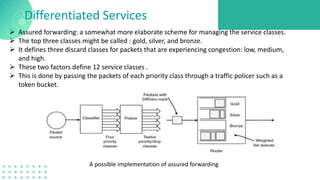
 Assured forwarding: a somewhat more elaborate scheme for managing the service classes.
 The top three classes might be called : gold, silver, and bronze.
 It defines three discard classes for packets that are experiencing congestion: low, medium,
and high.
 These two factors define 12 service classes .
 This is done by passing the packets of each priority class through a traffic policer such as a
token bucket.
A possible implementation of assured forwarding
Thank you

QOSPPT.2019122-2020131[1].pptx

  • 1.
    Computer Network Chapter 5 QualityOf Service Alaa Gamal 2019122 Toka Mostafa 2020131
  • 2.
    Packet scheduling Traffic shapingIntegrated services Differentiated services Admission control Application requirements
  • 3.
    Quality of service Mechanisms let a network with less capacity meet application requirements just as well at a lower cost.  The network can honor the performance guarantees that it makes even when traffic spikes, at the cost of turning down some requests.  Four issues must be addressed to ensure quality of service:  Application Requirements.  Traffic shaping.  Packet scheduling.  Admission control.  Versions of quality of service for the Internet:  Integrated Services.  Differentiated Services.
  • 4.
    Application Requirements Flow: Astream of packets from a source to a destination. Flow requires that determine the QoS (Quality of Service): 1. Bandwidth: The speed of a link. QoS can tell a router how to use bandwidth. For example, assigning a certain amount of bandwidth to different queues for different traffic types. 2. Delay: The time it takes for a packet to go from its source to its end destination. This can often be affected by queuing delay, which occurs during times of congestion and a packet waits in a queue before being transmitted. QoS enables organizations to avoid this by creating a priority queue for certain types of traffic. 3. Loss: The amount of data lost as a result of packet loss, which typically occurs due to network congestion. QoS enables organizations to decide which packets to drop in this event. 4. Jitter: The irregular speed of packets on a network as a result of congestion, which can result in packets arriving late and out of sequence. This can cause distortion or gaps in audio and video being delivered.
  • 5.
    Traffic shaping • Trafficshaping: technique for regulating the average rate and burstiness of a flow of data that enters the network (allow applications to transmit a wide variety of traffic that suits their needs, including some bursts) • Traffic policing: monitoring a traffic flow. • Shaping and policing are not so important for peer-to-peer, but they are of great importance for real-time data Traffic shaping Leaky bucket Token bucket
  • 6.
    Traffic shaping(leaky bucket) Leakybucket: this algorithm shapes bursty bucket into fixed rate traffic by averaging the data rate.
  • 7.
    Traffic shaping(Token bucket) Tokenbucket: it allows bursty traffic at a regulated maximum rate
  • 8.
    Packet scheduling • Packetscheduling algorithms: Algorithms that allocate router resources among the packets of a flow and between competing flows. scheduling FIFO Priority Queue Weighted Queue
  • 9.
    Packet scheduling (FIFO) •FIFO(First in First out): Each router buffers packets in a queue for each output line until they can be sent, and they are sent in the same order that they arrived.
  • 10.
    Packet scheduling(Priority) • PriorityQueue: backets are classified according to its priority and backets with higher priority pass first
  • 11.
    Packet scheduling(weight) • WeightQueue: the backets classified according to its weight • Higher weight = Higher priority
  • 12.
    Admission control  QoSguarantees are established through the process of admission control.  Any routers on the path without reservations might become congested.  Determines if sufficient resources are available for a new flow at the requested QoS.  Admission control refers to the mechanism used by a router, or a switch, to accept or reject a flow based on predefined parameters called flow specifications.  Before a router accepts a flow for processing, it checks the flow specifications to see if its capacity (in terms of bandwidth, buffer size, CPU speed, etc.) and its previous commitments to other flows can handle the new flow.
  • 13.
    Integrated Services  Itwas aimed at both unicast and multicast applications.  RSVP (The Resource reSerVation Protocol): The main part of the integrated services architecture that is visible to the users of the network.  The routing algorithm is not part of RSVP.  The only difference from normal multicasting is a little extra information that is multicast to the group periodically to tell the routers along the tree to maintain certain data structures in their memories.  The capacity reserved must be large enough to satisfy the greediest receiver
  • 14.
    Integrated Services (a) Anetwork.(b) The multicast spanning tree for host 1. (c) The multicast spanning tree for host 2.
  • 15.
    Integrated Services (a) Host3 requests a channel to host 1. (b) Host 3 then requests a second channel, to host 2. (c) Host 5 requests a channel to host 1.
  • 16.
    Differentiated Services  Flow-basedalgorithms have the potential to offer good quality of service to one or more flows because they reserve whatever resources are needed along the route.  Disadvantage: They require an advance setup to establish each flow.  Class-based: simpler approach to quality of service, one that can be largely implemented locally in each router without advance setup and without having the whole path involved.  Flow-based quality of service : each telephone call gets its own resources and guarantees.  Class-based quality of service clearer : all the telephone calls together get the resources reserved for the class telephony.
  • 17.
    Differentiated Services  classesof service:  Regular : Majority of the traffic.  Expedited : Limited fraction of the packets.  The advantage of doing classification on the sending host is that more information is available about which packets belong to which flows. Expedited packets experience a traffic-free network
  • 18.
    Differentiated Services  Assuredforwarding: a somewhat more elaborate scheme for managing the service classes.  The top three classes might be called : gold, silver, and bronze.  It defines three discard classes for packets that are experiencing congestion: low, medium, and high.  These two factors define 12 service classes .  This is done by passing the packets of each priority class through a traffic policer such as a token bucket. A possible implementation of assured forwarding
  • 19.