Process ControlGuidance of the process along a certain
path to produce a product that meets
predefined quality specifications
The Aim
To produce the product of interest at a
minimum of operating costs (ie. Increase
the cost/benefit ratio)
Reasons for Process Control
 Easier optimisation of the process
 More constant product quality
 Detection of problems and their
location at an early stage
 Greater quality assurance
(1) Bioreactor
Batch process
• significant changes of process variables over time
• requires more complex control
• requires experience with the process (feed
forward control)
Steady state processes (chemostat)
• constant process conditions
• more simple process control
• feedback control often sufficient
(2) Sensors (Measuring Devices)
 Enable monitoring of the state of the
process
– e.g. temperature, DO concentration,
biomass conc.
 Measurements can be on-line or off-line.
On-line Measurements
 Performed automatically
 Results directly available for control
 Monitored continuously
Off-line Measurements
 Require human interface
 Less frequent and usually irregular
 Best suited for checking and calibrating
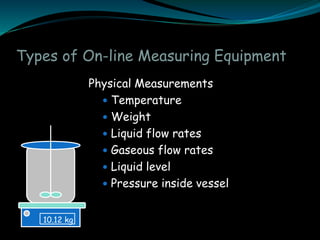
Types of On-line Measuring Equipment
Physical Measurements
 Temperature
 Weight
 Liquid flow rates
 Gaseous flow rates
 Liquid level
 Pressure inside vessel
10.12 kg
(3) Actuators
 Devices which make the changes to
the process, e.g.
 Aeration pumps
 Stirrers
 Feed pumps
 Chemical dosing pumps
 Inoculation ports
 Recycle pumps
Basic Control Schemes
 Open-Loop Control (Feedforward)
 Closed-Loop Control (Feedback)
 Inferential control
 Combined feedforward and feedback
(model-supported control)
Devices that decide on the appropriate action
to be taken to keep the process running along
the desired path
◦ Computers
◦ “Biocontrollers”
Examples of feedback loops:
 Temperature control
 pH control
 Oxygen control (e.g. SND)
 The pattern of the manipulable variable is
predetermined, and directly adjusts the actuator
 There is no feedback from the process to the
controller
 Requires no measurement of the variable
 Often model-based  requires reliable model
 Large deviations of the process from the required
path are not corrected for
 Sounds very theoretical (examples?)
 Simplest type – digital
on-off switching, e.g. thermostat
 PID control (very common and
important)
 Fuzzy logic control, Adaptive
Controllers, Self learning systems
(not covered in this unit)
 Measurements give indirect information
about critical variables in the process (e.g.
biomass activity, biomass concentration,
substrate concentration etc.)
 Using the on-line measurements to estimate
the current state of the biomass
 state estimators (e.g. SOUR)
 Advantage: enables on-line control of a
variable that cannot be measured on-line
 Modelling plays important role
 Measurements give indirect information
about critical variables in the process (e.g.
biomass activity, biomass concentration,
substrate concentration etc.)
 Using the on-line measurements to estimate
the current state of the biomass
 state estimators (e.g. SOUR)
 Advantage: enables on-line control of a
variable that cannot be measured on-line
 Modelling plays important role
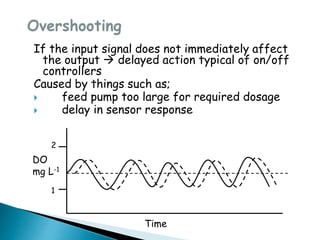
If the input signal does not immediately affect
the output  delayed action typical of on/off
controllers
Caused by things such as;
 feed pump too large for required dosage
 delay in sensor response
DO
mg L-1
Time
1
2
error
Controller Process
Actuator
Measured
output
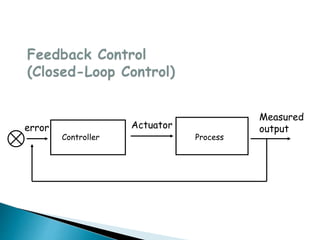
 Conventional and most common type of control
scheme … “safest”
 Measurements from the process are used to
calculate a suitable control action
 Appropriate when the accuracy requirement is
higher
 Deviations between the variable and its setpoint
are used to change the process
 smaller deviations

Parsentation

  • 3.
    Process ControlGuidance ofthe process along a certain path to produce a product that meets predefined quality specifications The Aim To produce the product of interest at a minimum of operating costs (ie. Increase the cost/benefit ratio)
  • 4.
    Reasons for ProcessControl  Easier optimisation of the process  More constant product quality  Detection of problems and their location at an early stage  Greater quality assurance
  • 5.
    (1) Bioreactor Batch process •significant changes of process variables over time • requires more complex control • requires experience with the process (feed forward control) Steady state processes (chemostat) • constant process conditions • more simple process control • feedback control often sufficient
  • 6.
    (2) Sensors (MeasuringDevices)  Enable monitoring of the state of the process – e.g. temperature, DO concentration, biomass conc.  Measurements can be on-line or off-line.
  • 7.
    On-line Measurements  Performedautomatically  Results directly available for control  Monitored continuously Off-line Measurements  Require human interface  Less frequent and usually irregular  Best suited for checking and calibrating
  • 8.
    Types of On-lineMeasuring Equipment Physical Measurements  Temperature  Weight  Liquid flow rates  Gaseous flow rates  Liquid level  Pressure inside vessel 10.12 kg
  • 9.
    (3) Actuators  Deviceswhich make the changes to the process, e.g.  Aeration pumps  Stirrers  Feed pumps  Chemical dosing pumps  Inoculation ports  Recycle pumps
  • 10.
    Basic Control Schemes Open-Loop Control (Feedforward)  Closed-Loop Control (Feedback)  Inferential control  Combined feedforward and feedback (model-supported control)
  • 11.
    Devices that decideon the appropriate action to be taken to keep the process running along the desired path ◦ Computers ◦ “Biocontrollers”
  • 12.
    Examples of feedbackloops:  Temperature control  pH control  Oxygen control (e.g. SND)
  • 13.
     The patternof the manipulable variable is predetermined, and directly adjusts the actuator  There is no feedback from the process to the controller  Requires no measurement of the variable  Often model-based  requires reliable model  Large deviations of the process from the required path are not corrected for  Sounds very theoretical (examples?)
  • 14.
     Simplest type– digital on-off switching, e.g. thermostat  PID control (very common and important)  Fuzzy logic control, Adaptive Controllers, Self learning systems (not covered in this unit)
  • 15.
     Measurements giveindirect information about critical variables in the process (e.g. biomass activity, biomass concentration, substrate concentration etc.)  Using the on-line measurements to estimate the current state of the biomass  state estimators (e.g. SOUR)  Advantage: enables on-line control of a variable that cannot be measured on-line  Modelling plays important role
  • 16.
     Measurements giveindirect information about critical variables in the process (e.g. biomass activity, biomass concentration, substrate concentration etc.)  Using the on-line measurements to estimate the current state of the biomass  state estimators (e.g. SOUR)  Advantage: enables on-line control of a variable that cannot be measured on-line  Modelling plays important role
  • 17.
    If the inputsignal does not immediately affect the output  delayed action typical of on/off controllers Caused by things such as;  feed pump too large for required dosage  delay in sensor response DO mg L-1 Time 1 2
  • 18.
  • 19.
     Conventional andmost common type of control scheme … “safest”  Measurements from the process are used to calculate a suitable control action  Appropriate when the accuracy requirement is higher  Deviations between the variable and its setpoint are used to change the process  smaller deviations