Proposal for
              Establishment of
                a Pan-Asian
               Resuscitation
              Outcomes Study
                  (PAROS)
A/Prof Marcus Ong Eng Hock
Consultant, Director of Research and Senior Medical Scientist
Dept of Emergency Medicine, Singapore General Hospital
Adjunct Assoc Professor, Office of Research
Duke-NUS Graduate Medical School, Singapore
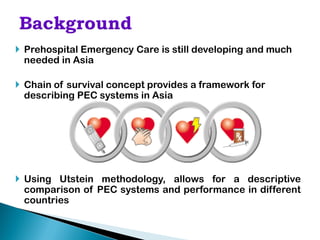
 Prehospital Emergency Care is still developing and much
  needed in Asia

 Chain of survival concept provides a framework for
  describing PEC systems in Asia


 Using Utstein methodology, allows for a descriptive
  comparison of PEC systems and performance in different
  countries
 Out of Hospital Cardiac Arrest
  (OHCA) is a global health concern.

 Eg, 16, 000 deaths occur in Singapore
  every year:
  ◦ 23% from a cardiac cause,
  ◦ 30-40% will occur suddenly, outside
    of a hospital.

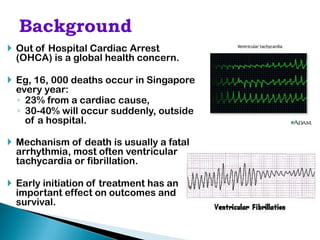
 Mechanism of death is usually a fatal
  arrhythmia, most often ventricular
  tachycardia or fibrillation.

 Early initiation of treatment has an
  important effect on outcomes and
  survival.
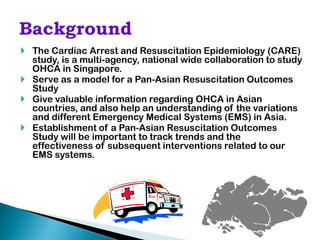
 The Cardiac Arrest and Resuscitation Epidemiology (CARE)
  study, is a multi-agency, national wide collaboration to study
  OHCA in Singapore.
 Serve as a model for a Pan-Asian Resuscitation Outcomes
  Study
 Give valuable information regarding OHCA in Asian
  countries, and also help an understanding of the variations
  and different Emergency Medical Systems (EMS) in Asia.
 Establishment of a Pan-Asian Resuscitation Outcomes
  Study will be important to track trends and the
  effectiveness of subsequent interventions related to our
  EMS systems.
   Opportunity to conduct
    interventional trials across
    countries

   Can be extended to look at
    major trauma, myocardial
    infarction, stroke, respiratory
    distress etc
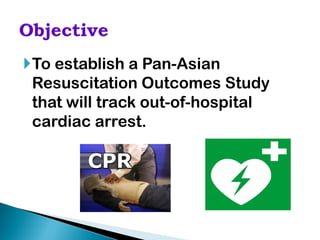
To establish a Pan-Asian
 Resuscitation Outcomes Study
 that will track out-of-hospital
 cardiac arrest.
1. Describing regional variations in the incidence and outcomes of OHCA
   across Asia and beyond
2. Describing the true population based incidence of OHCA across different
   countries, using standardized common denominators as agreed across the
   network
3. Comparing Emergency Medical Services (EMS) outcomes (including
   response times and treatment outcomes) for OHCA across regions,
   allowing for international benchmarking and study of best practices
4. Understanding the etiology and preventable risk factors for OHCA and
   predictors of survival. The large sample size and international nature of the
   study will allow analysis of the influence of racial, population age structure,
   chronic disease burden, socio-economic factors, EMS characteristics,
   bystander cardio-pulmonary resuscitation (CPR), EMS response times,
   prehospital defibrillation and treatment, seasonal, geographic and climatic
   factors on OHCA incidence and outcomes.
5. Understanding geospatial and temporal occurrence of OHCA across
   regions that will facilitate systems level strategies for Public Access
   Defibrillation, community education and CPR training.
6. Study differences in the occurrence of OHCA between North American and
   Asia-Pacific populations, specifically with regards to the role of primary
   ventricular arrhythmias in sudden cardiac arrest.
 Establish a Pan Asian network of EMS
  physicians that will collect and link data
  and outcomes from OHCA in their
  respective cities and countries.

 Include EMS data from dispatch services,
  ambulance records and service
  providers.

 Data regarding cardiac arrest outcomes
  will be collected from all major hospitals.
 Data will be collected from:
  ◦ ‘995’ dispatch records
  ◦ Ambulance patient case notes
  ◦ Emergency Department (ED)
  ◦ In-hospital records

 Completed data will collected and sent to the
  Pan-Asian Resuscitation Outcomes Study Co-
  ordination Center for data management using
  Electronic Data Capture (EDC).
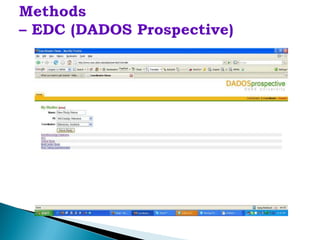
   Web based data collection software that enables
    researchers for single sites or multi-site clinical
    trials to "create" a study online.

   Customizing CRFs for the study, enrolling patients
    and collecting data, and extracting data.

   Give access to team members all over the world for
    data collection (Ethics approval must be attained for
    your study before data collection can begin).

   In collaboration with CDC Atlanta/Emory USA
   A Pan-Asian Resuscitation Outcomes Study
    will be an important foundation to implement
    and track planned improvements to EMS in
    Asia.

   It will aid in planning for deployment of
    resources, interventions and ongoing efforts
    to improve Asian EMS.
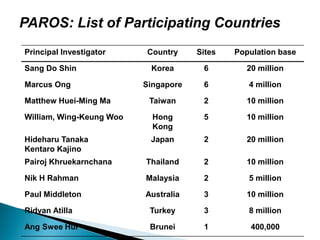
PAROS: List of Participating Countries
Principal Investigator    Country     Sites   Population base

Sang Do Shin               Korea       6         20 million

Marcus Ong                Singapore    6         4 million

Matthew Huei-Ming Ma       Taiwan      2         10 million

William, Wing-Keung Woo     Hong       5         10 million
                            Kong
Hideharu Tanaka            Japan       2         20 million
Kentaro Kajino
Pairoj Khruekarnchana     Thailand     2         10 million

Nik H Rahman              Malaysia     2         5 million

Paul Middleton            Australia    3         10 million

Ridvan Atilla              Turkey      3         8 million

Ang Swee Hui               Brunei      1          400,000
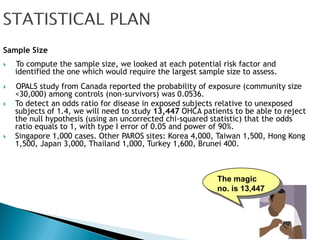
Sample Size
   To compute the sample size, we looked at each potential risk factor and
    identified the one which would require the largest sample size to assess.
   OPALS study from Canada reported the probability of exposure (community size
    <30,000) among controls (non-survivors) was 0.0536.
   To detect an odds ratio for disease in exposed subjects relative to unexposed
    subjects of 1.4, we will need to study 13,447 OHCA patients to be able to reject
    the null hypothesis (using an uncorrected chi-squared statistic) that the odds
    ratio equals to 1, with type I error of 0.05 and power of 90%.
   Singapore 1,000 cases. Other PAROS sites: Korea 4,000, Taiwan 1,500, Hong Kong
    1,500, Japan 3,000, Thailand 1,000, Turkey 1,600, Brunei 400.


                                                            The magic
                                                            no. is 13,447
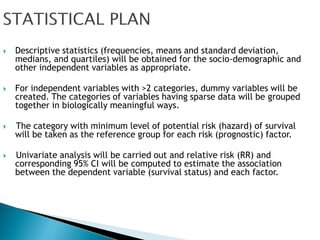
   Descriptive statistics (frequencies, means and standard deviation,
    medians, and quartiles) will be obtained for the socio-demographic and
    other independent variables as appropriate.

   For independent variables with >2 categories, dummy variables will be
    created. The categories of variables having sparse data will be grouped
    together in biologically meaningful ways.

   The category with minimum level of potential risk (hazard) of survival
    will be taken as the reference group for each risk (prognostic) factor.

   Univariate analysis will be carried out and relative risk (RR) and
    corresponding 95% CI will be computed to estimate the association
    between the dependent variable (survival status) and each factor.
   Independent variables associated with survival status at 0.25 significance
    level in the univariate analysis or those with biological importance will be
    further analyzed through multivariate logistic regression
   The overall significance of the independent variables in the model will be
    assessed by the Likelihood ratio test.
   Confounding variables will be assessed by ≥10% change in the estimated
    coefficient for the particular variable.
   After developing the main effect model, to uncover any multicollinearity,
    the association among independent variables will be assessed by using the
    appropriate test, and plausible interactions between the independent
    variables will also be assessed.
   The Pearson’s Chi-square test will be applied to check for the goodness-of-
    fit of the final model.
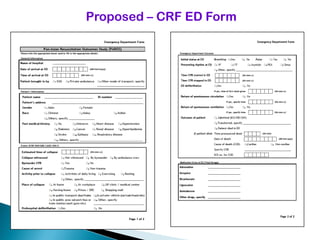
Proposed – CRF ED Form
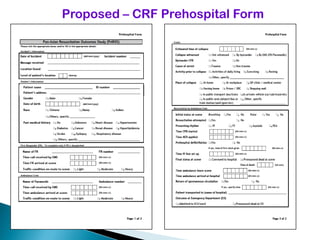
Proposed – CRF Prehospital Form
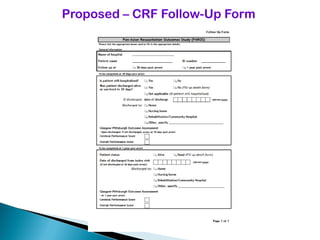
Proposed – CRF Follow-Up Form
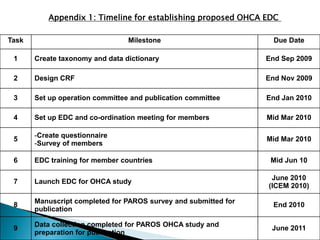
Appendix 1: Timeline for establishing proposed OHCA EDC

Task                             Milestone                         Due Date

 1     Create taxonomy and data dictionary                       End Sep 2009

 2     Design CRF                                                End Nov 2009

 3     Set up operation committee and publication committee      End Jan 2010

 4     Set up EDC and co-ordination meeting for members          Mid Mar 2010

       -Create questionnaire
 5                                                               Mid Mar 2010
       -Survey of members

 6     EDC training for member countries                          Mid Jun 10

                                                                  June 2010
 7     Launch EDC for OHCA study
                                                                 (ICEM 2010)

       Manuscript completed for PAROS survey and submitted for
 8                                                                End 2010
       publication

       Data collection completed for PAROS OHCA study and
 9                                                                June 2011
       preparation for publication
Thank You

PAROS Proposal

  • 1.
    Proposal for Establishment of a Pan-Asian Resuscitation Outcomes Study (PAROS) A/Prof Marcus Ong Eng Hock Consultant, Director of Research and Senior Medical Scientist Dept of Emergency Medicine, Singapore General Hospital Adjunct Assoc Professor, Office of Research Duke-NUS Graduate Medical School, Singapore
  • 2.
     Prehospital EmergencyCare is still developing and much needed in Asia  Chain of survival concept provides a framework for describing PEC systems in Asia  Using Utstein methodology, allows for a descriptive comparison of PEC systems and performance in different countries
  • 3.
     Out ofHospital Cardiac Arrest (OHCA) is a global health concern.  Eg, 16, 000 deaths occur in Singapore every year: ◦ 23% from a cardiac cause, ◦ 30-40% will occur suddenly, outside of a hospital.  Mechanism of death is usually a fatal arrhythmia, most often ventricular tachycardia or fibrillation.  Early initiation of treatment has an important effect on outcomes and survival.
  • 4.
     The CardiacArrest and Resuscitation Epidemiology (CARE) study, is a multi-agency, national wide collaboration to study OHCA in Singapore.  Serve as a model for a Pan-Asian Resuscitation Outcomes Study  Give valuable information regarding OHCA in Asian countries, and also help an understanding of the variations and different Emergency Medical Systems (EMS) in Asia.  Establishment of a Pan-Asian Resuscitation Outcomes Study will be important to track trends and the effectiveness of subsequent interventions related to our EMS systems.
  • 5.
    Opportunity to conduct interventional trials across countries  Can be extended to look at major trauma, myocardial infarction, stroke, respiratory distress etc
  • 6.
    To establish aPan-Asian Resuscitation Outcomes Study that will track out-of-hospital cardiac arrest.
  • 7.
    1. Describing regionalvariations in the incidence and outcomes of OHCA across Asia and beyond 2. Describing the true population based incidence of OHCA across different countries, using standardized common denominators as agreed across the network 3. Comparing Emergency Medical Services (EMS) outcomes (including response times and treatment outcomes) for OHCA across regions, allowing for international benchmarking and study of best practices 4. Understanding the etiology and preventable risk factors for OHCA and predictors of survival. The large sample size and international nature of the study will allow analysis of the influence of racial, population age structure, chronic disease burden, socio-economic factors, EMS characteristics, bystander cardio-pulmonary resuscitation (CPR), EMS response times, prehospital defibrillation and treatment, seasonal, geographic and climatic factors on OHCA incidence and outcomes. 5. Understanding geospatial and temporal occurrence of OHCA across regions that will facilitate systems level strategies for Public Access Defibrillation, community education and CPR training. 6. Study differences in the occurrence of OHCA between North American and Asia-Pacific populations, specifically with regards to the role of primary ventricular arrhythmias in sudden cardiac arrest.
  • 8.
     Establish aPan Asian network of EMS physicians that will collect and link data and outcomes from OHCA in their respective cities and countries.  Include EMS data from dispatch services, ambulance records and service providers.  Data regarding cardiac arrest outcomes will be collected from all major hospitals.
  • 9.
     Data willbe collected from: ◦ ‘995’ dispatch records ◦ Ambulance patient case notes ◦ Emergency Department (ED) ◦ In-hospital records  Completed data will collected and sent to the Pan-Asian Resuscitation Outcomes Study Co- ordination Center for data management using Electronic Data Capture (EDC).
  • 10.
    Web based data collection software that enables researchers for single sites or multi-site clinical trials to "create" a study online.  Customizing CRFs for the study, enrolling patients and collecting data, and extracting data.  Give access to team members all over the world for data collection (Ethics approval must be attained for your study before data collection can begin).  In collaboration with CDC Atlanta/Emory USA
  • 12.
    A Pan-Asian Resuscitation Outcomes Study will be an important foundation to implement and track planned improvements to EMS in Asia.  It will aid in planning for deployment of resources, interventions and ongoing efforts to improve Asian EMS.
  • 13.
    PAROS: List ofParticipating Countries Principal Investigator Country Sites Population base Sang Do Shin Korea 6 20 million Marcus Ong Singapore 6 4 million Matthew Huei-Ming Ma Taiwan 2 10 million William, Wing-Keung Woo Hong 5 10 million Kong Hideharu Tanaka Japan 2 20 million Kentaro Kajino Pairoj Khruekarnchana Thailand 2 10 million Nik H Rahman Malaysia 2 5 million Paul Middleton Australia 3 10 million Ridvan Atilla Turkey 3 8 million Ang Swee Hui Brunei 1 400,000
  • 14.
    Sample Size  To compute the sample size, we looked at each potential risk factor and identified the one which would require the largest sample size to assess.  OPALS study from Canada reported the probability of exposure (community size <30,000) among controls (non-survivors) was 0.0536.  To detect an odds ratio for disease in exposed subjects relative to unexposed subjects of 1.4, we will need to study 13,447 OHCA patients to be able to reject the null hypothesis (using an uncorrected chi-squared statistic) that the odds ratio equals to 1, with type I error of 0.05 and power of 90%.  Singapore 1,000 cases. Other PAROS sites: Korea 4,000, Taiwan 1,500, Hong Kong 1,500, Japan 3,000, Thailand 1,000, Turkey 1,600, Brunei 400. The magic no. is 13,447
  • 15.
    Descriptive statistics (frequencies, means and standard deviation, medians, and quartiles) will be obtained for the socio-demographic and other independent variables as appropriate.  For independent variables with >2 categories, dummy variables will be created. The categories of variables having sparse data will be grouped together in biologically meaningful ways.  The category with minimum level of potential risk (hazard) of survival will be taken as the reference group for each risk (prognostic) factor.  Univariate analysis will be carried out and relative risk (RR) and corresponding 95% CI will be computed to estimate the association between the dependent variable (survival status) and each factor.
  • 16.
    Independent variables associated with survival status at 0.25 significance level in the univariate analysis or those with biological importance will be further analyzed through multivariate logistic regression  The overall significance of the independent variables in the model will be assessed by the Likelihood ratio test.  Confounding variables will be assessed by ≥10% change in the estimated coefficient for the particular variable.  After developing the main effect model, to uncover any multicollinearity, the association among independent variables will be assessed by using the appropriate test, and plausible interactions between the independent variables will also be assessed.  The Pearson’s Chi-square test will be applied to check for the goodness-of- fit of the final model.
  • 17.
  • 18.
    Proposed – CRFPrehospital Form
  • 19.
    Proposed – CRFFollow-Up Form
  • 21.
    Appendix 1: Timelinefor establishing proposed OHCA EDC Task Milestone Due Date 1 Create taxonomy and data dictionary End Sep 2009 2 Design CRF End Nov 2009 3 Set up operation committee and publication committee End Jan 2010 4 Set up EDC and co-ordination meeting for members Mid Mar 2010 -Create questionnaire 5 Mid Mar 2010 -Survey of members 6 EDC training for member countries Mid Jun 10 June 2010 7 Launch EDC for OHCA study (ICEM 2010) Manuscript completed for PAROS survey and submitted for 8 End 2010 publication Data collection completed for PAROS OHCA study and 9 June 2011 preparation for publication
  • 22.