St. Paul Hospital Millennium Medical College
Proposal on Experience of Laparoscopic Cholecystectomy in St. Paul’s
Hospital Millennium Medical College, Addis Ababa, Ethiopia
Investigator: Ashenafi Ermias(MD, GSR III)
January 2020
Addis Ababa, Ethiopia
Outline
• Introduction
• Literature review
• Statement of the problem
• Significance of the study
• Objectives
• Methods
• Work plan
• Cost of the project
• Acknowledgement
I. Introduction
• Gallstone disease is one of the most common conditions handled by a
general surgeons worldwide.
• Prevalence 10-15% in Europe and North America.
• Prevalence is even lower in Africa. (Brett M, 1976)
• No community based studies in Ethiopia;
• From hospital based study in Gondar, prevalence is about 5.2%. (Getachew A)
• Prevalence from hospital registry in SPHHMC was 8.9% ( Mahteme et al,2019)
• It is asymptomatic in about 80% of the patients.
• Symptomatic patients may present with biliary colic or with one of the
several complications.
• Laparoscopic cholecystectomy (LC) was introduced by Mühe of Germany in 1985
and since then it has been used in the management of gallstones. (Reynolds Jr W)
• Symptomatic patients are offered LC “the gold standard” treatment if the set up
allows
• Patient outcomes are superior in terms of surgical site infection, post operative
pain and hospital stay.
• But it has higher rate of biliary tree injury as compared to open cholecystectomy.
II. Literature review
• Outcomes of a surgical procedure can measured by morbidity and
mortality rates.
• Several studies have been conducted throughout the world regarding
the outcomes of LC.
• The incidence of bleeding has been reported to be up to 10%. It can
occur at any time starting from insertion of trocar to dissection or after
completion of the procedure due to slippage of clip.
• Mbatha et al reported 3 intraoperative bleeding out of 167 laparoscopic
cholecystectomies in a study they did in South Africa. All of the incidences were
handled laparoscopically. (Mbatha et al,2016)
• Older age did not affect the outcomes significantly as long as they have good
ASA functional status. But aged individuals tend to present with complications
and have higher ASA class. (Rafael S et al)
• Biliary tree injury remain the feared complication in LC
• In a study done by Engida et al in SPHMMC, they found significantly higher
number of biliary tree injury (2.3%) and higher for laparoscopic than open
technique. (2.3% vs 5.2%)
• Experience was the major factor responsible for the higher rate of bile duct injury.
(Engida A et al, 2014)
• Taki-Eldin reported 12 (of 492) patients had bile leak in a study done in Saudi
Arabia (7 due to CBD injury and 5 due slippage of cystic duct) (Taki-Eldin et
al,2018)
• Conversion to open surgery may be required in occasions where LC cannot be
completed because complication has occurred or as a preventive measure.
• In a study done in a private hospital in Addis Ababa, Bekele S et al reported conversion
rate of 2.9%. (Bekele et al, 2012)
• A study by Ballal M in England found a conversion rate of 5.2%; with higher conversion
rate for emergency cholecystectomy as compared to elective cholecystectomy. ( Ballal
M, 2009)
• Bowel injuries are less common during LC.
• In a US national survey, there were about 0.14% bowel injuries reported from 4,292
hospitals.
• Wound infections may complicate LC.
• Most publications have indicated lower SSI for LC than Open cholecytectomy
• Radunovic M et al reported infection of surgical wound in 7 out of 740 patients
(0.094%) in a study done in Montenegro. (Radunovic et al, 2016)
• One of the advantages of LC is the short post op stay.
• An average hospital stay of 1.1 day was reported by Clegg-Lamptey et al in
their paper evaluating LC in Korle Bu teaching Hospital Accra
Ghana.(Clegg-Lamptey et al, 2010)
• Operative time (duration of procedure) for laparoscopic
cholecystectomy have been reported ranging from 45-180 min.
• Rai P et al reported mean operating time of 79 min in their study.
(Rai P, 2016)
• Mean operating time in Myungsung Christian Medial center was
58.9min (Bekele et al, 2012)
• Pre-operative ultrasound can predict difficulty of LC.
• Of the 73 cases, 21 (28.76%) cases were predicted to be difficult,
17 (23.3%) were actually difficult, of which 13 (17.8%) were
converted to open procedure according to Lal P. (Lal P, 2012)
Statement of the Problem
• Laparoscopic cholecystectomy is associated with several
complications.
• This study looks into the following questions
• What is the pattern of biliary tree injury?
• What is the conversion rate and what factors influence conversion?
• What are the determinants of intra-op/post operative complications?
Significance of the study
• This study will help us judge the safety of laparoscopic
cholecystectomy in our set up
• It will be used as a source of data for future researches
III. Objectives
General objectives
To evaluate morbidity and mortality of laparoscopic cholecystectomy in
SPHMMC
Specific objectives
To assess the patterns of post-operative complications following
laparoscopic cholecystectomy
To determine factors associated with post-operative complications
To calculate the conversion rate and reasons for conversion
IV. METHODS
• Study setting: This study will be conducted in SPHMMC, Addis Ababa. The
hospital has been providing clinical service for over 50 years and teaching
undergraduate and postgraduate students in various clinical areas.
• Laparoscopic cholecystectomy was started in 2007 G.C and several patients have
undergone the procedure
• Study design: a cross-sectional study design will be utilized based on medical
records of patients who underwent laparoscopic cholecystectomies over the past
5years (January 2015 to December 2020 G.C.)
• Study population: the study population comprises of all patients who
undergone laparoscopic cholecystectomy
Sample size and sampling method
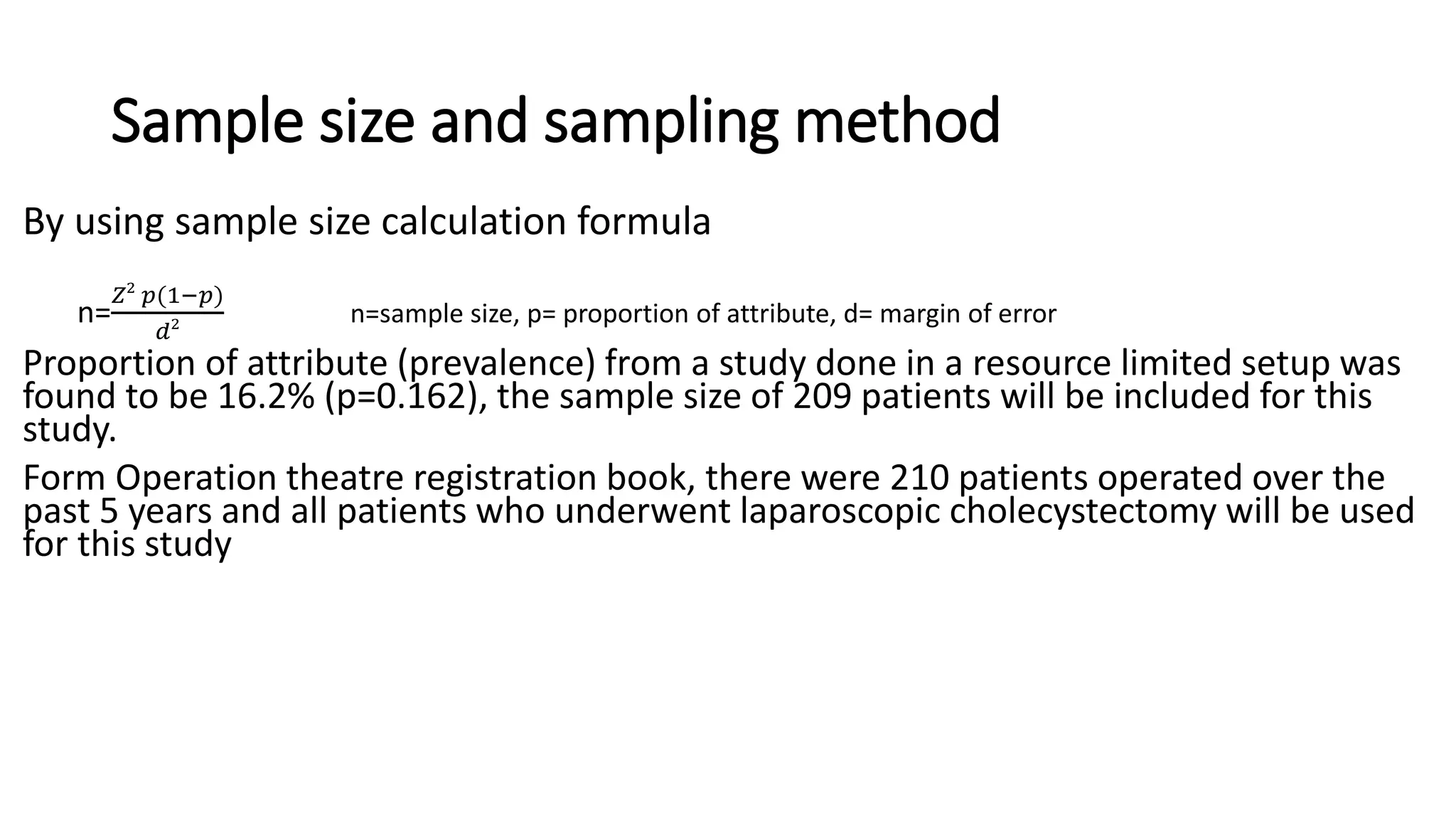
By using sample size calculation formula
n=
𝑍2
𝑝(1−𝑝)
𝑑2 n=sample size, p= proportion of attribute, d= margin of error
Proportion of attribute (prevalence) from a study done in a resource limited setup was
found to be 16.2% (p=0.162), the sample size of 209 patients will be included for this
study.
Form Operation theatre registration book, there were 210 patients operated over the
past 5 years and all patients who underwent laparoscopic cholecystectomy will be used
for this study
Data collection and analysis
• Medical records will be retrieved from central record room and data
will be collected by using a checklist.
• Data will be entered into SPSS version 26 and analyzed.
• Confidence interval of 95% with 5% margin of error and p<0.05 will
be used for statistical significance.
• Exclusion criteria: Medical records which lack/lost operation notes,
patients with CBD stone or jaundice will be excluded.
• Independent variables: age, sex, obesity, history of acute
cholecystitis, ASA class, previous surgery
• Dependent variables: conversion, intraoperative and post-operative
complications
• Ethical considerations: identity of the subjects will be kept
confidential.
• Ethical clearance will be obtained from college IRB.
Limitations of the study
• It is a retrospective study based on secondary data.
• Results cannot be generalized to indicate outcomes in other hospitals
since it is a single institution based study
V. WORK PLAN
November December January February March April May June July
Identification of research area
Formulate research questions and design
Literature review
Prepare research proposal
Proposal defense
Training
Pre-testing
Data collection
Analysis
Submission of initial draft
Submission of second draft
Thesis defense
Dissemination of results
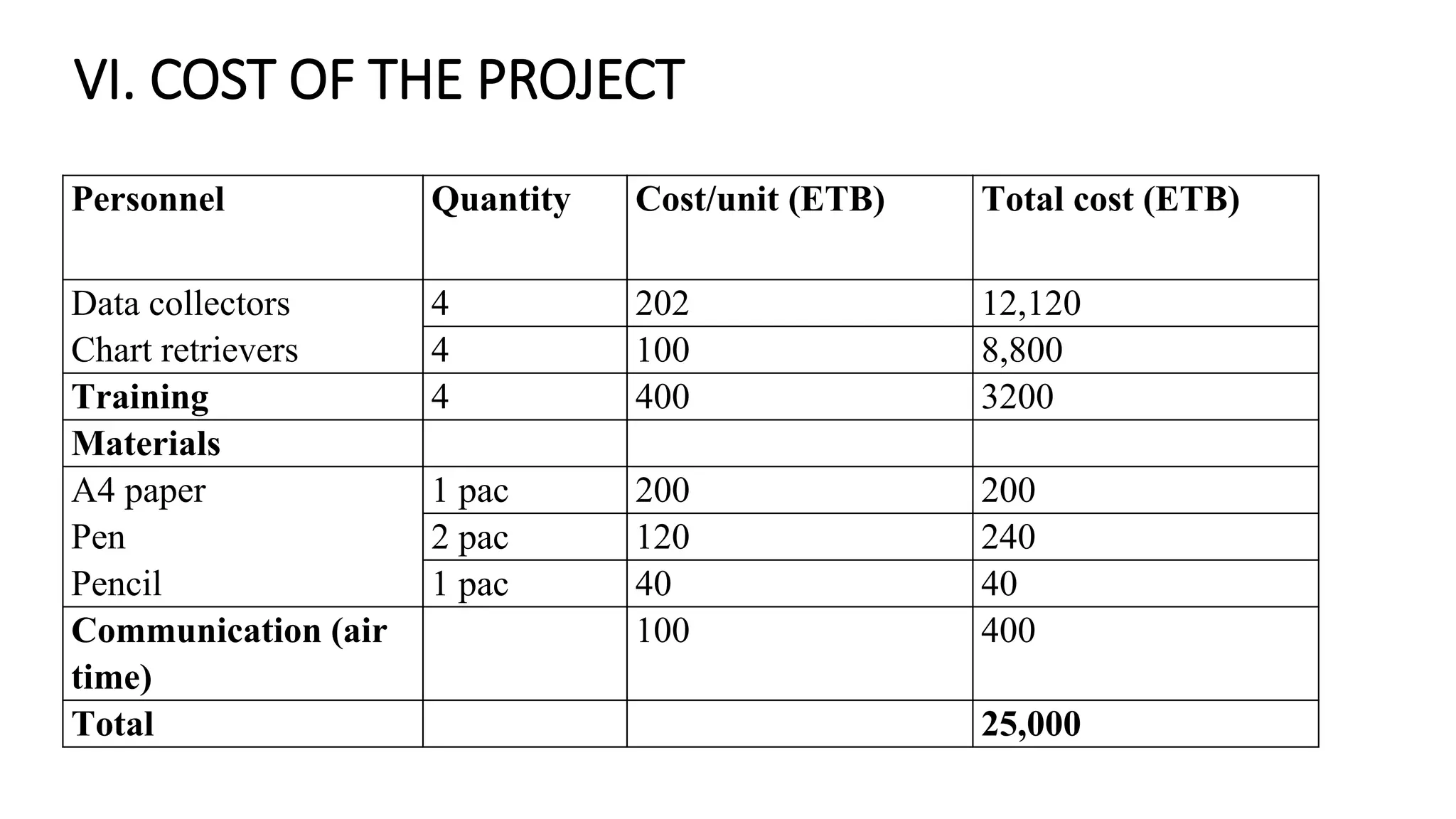
VI. COST OF THE PROJECT
Personnel Quantity Cost/unit (ETB) Total cost (ETB)
Data collectors
Chart retrievers
4 202 12,120
4 100 8,800
Training 4 400 3200
Materials
A4 paper
Pen
Pencil
1 pac 200 200
2 pac 120 240
1 pac 40 40
Communication (air
time)
100 400
Total 25,000
Acknowledgement
• I am grateful to the guidance provided by my advisors Henok T. (MD,
Asst prof of Surgery), Birhane R. (MD, Asst prof of Surgery) and Tariku
S. (BSc, BA, MSc in Pharmaco-epidemiology)
•Thank you!!

Proposal presentation

  • 1.
    St. Paul HospitalMillennium Medical College Proposal on Experience of Laparoscopic Cholecystectomy in St. Paul’s Hospital Millennium Medical College, Addis Ababa, Ethiopia Investigator: Ashenafi Ermias(MD, GSR III) January 2020 Addis Ababa, Ethiopia
  • 2.
    Outline • Introduction • Literaturereview • Statement of the problem • Significance of the study • Objectives • Methods • Work plan • Cost of the project • Acknowledgement
  • 3.
    I. Introduction • Gallstonedisease is one of the most common conditions handled by a general surgeons worldwide. • Prevalence 10-15% in Europe and North America. • Prevalence is even lower in Africa. (Brett M, 1976) • No community based studies in Ethiopia; • From hospital based study in Gondar, prevalence is about 5.2%. (Getachew A) • Prevalence from hospital registry in SPHHMC was 8.9% ( Mahteme et al,2019) • It is asymptomatic in about 80% of the patients. • Symptomatic patients may present with biliary colic or with one of the several complications.
  • 4.
    • Laparoscopic cholecystectomy(LC) was introduced by Mühe of Germany in 1985 and since then it has been used in the management of gallstones. (Reynolds Jr W) • Symptomatic patients are offered LC “the gold standard” treatment if the set up allows • Patient outcomes are superior in terms of surgical site infection, post operative pain and hospital stay. • But it has higher rate of biliary tree injury as compared to open cholecystectomy.
  • 5.
    II. Literature review •Outcomes of a surgical procedure can measured by morbidity and mortality rates. • Several studies have been conducted throughout the world regarding the outcomes of LC. • The incidence of bleeding has been reported to be up to 10%. It can occur at any time starting from insertion of trocar to dissection or after completion of the procedure due to slippage of clip.
  • 6.
    • Mbatha etal reported 3 intraoperative bleeding out of 167 laparoscopic cholecystectomies in a study they did in South Africa. All of the incidences were handled laparoscopically. (Mbatha et al,2016) • Older age did not affect the outcomes significantly as long as they have good ASA functional status. But aged individuals tend to present with complications and have higher ASA class. (Rafael S et al)
  • 7.
    • Biliary treeinjury remain the feared complication in LC • In a study done by Engida et al in SPHMMC, they found significantly higher number of biliary tree injury (2.3%) and higher for laparoscopic than open technique. (2.3% vs 5.2%) • Experience was the major factor responsible for the higher rate of bile duct injury. (Engida A et al, 2014) • Taki-Eldin reported 12 (of 492) patients had bile leak in a study done in Saudi Arabia (7 due to CBD injury and 5 due slippage of cystic duct) (Taki-Eldin et al,2018)
  • 8.
    • Conversion toopen surgery may be required in occasions where LC cannot be completed because complication has occurred or as a preventive measure. • In a study done in a private hospital in Addis Ababa, Bekele S et al reported conversion rate of 2.9%. (Bekele et al, 2012) • A study by Ballal M in England found a conversion rate of 5.2%; with higher conversion rate for emergency cholecystectomy as compared to elective cholecystectomy. ( Ballal M, 2009) • Bowel injuries are less common during LC. • In a US national survey, there were about 0.14% bowel injuries reported from 4,292 hospitals.
  • 9.
    • Wound infectionsmay complicate LC. • Most publications have indicated lower SSI for LC than Open cholecytectomy • Radunovic M et al reported infection of surgical wound in 7 out of 740 patients (0.094%) in a study done in Montenegro. (Radunovic et al, 2016) • One of the advantages of LC is the short post op stay. • An average hospital stay of 1.1 day was reported by Clegg-Lamptey et al in their paper evaluating LC in Korle Bu teaching Hospital Accra Ghana.(Clegg-Lamptey et al, 2010)
  • 10.
    • Operative time(duration of procedure) for laparoscopic cholecystectomy have been reported ranging from 45-180 min. • Rai P et al reported mean operating time of 79 min in their study. (Rai P, 2016) • Mean operating time in Myungsung Christian Medial center was 58.9min (Bekele et al, 2012) • Pre-operative ultrasound can predict difficulty of LC. • Of the 73 cases, 21 (28.76%) cases were predicted to be difficult, 17 (23.3%) were actually difficult, of which 13 (17.8%) were converted to open procedure according to Lal P. (Lal P, 2012)
  • 11.
    Statement of theProblem • Laparoscopic cholecystectomy is associated with several complications. • This study looks into the following questions • What is the pattern of biliary tree injury? • What is the conversion rate and what factors influence conversion? • What are the determinants of intra-op/post operative complications?
  • 12.
    Significance of thestudy • This study will help us judge the safety of laparoscopic cholecystectomy in our set up • It will be used as a source of data for future researches
  • 13.
    III. Objectives General objectives Toevaluate morbidity and mortality of laparoscopic cholecystectomy in SPHMMC Specific objectives To assess the patterns of post-operative complications following laparoscopic cholecystectomy To determine factors associated with post-operative complications To calculate the conversion rate and reasons for conversion
  • 14.
    IV. METHODS • Studysetting: This study will be conducted in SPHMMC, Addis Ababa. The hospital has been providing clinical service for over 50 years and teaching undergraduate and postgraduate students in various clinical areas. • Laparoscopic cholecystectomy was started in 2007 G.C and several patients have undergone the procedure • Study design: a cross-sectional study design will be utilized based on medical records of patients who underwent laparoscopic cholecystectomies over the past 5years (January 2015 to December 2020 G.C.) • Study population: the study population comprises of all patients who undergone laparoscopic cholecystectomy
  • 15.
    Sample size andsampling method By using sample size calculation formula n= 𝑍2 𝑝(1−𝑝) 𝑑2 n=sample size, p= proportion of attribute, d= margin of error Proportion of attribute (prevalence) from a study done in a resource limited setup was found to be 16.2% (p=0.162), the sample size of 209 patients will be included for this study. Form Operation theatre registration book, there were 210 patients operated over the past 5 years and all patients who underwent laparoscopic cholecystectomy will be used for this study
  • 16.
    Data collection andanalysis • Medical records will be retrieved from central record room and data will be collected by using a checklist. • Data will be entered into SPSS version 26 and analyzed. • Confidence interval of 95% with 5% margin of error and p<0.05 will be used for statistical significance. • Exclusion criteria: Medical records which lack/lost operation notes, patients with CBD stone or jaundice will be excluded.
  • 17.
    • Independent variables:age, sex, obesity, history of acute cholecystitis, ASA class, previous surgery • Dependent variables: conversion, intraoperative and post-operative complications • Ethical considerations: identity of the subjects will be kept confidential. • Ethical clearance will be obtained from college IRB.
  • 18.
    Limitations of thestudy • It is a retrospective study based on secondary data. • Results cannot be generalized to indicate outcomes in other hospitals since it is a single institution based study
  • 19.
    V. WORK PLAN NovemberDecember January February March April May June July Identification of research area Formulate research questions and design Literature review Prepare research proposal Proposal defense Training Pre-testing Data collection Analysis Submission of initial draft Submission of second draft Thesis defense Dissemination of results
  • 20.
    VI. COST OFTHE PROJECT Personnel Quantity Cost/unit (ETB) Total cost (ETB) Data collectors Chart retrievers 4 202 12,120 4 100 8,800 Training 4 400 3200 Materials A4 paper Pen Pencil 1 pac 200 200 2 pac 120 240 1 pac 40 40 Communication (air time) 100 400 Total 25,000
  • 21.
    Acknowledgement • I amgrateful to the guidance provided by my advisors Henok T. (MD, Asst prof of Surgery), Birhane R. (MD, Asst prof of Surgery) and Tariku S. (BSc, BA, MSc in Pharmaco-epidemiology)
  • 22.