Strictly Clinical — 
Facing cranial nerve 
assessment 
November 2006 American Nurse Today 21 
MANY YEARS AGO when I was in 
nursing school, I learned a saying 
that was supposed to help me re-call 
the cranial nerves. You’ve 
probably heard it: On Old Olym-pus 
Towering Tops A Finn and German Viewed Some 
Hops. It didn’t make much sense to me, and it didn’t 
help me remember the cranial nerves. 
A few years ago, a colleague taught me a much 
easier way to remember the cranial nerves and their 
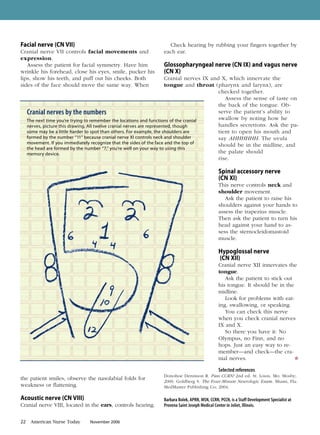
locations—by drawing a face and using numbers as 
the facial features. Each number represents one of 
the 12 cranial nerves, and the placement of the 
numbers represents the location of or an associa-tion 
with them. (See Cranial nerves by the 
numbers.) 
Olfactory nerve (CN I) 
Located in the nose, cranial nerve (CN) I controls 
the sense of smell. This nerve isn’t frequently tested, 
even by neurologists. However, suspect an abnor-mality 
in a neurologic patient who has a poor ap-petite. 
To assess the nerve, use soap and coffee—both 
are easy to find on a unit. Or take a trip to the 
kitchen for cloves and vanilla. Don’t use a substance 
with a harsh odor, such as ammonia, because it will 
stimulate the intranasal pain endings of CN V. 
Have the patient close both eyes, close one nos-tril, 
and gently inhale to smell the scent. Remember 
to do both nostrils. 
Optic nerve (CN II) 
Located in and behind the eyes, CN II controls cen-tral 
and peripheral vision. 
The fovea in the center of the retina is responsible 
for visual acuity in our central vision. Test one eye at 
a time. Ask the patient to read his I.V. bag. Then 
have him count how many fingers you are holding 
up 6 inches in front of him. 
Test peripheral vision one eye at a time, too. Cov-er 
one eye and instruct the patient to look at your 
nose. Move your index fingers to check the superior 
and inferior fields one at a time. Ask the patient to 
note any movement in the peripheral visual fields. 
Oculomotor nerve (CN III) 
Also positioned in and behind the 
eyes, CN III controls pupillary con-striction. 
To test the patient’s pupils, dim 
the lights, bring the light of the penlight from the 
outside periphery to the center of each eye, and 
note the response. Use the mm chart to describe 
pupil size; descriptions such as “small,” “medium,” 
and “large” are too subjective. 
Also, check where the eyelid falls on the pupil. If 
it droops, note that the patient has ptosis. 
It’s easy to check cranial nerves III, IV, and VI together. 
Trochlear nerve (CN IV) 
Cranial nerve IV acts as a pulley to move the eyes 
down—toward the tip of the nose. 
To assess the trochlear nerve, instruct the patient 
to follow your finger while you move it down to-ward 
his nose. 
Trigeminal nerve (CN V) 
Cranial nerve V covers most of the face. 
If a patient has a problem with this nerve, it usu-ally 
involves the forehead, cheek, or jaw—the three 
areas of the trigeminal nerve. Check sensation in all 
three areas, using a soft and a dull object. Check 
sensation of the scalp, too. 
Test the motor function of the temporal and mas-seter 
muscles by assessing jaw opening strength. If 
you suspect a problem with cranial nerves VI and 
VII, check the corneal reflex with a cotton wisp 
since it’s easy to do while you’re checking trigeminal 
nerve function. 
Abducens nerve (CN VI) 
Cranial nerve VI controls eye movement to the 
sides. 
Ask the patient to look toward each ear. Then 
have him follow your fingers through the six cardi-nal 
fields of gaze. 
Here’s another easy technique you can use: With 
your finger, make a big X in the air and then draw a 
horizontal line across it. Observe the patient for nys-tagmus 
or twitching of the eye. 
By Barbara Bolek, APRN, MSN, CCRN, PCCN 
How to remember 
and assess the cranial 
nerves with ease
Facial nerve (CN VII) 
Cranial nerve VII controls facial movements and 
expression. 
Assess the patient for facial symmetry. Have him 
wrinkle his forehead, close his eyes, smile, pucker his 
lips, show his teeth, and puff out his cheeks. Both 
sides of the face should move the same way. When 
Cranial nerves by the numbers 
The next time you’re trying to remember the locations and functions of the cranial 
nerves, picture this drawing. All twelve cranial nerves are represented, though 
some may be a little harder to spot than others. For example, the shoulders are 
formed by the number “11” because cranial nerve XI controls neck and shoulder 
movement. If you immediately recognize that the sides of the face and the top of 
the head are formed by the number “7,” you’re well on your way to using this 
memory device. 
the patient smiles, observe the nasolabial folds for 
weakness or flattening. 
Acoustic nerve (CN VIII) 
Cranial nerve VIII, located in the ears, controls hearing. 
22 American Nurse Today November 2006 
Check hearing by rubbing your fingers together by 
each ear. 
Glossopharyngeal nerve (CN IX) and vagus nerve 
(CN X) 
Cranial nerves IX and X, which innervate the 
tongue and throat (pharynx and larynx), are 
checked together. 
Assess the sense of taste on 
the back of the tongue. Ob-serve 
the patient’s ability to 
swallow by noting how he 
handles secretions. Ask the pa-tient 
to open his mouth and 
say AHHHHHH. The uvula 
should be in the midline, and 
the palate should 
rise. 
Spinal accessory nerve 
(CN XI) 
This nerve controls neck and 
shoulder movement. 
Ask the patient to raise his 
shoulders against your hands to 
assess the trapezius muscle. 
Then ask the patient to turn his 
head against your hand to as-sess 
the sternocleidomastoid 
muscle. 
Hypoglossal nerve 
(CN XII) 
Cranial nerve XII innervates the 
tongue. 
Ask the patient to stick out 
his tongue. It should be in the 
midline. 
Look for problems with eat-ing, 
swallowing, or speaking. 
You can check this nerve 
when you check cranial nerves 
IX and X. 
So there you have it: No 
Olympus, no Finn, and no 
hops. Just an easy way to re-member— 
and check—the cra-nial 
nerves. O 
Selected references 
Donohoe Dennison R. Pass CCRN! 2nd ed. St. Louis, Mo: Mosby; 
2000. Goldberg S. The Four-Minute Neurologic Exam. Miami, Fla: 
MedMaster Publishing Co; 2004. 
Barbara Bolek, APRN, MSN, CCRN, PCCN, is a Staff Development Specialist at 
Provena Saint Joseph Medical Center in Joliet, Illinois.

Pares craneales

  • 1.
    Strictly Clinical — Facing cranial nerve assessment November 2006 American Nurse Today 21 MANY YEARS AGO when I was in nursing school, I learned a saying that was supposed to help me re-call the cranial nerves. You’ve probably heard it: On Old Olym-pus Towering Tops A Finn and German Viewed Some Hops. It didn’t make much sense to me, and it didn’t help me remember the cranial nerves. A few years ago, a colleague taught me a much easier way to remember the cranial nerves and their locations—by drawing a face and using numbers as the facial features. Each number represents one of the 12 cranial nerves, and the placement of the numbers represents the location of or an associa-tion with them. (See Cranial nerves by the numbers.) Olfactory nerve (CN I) Located in the nose, cranial nerve (CN) I controls the sense of smell. This nerve isn’t frequently tested, even by neurologists. However, suspect an abnor-mality in a neurologic patient who has a poor ap-petite. To assess the nerve, use soap and coffee—both are easy to find on a unit. Or take a trip to the kitchen for cloves and vanilla. Don’t use a substance with a harsh odor, such as ammonia, because it will stimulate the intranasal pain endings of CN V. Have the patient close both eyes, close one nos-tril, and gently inhale to smell the scent. Remember to do both nostrils. Optic nerve (CN II) Located in and behind the eyes, CN II controls cen-tral and peripheral vision. The fovea in the center of the retina is responsible for visual acuity in our central vision. Test one eye at a time. Ask the patient to read his I.V. bag. Then have him count how many fingers you are holding up 6 inches in front of him. Test peripheral vision one eye at a time, too. Cov-er one eye and instruct the patient to look at your nose. Move your index fingers to check the superior and inferior fields one at a time. Ask the patient to note any movement in the peripheral visual fields. Oculomotor nerve (CN III) Also positioned in and behind the eyes, CN III controls pupillary con-striction. To test the patient’s pupils, dim the lights, bring the light of the penlight from the outside periphery to the center of each eye, and note the response. Use the mm chart to describe pupil size; descriptions such as “small,” “medium,” and “large” are too subjective. Also, check where the eyelid falls on the pupil. If it droops, note that the patient has ptosis. It’s easy to check cranial nerves III, IV, and VI together. Trochlear nerve (CN IV) Cranial nerve IV acts as a pulley to move the eyes down—toward the tip of the nose. To assess the trochlear nerve, instruct the patient to follow your finger while you move it down to-ward his nose. Trigeminal nerve (CN V) Cranial nerve V covers most of the face. If a patient has a problem with this nerve, it usu-ally involves the forehead, cheek, or jaw—the three areas of the trigeminal nerve. Check sensation in all three areas, using a soft and a dull object. Check sensation of the scalp, too. Test the motor function of the temporal and mas-seter muscles by assessing jaw opening strength. If you suspect a problem with cranial nerves VI and VII, check the corneal reflex with a cotton wisp since it’s easy to do while you’re checking trigeminal nerve function. Abducens nerve (CN VI) Cranial nerve VI controls eye movement to the sides. Ask the patient to look toward each ear. Then have him follow your fingers through the six cardi-nal fields of gaze. Here’s another easy technique you can use: With your finger, make a big X in the air and then draw a horizontal line across it. Observe the patient for nys-tagmus or twitching of the eye. By Barbara Bolek, APRN, MSN, CCRN, PCCN How to remember and assess the cranial nerves with ease
  • 2.
    Facial nerve (CNVII) Cranial nerve VII controls facial movements and expression. Assess the patient for facial symmetry. Have him wrinkle his forehead, close his eyes, smile, pucker his lips, show his teeth, and puff out his cheeks. Both sides of the face should move the same way. When Cranial nerves by the numbers The next time you’re trying to remember the locations and functions of the cranial nerves, picture this drawing. All twelve cranial nerves are represented, though some may be a little harder to spot than others. For example, the shoulders are formed by the number “11” because cranial nerve XI controls neck and shoulder movement. If you immediately recognize that the sides of the face and the top of the head are formed by the number “7,” you’re well on your way to using this memory device. the patient smiles, observe the nasolabial folds for weakness or flattening. Acoustic nerve (CN VIII) Cranial nerve VIII, located in the ears, controls hearing. 22 American Nurse Today November 2006 Check hearing by rubbing your fingers together by each ear. Glossopharyngeal nerve (CN IX) and vagus nerve (CN X) Cranial nerves IX and X, which innervate the tongue and throat (pharynx and larynx), are checked together. Assess the sense of taste on the back of the tongue. Ob-serve the patient’s ability to swallow by noting how he handles secretions. Ask the pa-tient to open his mouth and say AHHHHHH. The uvula should be in the midline, and the palate should rise. Spinal accessory nerve (CN XI) This nerve controls neck and shoulder movement. Ask the patient to raise his shoulders against your hands to assess the trapezius muscle. Then ask the patient to turn his head against your hand to as-sess the sternocleidomastoid muscle. Hypoglossal nerve (CN XII) Cranial nerve XII innervates the tongue. Ask the patient to stick out his tongue. It should be in the midline. Look for problems with eat-ing, swallowing, or speaking. You can check this nerve when you check cranial nerves IX and X. So there you have it: No Olympus, no Finn, and no hops. Just an easy way to re-member— and check—the cra-nial nerves. O Selected references Donohoe Dennison R. Pass CCRN! 2nd ed. St. Louis, Mo: Mosby; 2000. Goldberg S. The Four-Minute Neurologic Exam. Miami, Fla: MedMaster Publishing Co; 2004. Barbara Bolek, APRN, MSN, CCRN, PCCN, is a Staff Development Specialist at Provena Saint Joseph Medical Center in Joliet, Illinois.